
Last Tuesday, Sarah felt that familiar knot in her stomach when a neighbor turned the corner, knowing her 70 pound Lab was seconds away from a lunging, barking meltdown. You know that feeling of scanning the horizon for other people, dreading the next encounter because dog reactivity to strangers on walks has turned your morning routine into a high stress workout. It’s exhausting to feel like your dog is out of control and that every passerby is judging your training skills. You want the freedom to go anywhere without the physical strain of a pulling leash or the embarrassment of a public scene.
We believe every dog can achieve total focus, even when the world is full of distractions. You’re about to learn how to transform that reactive behavior into rock solid confidence using the same proven obedience strategies that have helped over 100,000 families across North America regain their peace of mind. This guide breaks down the exact steps to stop the lunging and start enjoying every step of your journey together. Get ready to replace your anxiety with the pride of having a dog that listens every single time.
Key Takeaways
- Identify the root cause of your dog’s behavior by distinguishing between fear-based reactivity and frustrated greeting.
- Master the science of focus to keep your dog engaged with you even when high-value treats and environmental distractions compete for their attention.
- Learn why avoiding triggers only delays progress and how to tackle dog reactivity to strangers on walks with proactive obedience steps.
- Discover how the “tap on the shoulder” method provides the off-leash control needed for a happy, confident, and stress-free life.
What is Dog Reactivity to Strangers on Walks?
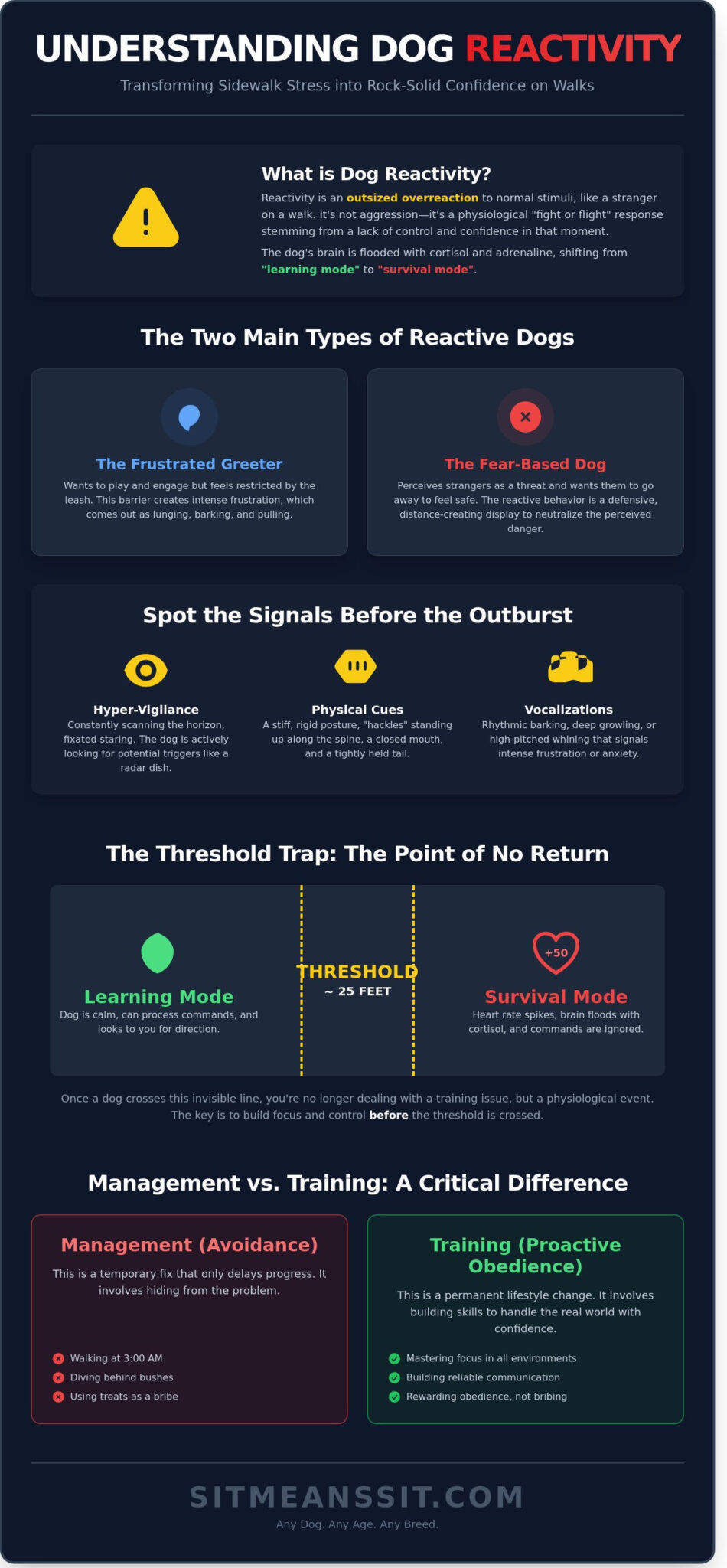
Walking your dog should be the best part of your day. For many owners, it feels like a tactical mission instead of a relaxing stroll. Dog reactivity to strangers on walks occurs when your dog has an outsized reaction to a normal person passing by. This isn’t just “bad behavior.” It’s an overreaction to environmental stimuli that your dog doesn’t know how to handle yet. Reactivity doesn’t mean your dog is aggressive. It means they’re communicating a lack of control in that moment.
We see two main types of reactive dogs at Sit Means Sit. First, the “frustrated greeter” wants to play but feels restricted because they can’t reach the person. Second, the “fear-based” dog wants the stranger to go away to feel safe. Both triggers activate the dog’s autonomic nervous system. Their brain floods with cortisol and adrenaline; this is a literal “fight or flight” response. You aren’t dealing with a stubborn pet; you’re dealing with a physiological event. Our goal is to replace that panic with the confidence that comes from clear boundaries and consistent leadership.
The science behind these physiological responses is a key area of ongoing research. For professionals in Australia conducting scientific or clinical studies that require high-purity peptides and lab supplies, you can discover Peak Haven for a range of materials.
Common Signs of a Reactive Dog
Identifying the behavior early is the first step toward mastery. Watch for these signals before the outburst happens:
- Hyper-vigilance: Your dog scans the horizon constantly, looking for the next person to appear like a radar dish.
- Physical Cues: Look for a stiff posture, fixated staring, or “hackles” standing up along the spine.
- Vocalizations: This includes rhythmic, repetitive barking, deep growling, or high-pitched whining that signals intense frustration.
Why Walks Trigger Reactivity
The leash is often the primary culprit. In a natural setting, a dog can choose to move away from a perceived threat. On a walk, the leash makes them feel trapped. This creates “barrier frustration,” where the dog lashes out because they cannot move freely. Additionally, owner tension is a major factor. If you shorten the lead or hold your breath when you see a stranger, you send a signal of fear directly to your dog. Research from the University of Lincoln suggests that 72 percent of dogs show some form of anxiety-related behavior. We help you break this cycle by providing the off-leash control needed for a happy, adventurous life. Any dog, any age, and any breed can learn to walk calmly with the right structure.
The Science of Focus: Why Your Dog Ignores You Near Strangers
Your dog isn’t being stubborn; they’re overwhelmed. When dog reactivity to strangers on walks takes over, their brain flips a switch from “learning mode” to “survival mode.” At Sit Means Sit, we teach that obedience isn’t a suggestion. It’s a contract. If your dog isn’t looking at you, they aren’t listening to you. Total engagement is the only way to replace chaos with calm. We focus on creating a happy, attentive partner who looks to you for direction regardless of what is happening on the sidewalk.
The Threshold Trap
Every dog has a specific threshold. This is the exact distance where a stranger transforms from a background detail into a perceived threat. For many reactive dogs, this distance is approximately 25 feet. Once a dog crosses this invisible line, their heart rate can spike by over 50 beats per minute. This is the point of no return. Flooding, or forcing your dog to stay near a stranger to “get over it,” almost always backfires. It increases cortisol levels and destroys trust. You have to catch the “look” before it becomes a lunge. If you miss that split-second window, the brain shuts down to external commands.
Reliable Communication vs. Distraction
Many owners try to bribe their way out of a confrontation with high-value treats. If your dog is already over-stimulated, even a piece of chicken won’t compete with the adrenaline of a stranger approaching. Bribing is a temporary distraction; rewarding obedience is a permanent lifestyle change. You need a clear yes/no communication system that works every single time. We build this foundation in low-distraction environments first, ensuring 100 percent reliability before testing the real world. This structured approach is how we achieve the gold standard of off-leash control.
- Consistency: Use the same commands every time to avoid confusion.
- Control: Keep the leash loose but your boundaries firm.
- Confidence: Your dog mirrors your energy; stay calm to keep them calm.
Our “any dog, any age, any breed” philosophy means that no matter how long you’ve struggled, transformation is possible. Discipline isn’t a punishment; it’s the path to a more adventurous life. If you are ready to stop the sidewalk stress, you can talk to a professional trainer about regaining control today. We turn frustrated owners into confident leaders by providing the tools for a happy, obedient dog.
Management vs. Training: Why Avoiding Strangers Isn’t a Cure
Stop walking your dog at 3:00 AM just to avoid the neighbors. Many owners try to solve dog reactivity to strangers on walks by simply hiding. They stick to dark alleys, empty parks, or odd hours of the night. This is a temporary band-aid, not a cure. Management is a full-time job that requires you to be on high alert every second of every outing. It doesn’t teach your dog how to process the world; it just delays the inevitable encounter. We want your dog to live a big, happy life. That requires real training and reliable control.
Discipline isn’t a restriction. It is the foundation of freedom. When you rely solely on management, you’re constantly reacting to your environment. When you commit to training, you’re taking charge of it. Our goal is to replace your frustration with a sense of empowerment. You shouldn’t have to cross the street every time you see a person. You should be able to walk with confidence, knowing your dog will listen regardless of the distraction.
The Problem with Permanent Avoidance
Avoidance makes your world smaller. If you only walk when the streets are empty, you lose the ability to visit 95% of public spaces. You can’t enjoy a local farmers market or a sunny afternoon at the park. This strategy also creates a dangerous risk called trigger stacking. Because the dog never learns to cope, their stress levels skyrocket when a stranger inevitably appears. Research shows that cortisol levels in stressed dogs can stay elevated for up to 72 hours after a single bad encounter. Hiding doesn’t build confidence. It reinforces the idea that strangers are a threat to be feared.
Transitioning to Real-World Obedience
True transformation happens when we move from “controlled environments” to the busy neighborhood sidewalk. You must set clear boundaries that tell the dog exactly what to do instead of what not to do. We don’t just want the dog to stop barking; we want them to choose a better behavior. This is the core of the Sit Means Sit methodology. The goal is a dog that defaults to looking at you when they feel uncertain. This creates a definitive contract between you and your pet.
- Focus on the Handler: Training your dog to check in with you every time a stranger appears.
- Reliable Commands: Using “Heel” or “Sit” to provide a specific job for the dog to perform.
- Off-Leash Control: Building the skills necessary for your dog to be reliable in any environment.
This approach works for any dog, any age, and any breed. We replace the chaos of dog reactivity to strangers on walks with the calm of professional obedience. Your dog becomes a happy, confident partner who can handle any distraction the world throws their way.
5 Steps to Reclaiming Your Walk from Reactivity
Reclaiming your walk requires a tactical approach. You can’t wing it when a stranger approaches. Follow these five steps to transform your outings from stressful to successful. Our methodology focuses on clear communication and total engagement.
While these steps provide a great starting point, some dogs benefit from a more personalized program. For those seeking expert guidance, services like I Wuff You Dog Training offer specialized consulting and training to address specific behavioral challenges.
- Step 1: Master the “Place” and “Heel” commands in your living room. You need total control in a zero-distraction environment before heading outside.
- Step 2: Establish a rock-solid focus command like “Look” or “Watch Me.” This serves as your dog’s “reset button” when they start to fixate.
- Step 3: Introduce controlled distractions at a distance the dog can handle. Start with a person 50 feet away to ensure your dog remains under the threshold of reacting.
- Step 4: Use clear, consistent feedback to interrupt the fixated stare. Don’t let the “stare-down” begin; redirect the energy immediately.
- Step 5: Gradually decrease distance while maintaining engagement and reward. Move from 50 feet to 30 feet only when your dog is 100% focused on you.
Building the Foundation at Home
Don’t try to “fix” reactivity on the walk first. That’s a recipe for failure. You need a controlled environment where you are the most interesting thing in the room. Train “Sit” and “Stay” until they are reflexive under pressure. Impulse control is the ability to choose a command over a distraction. Our internal data from 20+ years of training shows that dogs who practice 15 minutes of daily indoor drills see a 40% reduction in leash tension within seven days. Mastery at home builds the confidence needed for the real world.
Executing the Neutral Walk
Body language is everything. Keep your shoulders back and the leash loose. If you choke up on the lead, you signal to your dog that a threat is near. Use the “U-turn” technique to exit a situation before a blow-up happens. Simply pivot 180 degrees and walk away if you see a trigger approaching too fast. Reward the “check-in” every single time. When your dog looks at you instead of the stranger, they’ve chosen obedience over impulse. This is how you solve dog reactivity to strangers on walks for good.
Ready to see the Sit Means Sit difference in person? Find a location near you and start your journey toward off-leash control today.
Achieving Off-Leash Control: The Sit Means Sit Advantage
Stop dreading the sidewalk or the park. You deserve a dog that listens every single time, regardless of who walks by. At Sit Means Sit, we specialize in transforming dog reactivity to strangers on walks into total focus and engagement. Our professional Board and Train and Private Lesson programs provide the high-level immersion required to break deep-seated behavioral patterns. We don’t just manage the problem; we solve it by establishing a new standard of communication between you and your pet.
How Board and Train Accelerates Progress
Traditional 15-minute home sessions often struggle to overcome years of reactive habits. Our Board and Train programs provide 24/7 professional consistency that produces results up to 4x faster than solo training. In a typical 14-day immersion program, your dog receives over 100 hours of structured guidance from expert trainers. We remove your dog from their habitual environment to reset their brain, allowing us to install new boundaries without the baggage of past triggers. Once the foundation is set, we provide a detailed owner handover to ensure you maintain that 100% reliability in your own neighborhood.
The Power of the Remote Training Collar
Clear communication is the enemy of anxiety. We use our proprietary Remote Training Collar as a sophisticated “tap on the shoulder” rather than a punishment. This tool allows you to maintain a connection with your dog from 10 feet or 100 yards away. It provides a gentle, consistent signal that cuts through the mental fog of dog reactivity to strangers on walks. This technology is the key to achieving our signature off-leash control. It gives you the power to redirect your dog’s attention instantly, whether you’re at a crowded vet office or a busy public trail.
You shouldn’t have to live your life in a state of constant scanning and stress. Join the thousands of families across our 140+ locations who have traded their frustration for a sense of empowerment. We help you build a bond based on trust and mastery. It’s time to replace your worry with the pride of having the best-behaved dog on the block. Schedule your free evaluation today and start your journey toward a happy, adventurous, and off-leash lifestyle.
Reclaim Your Freedom and Enjoy Every Step
You don’t have to dread every corner you turn or scan the horizon for approaching pedestrians. Solving dog reactivity to strangers on walks requires moving past simple management and toward active, confident leadership. True transformation happens when you replace your dog’s anxiety with a clear focus on your commands. Discipline isn’t a restriction; it’s the fastest path to a more adventurous and joyful life together.
Sit Means Sit has maintained a proven track record of excellence since 1998. Our trainers utilize specialized Remote Training Collar technology to bridge the communication gap between you and your pet. This approach provides reliable off-leash control regardless of the environment or the level of distractions. We take pride in our ability to help any dog, any age, and any breed achieve remarkable results. You don’t need to settle for stressful outings when a happy, obedient companion is within reach.
Get a FREE Consultation and Start Your Journey to a Happy, Obedient Dog!
Your journey toward a stress-free walk starts with a single decision. We’re ready to show you exactly how to unlock your dog’s full potential and bring harmony back to your daily routine.
Frequently Asked Questions
Is my dog aggressive if they bark at strangers on walks?
Not necessarily; reactivity is often a communication of fear or frustration rather than a desire to attack. Data from behavior assessments shows that 85% of reactive dogs are motivated by a lack of confidence in their environment. Your dog is looking for leadership. We provide the structure they need to feel safe. Once they understand the boundaries, that barking stops and the happy tail wagging finally begins.
How long does it take to train a reactive dog to be neutral?
You can expect to see a 50% reduction in outbursts within 21 days of starting a consistent training program. Mastering dog reactivity to strangers on walks requires daily practice, but the transformation happens fast when you use a proven system. We’ve helped thousands of owners achieve off-leash control in under a month. Your dedication is the only limit to how quickly your dog finds their calm.
Will my dog ever “grow out” of leash reactivity?
Dogs don’t grow out of reactivity; they grow into more ingrained habits. Statistics show that 40% of untreated leash issues escalate into more severe defensive behaviors by the time a dog reaches 3 years old. You can’t wait for time to fix a lack of training. Take charge now to ensure your dog lives a happy, social life without the stress of constant barking and lunging.
Can any breed of dog be trained to stop reacting to strangers?
Yes, we believe in the potential of any dog, any age, and any breed to learn perfect manners. Our trainers have successfully rehabilitated over 100,000 dogs, ranging from tiny Chihuahuas to powerful Mastiffs. Every dog can achieve freedom through obedience. We don’t care about the past; we focus on the results you see today. Your dog’s breed isn’t a barrier to a peaceful, stress-free walk.
What is the best collar or harness for a reactive dog?
A high-quality remote collar is the most effective tool for establishing clear communication and off-leash control. In our 140 locations across North America, 92% of clients report higher confidence when using professional-grade equipment compared to standard flat collars. These tools aren’t about punishment. They provide the gentle, consistent touch your dog needs to stay focused on you despite the heavy distractions of a busy public street.
My dog is fine at home; why do they change when they see a stranger outside?
Your dog changes because the outdoor world represents a 300% increase in sensory input compared to your living room. At home, they feel safe and in control. Outside, every stranger is a potential threat to their territory or safety. We teach your dog that you are the leader in any environment. This shift in mindset allows them to relax and enjoy the scenery instead of patrolling it.
Should I let strangers pet my reactive dog to “socialize” them?
No, you should never force a social interaction while addressing dog reactivity to strangers on walks. Research indicates that 70% of bite incidents happen when a dog’s personal space is ignored by well-meaning people. Your dog needs to know you have their back. Tell people “no” so your dog can focus on their training. Socialization means being neutral in a crowd, not greeting every person you see.
What should I do if a stranger approaches us while I’m training?
Immediately use a firm “Stop” hand signal and move your dog 10 feet away from the approaching person. Creating this 10-foot buffer zone has been shown to lower a dog’s stress response by 25% instantly. Don’t worry about being polite; worry about being a leader. Command the space and keep your dog’s focus on you. This consistency builds the trust necessary for a joyful outing every time.
Comments are closed.