
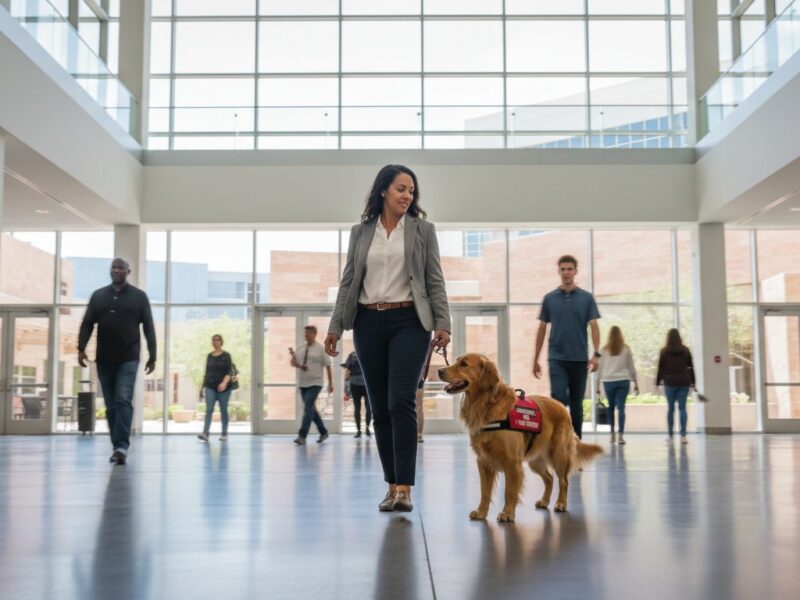
Imagine walking through a bustling grocery store at 5:00 PM on a Saturday with a partner that remains completely unfazed by falling carts or spilled snacks. For many handlers, the dream of total independence feels out of reach because 70% of owner-trained dogs fail to meet public access standards in their first year. You’ve likely felt the sting of frustration when progress stalls or the anxiety of a potential public outburst. It’s exhausting to second-guess whether your dog is truly ready for the high-stakes environment of service dog training. You want a dog that doesn’t just listen; you want a dog that excels under pressure.
We’re here to turn that stress into absolute confidence and pride. This guide breaks down the rigorous standards and specialized techniques used to create a life-changing partner. You’ll discover how to master off-leash control, navigate ADA laws with ease, and build a dog that ignores every distraction. We’ll explore the exact professional pathways that transform a promising puppy into a reliable, task-performing asset. Get ready to experience the freedom that comes from elite obedience and a rock-solid bond.
Key Takeaways
- Understand the elite standards that separate a task-trained service partner from a standard pet or emotional support animal.
- Identify the non-negotiable pillars of health and temperament required to transform a promising prospect into a reliable worker.
- Master the “Big Three” environments—malls, airports, and restaurants—by applying professional service dog training techniques for real-world chaos.
- Compare owner-led training against professional “Board and Train” programs to find the fastest path to total off-leash control.
- Take the first step toward independence with a professional temperament evaluation and a training foundation where attention is everything.
What is Service Dog Training? Defining the Standard of Excellence
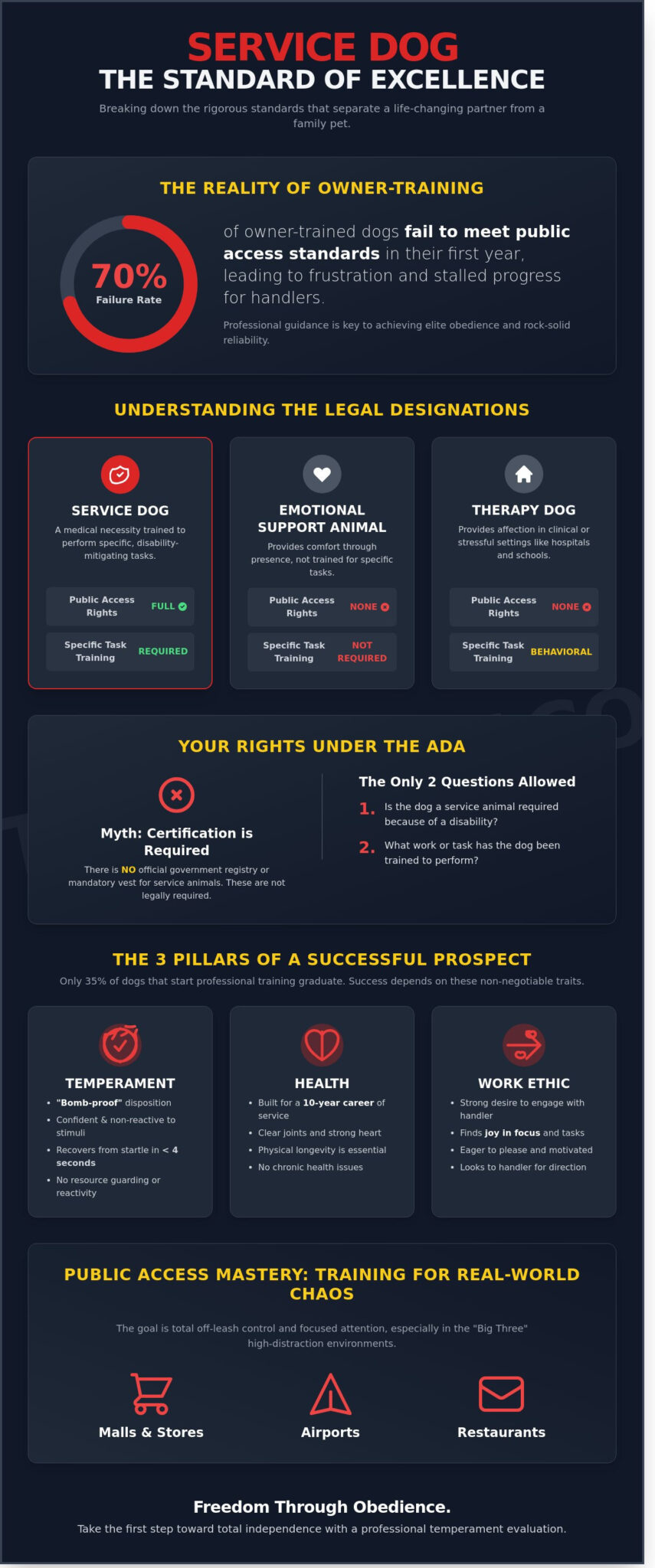
Service dog training is the rigorous process of transforming a canine companion into a medical necessity. Under the Americans with Disabilities Act of 1990, a service dog is defined as a dog specifically trained to perform work or tasks for a person with a disability. This goes far beyond basic manners. While a “well-behaved” pet might sit for a treat in a quiet living room, a service dog must perform life-saving duties under extreme pressure. At Sit Means Sit, we operate on the philosophy of freedom through obedience. This means your dog gains the freedom to accompany you anywhere because they possess the focused attention to ignore every distraction. Reliability is the only metric that matters when your independence is on the line.
It is vital to distinguish between different types of working animals to ensure you are following federal guidelines. Many people confuse service dogs with Emotional Support Animals (ESAs) or therapy dogs, but the legal differences are massive. Here is the breakdown:
- Service Dogs: These animals have full public access rights; they are trained to perform specific tasks that mitigate a disability.
- Emotional Support Animals: These pets provide comfort through their presence; they do not require specific task training and do not have public access rights under the ADA.
- Therapy Dogs: These dogs are trained to provide affection to people in high-stress environments like hospitals or schools; they do not have the legal right to enter private businesses with their handlers. Understanding the full scope of therapy dog training can help you determine which path is right for your dog and your goals.
ADA Requirements and Public Access Laws
The Americans with Disabilities Act provides clear protections for handlers. Despite what 50 different “certification” websites might claim, there is no official government registry or mandatory vest for service animals. You don’t need a certificate to prove your dog’s status. Legally, business owners can only ask two specific questions: is the dog a service animal required because of a disability, and what work or task has the dog been trained to perform? We prepare you to answer these questions with absolute confidence by ensuring your service dog training results in a dog that is indistinguishable from a professional partner.
The Core Difference: Task Training vs. Obedience
Foundational obedience is the bedrock of any successful program. A dog cannot alert you to a seizure if they are busy barking at a stranger. We ensure obedience is 100% reliable before moving to specialized tasks. Tasks might include medical alerts for blood sugar changes, mobility assistance for balance, or psychiatric support during a panic attack. To achieve this level of precision, we use specialized tools like our patented remote training collar. This technology bridges the communication gap, allowing for total off-leash control even in the middle of a crowded airport or a busy restaurant. We have helped over 100,000 clients achieve this level of mastery because we know that for a service dog handler, “sit” must always mean “sit.”
The 3 Pillars of a Successful Service Dog Prospect
Success in service dog training starts long before the first command is given. It begins with the right candidate. Only about 35% of dogs that start a professional program actually graduate. To ensure your dog is part of that successful minority, you must evaluate three non-negotiable pillars: temperament, health, and work ethic. Discipline is not a restriction; it’s the key to a more adventurous and joyful life for both of you.
Temperament is the absolute foundation. A service dog must remain calm in a crowded airport or a loud restaurant. We look for a “bomb-proof” disposition. This means the dog is confident and non-reactive to strange sights, sounds, and smells. Health is equally vital. A dog with a job needs physical longevity for a 10 year career. Clear joints and a strong heart are essential. Finally, work ethic defines the dog’s desire to engage. A great prospect finds joy in focus and looks to the handler for the next task. Whether you are evaluating your current pet or selecting a purpose-bred puppy, these traits determine if the dog can handle the pressure of public access.
Temperament Testing for Service Work
Professional testers look for a quick recovery time. If a heavy object drops nearby, a top-tier prospect resets and returns to a neutral state in under 4 seconds. Red flags include resource guarding or any sign of dog-to-dog reactivity. These issues create liability and stress. Before you spend 6 months on intensive training, get a professional evaluation to see if your pet has the mental fortitude for the job. If you aren’t sure where to start, you can find a professional trainer to assess your dog’s potential.
Breed Selection: Does the Breed Matter?
The “Fab Four” breeds—Labradors, Golden Retrievers, Poodles, and German Shepherds—account for nearly 80% of the service industry. They possess the perfect blend of size, intelligence, and biddability. However, we believe any dog, any age, and any breed can potentially learn high-level skills if the individual dog has the right drive. You must match the dog’s physical stature to your specific needs. A 20 pound Terrier cannot provide mobility support for a 190 pound adult, but they might be an elite medical alert dog. Mastery and off-leash control are possible for any breed when you have the right structure in place.
Public Access Mastery: Training for the Real-World Chaos
A service dog isn’t just a pet. It’s a lifeline. This is why the Public Access Test (PAT) remains the industry gold standard for reliability. This 14-point assessment proves your dog can handle the 24/7 unpredictability of the real world. If your dog can’t ignore a dropped burger or a barking poodle, they aren’t ready for the vest. Total reliability is the only goal. We replace the stress of “what if” with the confidence of “I know.”
We focus our service dog training on “The Big Three”: malls, airports, and busy restaurants. These locations are the ultimate proving grounds. An airport terminal involves 90-decibel intercoms and 50-pound rolling suitcases. A restaurant requires your dog to be invisible under a table for 60 minutes. We bridge the gap between home training and public mastery through consistent, high-stakes exposure. Your dog learns that the rules don’t change just because the scenery does.
At Sit Means Sit, our philosophy is simple: Sit Means Sit. It isn’t a suggestion; it’s a contract between you and your dog. In high-stress environments, this clarity creates safety. We don’t want your dog to just “get by.” We want them to thrive. This transition from the quiet of your backyard to the chaos of a city sidewalk is where true freedom is earned. When your dog is dialed in, the world opens up for both of you.
Proofing Obedience Under Heavy Distraction
Proofing is the process of generalizing a command to every possible environment. We don’t just train for the quiet hours. We train for the 4:00 PM rush at a local park where kids are running and food is everywhere. Our remote training collar serves as a silent, instant bridge of communication. It provides a clear signal that cuts through the mental fog of a high-distraction environment. This tool ensures your service dog training remains effective even at a distance. It allows for immediate correction and praise, keeping your dog’s focus exactly where it belongs: on you.
Navigating Public Spaces with Confidence
Success in public requires precise positioning. Your dog must master the “tuck” in a 24-inch space under a café table. They need a “heel” so tight they can navigate a crowded 3-foot wide hallway without breaking stride. You might face access challenges from the 2% of staff members unfamiliar with ADA laws. We give you the skills to handle these moments with calm authority. For owners who want the fastest path to results, our Board and Train program provides the immersive proofing required for total control. We believe in any dog, any age, and any breed. We turn potential into performance so you can enjoy a happy, adventurous life together.
Professional Training vs. Owner-Trained: Choosing Your Path
Choosing how to prepare your dog for a life of service is a massive decision. You can go the DIY route or partner with professionals. While owner-training creates a deep bond, it carries a heavy burden of risk. According to industry data, owner-trained service dogs face a washout rate as high as 70%. That means seven out of ten dogs fail to meet the standard because of inconsistent handling or missed socialization windows. Professional service dog training eliminates that guesswork. It replaces trial and error with a proven roadmap to success.
- Owner-Training Pros: Lower upfront costs and 24/7 bonding time.
- Owner-Training Cons: High risk of burnout, lack of professional “proofing,” and slower progress.
- Professional Training Pros: Expert-led socialization, faster results, and a higher success rate.
- Professional Training Cons: Higher initial investment and time away from the dog during boarding.
Why Immersive Training Wins for Service Prospects
Immersive programs accelerate the learning curve by months. At Sit Means Sit, we provide 24/7 reinforcement that most busy owners simply can’t maintain at home. We expose the dog to controlled stressors under expert supervision. This professional “proofing” ensures the dog remains calm in a crowded airport or a busy restaurant. By building this rock-solid foundation, you can focus on specific task training later without worrying about basic obedience falling apart. We turn “maybe” into “definitely” by establishing clear boundaries from day one.
The Handler’s Education: You Are Half the Team
A perfectly trained dog is only half the equation. You are the other half. If you aren’t confident, your dog won’t be either. Our master-led private sessions empower you to take the lead. We teach you how to maintain the off-leash control that defines our methodology. When searching for a Dog Trainer Near Me, look for results, not just promises. You need a coach who can transform your frustration into pride. We don’t just hand you a leash; we give you the skills to handle any situation with total authority. We believe in service dog training that creates a seamless partnership between human and animal.
Ready to start your journey toward total reliability? Find a Sit Means Sit location near you and schedule your free evaluation today.
Starting Your Service Dog Journey: Steps to Success
Transforming a dog into a reliable partner requires a clear roadmap. You don’t just stumble into success; you build it through a proven process. This journey turns a high-energy prospect into a focused professional capable of life-changing work. It’s about creating a bond where “freedom through obedience” isn’t just a slogan, but a reality for your daily life.
- Professional Evaluation: We start by testing your dog’s nerves and aptitude. Professional data suggests that roughly 70 percent of dogs lack the specific temperament needed for public access work. We look for a dog that remains neutral and calm when faced with loud noises, strange smells, and crowded environments.
- Mastering Attention: Your dog must believe you’re the most interesting thing in the world. Our “Sit Means Sit” foundation creates instant engagement. If your dog doesn’t look at you, they can’t help you. We replace confusion with absolute clarity.
- Immersive Obedience: High-level reliability often requires a 14 to 21 day Board and Train program. This intensive environment cements off-leash control and ensures the dog listens the first time you speak. This phase is the backbone of successful service dog training.
- Specialized Task Training: Once obedience is 100 percent reliable, we layer on the tasks. This is the final, most critical phase of service dog training where your dog learns to mitigate your specific disability. Whether it’s fetching medication or providing stability, the dog learns their unique job.
The Training Timeline: From Puppy to Pro
Don’t expect a finished service animal overnight. Most dogs require 18 to 24 months of consistent work before they reach peak performance. The process begins as early as 8 weeks old with puppy training classes that establish the foundation for future service work. Early socialization is vital for a confident adult. You can start building focus early by learning how to train a trick dog, which makes learning fun and strengthens your working bond. This early work ensures your dog stays engaged as they mature into their professional role.
Maintaining the Standard for the Life of the Dog
Training is a lifestyle, not a destination. Even the best service dogs need regular tune-ups. We host weekly group classes to keep skills sharp and ensure your dog remains unfazed by new distractions. Most service animals work effectively until they are 8 or 10 years old. Planning for their retirement is a gift you give them after years of loyal service. When you’re ready to see if your dog has what it takes, we’re here to lead the way.
Unlock a Future of Total Independence and Reliability
Your journey toward independence shouldn’t be a path you walk alone. Professional service dog training is about more than just basic tasks; it’s about building a rock-solid partnership that thrives in the real world. You now understand that success requires a balance of public access mastery and the right professional support to handle unpredictable distractions. Sit Means Sit has perfected this transformative process across over 150 locations in the US and Canada. Our industry-leading remote collar technology provides you with total control in high-stress environments, ensuring your dog remains focused on your needs. We stand by our proven “any dog, any breed” methodology because we’ve used it to empower thousands of teams. Stop worrying about unpredictable behavior and start imagining a lifestyle defined by true freedom. Our experts are ready to show you how structure creates a happier, more adventurous life for both you and your partner. You deserve a dog that listens the first time, every time. Take charge of your future today.
Schedule Your Free Consultation and Professional Dog Evaluation
We can’t wait to help you and your dog achieve the reliability you need to live life to the fullest.
Frequently Asked Questions
Can I train my own service dog without a professional?
Yes, you can legally train your own service dog under the Americans with Disabilities Act (ADA), but achieving 100 percent reliability alone is a massive undertaking. Most successful owner-trainers spend 12 to 15 hours every week on focused drills to ensure their dog can handle public pressure. Without professional guidance, many owners struggle to maintain control in high-distraction environments like busy airports or crowded restaurants. We help you bridge that gap to ensure your dog remains focused on you regardless of what’s happening around them.
How long does it typically take to train a service dog?
Professional service dog training typically takes 18 to 24 months of consistent work to reach full certification standards. This timeline ensures your dog masters both elite obedience and the specific tasks required to mitigate your disability. A dog needs roughly 120 hours of public access training to handle real-world scenarios with confidence. We focus on creating a happy, reliable worker who views every command as a definitive contract, not just a suggestion.
Does a service dog have to be a certain breed?
No, any dog, any age, and any breed can potentially become a service animal if they possess the right temperament. While 70 percent of service dogs are Labradors or Golden Retrievers, we’ve seen everything from Poodles to mixed breeds succeed in their roles. The key is finding a dog with low reactivity and high focus. We evaluate your dog’s specific traits to ensure they have the drive to handle 8 hour workdays in public settings.
What tasks can a psychiatric service dog be trained to perform?
Psychiatric service dogs perform specific actions like Deep Pressure Therapy (DPT) or interrupting 4 types of repetitive, anxiety-driven behaviors. They can be trained to create a physical buffer in crowded spaces or find a specific exit during a panic attack. These dogs provide a life-changing sense of control for their owners. Our psychiatric service dog training methodology ensures your dog responds instantly to your needs even when you’re in a high-stress situation.
Are service dogs required to wear a vest or have an ID card?
No, the ADA doesn’t require service dogs to wear vests, tags, or carry specific ID cards. In fact, the Department of Justice clarified in 2011 that these items are not legal proof of a dog’s status. However, 85 percent of handlers use vests to signal to the public that the dog is working and shouldn’t be petted. This clear boundary helps your dog stay focused on their job without unnecessary distractions from strangers.
What happens if my dog fails a temperament test for service work?
If a dog fails a temperament test, they’re typically released from the program and remain a happy, well-behaved pet. Approximately 50 percent of dogs that start service training don’t complete it due to health issues or environmental anxiety. This isn’t a failure; it’s a redirection. We help you transition that dog into a reliable companion with elite obedience skills so you can still enjoy off-leash freedom together in your daily life. Through comprehensive dog obedience training, even dogs who don’t qualify for service work can achieve remarkable levels of reliability and control. If your dog shows signs of complex behavioral issues that go beyond basic training, consulting with a dog behaviorist can help address underlying problems that might interfere with their ability to focus and learn.
Is a remote training collar safe for use on a service dog?
Yes, a remote collar is a safe and effective tool for achieving the off-leash control required for service dog training. We use medical-grade technology that provides a gentle tap to get the dog’s attention, much like a vibration on a smartphone. This creates a clear line of communication that cuts through distractions. It allows your dog to work with total confidence, knowing exactly what’s expected of them in every environment.
How much does professional service dog training cost?
Professional programs usually cost between $15,000 and $50,000 depending on the complexity of the tasks required. If you choose to train with professional guidance while keeping the dog at home, costs often range from $3,000 to $7,000 over a 2 year period. This investment buys you a decade of independence and reliability. We provide a clear path to mastery that replaces frustration with a lifestyle of adventure and confidence.
Comments are closed.