

Imagine walking into a busy restaurant at 7:00 PM on a Saturday. Your dog sits perfectly under the table, ignoring the smell of steaks and the clatter of dropped silverware. You don’t feel the usual spike of panic because you have mastered psychiatric service dog training. According to the CDC, 61 million adults in the U.S. live with a disability, yet many feel trapped at home because they can’t trust their dog in public. You want a partner that provides medical support, not a distraction that adds to your anxiety.
We agree that your independence shouldn’t be limited by a leash or a lack of consistency. This guide will teach you how to transform your dog into a focused, life-changing partner that remains reliable under any distraction. We are going to break down the task-specific training required by the ADA and show you how any dog, any age, and any breed can achieve the total off-leash control that leads to true freedom. It’s time to take your life back.
Key Takeaways
- Understand the critical legal distinction between a pet and a Psychiatric Service Dog to ensure your partner is fully recognized under the ADA.
- Discover how life-changing tasks like Deep Pressure Therapy and grounding can interrupt panic attacks and provide immediate nervous system relief.
- Learn the “Sit Means Sit Dog Training” approach to psychiatric service dog training that turns every command into a reliable contract of communication.
- Master the transition from your living room to the real world by building total off-leash control in high-distraction public environments.
- Accelerate your journey toward total reliability with immersive programs that build a rock-solid foundation for your service dog in weeks, not years.
Table of Contents
- What is Psychiatric Service Dog Training?
- Essential Tasks for Psychiatric Service Dogs
- The Path to Reliability: Training Methodology
- Mastering Public Access and Distractions
- Starting Your Journey with Sit Means Sit
What is Psychiatric Service Dog Training?
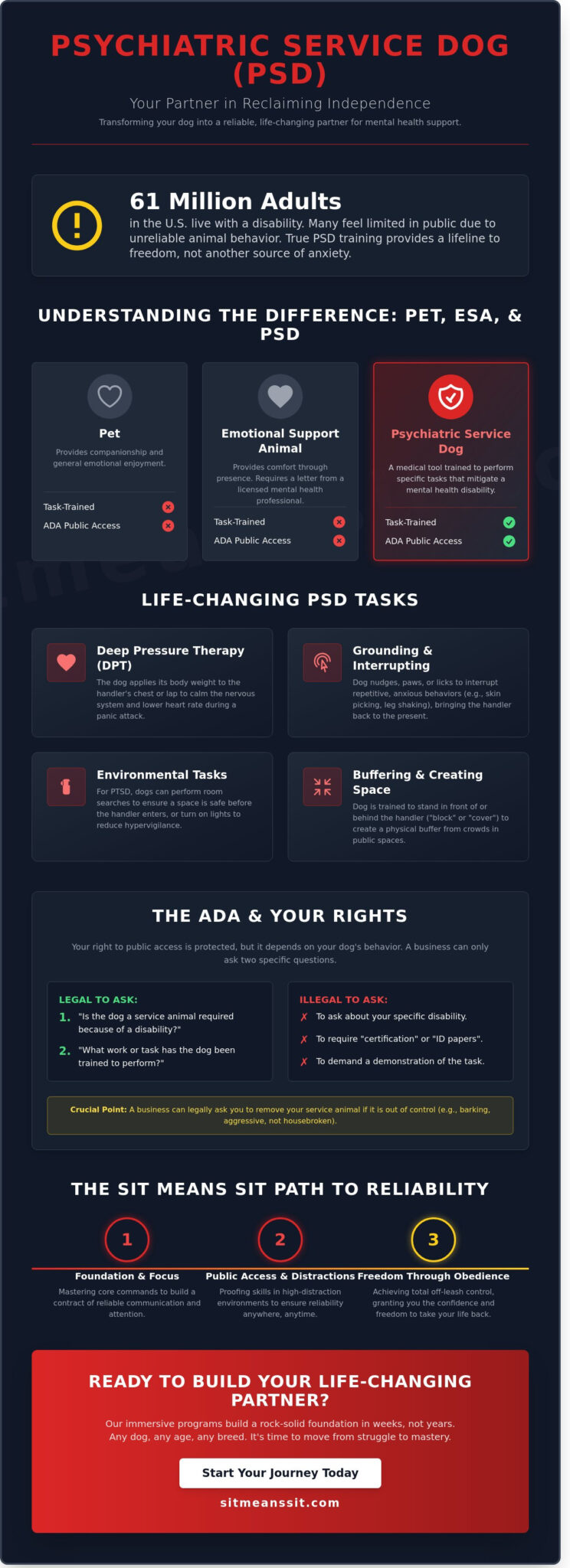
A psychiatric service dog (PSD) is a medical necessity, not a pet. This is the first and most important distinction you must understand. While a standard pet provides companionship, a PSD provides a lifeline. These dogs are highly trained professionals that perform specific tasks to mitigate the symptoms of a mental health disability. When you invest in professional psychiatric service dog training, you are moving from a place of struggle to a place of mastery. You are choosing a path that replaces fear with a sense of empowerment and pride.
The legal distinction between a PSD and an Emotional Support Animal (ESA) is significant under the Americans with Disabilities Act (ADA). An ESA provides comfort just by being present. A PSD, however, is trained to take action. Whether it is interrupting a repetitive behavior or providing deep pressure therapy during a panic attack, the dog must perform a job. Many people believe they need a special “certification” or a vest to make their dog official. This is a myth. The ADA does not recognize any specific certification or registration as a legal requirement. The only legal requirement is that the dog is trained to perform tasks that help with your specific disability. Actual training is the foundation of your legal protection and your personal freedom.
At Sit Means Sit, we believe in “freedom through obedience.” This philosophy is vital for a psychiatric assistance dog. A dog that is out of control cannot help you. True psychiatric service dog training focuses on reliability under pressure. It ensures your dog is focused on you, regardless of the distractions around them. This level of mastery creates a partnership where you can finally feel safe in public spaces again.
The Legal Framework: ADA and Public Access
The ADA was established in 1990 to ensure people with disabilities have the same rights as everyone else. This includes the right to bring a trained PSD into businesses, restaurants, and hospitals. Business owners are legally allowed to ask only two specific questions. First, is the dog a service animal required because of a disability? Second, what work or task has the dog been trained to perform? They cannot ask about your medical history or demand a demonstration of the task. However, your right to access depends on your dog’s behavior. If a dog is barking, jumping, or acting aggressively, a business can legally ask you to leave. Behavioral standards are just as important as task training for your legal protection.
Who Benefits from a Psychiatric Service Dog?
Individuals living with PTSD, Panic Disorder, Depression, and Severe Anxiety benefit most from a PSD. The difference between “comfort” and “task-based mitigation” is the key. A dog providing comfort sits on the couch with you. A dog providing mitigation senses your rising cortisol levels and nudges your hand to ground you. Identifying if your current dog has the temperament for service work is the first step. We look for dogs that are confident, stable, and unfazed by loud noises or crowded environments. We believe in the potential of any dog, any age, and any breed, but service work requires a specific, calm disposition. If your dog is naturally anxious, they may not be the right candidate for this high-level responsibility.
Essential Tasks for Psychiatric Service Dogs
Psychiatric service dog training focuses on building a bond based on precision and purpose. It moves beyond basic obedience to create a reliable partner capable of managing complex mental health challenges. Task-based mitigation serves as the functional bridge that transforms a loyal pet into a life-saving medical tool. When a dog is trained to perform specific tasks, they provide their handler with a sense of security that traditional therapy alone cannot match.
Deep Pressure Therapy (DPT) is one of the most common interventions. The dog uses their body weight to apply pressure to the handler’s chest or lap. This action stimulates the parasympathetic nervous system, which helps lower the heart rate during a panic attack. Grounding and interrupting are also critical. If a handler begins a repetitive behavior like leg shaking or skin picking, the dog will nudge or paw at them to break the cycle. This immediate feedback helps the human stay present and focused on the moment.
For those living with PTSD, environmental tasks are life-changing. A dog can be trained to perform room searches, entering a dark home first to ensure it is safe. They can also turn on lights using specialized switches. In crowded environments, non-aggressive buffering is a vital skill. The dog stands in a “block” or “cover” position to create a physical perimeter. This creates a safe zone in public spaces, preventing the handler from being accidentally crowded or startled by strangers.
Medical Response vs. Medical Alert
There is a distinct difference between a dog that responds to a crisis and one that alerts you before it happens. Medical response involves the dog taking action once a panic attack or flashback has already started. Medical alerts are more advanced; they rely on the dog’s ability to detect scent changes or subtle behavioral cues before symptoms peak. A 2018 study from Purdue University found that service dogs significantly reduced the severity of PTSD symptoms in over 80% of participants. This level of reliability is only possible through high-level psychiatric service dog training. Consistency is a non-negotiable safety requirement. If the dog doesn’t perform every single time, the handler’s safety is at risk. Understanding the legal standards for these tasks is essential, as outlined in the guide for Service Animals and the ADA.
The Science of Attention in Task Performance
A service dog must possess unwavering focus to be effective. This means they must ignore a dropped sandwich or a barking dog to remain tuned into their handler’s physiological cues. They learn to read micro-expressions and shifts in breathing that signal an oncoming episode. Through structured discipline, the dog develops the ability to work through intense distractions. This mastery is what provides “freedom through obedience.” If you want to see how your dog can achieve this level of off-leash control, start with a professional evaluation. Reliability isn’t a happy accident; it’s the result of a proven training system that prioritizes the human-dog bond.
The Path to Reliability: Training Methodology
Many handlers start their journey with psychiatric service dog training in the quiet comfort of their living room. Success comes easy when there are no distractions. The real test happens at the grocery store or a busy airport. Most owner-trainers fail because they cannot bridge the gap between a quiet home and a chaotic public space. This is where reliability matters most. If your dog only listens when it is convenient, they cannot truly support your mental health in a crisis.
The Sit Means Sit approach turns a command into a definitive contract. We do not believe in “maybe” or “sometimes.” Our methodology uses a Remote Training Collar to provide clear, low-level feedback. Think of it as a digital tap on the shoulder. It keeps your dog focused on you even when the world is loud. This clear communication builds the confidence your dog needs to ignore a dropped piece of food or a barking dog nearby. Once your dog masters basic obedience under heavy distraction, we transition to specialized task work. This ensures your dog performs their job exactly when you need it most.
Professional Support vs. DIY Training
Training a service dog is a massive commitment. Without a professional structure, many dogs “wash” or fail out of training. Professional help simplifies psychiatric service dog training by removing the guesswork. Industry data suggests that approximately 65 percent of owner-trained dogs do not make it to full service status. You can avoid this heartbreak. Our board and train programs accelerate the process by providing an immersive environment for learning. We handle the heavy lifting of foundational discipline. Then, we train you to be the leader your dog needs. You will gain the mastery required to maintain their skills for life.
Temperament Testing: Can Any Dog Be a PSD?
We believe in “any dog, any breed,” but every individual dog must be tested for the job. A psychiatric service dog needs incredible environmental stability. We look for a fast recovery time. If a loud noise occurs, a suitable dog should recover in less than 3 seconds. If they remain fearful, they may not be right for high-stress public access. The Americans with Disabilities Act (ADA) requirements for service animals state that a dog must be under the handler’s control at all times. If a dog is reactive or easily overwhelmed, they cannot meet this legal standard. We help you evaluate your dog’s heart and biddability to ensure they are ready for the mission ahead.
Mastering Public Access and Distractions
Public access is the ultimate proving ground for psychiatric service dog training. It transforms a well-behaved pet into a reliable medical partner. You don’t just want a dog that listens; you need a dog that thrives under pressure. Mastery happens in four definitive stages.
- Step 1: Total Off-Leash Control. Start in a quiet, familiar environment. Your dog must respond to every command on the first ask, 100% of the time, without the physical safety net of a leash.
- Step 2: Low-Stakes Public Exposure. Move to “dog-friendly” retail spaces like hardware stores or outdoor equipment shops. These locations offer wide aisles and neutral smells, providing a controlled bridge between home and high-traffic areas.
- Step 3: High-Value Proofing. Introduce intense distractions. We test the dog’s focus against dropped food, barking dogs, and sudden loud noises. A professional service dog remains locked on their handler even if a piece of bacon hits the floor 2 feet away.
- Step 4: The Public Access Test (PAT) Standards. This industry-standard evaluation ensures your dog maintains a “tucked” position in restaurants and ignores strangers completely. It is the gold standard for professional behavior in 24/7 public environments.
The “Sit Means Sit” Standard of Focus
Neutrality is the heartbeat of a successful service dog. Your dog must view the world as background noise. Achieving dog obedience training that works during a psychiatric crisis requires a deep, unbreakable bond. We train for “active engagement,” where the dog checks in with the handler every 30 to 60 seconds without being prompted. Whether you are in a crowded airport or a busy mall, your dog’s focus remains a constant shield against the environment.
Common Public Access Mistakes to Avoid
Inconsistency is the enemy of progress. Even small lapses in discipline can lead to a total decline in professional standards. Avoid these three critical errors:
- Socializing “On the Clock”: Never allow your dog to sniff or greet others while wearing their vest. This creates an expectation of play that breaks their professional mindset.
- Allowing Task Creep: If you stop enforcing boundaries during a 4-hour outing, your dog will begin to self-release from commands. Consistency must be absolute from the moment you leave the car.
- Ignoring Stress Signals: Watch for subtle signs like excessive yawning or lip licking. Since 2022, trainers have emphasized that a stressed dog cannot effectively perform psychiatric service dog training tasks.
Starting Your Journey with Sit Means Sit
You aren’t just looking for a pet; you’re looking for a lifeline. Our specialized service dog training programs provide a custom roadmap designed to turn your canine companion into a reliable partner. We don’t believe in waiting years for results. While traditional methods can take over 24 months to produce a working dog, our immersive training approach builds a rock-solid foundation in a fraction of that time. We focus on rapid, reliable transformation that allows you to reclaim your life sooner.
The core of our philosophy is “Freedom through Obedience.” This means that discipline isn’t a cage; it’s the key to a bigger world. When your dog is perfectly under control, the world opens up for both of you. You can walk into a crowded airport, a busy grocery store, or a noisy restaurant with total confidence. We empower every handler to lead with authority, replacing anxiety with the pride of a well-behaved, working dog. Our psychiatric service dog training focuses on creating a team that can handle any distraction with ease.
Customized Training Plans for Your Specific Needs
Every diagnosis is different, and every training plan should be too. We match task training to your specific psychiatric triggers and daily lifestyle. If you experience night terrors, we train your dog to wake you gently. If crowds trigger panic, we teach your dog to “block” and create physical space. These aren’t just tricks; they are essential tools for your independence. Our private lessons allow us to fine-tune the human-canine bond in real-world settings. A service dog is a lifetime commitment to consistency and leadership that ensures your partner remains sharp and reliable for years to come. If you are also exploring how dogs can support others in clinical or community settings, understanding therapy dog training and the reliability standards required for real-world impact can help you see the full spectrum of canine-assisted support.
Next Steps: Your Evaluation
Your journey begins with a professional temperament and training assessment. We don’t guess; we test. We evaluate your dog’s drive, focus, and stability under pressure to ensure they have the right “job fit” for psychiatric work. During this session, we help you decide if an intensive board and train program or a structured private lesson track fits your goals best. With over 140 locations across the United States, we have seen every behavioral challenge and know how to solve it. We believe in any dog, any age, and any breed. It is time to stop managing your symptoms alone and start leading your life. Find a Sit Means Sit trainer near you and start your path to independence today.
Take Control of Your Future with Absolute Confidence
You deserve a partner that stays focused when the world gets loud. Professional coaching isn’t just about learning specific tasks; it’s about building a bond based on total reliability. At Sit Means Sit, we’ve spent over 25 years perfecting a methodology that ensures off-leash control even under heavy distraction. Our nationwide network of professional trainers has seen every behavioral challenge and knows exactly how to help you achieve the freedom you’ve been looking for.
Imagine walking through a crowded city or a busy park with a dog that remains calm, attentive, and ready to work. We replace your frustration with empowerment by turning every command into a definitive contract. We work with any dog, any age, and any breed to ensure you get the results you need. Don’t wait to start this life-changing journey for you and your dog. Contact us for a free psychiatric service dog training evaluation and see the Sit Means Sit difference for yourself. Your new life of independence and joy is just one session away. We can’t wait to help you and your dog succeed together.
Frequently Asked Questions
Is a psychiatric service dog the same as an emotional support dog?
No, a psychiatric service dog is not the same as an emotional support animal. Under the Americans with Disabilities Act (ADA), service dogs must perform specific tasks that mitigate a disability. An ESA provides comfort just by being present. Psychiatric service dog training transforms a pet into a working partner that can interrupt panic attacks or provide deep pressure therapy. This distinction is the key to legal public access.
Can I train my own psychiatric service dog under the ADA?
Yes, you can absolutely train your own dog under the ADA. The law does not require professional certification or third-party testing. However, achieving 100 percent reliability in high-distraction environments requires a disciplined approach. Most successful owner-trainers seek expert guidance to ensure their dog masters the Sit Means Sit standard of obedience. This ensures your dog remains focused on you, even in a crowded airport or busy restaurant.
What breeds are best for psychiatric service dog training?
We believe in the potential of any dog, any age, any breed. While 70 percent of service dog programs favor Golden Retrievers and Labradors for their temperament, your current pet might have the right drive. Successful psychiatric service dog training focuses on individual temperament rather than just a pedigree. We look for dogs that stay calm under pressure and show a natural desire to work alongside their human partner.
How long does it take to fully train a psychiatric service dog?
Fully training a psychiatric service dog typically takes 18 to 24 months. This timeline ensures the dog masters both basic obedience and specialized tasks. You need to log hundreds of hours of public access training to ensure total control. Consistency is your best friend during this process. A dog that practices commands daily reaches the goal of off-leash control much faster than one with an irregular schedule.
Do psychiatric service dogs need to wear a vest or ID tag?
No, the ADA does not require service dogs to wear vests, ID tags, or special harnesses. While these items can help 90 percent of the public identify your dog as a working animal, they aren’t a legal necessity. Your dog’s behavior is its true credential. A well-behaved dog that ignores distractions proves its status more effectively than any piece of gear ever could.
What happens if my psychiatric service dog misbehaves in a public place?
If a service dog barks excessively or acts aggressively, a business owner can legally ask you to remove the animal. The ADA requires service dogs to be under the handler’s control at all times. This is why we emphasize boundaries and discipline from day one. Proper psychiatric service dog training prevents these stressful situations by proofing your dog against real-world triggers like dropped food or loud noises.
Can a puppy be a psychiatric service dog?
A puppy can be a psychiatric service dog in training, but they aren’t considered full service dogs until they complete their task training. Most dogs aren’t ready for full-time service work until they reach at least 18 months of age. Starting early is vital for socialization. We help owners build a foundation of confidence in young dogs, turning them into reliable partners that can handle any environment.
How much does psychiatric service dog training cost on average?
Professional service dog training costs range from 15,000 to 30,000 dollars according to Assistance Dogs International. If you choose to train the dog yourself with professional coaching, your costs will be significantly lower. Investing in a proven program ensures you don’t waste time or money on ineffective methods. We focus on results that give you the freedom to live your life without worrying about your dog’s behavior.
Comments are closed.