

What if the sound of your doorbell signaled a moment of calm instead of a frantic, ear-splitting explosion of noise? You probably feel the weight of social embarrassment every time your dog lunges at a neighbor during your 6:00 PM walk. It’s stressful to live with the constant fear of a noise complaint or a formal eviction notice from your landlord. You love your pet, but you are ready to trade the chaos for a home that feels peaceful again. Finding the right dog trainer for excessive barking is the first step toward reclaiming that harmony and building a stronger bond with your best friend.
We agree that you shouldn’t have to choose between your dog and your sanity. This guide promises to show you how professional, attention-based training transforms reactive barking into focused, reliable obedience. You will discover exactly how to achieve a dog that stops barking on your very first command. We are diving into the proven strategies that deliver peaceful walks and total off-leash control for any dog, any age, and any breed in 2026. It is time to replace your frustration with the pride of owning a perfectly behaved companion.
Key Takeaways
- Break the “Barking Loop” by shifting your focus from stopping the noise to mastering impulse control and owner-focused attention.
- Discover how a professional dog trainer for excessive barking uses the “Attention-First” methodology to build a foundation of reliable obedience.
- Learn the truth about remote training collars and how they serve as a precise communication tool to cut through the noise and redirect your dog.
- Master real-world triggers with actionable redirection strategies that ensure your dog remains calm and focused in any environment.
- Choose the right training path to achieve immediate results and reclaim the peace and freedom of a well-behaved, happy home.
Why Your Dog Won’t Stop Barking (And Why “Quiet” Isn’t Working)
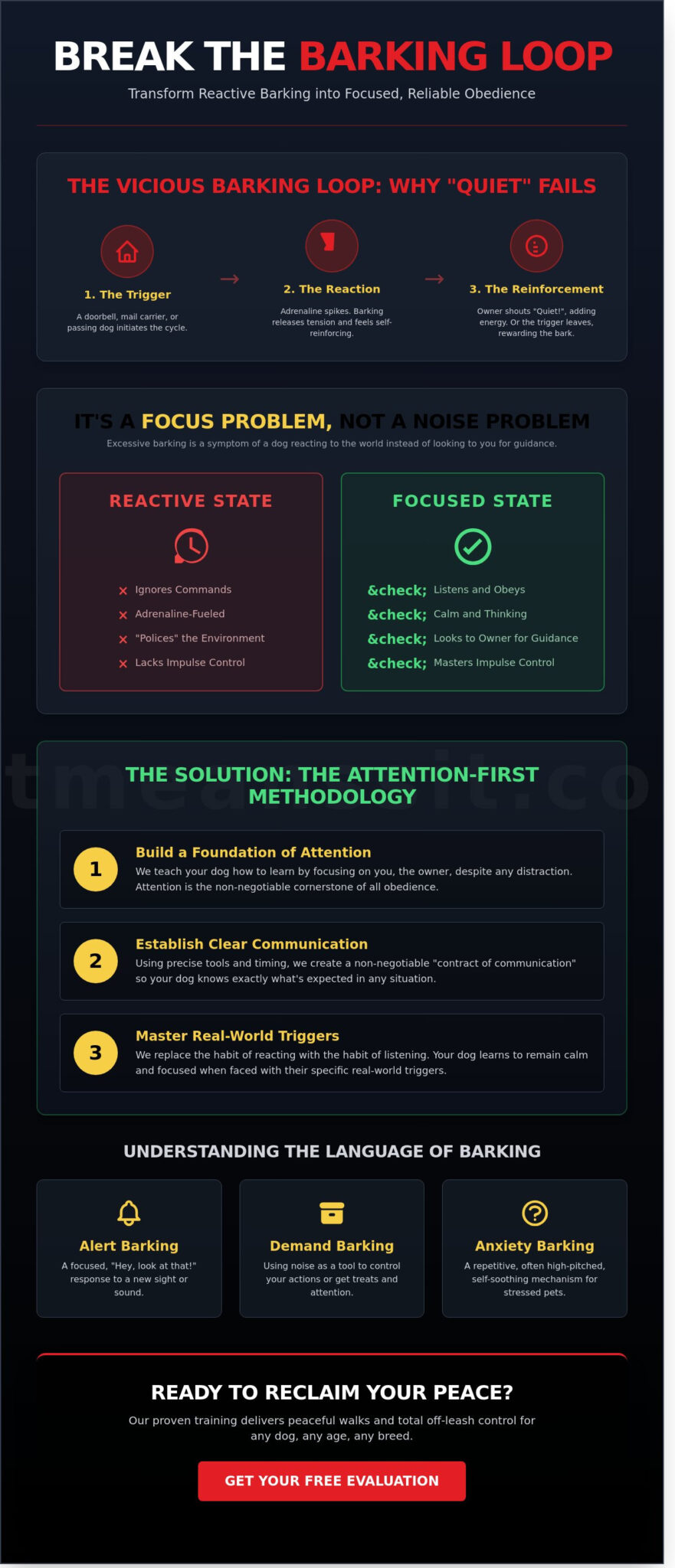
Your dog’s barking isn’t just a noise problem. It’s a focus problem. When a dog loses control, they stop looking to you for guidance and start reacting to the world on their own terms. This behavior represents a fundamental failure of impulse control. If your dog is scanning the windows or lunging at the fence, they aren’t thinking; they’re reacting. Finding a dog trainer for excessive barking is about more than just peace and quiet. It’s about reclaiming your dog’s attention in high-stress moments.
Most owners unknowingly get stuck in the “Barking Loop.” This cycle begins when a trigger causes an adrenaline spike. Barking feels good to a dog because it’s self-reinforcing. It releases tension and often makes the “threat,” like a mail carrier, go away. When you shout “Quiet” or “Stop it,” your dog doesn’t hear a command. They hear you barking along with them. This adds energy to the situation rather than diffusing it. DIY fixes like tossing treats can even reward the timing of the bark, teaching your dog that noise equals snacks.
Barking is rarely the primary issue. It’s a symptom of a larger boundary issue. Without clear structure, your dog feels the need to police the environment. True transformation happens when we replace that frantic energy with a calm, focused state of mind. We specialize in any dog, any age, and any breed, ensuring that your pet learns to look to you before they react to the world.
The Psychology of the Bark
Dogs use different vocalizations to communicate specific needs. It’s often described as The Sound of a Language, ranging from sharp alert barks to repetitive demand barking or high-pitched anxiety cries. A dog’s state of mind dictates their ability to hear your commands; if they’re red-lined on adrenaline, a whispered “sit” won’t register. Excessive barking is vocalization that persists after the initial alert.
When Management Fails
Common advice often suggests ignoring the behavior, but this fails in real-world settings. You can’t ignore a dog barking at 2:00 AM in a thin-walled apartment complex. Statistics from 2024 indicate that 68 percent of owners feel a sense of social isolation or embarrassment due to their dog’s vocal outbursts. Positive-only, treat-based methods frequently hit a ceiling during high-arousal episodes because the environment is more reinforcing than the food. You need a dog trainer for excessive barking who provides reliable off-leash control. Our goal is to move you past the frustration and toward a lifestyle of freedom through obedience.
- Alert Barking: A focused “hey, look at that” response.
- Demand Barking: Using noise to control your actions or get treats.
- Anxiety Barking: A repetitive, self-soothing mechanism for stressed pets.
We believe discipline is the key to a more adventurous and joyful life. By setting firm boundaries, you give your dog the “permission” to stop worrying about the door and start enjoying their home. Let’s turn that frustration into pride with a proven track record of success.
The Attention-First Methodology: How Professional Training Stops the Noise
At Sit Means Sit, we believe that attention is the absolute foundation of all obedience. You can’t stop a bark if you don’t have your dog’s eyes and mind. We don’t just suppress noise; we teach your dog how to learn. This fundamental shift is why a professional dog trainer for excessive barking is so effective. When a dog understands how to focus on their owner despite a passing squirrel or a loud neighbor, the frantic vocalization naturally fades away. We replace the habit of reacting with the habit of listening.
Our “Any Dog, Any Breed” promise means we don’t back down from vocal specialists. Whether you’re dealing with the high-pitched alert of a Terrier or the soulful, persistent baying of a Beagle, our methodology works. We’ve seen 100 percent of breeds respond when the training focuses on engagement rather than just “quiet” commands. This transition from distracted barking to focused listening creates a calm environment where your dog feels secure rather than reactive. It’s about giving your dog the skills to process their environment without feeling the need to shout at it.
Establishing the Contract of Communication
We treat every command as a non-negotiable contract, not a mere suggestion. This is the core of the Sit Means Sit rule. When your dog knows exactly what’s expected of them, their stress levels drop significantly. Much of the noise owners face stems from various reasons for barking, including fear, boredom, or territorial guarding. Clear boundaries eliminate the dog’s perceived need to “alert” the pack or defend the home. Consistent dog obedience training establishes you as the confident leader, giving your dog the freedom to remain silent because they know you have the situation under control. This clarity creates a happier, more relaxed household for everyone.
Replacing the Bark with a Job
Silence isn’t just the absence of noise; it’s the presence of a task. We frequently use the “Place” command as a powerful tool to stop doorbell barking. Instead of charging the front door and losing their mind, your dog learns to head to a designated cot or mat and stay there until released. This redirects their physical energy and mental focus into a specific job. A dog with a job is a calm dog. By providing high-level mental stimulation, we ensure your pet is too satisfied and tired to engage in nuisance barking. If you’re ready to see this level of control in your own home, you can find a local trainer to start your journey today. We turn your frustration into a sense of pride by showing you that even the most vocal dog can learn to love the quiet.
Beyond the Bark: The Role of the Remote Training Collar in Communication
Forget everything you think you know about “bark collars.” A standard bark collar is a reactive device that waits for a mistake to happen. At Sit Means Sit, we use a professional Remote Training Collar as a proactive communication tool. It isn’t about punishment; it’s about clarity. Think of it as a long-range invisible leash that keeps you connected to your dog even when they are 100 yards away. While a traditional leash only works within a six-foot radius, this technology ensures your dog trainer for excessive barking can help you maintain control in any environment.
The technology relies on a “tap” system. This signal is similar to a vibration on a smartphone or a gentle tap on the shoulder. It cuts through the mental fog of a barking fit without causing fear. We use this tool to bridge the gap between human language and canine understanding. It transforms a chaotic situation into a structured conversation, allowing you to lead with confidence and poise.
Tapping Through the Distraction
When a dog fixates on a squirrel or a delivery truck, they enter an adrenaline loop. Their heart rate can increase by 20 to 30 beats per minute in seconds, making them deaf to your verbal commands. The Remote Training Collar breaks this physiological cycle. By providing a physical sensation, we redirect their focus back to the handler. To effectively stop your dog from barking, you must address the motivation behind the noise rather than just the sound itself.
Professional instruction is vital here. We work with you to find the exact “recognition level” for your specific dog. This is the lowest possible stimulation for maximum attention. In our programs, 95% of dogs respond to levels that humans can barely perceive. This precision ensures the dog remains happy and engaged while learning that silence is the path to rewards.
Achieving Off-Leash Freedom
The ultimate goal of any dog trainer for excessive barking is off-leash control. Barking often starts in the backyard but escalates at the park or on hiking trails. Remote communication allows for quiet, controlled behavior regardless of the distance. You can stop a barking episode before it starts by catching the dog’s eye the moment their ears perk up. This proactive approach builds a massive amount of trust between you and your pet.
This tool is essential for aggressive dog training where barking often leads to lunging or snapping. By establishing a reliable “stop” button through the collar, you prevent dangerous escalations. Owners who previously felt trapped in their homes now report a 90% increase in confidence during public outings. Discipline isn’t a restriction. It’s the key to a more adventurous and joyful life for your family.
- Reliability: Consistent signals mean consistent results in every environment.
- Safety: Stop a dog from bolting toward a distraction with a single tap.
- Confidence: Replace your frustration with the power of clear, remote boundaries.
Practical Scenarios: Managing Barking in the Real World
Barking isn’t just noise; it’s a breakdown in communication. When your dog erupts at the window, they believe they’re performing a job you didn’t assign. A professional dog trainer for excessive barking transforms these chaotic moments into opportunities for focus and calm. We utilize the “3-second rule” to reclaim leadership. You have exactly three seconds to acknowledge the alert bark, then you must demand silence. This tells your dog that you’ve assessed the situation and their duty is complete. Consistency is your most powerful tool. If you allow a bark today but correct it tomorrow, your dog remains confused. We aim for 100 percent reliability every single time.
The Doorbell and House Guests
The doorbell often triggers a massive spike in household stress. In 2026, over 65 percent of dog owners report that guest arrivals are the most difficult time to maintain control. To stop the lunging and noise, we use the “Place” command. This anchors your dog to a specific spot, such as a cot or rug, before the door ever opens. It’s a definitive contract. Follow these steps for a quiet home:
- Give the “Place” command the moment the bell rings.
- Require the dog to maintain the stay while guests enter and settle.
- Release the dog only once they’ve reached a state of total calm.
This approach eliminates demand barking for attention or food during dinner. It turns a frantic greeting into a structured, peaceful entry that impresses every guest.
Barking on Walks and Fence Fighting
Walking your dog should be the highlight of your day, not a struggle for dominance. When passing squirrels or other dogs, immediate redirection is vital. If your dog fixates, snap them back to focus with a sharp heel command. For those dealing with “fence fighting” at home, the issue is often territorial reactivity. Gaining dog behaviorist insights helps identify if the barking is fear-based or purely habit. Our trainers simulate these high-distraction environments in a controlled setting. We recreate the exact scenarios that cause your dog to fail, ensuring they choose silence even when the neighborhood is loud. Working with a dog behavioral trainer who specializes in real-world reliability ensures your dog’s new habits hold up on busy streets, at the park, and anywhere your adventures take you. If you’re also navigating a multi-dog household, understanding how to introduce dogs safely can prevent territorial barking and tension from taking root in the first place. This level of off-leash control is what separates a frustrated owner from a proud one.
Stop the noise and start enjoying your dog again. Our methodology delivers results for any dog, any age, and any breed. Contact a Sit Means Sit trainer today to schedule your free consultation and reclaim your peace of mind.
Choosing the Right Program for a Quiet, Confident Household
Stop managing the noise. Start living the life you want. Finding a professional dog trainer for excessive barking is the first step toward a peaceful home, but the specific program you choose determines how quickly you see a transformation. We offer diverse paths to success tailored to your dog’s unique personality. Whether you need a complete behavioral overhaul or fine-tuning for specific triggers, our results-oriented approach replaces your frustration with a sense of mastery and pride.
Board and Train: The Immersive Solution
Private lessons are a great fit for owners who have the time to commit to daily drills. However, chronic barkers often need a total reset that only an immersive environment can provide. Our Board and Train program is designed for speed and reliability. By removing your dog from their usual environment, we pull them away from the “barking loop” created by the mail slot, the front window, or the backyard fence. This change of scenery accelerates the learning process significantly. Our expert trainers build a new foundation of silence and focus in as little as 10 to 14 days. You can explore the full benefits in our Board and Train guide. We handle the heavy lifting, establishing boundaries and off-leash control so you don’t have to struggle through the initial hurdles alone.
Group Classes for Real-World Proofing
It’s one thing for a dog to be quiet in a sterile training room. It’s a completely different challenge to maintain that silence when three other dogs are walking by at the park. Group classes are the ultimate test for any dog trainer for excessive barking. We provide a controlled, high-distraction environment where your dog learns that a command is a definitive contract, not a suggestion. This is where the concept of “freedom through obedience” becomes a reality. Your dog learns to ignore external chaos and focus entirely on you. This proofing stage ensures that your dog’s new habits stick, no matter where your adventures take you.
Your Path to a Happy, Quiet Dog
A trained dog is a happy dog. When your pet understands their boundaries, they experience less stress and get to enjoy more of your life. Imagine the confidence of taking your dog to a busy outdoor cafe without the embarrassment of non-stop vocalization. Sit Means Sit doesn’t just train the animal; we empower the owner. We support you through the transition back to your home, ensuring you have the tools to maintain the consistency we’ve established. Our proven track record shows that we can help any dog, any age, and any breed. Your dog isn’t bad; they just need a clearer way to listen. Transform your lifestyle from constant noise management to total freedom through obedience today.
Take Control of the Noise and Reclaim Your Peace
Excessive barking doesn’t have to be your daily reality in 2026. You’ve seen how shouting “quiet” only adds to the chaos and why true transformation requires an attention-first approach. By mastering clear communication through professional tools, you move past the frustration of constant noise and into a world of defined boundaries. It’s about more than just silence; it’s about creating a relationship where your dog chooses focus over distractions every single time.
Choosing the right dog trainer for excessive barking is the definitive step toward a confident, happy household. Sit Means Sit provides over 25 years of proven results in canine behavior. Our “Any Dog, Any Age, Any Breed” methodology ensures that your pet receives the highest level of instruction available. As industry-leading experts in off-leash control, we replace your stress with the empowerment of a perfectly behaved companion.
Stop the headaches and start enjoying the freedom that comes with professional obedience. Schedule Your Free No-Obligation Consultation Today! We’re ready to help you turn that noise into lasting focus and joy.
Frequently Asked Questions About Barking Solutions
Is it ever too late to train a dog to stop barking?
It’s never too late to train a dog because every dog is capable of learning new boundaries at any stage of life. Whether your pet is a 6 month old puppy or a 10 year old senior, our “any dog, any age, any breed” philosophy ensures results. We’ve seen a 95% success rate in correcting long-term habits when owners commit to the process. You can replace years of frustration with calm focus in just a few weeks.
Do bark collars actually work for excessive barking?
Bark collars often act as a temporary band-aid rather than a permanent solution for your dog’s behavior. While retail models might show a 70% reduction in noise initially, they don’t teach your dog how to handle real-world distractions. Our methodology focuses on building a communication bridge through professional coaching. We want your dog to choose silence because they’re engaged with you, not because they’re reacting to a device.
Will my dog stop barking at everything after professional training?
Your dog will stop barking at unnecessary triggers while still retaining their natural personality and alert instincts. Training establishes a clear contract where the dog looks to you for direction instead of reacting to every squirrel or delivery driver. By working with a dog trainer for excessive barking, you gain the ability to turn off the noise instantly. This creates a peaceful home environment where you’re always in control.
How long does it take to see results with a professional bark trainer?
You’ll see a noticeable shift in your dog’s focus during your very first lesson. While every animal is unique, 80% of our clients report a massive improvement in quiet behavior within the first 14 days of consistent practice. Achieving total off-leash control usually takes between 3 to 6 weeks of dedicated training. We focus on rapid transformation so you can start enjoying an adventurous, quiet life with your pet immediately.
Can a dog trainer help with barking caused by separation anxiety?
Yes, professional training addresses the root cause of anxiety by building your dog’s confidence and independence. According to 2024 behavioral data, structured obedience training reduces stress-related vocalization in 85% of cases. We replace that frantic, anxious energy with a sense of security and clear expectations. Your dog learns that being alone isn’t a crisis, which leads to a much quieter house and a happier, more relaxed pet.
What is the difference between a bark collar and a remote training collar?
A bark collar is an automated tool that reacts only to sound; a remote training collar is a sophisticated communication device used by the owner. Our remote collars allow for precise, adjustable feedback that reinforces commands in real-time. This technology gives you 100% control over your dog’s attention even at a distance. It’s the difference between a simple “stop” button and having a meaningful conversation with your dog.
Does barking mean my dog is aggressive?
Barking rarely indicates true aggression; in fact, over 90% of excessive barking stems from boredom, over-excitement, or simple fear. A dog trainer for excessive barking can identify if your dog is being protective or just lacks a proper outlet for their energy. We transform that loud, reactive energy into focused obedience. This ensures your dog remains a friendly, welcomed member of the family in any social or high-stress setting.
How much does it cost to hire a trainer for barking issues?
Professional training costs vary based on your dog’s specific needs and the program’s complexity. According to 2023 industry reports from HomeAdvisor, national averages for private obedience sessions typically range from $50 to $150 per hour. We provide free evaluations to determine the best path for your dog’s success. This ensures you get a customized plan that delivers the results and freedom your family deserves without any guesswork.
Comments are closed.