
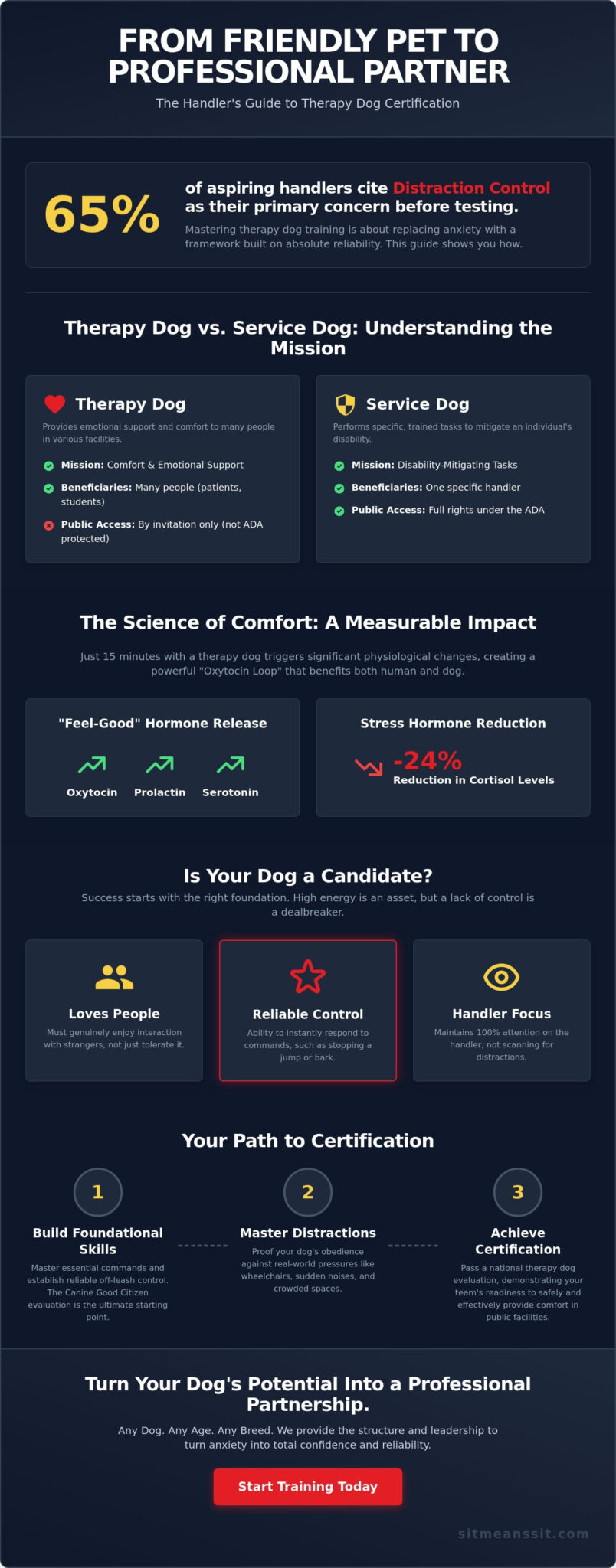
A wagging tail is a great start, but it isn’t enough to make a dog a professional. In a high-stakes environment like a hospital or a school, a friendly greeting is only valuable if it comes with total control. If you’re worried about your dog jumping on a patient or getting distracted by a rolling wheelchair, you aren’t alone. A 2023 survey of aspiring handlers showed that 65% cited distraction control as their primary concern before testing. Mastering therapy dog training is about replacing that anxiety with a framework built on absolute reliability.
We agree that your dog’s potential shouldn’t be limited by a lack of structure. You deserve the pride that comes with a perfectly behaved partner, and we believe any dog, any age, and any breed can achieve this standard. This guide will show you how to move past the confusion of service dog versus therapy dog roles and build the focus required for real-world impact. You’ll learn the exact steps to pass your evaluation on the first try with a dog that remains calm under any pressure. We’re going to dive into the essential commands, distraction-proofing techniques, and handler secrets that turn anxiety into total confidence.
Key Takeaways
- Identify the essential temperament traits and structural foundations required to transform a friendly pet into a focused source of comfort.
- Master specialized therapy dog training techniques that cut through distractions, ensuring your dog remains calm in high-pressure environments.
- Map out your path to national certification and learn why the Canine Good Citizen evaluation is the ultimate starting point for success.
- Bridge the gap between the training center and real-world facilities by building the social stamina your dog needs to thrive in public.
- Achieve total reliability and confidence, turning your pet’s potential into a professional partnership that changes lives through obedience.
What is Therapy Dog Training? Understanding the Mission of Comfort
Therapy dog training transforms a well-behaved pet into a professional provider of emotional support. It is a specialized conditioning process designed to ensure your dog remains calm, approachable, and focused in busy public facilities. Whether it is a bustling hospital corridor or a quiet elementary school library, a therapy dog must handle unpredictable noises and physical contact without hesitation. The primary goal is total reliability. You are training for a dog that stays composed under pressure; this allows them to deliver the comfort people desperately need during their hardest moments.
We believe in a simple truth: any dog, any age, and any breed can succeed in this mission with the right leadership. You don’t need a specific pedigree to make a difference. You need a proven system that builds confidence through consistency. When a dog knows exactly what’s expected of them, they lose the anxiety that comes with uncertainty. This creates a powerful win-win scenario. Patients receive a measurable boost in morale, and the dog enjoys a life filled with purpose and adventure. It is about replacing hesitation with mastery.
Therapy Dogs vs. Service Dogs: Knowing the Difference
It’s vital to understand the legal distinctions defined by the Americans with Disabilities Act (ADA). Service dogs are trained to perform specific tasks to mitigate a person’s disability, such as guiding the blind or alerting to a seizure. Therapy dogs, however, provide emotional support to many people rather than just one handler. Because of this, therapy dogs don’t have the same universal public access rights as service animals. They only have access to facilities where they are specifically invited. If you require a dog trained for individual task-based assistance, review our guide on service dog training.
The Emotional Core: Why We Train for Happiness and Health
Science confirms the impact of these visits. Research from the University of Missouri indicates that just 15 minutes of interacting with a dog triggers a significant release of “feel-good” hormones like oxytocin, prolactin, and serotonin. These sessions also lower cortisol levels, the primary marker of stress, by up to 24 percent in some clinical settings. This “oxytocin loop” benefits both the human and the dog simultaneously. A well-trained dog is a happy dog because they understand their job and trust their handler’s cues. Therapy work is a partnership of trust and clear communication.
- Reliability: Your dog stays focused despite wheelchairs, sirens, or shouting.
- Accessibility: Training opens doors to hospitals, schools, and courtrooms.
- Connection: You and your dog work as a synchronized team to help others.
By investing in therapy dog training, you aren’t just teaching commands. You are unlocking a lifestyle where your dog becomes a beacon of hope for the community. We focus on creating a dog that is neutral to distractions and eager to engage, ensuring every visit is safe and impactful.
Is Your Dog a Candidate? Temperament and Foundation Skills
Not every pet is cut out for the hospital ward or a busy classroom. Success in therapy dog training starts with the right raw materials. You need a dog that truly loves people, not just one that tolerates them. At Sit Means Sit, we believe structure creates the freedom to enjoy these high-stakes environments. When your dog knows exactly what is expected, they can relax and shine. Discipline isn’t a cage; it’s the key to a bigger, more impactful life.
Owners often ask if their dog is too energetic for this path. High energy is actually an asset, but a lack of control is a dealbreaker. A dog with high drive can be a phenomenal therapy partner if they have a clear connection with their handler. Reliability is the ultimate goal. If you can’t stop a jump or a bark instantly, you aren’t ready for a facility. Total control allows your dog to be their best self in public without the stress of uncertainty.
The most critical foundation for this work is attention. A dog scanning the floor for crumbs or staring at a doorway isn’t working with you. You need 100% focus to navigate a medical facility safely. If you’re ready to see if your pup has what it takes, you can start by mastering off-leash control today. Consistent focus transforms a standard pet into a professional partner.
Core Personality Traits of a Successful Therapy Team
Resilience is mandatory. We use the recovery time test to measure this trait accurately. If a tray drops and makes a loud bang, how fast does your dog bounce back? A 3-second recovery is the gold standard for therapy work. We also look for pro-active friendliness. A shy dog might be well-behaved, but a therapy dog should actively seek out engagement. They must genuinely enjoy being touched by strangers in unpredictable ways, from heavy-handed petting to sudden hugs.
The Handler’s Role: Becoming a Confident Leader
You are exactly half of the team. Your dog reads your body language like a map. If you’re anxious, that stress travels straight down the leash and affects your dog’s performance. You must be a confident leader and a trusted neighbor in every facility you visit. This means being your dog’s advocate and staying calm under pressure. Use this checklist to evaluate your readiness for the commitment of therapy dog training:
- Can you commit to 15 minutes of focused daily practice?
- Do you remain calm and decisive when your dog makes a mistake?
- Are you comfortable talking to strangers while managing your dog?
- Can you maintain a consistent schedule for facility visits?
Mastering Distractions: The Sit Means Sit Methodology for Reliability
Therapy work does not happen in a quiet living room. It happens in the middle of chaotic environments. Hospitals feature beeping monitors and rolling carts. Schools have shouting children and ringing bells. We specialize in therapy dog training that cuts through this “noise” with absolute clarity. Our methodology is not about making suggestions to your pet. It is about establishing a definitive contract. When you give a command, your dog listens every single time. This level of communication transforms a nervous pet into a confident partner. We move beyond basic manners to achieve total off-leash control. This ensures your dog remains focused on the person they are helping, not the distractions around them.
Achieving Total Focus in High-Stress Environments
We simulate real-world challenges during our training sessions to ensure your dog is prepared for anything. We introduce walkers, wheelchairs, and crutches early in the process. This exposure ensures your dog remains unfazed by bulky medical equipment or sudden movements. To maintain this focus, we utilize our specialized Remote Training Collar. Think of this as a digital leash or a gentle tap on the shoulder. It is a communication tool, not a punishment. It allows you to maintain a “conversation” with your dog even in a crowded room. We also master the “Watch Me” command. This tool redirects your dog’s attention away from floor scraps or strange smells instantly. It keeps their eyes on you and their mind on the mission.
Reliable Obedience: The Pillars of Therapy Performance
Safety is the top priority in every medical or educational facility. Our training focuses on specific pillars of performance that ensure your dog is a welcome guest. The “Leave It” command is a critical skill for any dog in a hospital setting. Whether it is a dropped pill or a piece of cafeteria food, your dog must ignore it on command. We train this until the response is an automatic reflex. The “Place” command is equally vital for therapy work. It provides your dog with a defined boundary where they can stay calm and relaxed while patients interact with them. This prevents the dog from wandering or becoming overwhelmed by a crowd.
- Leave It: Prevents the ingestion of dangerous medications or debris in public spaces.
- Place: Establishes a “home base” for the dog to remain stationary and calm during long visits.
- Loose-Leash Walking: Ensures the dog moves gracefully alongside handlers without pulling toward patients.
We also emphasize perfect loose-leash walking. Even when your dog is excited to see a friendly face, they must remain steady and controlled. This discipline creates the freedom for you to go anywhere and help anyone. We believe in any dog, any age, and any breed reaching this level of mastery. Our results-oriented approach replaces frustration with a sense of pride. You will gain the confidence to lead your dog through any door with total reliability.
The Path to Certification: Requirements and Evaluations
Achieving total reliability in therapy dog training requires a structured roadmap. You aren’t just teaching tricks; you’re building a foundation of trust that holds up under pressure. Most national organizations, such as Therapy Dogs International (TDI) or the Alliance of Therapy Dogs (ATD), require a multi-step evaluation process to ensure safety. For the average team, reaching certification readiness takes 6 to 12 months of dedicated practice. This timeline ensures your dog is mature enough to handle the emotional and sensory demands of a busy hospital or a loud classroom environment.
The Canine Good Citizen (CGC) Foundation
Think of the AKC Canine Good Citizen (CGC) test as the high school diploma of the dog training world. Established in 1989, this 10-item evaluation proves your dog has the basic manners to exist in public without causing a scene. At Sit Means Sit, our results-oriented approach makes the CGC test a breeze for our clients. We focus on engagement and “off-leash control” from day one, meaning these requirements become second nature for your dog.
- Accepting a friendly stranger: The dog stays calm while the handler talks to a new person.
- Sitting politely for petting: No jumping or lunging when someone reaches out.
- Appearance and grooming: Allowing a stranger to check ears and paws for cleanliness.
- Out for a walk: Maintaining a loose leash without pulling the handler.
- Walking through a crowd: Navigating around at least three people with composure.
- Basic commands: Demonstrating a reliable sit, down, and stay on the first cue.
- Coming when called: Returning to the handler immediately from a distance.
- Reaction to another dog: Staying neutral when another dog approaches within 5 feet.
- Reaction to distraction: Remaining calm when a loud noise or sudden movement occurs.
- Supervised separation: Staying quiet while the owner is out of sight for 3 minutes.
Preparing for the Final Therapy Evaluation
The final evaluation goes beyond basic manners to test specific real-world stressors. One of the toughest hurdles is the neutral dog test. Your dog must remain completely focused on you while another dog passes within 3 feet. Any aggression or over-excitement results in an immediate fail. Evaluators also perform a clumsy petting simulation. They might pat the dog’s head firmly or accidentally tug on an ear to mimic the unpredictable movements of a patient. We prepare you for this by proofing your dog against high-level distractions in every session.
Mastering therapy dog training is about more than passing a test; it’s about the joy of giving back to your community. The waiting portion of the evaluation often catches handlers off guard. You may be required to stand and converse with a stranger for several minutes while your dog stays in a relaxed position. To prevent restlessness, we teach dogs to find “freedom through obedience.” When a dog understands their boundaries, they don’t feel the need to pace or whine. They remain a steady, calming presence. Our “any dog, any age, any breed” philosophy ensures that your companion can master these high-stakes environments with confidence.
Ready to turn your pet into a community hero? Find a Sit Means Sit location near you and start your journey today.
Real-World Readiness: From the Training Center to the Hospital
Training in a quiet facility is a great start. Walking into a bustling medical center is the real test. The transition from practice to performance is where many teams struggle, but it is where Sit Means Sit excels. Real-world readiness means your dog does not just know the command; they respect the contract of obedience regardless of the environment. This total reliability is the foundation of effective therapy dog training.
Day training and group classes are essential for building social stamina. While a dog might be perfect for ten minutes, a standard therapy visit often lasts 45 to 60 minutes. Exposure to different smells, sounds, and floor textures helps your dog remain unfazed. We focus on the “freedom through obedience” philosophy. When your dog is under control, they can focus on their actual job: providing comfort and joy to those who need it most. We replace the stress of the unknown with the confidence of a proven routine.
Simulating Facility Environments During Training
We do not wait until your first official visit to test your dog’s skills. Our Board and Train program provides an immersive environment where we proof behaviors against heavy distractions. We simulate the specific challenges of a hospital setting during every session. This ensures that when you step onto the ward, your dog is already familiar with the expectations.
- Door Etiquette: Your dog must wait calmly at every threshold. They should never bolt into a room or push past a person.
- Elevator Manners: We practice staying in a tight “heel” or “sit” within small, moving spaces. This is a vital skill for navigating multi-story facilities.
- Surface Transitions: We train on tile, carpet, and slick linoleum. Most hospitals use high-gloss flooring, and we ensure the dog feels confident on any footing.
Keeping your dog happy is a top priority. A stressed dog cannot provide therapy. We teach you how to read your dog’s body language so you can end a shift before they hit their limit. This ensures every visit is a positive experience for the dog, the handler, and the patients.
Choosing the Right Program for Your Goals
Every dog is an individual. Some thrive in group classes where they practice focus around other animals. Others benefit from private lessons to hammer out specific distractions like jumping or vocalizing. If your goals involve more than community visits, you might want to explore psychiatric service dog training for roles that require constant emotional support for a single handler.
The first visit is just the start of a lifelong journey. Consistency is the key to maintaining that off-leash control and reliability. Your dog has the potential to change lives and bring smiles to people facing their hardest days. We are here to help you unlock that potential and turn your pet into a confident worker.
Any dog, any age, and any breed can start this journey. Whether you have a playful puppy or a calm senior, the path to making a difference starts with a single decision. Let’s get to work and transform your dog’s natural empathy into a professional skill set.
Unlock the Power of a Reliable Therapy Partner
Your dog has the heart to help, but real impact requires more than good intentions. It demands total reliability in high-stress environments. By mastering off-leash control and neutralizing distractions, you transform a friendly pet into a focused professional. Our methodology ensures your dog remains calm when a hospital cart rattles by or a stranger approaches with excitement. Since 1998, Sit Means Sit has utilized industry-leading remote training technology to deliver results across more than 160 locations. We provide proven results for any dog, any age, and any breed.
This journey toward therapy dog training certification is about more than passing a test; it’s about the lives you’ll touch once you graduate. You’re building a bond based on trust and clear boundaries. Don’t let a lack of consistency hold your team back from making a difference. Take the first step toward a more joyful, adventurous life of service today.
Frequently Asked Questions
How long does it take to train a therapy dog?
It typically takes 6 to 12 months to achieve the level of reliability needed for therapy work. This timeline depends on your dog’s starting point and your own consistency. You must master basic obedience before moving into specialized skills. Most organizations like Therapy Dogs International require a solid foundation of 10 specific behaviors before you can test for registration. We focus on results so you can start making an impact sooner.
Can any breed of dog become a therapy dog?
Yes, we believe in any dog, any age, any breed when it comes to therapy dog training. Temperament matters more than the pedigree on a piece of paper. Whether it’s a 5 pound Chihuahua or a 100 pound Great Dane, the dog must be calm, confident, and friendly. Statistics show that over 150 different breeds are currently registered with major therapy organizations across the United States. Your dog’s potential is limitless.
What is the difference between a therapy dog and an emotional support animal?
Therapy dogs provide comfort to groups of people in public settings, while emotional support animals (ESAs) provide comfort only to their specific owner. Therapy dogs must have advanced training to handle high-distraction environments like hospitals or schools. ESAs have no legal requirement for specialized training under the Fair Housing Act. This distinction is critical because therapy dogs are invited guests in facilities, not personal medical necessities. Clarity ensures you follow the law.
Do therapy dogs need a special vest or certification?
Therapy dogs are not legally required by the ADA to wear a vest, but most facilities require official certification from a recognized organization. Groups like the Alliance of Therapy Dogs provide 5 million dollars in liability insurance to their members. Wearing a vest helps staff identify your dog as a working professional. It signals to everyone that your dog has passed a rigorous evaluation and is ready for duty. We build that professional reliability.
Can I train my own therapy dog or do I need a professional?
You can start training on your own, but professional guidance ensures your dog reaches the 100 percent reliability required for public work. A professional trainer helps you navigate intense distractions that you can’t replicate at home. Sit Means Sit uses a proven methodology to turn a distracted pet into a focused partner. Expert coaching reduces the risk of your dog reacting poorly in a high-stress hospital environment. Don’t leave your success to chance.
What happens if my dog fails the therapy dog evaluation?
If your dog fails, you receive a detailed report outlining the 3 or 4 specific areas that need improvement. This isn’t a dead end; it’s a roadmap for your next training session. Most evaluators allow you to retest after a 30 day waiting period. We use that time to tighten up commands and build the confidence your dog needs to pass with flying colors on the second attempt. Failure is just a step toward mastery.
Are there age requirements for therapy dog training?
Most national organizations require a dog to be at least 1 year old before they can be officially certified. While you can’t certify a puppy, you should start therapy dog training as early as 8 weeks old to build a foundation. Early socialization is key. Starting young ensures that by the time they hit that 12 month milestone, they already possess the maturity and focus needed for the job. We train puppies for future greatness.
How much does it cost to get a dog certified for therapy work?
Certification fees generally range from 30 to 80 dollars per year depending on the specific organization you choose. For example, the American Kennel Club charges a 20 dollar fee for their Therapy Dog title application if you’ve already met the 50 visit requirement. These costs typically cover your background check and liability insurance. You should also budget for annual vet exams to ensure your dog meets health requirements. Investing in certification opens doors.
Comments are closed.