

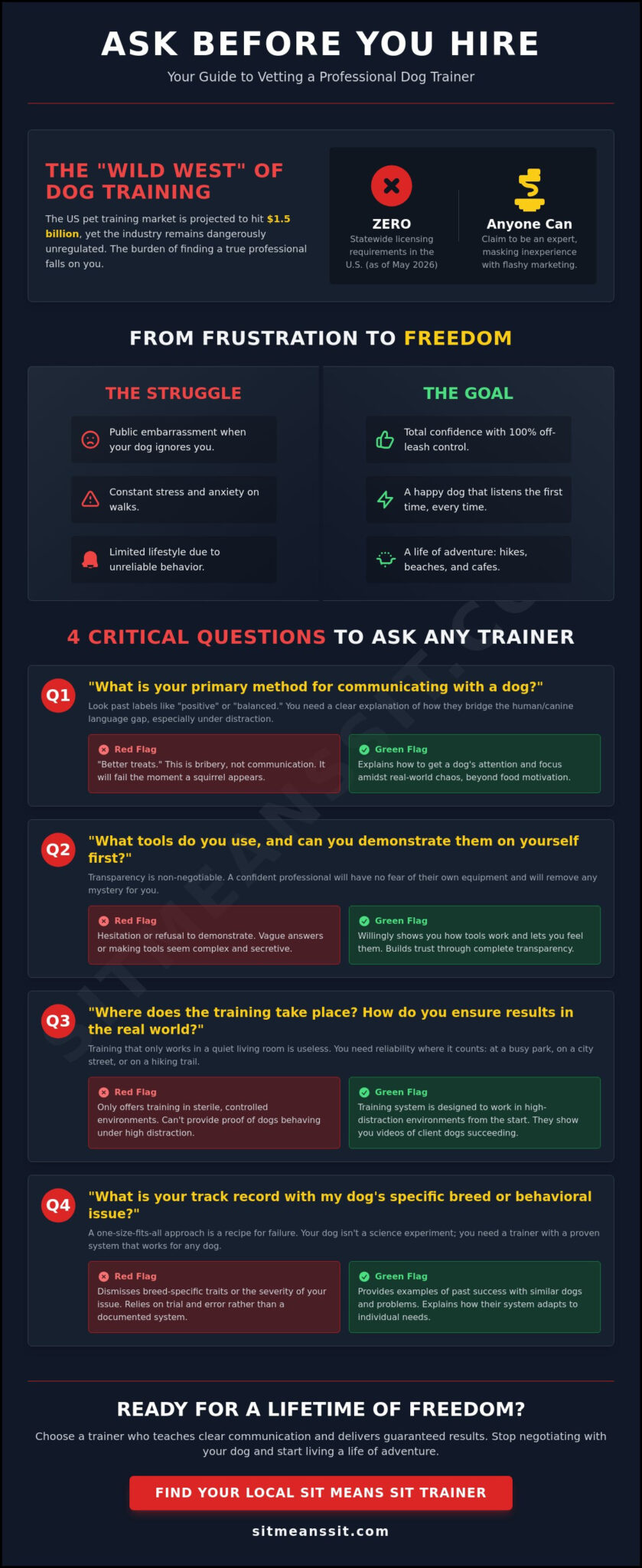
Did you know that as of May 2026, the United States still has no statewide licensing requirements for dog trainers? In a pet training market projected to hit $1.5 billion this year, almost anyone can claim to be an expert. This lack of regulation puts the pressure on you to find a professional who actually delivers results rather than just empty promises. You’re likely tired of the public embarrassment when your dog ignores your commands the moment a distraction appears. You want a dog that listens the first time, every time, so you can finally enjoy the freedom of a stress-free walk.
We agree that your dog deserves a clear, consistent leader and a life full of adventure. This guide provides the 15 critical questions to ask a dog trainer before hiring them to ensure you achieve total off-leash control. You will learn how to vet a trainer’s methodology and track record to guarantee your dog remains happy and responsive in any environment. We are going to show you exactly how to move past the confusion of conflicting philosophies and choose a partner who transforms your dog’s behavior for good.
Key Takeaways
- Take charge of your dog’s future by learning why professional training requires proven reliability in the real world, not just a classroom.
- Challenge potential trainers on their communication methods to ensure they can handle high-distraction environments when treats aren’t enough.
- Master the specific questions to ask a dog trainer before hiring to guarantee they can deliver the total off-leash control you need for a happy life.
- Evaluate a trainer’s past success with your specific breed or behavioral issue to ensure they have the expertise to fix any problem.
- Discover how a proven system creates a lifestyle of freedom where your dog listens the first time, every time, no matter the situation.
Why Vetting Your Dog Trainer is a Critical First Step
As of May 2026, the dog training industry remains a “wild west” where anyone with a leash and a business card can call themselves an expert. There are no national licensing requirements. This means the burden of proof falls entirely on you. While New Jersey took a step forward in February 2026 by introducing bills A4206 and A4207 to establish state licensure, most of the country still has zero oversight. With the U.S. dog training market projected to reach $824 million this year, flashy marketing often masks a lack of real experience. You need more than a “dog lover.” You need a professional who provides safety, reliability, and clear communication. Knowing the right questions to ask a dog trainer before hiring is the only way to protect your investment and your pet’s well-being.
Vetting your trainer is about more than just checking reviews. It is about ensuring they have a results-oriented methodology. Many trainers offer “quick fixes” that look good in a quiet living room but fall apart at a busy park. At Sit Means Sit, we don’t view a command as a suggestion. We view it as a contract of reliability. When you tell your dog to sit, it should mean they stay put until you say otherwise, regardless of the distractions around them. This level of control replaces your frustration with a sense of pride and empowerment.
The Danger of Unregulated Training Methods
Inconsistent training is worse than no training at all. When Dog training methods shift or lack a proven foundation, your dog becomes confused and stressed. This leads to behavioral setbacks that take months to correct. Many trainers rely on trial and error, but your dog isn’t a science experiment. Using unproven techniques can actually increase aggression or anxiety in some breeds. You deserve a system with a proven track record that works for any dog, any age, and any breed. Don’t let your dog’s progress become a victim of an amateur’s learning curve.
Shifting from “Training” to “Communication”
Real transformation happens when you stop bribing and start communicating. The best trainers teach you how to talk to your dog so they listen the first time, every time. We focus on the concept of “freedom through obedience.” This means clear boundaries aren’t restrictions; they are the keys to a more adventurous life. When your dog is reliable off-leash, they can join you on hikes, trips to the beach, and outdoor cafes. Clear communication creates a happy dog and a confident owner. It turns a stressful walk into a joyful experience for everyone involved.
Questions to Uncover Training Philosophy and Tools
“What is your primary method for communicating with a dog?” This is one of the most revealing questions to ask a dog trainer before hiring. You aren’t just looking for “positive” or “balanced” labels. You’re looking for a clear explanation of how they bridge the gap between human language and canine instinct. Professional training shouldn’t be a mystery. Ask them to show you exactly how they handle a dog that is distracted by a squirrel or completely uninterested in treats. If their only answer is “better treats,” your dog will only listen when you’re holding a piece of steak. With the global dog training market reaching an estimated $43.8 billion in 2026, the industry is becoming more professionalized, yet specialized tools remain a topic many trainers avoid.
Transparency is non-negotiable. Ask: “What tools do you use, and can you demonstrate how they work on yourself first?” A confident professional will never hesitate to show you their equipment. Whether it is a flat collar, a slip lead, or a remote collar, you should feel the levels yourself. This removes the fear of the unknown and builds trust. While organizations provide guidelines for choosing a dog trainer that focus on humane treatment, the ultimate test is whether the tool fosters a happy, confident dog. Asking specific questions to ask a dog trainer before hiring regarding their toolset ensures you aren’t caught off guard by their methods later.
Understanding the Role of the Remote Training Collar
The remote training collar is often misunderstood. We view it as a “digital leash” that provides total off-leash control. It isn’t for punishment or dominance. Think of it as a physical “tap” on the shoulder to get your dog’s attention amidst chaos. When integrated correctly into a curriculum, it enhances focus and keeps your dog safe. It allows you to communicate across a football field as clearly as if you were standing right next to them. This tool is the key to the freedom you want, transforming a distracted pet into a reliable companion.
Moving Beyond Food-Only Reinforcement
Treats are great for teaching new tricks, but they often fail in high-stress situations. You need to know how the trainer transitions a dog from high-value rewards to real-world reliability. A dog that only sits for a cookie isn’t truly trained; they’re just a business partner looking for a payout. Real obedience is built on a bond of respect and consistent boundaries. This ensures your dog listens the first time, every time, even when the treat bag is empty. If you’re ready to see how we achieve this level of mastery, reach out to a professional who can demonstrate the Sit Means Sit difference. We believe in results you can see, not just promises you hear.
Evaluating Real-World Reliability and Off-Leash Control
A dog that only listens in your quiet living room is not a trained dog. Performance inside a controlled environment is easy; performance at a crowded park with squirrels and barking dogs is where mastery is proven. When you are narrowing down your list of questions to ask a dog trainer before hiring, you must demand to see real-world results. Ask: “Can you show me a dog you have trained performing in a high-distraction environment?” A professional should be able to demonstrate a dog that remains focused and responsive even when a ball is bouncing or another dog is walking by. This is the difference between a command being a suggestion and a command being a contract of reliability.
You want the confidence to take your dog anywhere without fear. This requires a specific definition of success. Ask the trainer: “How do you define total off-leash control?” If their answer involves “mostly” or “usually,” it isn’t enough. In a world where pet services are the fastest-growing segment of a $157 billion industry, you deserve a standard that guarantees your dog will come back to you the first time, every time. Whether they see a squirrel or a bolting cat, their focus must remain on you. This level of reliability is the only metric that truly matters for your peace of mind and your dog’s safety.
The Distraction Test: The Ultimate Metric of Success
Inquire exactly how the trainer introduces distractions like bouncing balls, loud noises, or other dogs into their program. Training in a vacuum leads to failure in the field. Effective dog obedience training prepares your pet for the chaos of real life. It moves beyond the classroom and into the streets, parks, and cafes where you actually spend your time. If a trainer cannot explain their process for proofing behaviors against high-level distractions, they cannot guarantee the safety of your pet in an emergency.
The Goal of Off-Leash Freedom
Obedience is the foundation of a joyful and adventurous life. It provides the safety necessary for your dog to enjoy true off-leash time. Ask the trainer how they bridge the gap between a leashed walk and an off-leash hike. They should have a clear, step-by-step progression that builds your confidence alongside your dog’s skills. We believe that boundaries create freedom. When you know your dog will listen regardless of the environment, the world opens up for both of you. You stop worrying about “what if” and start enjoying the “right now” with your best friend.
Logistics, Experience, and the Support System
“How many dogs have you successfully trained with my specific breed or behavioral issue?” This is a non-negotiable entry on your list of questions to ask a dog trainer before hiring. Experience isn’t just a number of years on a resume. It’s a volume of successful transformations. If you own a high-drive Belgian Malinois or a rescue struggling with severe leash reactivity, you need a leader who has handled that exact scenario hundreds of times. General knowledge isn’t enough when your dog’s safety and your peace of mind are on the line. A professional with a proven track record will describe the specific patterns they’ve seen and the definitive steps they take to resolve them.
You also need to look beyond the initial training period. Ask: “What happens after the program ends?” True transformation is a lifestyle change, not a one-time event. Reliability is built through consistency over months and years, not just days. In an industry where the U.S. pet training market is hitting $824 million in 2026, many trainers disappear once the final check clears. Demand a support system that includes lifetime polish sessions or group classes. For new owners, early intervention is key. Ask about Puppy Preschool options to ensure your dog develops proper socialization and focus from the very start. This foundation prevents bad habits before they even begin.
Board and Train vs. Private Lessons
Determine which format fits your goals and your schedule. Private lessons offer great hands-on experience for the owner, but they move at a slower pace. If you need faster results, an immersive board and train guide explains how professional trainers can jumpstart your dog’s progress. These programs typically last 2 to 4 weeks and provide an environment of total consistency. Always ask how the trainer ensures the skills transfer to you. A dog that only listens to the trainer is still an untrained dog in your eyes.
The Importance of Owner Education
A professional dog trainer’s job is 50 percent training the dog and 50 percent coaching the human. Ask: “How much time will you spend training ME?” If the trainer doesn’t prioritize your education, the results will eventually fade. You must learn how to maintain boundaries and use the tools effectively. Group classes are an excellent way to reinforce these skills in a social, controlled environment. They provide the distractions necessary to proof your dog’s obedience while giving you the confidence to lead. If you are ready to take the first step toward a better life with your dog, find a location near you and schedule a free demonstration today.
Finding Freedom Through Obedience with Sit Means Sit
We don’t just answer your questions; we prove our answers through action. The vetting process we’ve outlined, including the critical questions to ask a dog trainer before hiring, is something we encourage every pet owner to use. We welcome the scrutiny because our results speak for themselves. With over 160 locations across the country, we’ve built a reputation for transforming even the most difficult behavioral issues into success stories. Our commitment to any dog, any age, and any breed isn’t just a slogan. It is a promise that we have the expertise to help your family, regardless of your dog’s history or temperament.
Choosing a trainer is one of the most important decisions you’ll make for your pet’s future. You aren’t just buying a few hours of instruction; you’re investing in a lifetime of safety and adventure. We operate from a place of absolute confidence because we know our system works in the real world. We replace your frustration with empowerment, turning every walk into a point of pride. When we say “Sit Means Sit,” we’re talking about a contract of reliability that gives your dog the freedom they deserve. You’ll finally have the peace of mind that comes with total off-leash control.
Why a Free Demo is the Best Interview
Stop guessing and start seeing results before you pay a dime. A website can promise anything, but a live demonstration tells the truth. When you search for a dog trainer near me, you’re looking for a transformation you can see with your own eyes. During our free demo, we show you exactly how our methodology works with a trained dog in a high-distraction environment. You’ll witness the focus, the happiness, and the immediate responsiveness that defines our programs. It’s the ultimate way to vet a professional and ensure they can handle the specific questions to ask a dog trainer before hiring that matter most to you.
The Sit Means Sit Difference
Consistency is our superpower. Our national network of experts ensures that the “Sit Means Sit” standard remains the same whether you’re in a busy city or a quiet suburb. We aren’t just teaching tricks; we’re selling a lifestyle change rooted in freedom through obedience. Imagine a future where your dog listens the first time, every time, allowing you to enjoy hikes, cafe visits, and travels without stress. This is the transformation we provide every day. If you’re ready to replace embarrassment with confidence, Schedule your free consultation today and see the difference a professional leader makes.
Take the Lead on Your Dog’s Transformation
You’ve now got the roadmap to find a partner who delivers real results. Remember that a professional must prove their methodology works in the chaos of a busy park, not just a quiet living room. By mastering the right questions to ask a dog trainer before hiring, you ensure your pet receives the consistency they need for a happy life. We’ve spent over 25 years perfecting a system that provides off-leash control in high-distraction environments for any dog, any age, and any breed.
Our industry-leading approach replaces your daily frustration with a sense of mastery and pride. You deserve a dog that listens the first time, every time, regardless of what’s happening around them. Stop settling for “good enough” behavior and start imagining a future of total freedom. Schedule Your Free No-Obligation Consultation and Demo to see our methodology in action today. Your journey toward a more adventurous and joyful life with your best friend starts right now.
Frequently Asked Questions
Do I really need to hire a professional dog trainer, or can I do it myself?
You need a professional if you want guaranteed reliability and total off-leash control in the real world. While many owners can teach a dog to sit for a treat in a quiet kitchen, professional trainers specialize in proofing those behaviors against high-level distractions. We provide the expertise to bridge the communication gap, ensuring your dog listens the first time, every time. Professional guidance replaces your frustration with a proven system that works for any dog, any age, and any breed.
How much does professional dog training typically cost in 2026?
As of May 2026, private dog training sessions typically cost between $75 and $200 per hour. If you are dealing with specific issues like aggression, expect those rates to be 25% to 50% higher due to the specialized expertise required. Group classes for a 4 to 8 week course generally range from $100 to $300. For those seeking immersive results, board and train programs range from $1,000 to $4,000 per week, usually lasting 2 to 4 weeks.
Is my dog too old to start a new training program?
No dog is ever too old to learn the boundaries that lead to a happier life. Our “any dog, any age, any breed” commitment means we see success with senior dogs every single day. In fact, older dogs often have better focus than high-energy puppies, making the training process smooth and rewarding. Establishing clear communication at any stage of life reduces stress for your pet and gives you the confidence to enjoy more adventures together.
What is the difference between a dog behaviorist and a dog trainer?
Dog trainers focus on teaching specific skills, obedience, and reliable communication between you and your pet. Dog behaviorists often deal with complex psychological issues like severe trauma or separation anxiety, sometimes requiring advanced degrees or clinical certifications. While trainers build the foundation for a well-behaved companion, behaviorists analyze the “why” behind extreme emotional responses. Most owners find that a results-oriented trainer provides the structure and control they need for a joyful, off-leash lifestyle.
How long does it take to see results with a Board and Train program?
You will typically see a massive transformation within a 2 to 4 week board and train program. These immersive sessions allow a professional to establish a consistent foundation without the distractions of your daily routine. This accelerated learning phase jumpstarts your dog’s progress, making the transition back to your home seamless. While the trainer does the heavy lifting, your commitment to maintaining those boundaries ensures the results last a lifetime.
Will my dog still have their personality if they are “too” obedient?
Obedience does not change your dog’s personality; it unlocks it by removing anxiety and confusion. A dog that understands their boundaries is a happy, confident dog that can safely participate in more family activities. Discipline is the key to freedom, not a restriction on spirit. When your dog knows exactly what is expected of them, their true character shines through because they aren’t constantly stressed about making the wrong choice.
Can you train a dog that has a history of aggression or biting?
Yes, we specialize in helping dogs with challenging behavioral histories find a path to reliability. Training for aggression requires a calm, confident leader who understands how to set firm boundaries while maintaining a safe environment. Because of the increased risk and specialized skill involved, these programs often cost 25% to 50% more than standard obedience. We focus on replacing dangerous impulses with clear, alternative behaviors that keep everyone safe and happy.
What should I bring to my first meeting with a potential trainer?
Bring a clear list of your goals and the specific questions to ask a dog trainer before hiring that we covered in this guide. It is also helpful to provide a record of your dog’s triggers, such as specific noises, animals, or environments that cause them to lose focus. Most importantly, bring an open mind and a readiness to see a transformation. A professional demonstration will show you exactly how clear communication can change your life together.
Comments are closed.