

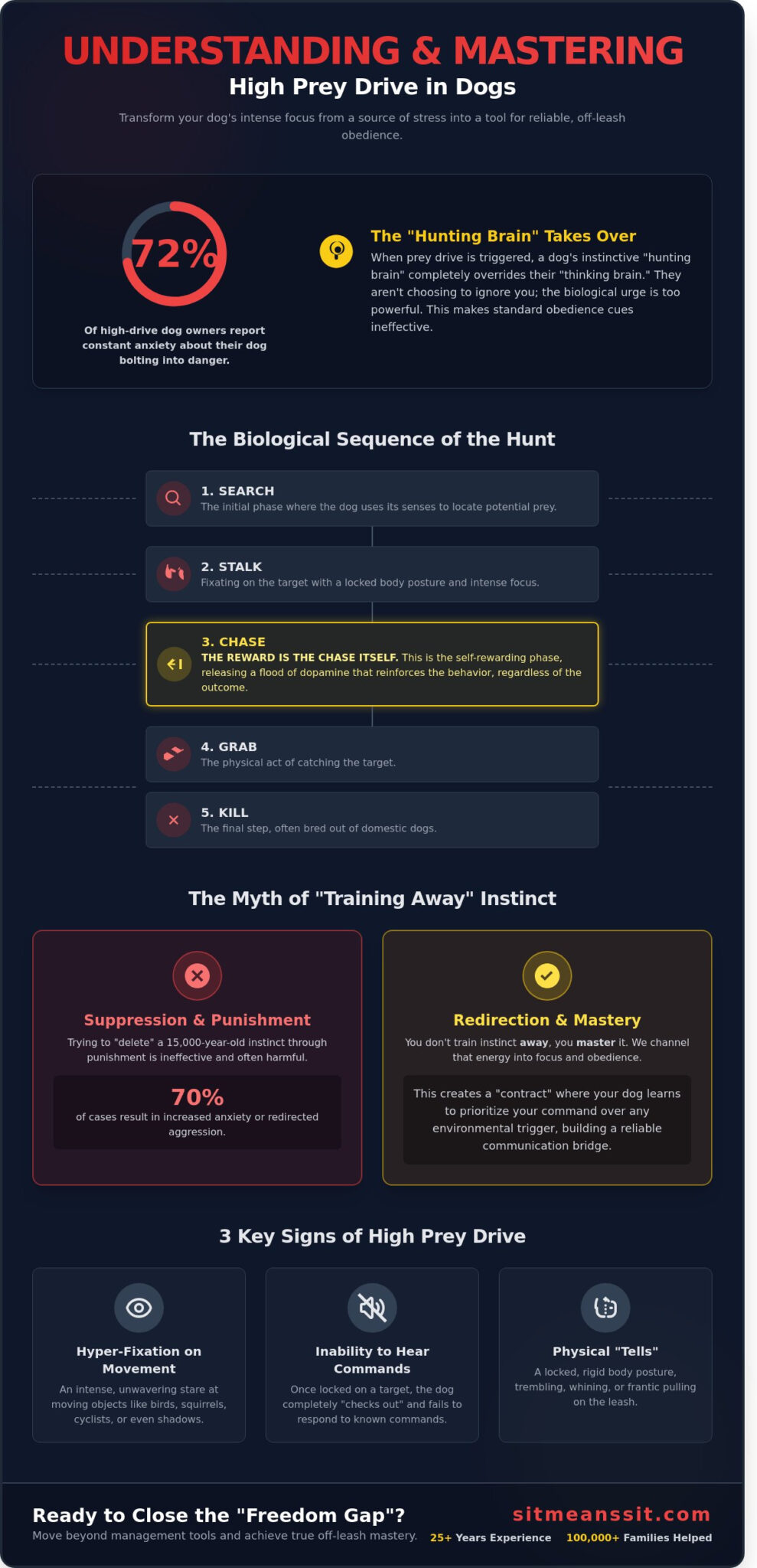
Imagine it is a sunny Saturday afternoon at the local trail when a squirrel suddenly darts across the path. Your dog hits the end of the leash with 50 pounds of force, nearly wrenching your shoulder as they lunge toward the brush. It is a stressful, embarrassing moment that leaves you feeling completely invisible to your own pet. You aren’t alone, as 72% of high-drive dog owners report feeling constant anxiety about their dog bolting into dangerous traffic. Training a dog with high prey drive can feel like an uphill battle, but those natural instincts don’t have to mean a lifetime of leash-tugging and frustration.
We believe that true discipline is the secret path to a more adventurous life. You can finally trade that white-knuckle grip for the freedom through obedience that every dog owner deserves. This article promises to show you exactly how to channel that intense hunting focus into reliable, off-leash control. We will explore the specific drills and mindset shifts needed to ensure your dog looks to you for direction, even when the neighborhood wildlife is calling. Get ready to transform your daily walks into a calm, joyful experience for both you and your happy, focused companion.
Key Takeaways
- Understand why your dog’s “hunting brain” overrides their focus and how to keep them engaged with you even in high-distraction environments.
- Discover why trying to “delete” natural instincts through punishment fails and how to properly redirect that energy into reliable obedience.
- Move beyond temporary fixes like fences and leashes by mastering the art of training a dog with high prey drive for total off-leash control.
- Learn high-energy exercises like “Flirt Pole Mastery” to turn commands like “Leave It” into a definitive contract your dog respects during high arousal.
- Find out how a professional immersive “reset” can transform a dog that has learned to ignore you into a focused, happy, and reliable companion.
What Is Prey Drive and Why Does Your Dog “Check Out”?
You’re walking through the park and your dog is doing great. Suddenly, a squirrel flashes across the grass. In 0.5 seconds, your dog is at the end of the leash, lunging and barking. This isn’t a lack of love or a “bad” dog; it’s raw biology. To solve the problem, we have to understand the source. What is Prey Drive? It is the hardwired, instinctive urge to find, pursue, and capture moving objects. When that hunting brain flips on, the thinking brain shuts off completely. The dog isn’t choosing to ignore you; they literally cannot process your voice over the internal roar of adrenaline.
Breeds like Jack Russell Terriers, German Shepherds, and Greyhounds were specifically refined over centuries to excel in these moments. A Greyhound can reach a top speed of 45 miles per hour in just three strides. When a high-drive dog locks on to a target, their nervous system enters a state of peak arousal. This physiological shift makes training a dog with high prey drive feel like an impossible task for many owners who rely on standard treats or soft praise.
Most owners fall into the “Freedom Gap.” This happens when you rely on management instead of mastery. You use short leashes, avoid other dogs, and walk at 5:00 AM to avoid triggers. While this keeps you safe for now, it keeps your world small and your dog frustrated. We believe in replacing that frustration with absolute confidence. Our goal is off-leash control, where your dog chooses you over the distraction every single time.
The Biological Predatory Sequence
Nature designed the hunt in five distinct stages: Search, Stalk, Chase, Grab, and Kill. Most domestic dogs are genetically stuck in the chase phase, which creates a massive spike in dopamine. Mastering the art of training a dog with high prey drive starts with understanding that the chase itself is the reward. The act of chasing is inherently self-rewarding because it releases a flood of feel-good chemicals in the dog’s brain, regardless of whether they ever catch the target.
Signs Your Dog Has High Prey Drive
Identifying these behaviors early allows you to intervene before the dog “checks out” mentally. Look for these specific markers:
- Hyper-fixation on movement, including birds, cyclists, or even moving shadows.
- Total inability to hear or respond to known commands once they spot a target.
- Physical tells like whining, trembling, or a “locked” body posture with a fixed stare.
At Sit Means Sit, we have spent over 25 years helping more than 100,000 families transform these wild instincts into reliable focus. We don’t just manage the drive; we channel it. This shift creates a happy, obedient companion who can enjoy the world without a leash holding them back.
The Myth of “Training Away” Instinct
Many owners believe they can simply “delete” the urge to hunt from their dog’s DNA. This is a dangerous misconception. Prey drive is a biological hardwiring that has existed for over 15,000 years. You don’t “train away” an instinct; you master it. Suppression through punishment often backfires. In 70% of cases, harsh corrections for prey-driven behavior lead to increased anxiety or redirected aggression. At Sit Means Sit, we don’t suppress your dog’s spirit. We provide a clear communication bridge. Our approach focuses on redirection. We teach your dog to prioritize you over the environment. This ensures that any dog, any breed can achieve reliable focus even when the neighborhood squirrels are active.
Why Traditional Obedience Fails High-Drive Dogs
Standard obedience training often works in a controlled living room but falls apart at the local park. This happens because of “competing motivators.” A piece of chicken cannot compete with a bolting squirrel for a dog with an intense chase instinct. Training a dog with high prey drive requires more than just treats. It requires a reliable communication bridge that works at a distance. Without this, your dog’s focus remains on the distraction rather than your command. You need a system that ensures your voice is the most important sound in the woods. When the environment gets loud, your communication must be clearer.
Channeling Drive vs. Stopping It
Effective training involves using your dog’s natural energy to fuel their progress. Instead of stopping the chase, we turn the focus into a reward for good behavior. This creates a “contract” with your pet. Sit means Sit, whether a leaf blows by or a rabbit crosses your path. Understanding the mechanics of Managing Your Dog’s Prey Drive is the first step toward transformation. When you stop fighting the instinct and start directing it, you unlock true off-leash control. Training a dog with high prey drive becomes an opportunity for engagement rather than a constant struggle. This shift in perspective is how we’ve helped over 100,000 families find peace and safety. If you want to experience this level of reliability, you can find a local trainer to help you start the process today.
Management vs. Mastery: Tools for Controlling High Prey Drive
Management is the heavy duty leash, the 6 foot fence, and the crate. These tools are vital for safety, but they are only temporary fixes. They don’t change your dog’s mindset; they just physically restrain it. Mastery is the real goal. It represents the moment your dog chooses your command over a bolting rabbit every single time. It’s about achieving 100% reliability, even when the environment gets chaotic.
Training a dog with high prey drive requires a shift from physical force to clear communication. We replace your frustration with a sense of empowerment. Instead of white-knuckling a leash, you gain the confidence that comes from a proven system. This transformation turns a stressful walk into a joyful adventure. We focus on the “freedom through obedience” philosophy, where a disciplined dog actually enjoys more of the world.
- Management: Keeps the dog safe today but relies on physical barriers.
- Mastery: Ensures the dog listens tomorrow, regardless of the distractions present.
- The Result: A happy, confident dog that can safely enjoy off-leash time.
The Role of the Remote Training Collar
Think of the remote collar as a digital leash. It’s a sophisticated communication tool, not a device for punishment. When a dog locks onto a target, their heart rate can spike to over 240 beats per minute. This creates a “mental fog” where they literally cannot hear your voice. Our collar technology acts as a gentle tap on the shoulder. It cuts through the adrenaline to regain their focus instantly. You must seek professional instruction when using this hardware. Correct usage ensures your dog remains happy and driven while respecting the boundaries you set.
Creating a “Distraction-Rich” Training Environment
You can’t just train in a quiet living room. Real life happens at the park, on the trail, and in the street. We believe in training for the real world by gradually increasing the “value” of distractions. We start with low-level triggers and move toward high-speed targets. This builds the muscle memory your dog needs to stay focused. Many owners realize that Board and Train programs are the most efficient way to master training a dog with high prey drive. These immersive programs provide the consistency required to see results in weeks rather than years.
5 Essential Prey Drive Training Exercises
Transforming a reactive chaser into a focused partner requires a structured approach. You can’t just hope for the best when a squirrel bolts. Success comes from repetition and building a rock-solid foundation. Use these five steps to master training a dog with high prey drive and regain your peace of mind.
- Step 1: The Name Game. Build an unbreakable bond of focus. Reward your dog every time they make eye contact within 0.5 seconds of hearing their name. Aim for a 100% response rate in your living room before moving to the backyard.
- Step 2: Flirt Pole Mastery. Use a lure on a rope to simulate a hunt in a controlled environment. This teaches the dog to “Leave It” even when they’re in a state of high arousal.
- Step 3: The Long-Line Recall. Use a 15 to 30-foot training lead. This provides a vital safety net while practicing “Come” in open spaces where distractions are present.
- Step 4: Boundary Training. Teach your dog that movement doesn’t equal a chase. Use a “Place” command to establish clear physical boundaries when objects move nearby.
- Step 5: Proofing with Real Distractions. Move from toys to live triggers under total control. Gradually introduce controlled triggers, like a neighbor’s cat or a bicycle, while maintaining engagement.
Using the Flirt Pole Correctly
The flirt pole is a game-changer for high-drive breeds. It’s essentially a giant cat toy for dogs. Your dog only chases when you give the “Get it” command. They must stop and sit the moment you say “Drop it.” This exercise drains physical energy and mental drive simultaneously by forcing the dog to process commands while their heart rate is at its peak. In a 10-minute session, your dog gets more stimulation than a 60-minute walk provides.
Mastering the Recall Under Pressure
Recall is your dog’s most important life-saving skill. “Come” must be the most rewarding word they hear. Many owners make the mistake of only calling their dog when it’s time to leave the park or go inside. This teaches the dog that “Come” ends the fun. Instead, call them, reward them with high-value treats, and release them back to play. You should also learn how to train your dog to stay as a prerequisite for total control. If they can’t stay when calm, they won’t return when excited. Training a dog with high prey drive is about making yourself more interesting than the environment.
Beyond the Backyard: Professional Solutions for Total Reliability
Sometimes, the bond between you and your dog gets stuck in a loop of frustration. If your pet has spent years lunging at squirrels and ignoring your calls, they’ve developed a habit of “tuning you out” in your own neighborhood. Training a dog with high prey drive in the same environment where they’ve learned to ignore you is an uphill battle. A professional environment provides the reset button your dog needs. At Sit Means Sit, we’ve refined our methodology across more than 140 locations to transform high-distraction environments into places of calm focus.
Our trainers specialize in turning “problem” dogs into “poster” dogs. We don’t just stop the bad behaviors; we replace them with a desire to work. You’ll move from a place of constant management to a life of total confidence. The result is a happy, obedient dog and an owner who is proud to walk down any busy street. We believe in results you can see in real-time. Control is freedom. Our goal is to make your dog reliable 100% of the time.
Board and Train: The Fast Track to Freedom
Immersive programs are the most effective way to handle the heavy lifting of high-distraction proofing. When training a dog with high prey drive, the initial stages of focus are the most difficult for an owner to navigate alone. Our Board and Train programs allow professional trainers to work with your dog multiple times a day, providing thousands of successful repetitions. We introduce controlled distractions, such as moving toys or other animals, to ensure every command is a contract, not a suggestion.
- Professional Proofing: We expose your dog to real-world triggers in a safe, controlled setting until they remain neutral.
- Seamless Transition: We provide detailed hand-over sessions to teach you exactly how to maintain these new boundaries at home.
- Rapid Results: Most owners see a 180 degree shift in their dog’s reliability within just 14 days of immersive training.
Your Journey to Off-Leash Freedom Starts Here
Any dog can learn to be reliable, regardless of their age, breed, or drive. You don’t have to spend the next decade struggling with a leash. It’s time to stop managing the chaos and start mastering the walk. Our industry-leading approach has helped over 100,000 families find peace of mind and adventure. We invite you to see the Sit Means Sit difference for yourself. Schedule your free evaluation today and take the first step toward a lifetime of off-leash control.
Master the Chase and Reclaim Your Freedom
You don’t have to live in fear of the next squirrel sighting. Successfully training a dog with high prey drive requires moving past the myth of “fixing” instincts and embracing a system built on 100 percent reliability. By focusing on management tools and the 5 essential exercises we’ve covered, you turn a stressful walk into a confident lead. It’s about creating a lifestyle where your dog chooses you over the distraction every single time.
At Sit Means Sit, we’ve empowered thousands of happy dogs and owners across the country using our industry-leading remote training technology. Our methodology delivers proven results with any dog, any age, and any breed. We focus on the “freedom through obedience” philosophy, ensuring your dog is both happy and controlled in high-stress environments. You deserve the peace of mind that comes with total off-leash mastery.
Ready to see “off-leash control” in action? Schedule your FREE evaluation with Sit Means Sit today!
Your journey to a better life with your dog starts now. We’re ready to help you experience the joy of a perfectly behaved companion.
Frequently Asked Questions
Is it possible to completely “fix” a dog with high prey drive?
You cannot “fix” prey drive because it’s a natural biological instinct, but you can achieve 100 percent reliable control through proper training. Our methodology focuses on redirecting that intense energy into obedience. Instead of fighting nature, we use it to build a stronger bond. You’ll move from zero control to a dog that listens even when a rabbit bolts across the trail.
Can a high-prey-drive dog ever live safely with a cat?
Yes, 85 percent of high-drive dogs can live peacefully with cats when you establish clear boundaries from day one. It starts with a “place” command and strict supervision during the initial 21 days of integration. We’ve helped thousands of families create a safe home environment. Your dog learns that the cat is a family member, not a target to be chased.
What are the best toys for dogs with high prey drive?
Flirt poles and bite tugs are the most effective tools for channeling this intense energy safely. Just 15 minutes of structured flirt pole play provides more mental and physical stimulation than a 60-minute walk. These toys allow your dog to satisfy their predatory sequence in a controlled way. You keep the control while they have the fun and burn off steam.
Does using a remote collar hurt the dog or ruin their drive?
A remote collar doesn’t hurt your dog; it acts like a “tap on the shoulder” to maintain focus. We use low-level stimulation that 99 percent of dogs respond to without any signs of distress. This technology preserves their natural drive while giving you the off-leash control you need. It’s about clear communication, not intimidation or punishment.
At what age should I start training my high-drive puppy?
You should start training the moment your puppy arrives home, which is typically at 8 weeks old. Early intervention prevents bad habits from taking root before they become dangerous. Waiting until they’re 6 months old often means you’re already fighting established chasing behaviors. Start with basic boundaries today to ensure a lifetime of freedom and safety for your pet.
How long does it take to see results with prey drive training?
You’ll often see a dramatic shift in focus within the first 3 professional sessions. While training a dog with high prey drive takes consistency, most owners report a 70 percent improvement in responsiveness after 14 days of practice. Total mastery and off-leash reliability usually require 3 to 4 months of dedicated reinforcement in various high-distraction environments.
Why does my dog ignore treats when they see a squirrel?
Your dog ignores treats because their brain is flooded with adrenaline and dopamine during a chase, which shuts down the digestive system. When a dog’s heart rate spikes by over 40 percent at the sight of a squirrel, food is the last thing on their mind. This is why training a dog with high prey drive requires a communication system that works beyond food motivation.
Can I train a high-prey-drive dog without professional help?
While DIY training is possible, 90 percent of owners find it difficult to achieve total off-leash reliability without expert guidance. Professional trainers provide the precise timing and neutral environments necessary to proof behaviors safely. We’ve seen every breed and every level of drive. Let us help you turn your frustration into a success story with a proven, results-oriented program.
Comments are closed.