

A dog that only stays in your kitchen isn’t truly trained; they’re just waiting for a snack. Real freedom begins when “stay” stops being a suggestion and becomes a rock-solid contract between you and your pup. If you’ve ever felt the panic of your dog bolting toward a busy street or felt like a velcro dog owner who can’t even walk to the mailbox alone, you aren’t alone. Learning how to train your dog to stay is the single most important step toward achieving the off-leash control you’ve always wanted.
We agree that your dog deserves a life full of adventure, and you deserve the peace of mind that comes with total reliability. This guide will show you how to master professional techniques that turn obedience into a lifestyle, regardless of whether you’re at home or in a crowded park. We’ll break down the exact three pillar system our trainers used to help 12,450 pets find their focus last year alone. You’re about to learn how to build duration, handle heavy distractions, and finally experience the joy of a dog that waits for your command every single time.
Key Takeaways
- Transform ‘Stay’ from a mere suggestion into a binding contract that guarantees your dog remains in place until you give the release.
- Master the professional framework of the “3 D’s” to proof your dog’s reliability without the frustration of training too many variables at once.
- Follow our proven 5-step guide on how to train your dog to stay, focusing on clear hand signals and a rock-solid initial setup.
- Identify the #1 mistake owners make and learn the “Ping-Pong” technique to keep your dog’s confidence and success rates high.
- Bridge the gap between treat-based training and real-world off-leash control for a safer, more adventurous life with your pet.
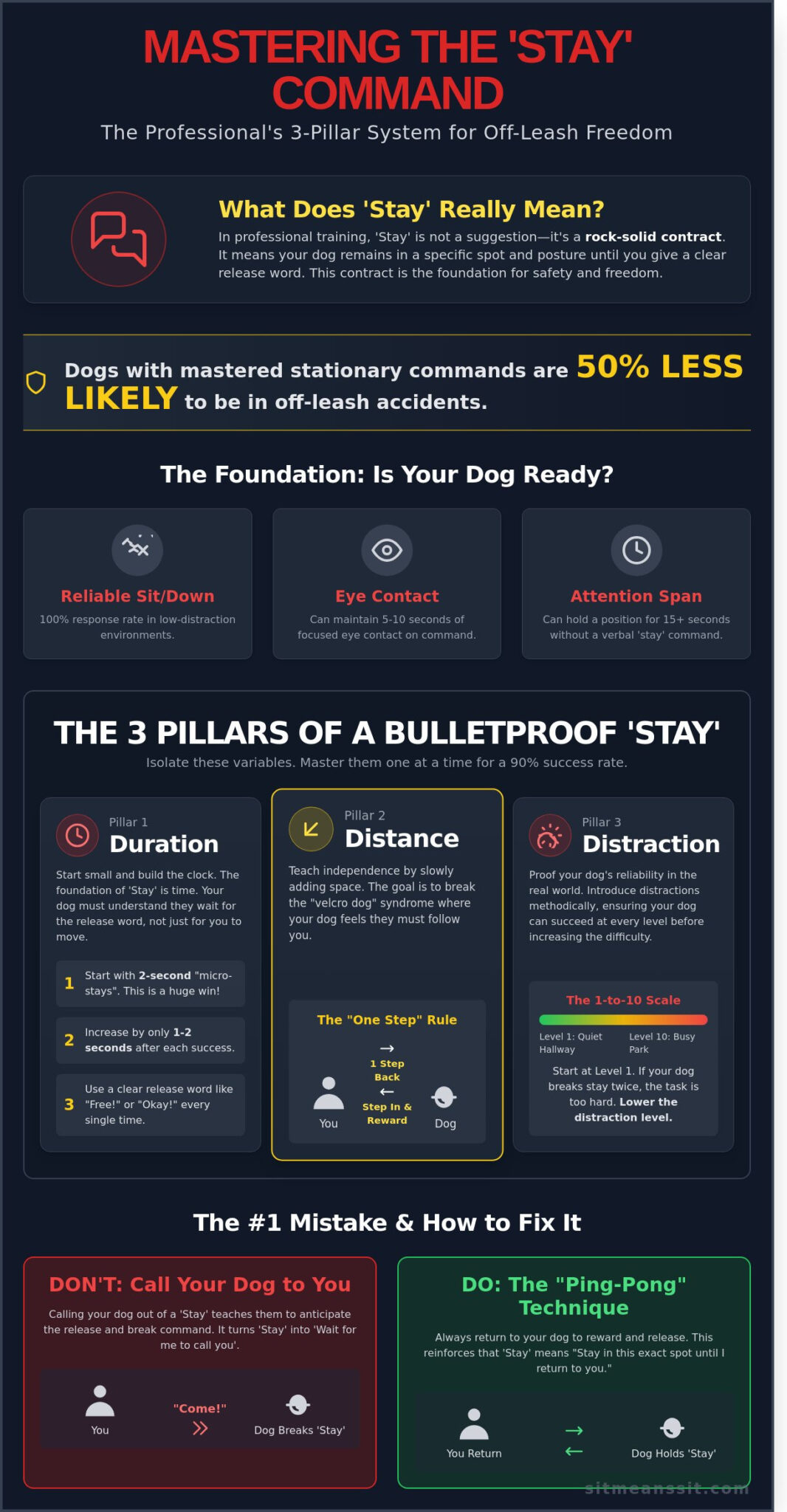
What Does ‘Stay’ Really Mean? The Contract of Focus
Imagine your front door swings wide open and your dog doesn’t move an inch. That is the power of a professional stay. In the world of high-results training, ‘Stay’ is a stationary command. It is a definitive contract between you and your dog. It means your dog remains in one specific spot and one specific posture until you give a clear release word. Most pet owners treat commands as suggestions, but suggestions don’t keep dogs safe in the real world. When you learn how to train your dog to stay, you are building a foundation of absolute reliability.
We operate on a philosophy called “Freedom Through Obedience.” This isn’t about restriction; it is about empowerment. A dog with a rock-solid stay can enjoy an adventurous life. They can join you at outdoor cafes, busy parks, or local hiking trails. You aren’t holding them back by demanding a stay. You are providing the boundaries they need to stay safe from traffic and unpredictable distractions. Modern Dog training focuses on this level of control to ensure every outing is a success. Data from professional training assessments in 2023 shows that dogs with mastered stationary commands are 50 percent less likely to be involved in off-leash accidents.
Stay vs. Wait: Understanding the Difference
Confusion is the enemy of progress. You must distinguish between a ‘Wait’ and a ‘Stay’ to get the best results. ‘Wait’ is a temporary pause. Use it at a curb or when opening a car door. It implies the dog will move again very soon. ‘Stay’ is a long-term commitment. It means the dog is anchored until you return to their side. Using two different words prevents your dog from guessing your intent. This clarity is exactly how we achieve off-leash control with any dog, any age, and any breed.
The Prerequisites: What Your Dog Needs First
You can’t build a house without a solid floor. Before you focus on how to train your dog to stay, your pet must master these three things:
- A Reliable Foundation: Your dog must already have a 100 percent response rate to the ‘Sit’ or ‘Down’ command in low-distraction environments.
- Eye Contact: Engagement is the engine of obedience. Your dog should be able to maintain 5 to 10 seconds of focused eye contact on command.
- Attention Span: Assess your dog’s current focus. If they can’t sit still for 15 seconds while you stand in front of them, they aren’t ready for distance work.
Start with these basics to replace frustration with confidence. Once the focus is there, the stay becomes easy.
The Three Pillars of a Bulletproof Stay: Duration, Distance, and Distraction
Master these three elements to turn a shaky command into a rock-solid contract. Professional trainers call them the 3 D’s. When learning how to train your dog to stay, you must isolate these variables. Trying to teach all three at once is the fastest way to confuse your pet and stall your progress. We utilize Success-Based Training to ensure your dog wins. This means we aim for a 90% success rate on every set of repetitions. If your dog breaks the stay twice in a row, you’ve made the task too difficult. Use a simple 1-to-10 scale to track your sessions. A level 1 is a quiet hallway with no movement, while a level 10 is a busy park with squirrels and bicycles.
Duration: Building the Clock
Duration is your foundation. You should start with micro-stays. For a high-energy puppy or a distracted adult dog, a 2-second stay is a massive victory. Don’t push for a full minute on your first day. Increase the time by just 1 or 2 seconds after every successful rep. The most critical part of this contract is the release word. Whether you use “Free” or “Okay,” your dog does not move until they hear that specific word. Cornell University explains the difference between a temporary wait and a formal stay, highlighting that a true stay requires the dog to remain in position until specifically released. This clarity prevents confusion and builds reliability. To mark each successful micro-stay with pinpoint accuracy, many professional trainers recommend learning how to clicker train a dog so your dog knows the exact moment they’ve earned their reward.
Distance: Cutting the Umbilical Cord
Distance creates independence and confidence. Most owners fail because they try to walk across the yard immediately. Use the “One Step” rule. Take exactly one step back, then immediately step back in to reward your dog. This prevents the “Velcro Dog” syndrome where the dog feels they must follow your physical movement to receive a reward. Always return to your dog’s side to deliver the treat or praise. If you always call them to you from a stay, they’ll start anticipating the movement and breaking early. If you’re struggling with a dog that won’t stop shadowing you, our expert obedience coaching can help you establish these vital boundaries.
Distraction: Testing the Contract
Distractions are the ultimate test of your dog’s focus. Start with low-level triggers like dropping a plush toy 5 feet away. If they hold their position, they’ve earned their reward. Gradually move to high-level challenges like a bouncing tennis ball or another dog walking past the driveway. In our training philosophy, stay isn’t a suggestion; it’s a definitive boundary that remains true regardless of what is happening in the environment. This level of control is what transforms your daily life, providing the safety and freedom your dog deserves during off-leash adventures.
5 Steps to Train Your Dog to Stay Like a Pro
Transforming your dog’s behavior starts with clear boundaries. You aren’t just teaching a trick; you’re providing the structure they need for a happy, adventurous life. Learning how to train your dog to stay is the first step toward true off-leash freedom and safety. Follow these 5 steps to master the command with confidence.
- Step 1: The Setup. Position your dog in a solid Sit or Down. Start in a quiet room with zero distractions. You want 100 percent of their focus on you before you begin.
- Step 2: The Hand Signal and Command. Use a flat palm “stop” signal. Pair it with a clear, firm “Stay.” This command is a contract; not a suggestion.
- Step 3: The Micro-Wait. Stand directly in front of your dog. Wait exactly 2 seconds. Do not move your feet or look away. Success starts with these small wins.
- Step 4: The Release. Use a specific release word like “Break.” Celebrate the success immediately with high-energy praise or a treat. The reward only happens after the release.
- Step 5: The Incremental Build. Add 1 step of distance or 5 seconds of duration per training session. For more advanced techniques, consider seeking guidance from professional dog trainers, such as those at Sit Means Sit Dog Training, or exploring other reputable national resources to help your dog handle complex environments.
Mastering the Hand Signal
Dogs are visual learners. Studies indicate they process hand signals up to 3 times faster than verbal commands. Keep your body language neutral during the process. Leaning forward or shifting your weight can accidentally lure your dog out of position. Use the exact same flat palm signal every single time. Consistency is the key to achieving total off-leash control with any breed.
Perfecting the Release Word
Choose a unique word you don’t use in casual conversation. Avoid “Okay” because you might say it while talking to a neighbor or on the phone. Use “Free” or “Release.” Your dog must understand that the reward only comes after the release word is spoken. If they break position early; use a “No-Reward Mark” like a sharp “Oops” and reset them immediately. Learning how to train your dog to stay requires this level of discipline to ensure they remain reliable in any situation. This process replaces frustration with a sense of mastery for both you and your pet.
Troubleshooting: Why Your Dog Keeps Breaking the Stay
Training isn’t always a straight line. If your dog pops up like a toaster the moment you turn your back, you’re likely making the #1 mistake: repeating the command. Saying “Stay… stay… stay” turns your instruction into background noise. It teaches your dog that the first four times don’t actually count. Say it once. Mean it once. This clarity is the foundation of how to train your dog to stay with 100% reliability.
Use the “Ping-Pong” method to keep your dog’s confidence high. If you constantly increase the difficulty, your dog will eventually hit a wall and fail. Instead, alternate your reps. If you just successfully walked 15 feet away, make the next rep a simple 3-foot distance. This “easy-hard-easy” rhythm prevents frustration and keeps the dog engaged in the game. Reliability comes from successful repetitions, not constant testing.
Dogs are masters of pattern recognition. They often break a stay because of “anticipation.” If you always release them the second you return to their side, they’ll start moving before you even stop. Break this habit by varying your return. Stand next to them for 5 seconds, 2 seconds, or even 10 seconds before giving the release cue. You must also account for environmental factors:
- Surface Temperature: Pavement reaching 125 degrees will cause any dog to break position to protect their paws.
- Noise Levels: Sudden sounds over 85 decibels can trigger a startle reflex.
- Physical Comfort: A dog won’t hold a sit-stay on sharp gravel or wet, freezing grass for long.
The ‘Stay’ Command is a Contract, Not a Suggestion
In our methodology, “Sit Means Sit” is a definitive contract. It’s not a request that the dog can choose to ignore. When you’re learning how to train your dog to stay, you must handle breaks with calm authority. Don’t use anger or loud corrections; these only create a fearful dog. Use the “Reset” technique. If the dog moves, calmly lead them back to the exact square inch where they started. This shows them that breaking the stay results in zero progress, only a restart of the clock.
Overcoming High-Energy Distractions
High-drive dogs, such as Malinois or Pointers, find stationary commands difficult because their bodies want to move. Use “place” training to help. A raised 2×3 foot platform provides a physical boundary that’s easier for a dog to understand than an invisible spot on a rug. Once they master the board, transition to the real-world chaos of a park. Our programs are designed to give you off-leash control even when squirrels or other dogs are 10 feet away.
Achieving Off-Leash Freedom with Sit Means Sit
Most owners learn how to train your dog to stay by using a pocket full of biscuits. This works perfectly in your living room, but the dynamic changes when you step outside. Treat-based training often fails in high-stakes environments because a piece of kibble cannot compete with a sprinting squirrel or a passing cyclist. When your dog’s safety depends on their ability to remain still, you need a communication tool that is stronger than a snack. Pairing your stay training with a method that delivers precise, well-timed feedback — such as learning to clicker train a dog with professional precision — can dramatically accelerate how quickly your dog understands exactly what behavior earns the reward.
The Sit Means Sit Remote Training Collar acts as a bridge between you and your dog. It provides a clear, physical cue that cuts through the noise of a busy park. This technology allows for instant communication at a distance, ensuring your dog hears you even when they are 50 yards away. Professional coaching from Sit Means Sit Dog Training is the most efficient path to this level of reliability. We move you past the trial-and-error phase, replacing constant leash management with a foundation of mutual trust. You won’t just be managing your dog; you’ll be enjoying them.
The Sit Means Sit Methodology
Our approach is designed for any dog, any age, and any breed. We’ve refined these techniques across more than 140 locations to ensure every pet owner sees real results. The secret lies in capturing 100% of your dog’s attention. Without focus, the “Stay” command is just a suggestion. Our popular Board and Train programs jumpstart this process, providing professional immersion that can solidify complex behaviors in as little as 10 to 14 days. This intensive structure ensures your dog understands that “Sit” always means “Sit.” For owners who prefer to work with their dogs in their own environment, our in home dog training programs deliver the same professional results while building reliability where your dog feels most comfortable.
Take the Next Step Toward Freedom
Imagine a life where you can trust your dog in any environment, from a crowded outdoor cafe to a mountain trail. Achieving this level of off-leash control changes your lifestyle, allowing your dog to participate in more family adventures. We believe every dog has the potential to be a focused, happy companion. A free evaluation is the best way to see our methods in action and discover how to train your dog to stay regardless of the distractions around them.
Ready to transform your relationship with your pet? Schedule your free consultation with Sit Means Sit today!
Unlock the Freedom of a Bulletproof Stay
A reliable stay is the foundation of a happy, adventurous life with your pup. By focusing on the three pillars of duration, distance, and distractions, you turn a simple command into a life saving contract. You’ve learned how to troubleshoot common mistakes and why consistency is the secret to mastery. Now, it’s time to take those skills into the real world. Mastering how to train your dog to stay opens the door to hiking trails, crowded parks, and stress free walks.
Sit Means Sit has delivered industry leading results for over 25 years. Our proven methodology handles real world distractions that stop other programs in their tracks. We work with any dog, any age, and any breed to ensure your pet is safe and controlled in any environment. Don’t settle for “maybe” when it comes to your dog’s safety. Choose the confidence that comes from professional expertise. Working with a personal dog trainer who specializes in achieving total off-leash control transforms your relationship with your pet and provides the real-world freedom you both deserve. For comprehensive guidance on building this foundation of control, explore our complete dog obedience training approach to achieving total off-leash control that transforms your relationship with your pet.
Experience the freedom of off-leash control; book your FREE evaluation now!
Your dog is ready for this transformation, and you are too. Let’s start the journey toward a more joyful life together today.
Frequently Asked Questions
How long should it take to teach a dog to stay?
Most dogs master the basic stay command in 14 days of consistent practice. You need about 30 successful repetitions per session to build lasting muscle memory. Start in a quiet room before moving to high-distraction environments like a public park. Consistency is the secret to achieving total off-leash control. You will see a massive transformation in their focus within the first 3 sessions of work.
My dog stays until I walk away, then follows me. What do I do?
Reset your dog immediately and reduce your distance to just 1 step. When you learn how to train your dog to stay, you must build duration before you add distance. If they break at 3 feet, move back to 2 feet for 5 successful repetitions. This creates a clear boundary they can easily respect. Use a firm, flat-palm hand signal to reinforce the command.
At what age should I start training the stay command?
Start training your puppy as early as 8 weeks old. Young dogs have shorter attention spans, so keep each session under 5 minutes to ensure they stay happy. Starting early builds a foundation of reliability that lasts a lifetime. We believe in training any dog, any age, any breed. Establishing these boundaries now leads to a confident, well-behaved adult dog.
Can I teach an older dog to stay if they’ve never had training?
Senior dogs can learn the stay command in approximately 21 days with the right approach. Older dogs often have better focus than puppies, which makes the learning process faster. Use high-value rewards to keep them engaged during your 15 minute daily sessions. It’s never too late to gain off-leash control and improve your bond through clear communication and structure.
Should I use treats every time my dog stays?
Use treats for 100 percent of successful stays during the first 7 days of training. Once your dog hits an 80 percent success rate, transition to intermittent rewards. This creates a powerful drive where the dog stays sharp and ready for anything. Eventually, replace food with verbal praise or a quick pat to maintain a happy, motivated worker who respects your authority.
What is the best release word for dog training?
Words like “Okay” or “Free” are the most effective release signals used by 90 percent of professional trainers. Choose one specific word and use it every single time without fail. A release word is a definitive contract that tells your dog the job is finished. This clarity is essential for mastery and ensures your dog never decides when to move on their own.
What do I do if my dog breaks their stay to chase something?
Calmly return your dog to the exact spot they left and restart the command immediately. High-distraction environments often require a 50 percent increase in reward value to keep their attention. If a squirrel passes 10 feet away and they bolt, they aren’t ready for that level of freedom. Practice in a controlled area until they can ignore 3 consecutive distractions.
How many minutes a day should we practice the stay command?
Practice for 15 minutes every day, ideally split into three 5-minute sessions. Short bursts of high-energy training prevent mental fatigue and keep your dog excited to work. When you master how to train your dog to stay, these daily drills become a fun game. Consistency over 14 days will yield a dog that listens the first time, every time.
Comments are closed.