

Your dogs don’t need to be best friends to live in a quiet home; they just need to respect the person holding the leash. If you’re tired of acting like a full-time referee between barking matches and food bowl standoffs, you aren’t alone. Managing a multi-dog household peacefully is a challenge that many of the 71 million dog-owning households in the U.S. face daily. You want a home where boundaries are respected. You want a life where high arousal doesn’t lead to a fight. You’re ready to trade the chaos for the off-leash control and reliability that comes with professional structure.
We agree that a house full of dogs should be a source of joy, not a constant source of stress. This article will show you how to transform your pack into a balanced, happy unit by mastering individual obedience. We’ll preview the Lead-Dog Strategy for 2026, covering everything from managing high-value distractions to the exact steps for walking multiple dogs simultaneously. It’s time to stop managing the mess and start leading the way to a more adventurous life. Any dog, any age, and any breed can learn to thrive under confident leadership.
Key Takeaways
- Build a rock-solid foundation by prioritizing individual mastery before attempting to train your dogs as a group.
- Eliminate high-arousal triggers by implementing strict threshold protocols and structured feeding routines that demand respect.
- Discover how managing a multi-dog household peacefully becomes easier when you use tools like the Remote Training Collar to maintain off-leash control.
- Learn to recognize when household tension is unsafe and why a professional Board and Train program is the ultimate solution for a pack reboot.
- Replace the dangerous myth of “letting them work it out” with a leadership strategy that works for any dog, any age, and any breed.
Why Your Multi-Dog Household Feels Like Chaos
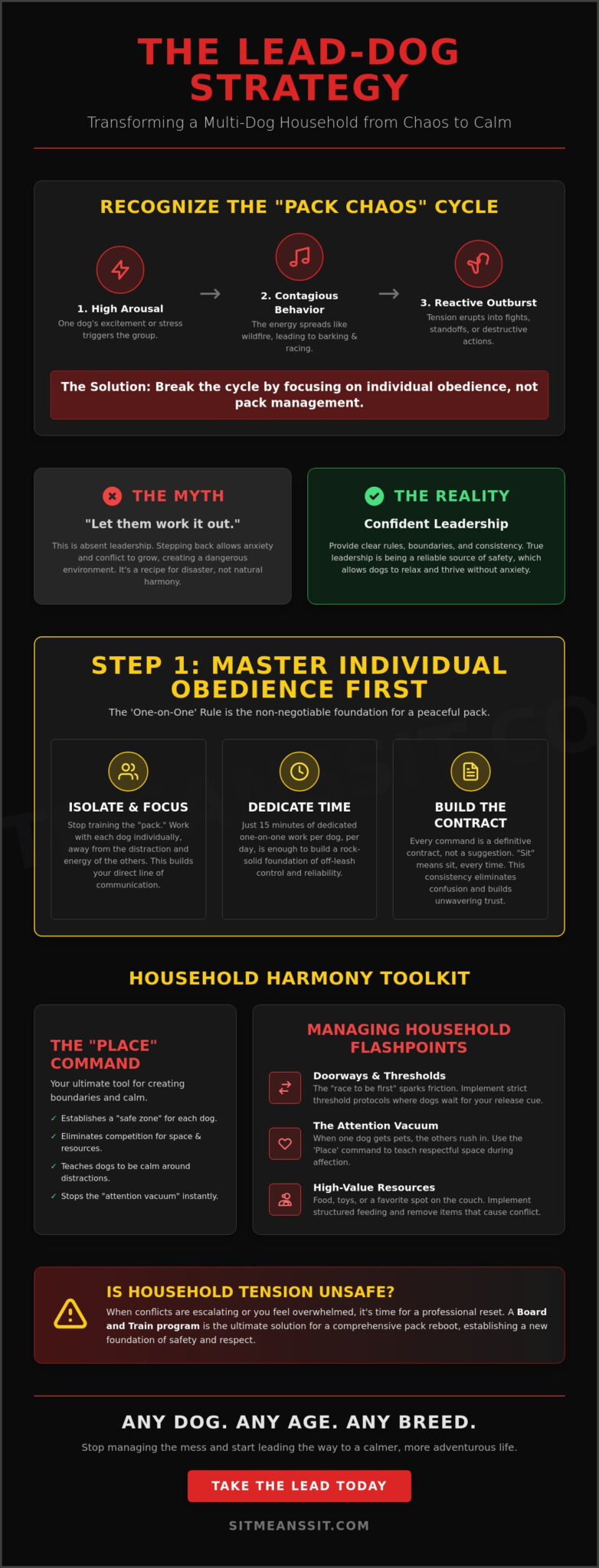
Living in a house with multiple dogs often feels like you’re trapped in a permanent tornado of barking and racing paws. This is the “Pack Chaos” cycle. It starts when one dog gets excited. That high arousal spreads like wildfire, turning into reactive behavior across the whole group. Managing a multi-dog household peacefully isn’t about hoping they’ll get along. It’s about stopping that cycle before it starts. You need to break the momentum of the group by focusing on the individual.
Many owners believe the dangerous myth that they should just “let them work it out.” In 2026, we know that’s a recipe for disaster. When you step back, you aren’t being “natural.” You’re being absent. Dogs don’t need a referee who only shows up to blow the whistle after a fight starts. They need a leader who sets the rules before the first growl. Most owners fail because they try to train the “pack” all at once. You can’t expect three dogs to listen together if they won’t listen alone. Individual mastery is the only path to collective peace.
At Sit Means Sit, we view every command as a definitive contract. It’s not a suggestion. It’s not a request. When you say “Sit,” it means sit every single time, regardless of what the other dogs are doing. This consistency creates a sense of reliability that calms the entire household. It replaces frustration with a sense of empowerment. When your dogs know the contract is non-negotiable, the chaos disappears.
Identifying Household Flashpoints
Chaos usually erupts in specific zones. Doorways are a major one. It’s the “race to be first” that sparks friction and high arousal. Then there’s the “Attention Vacuum.” When you pet one dog, the others rush in to compete for your affection. Finally, high-value triggers like a favorite toy or a spot on the couch can turn a quiet afternoon into a standoff. These aren’t just “dog things.” They are symptoms of a lack of structure. Identifying these triggers is the first step toward managing a multi-dog household peacefully.
The Myth of the ‘Alpha’ vs. Confident Leadership
Forget the old-school “alpha” talk. Physical dominance and “pinning” dogs don’t create peace. They create fear and more reactivity. True leadership is about being the source of safety and consistency. A deep dive into canine social behavior shows us that dogs crave clear boundaries. Without them, they feel anxious. They feel they must make their own rules to stay safe. When you provide the structure, they can finally relax. We believe in providing freedom through obedience for any dog, any age, and any breed. Leadership isn’t about being loud; it’s about being reliable.
Step 1: Mastering Individual Obedience First
Stop trying to train your dogs as a pack. It doesn’t work. When you attempt to teach three dogs at once, you aren’t training; you’re just managing chaos. If one dog breaks a command, the others will follow their lead, and you’ll lose control in seconds. Real progress in managing a multi-dog household peacefully starts with the “One-on-One Rule.” You must dedicate time to each dog individually, away from the distractions of the other pets. This is where you build a definitive contract with each animal.
Dedicating just fifteen minutes a day to individual work allows you to establish off-leash control without the interference of pack energy. Whether you are safely introducing a new dog to the family or working with a long-time resident, the individual bond is your foundation. Once a dog learns to listen to you with 100% reliability while alone, they’ll be much more likely to maintain that focus when their housemates are present. If you need help carving out this structured time, our private lessons provide the perfect environment to sharpen these individual skills.
The Power of the ‘Place’ Command
The “Place” command is the ultimate tool for household boundaries. By using a specific cot or elevated bed, you create a “safe zone” where the dog must remain until released. This isn’t a “stay”; it’s a boundary. When one dog is in Place, they cannot compete for your attention or the other dog’s toys. It teaches them to remain calm while other dogs move around them. This command effectively eliminates the competition for space and resources that often leads to household friction.
Proofing Commands Under Distraction
Proofing is the process of reinforcing obedience in high-stress environments. Once your dog masters a command alone, you must slowly introduce the “distraction” of the other dogs. Start by having one dog in a “Place” command while you work with the other just a few feet away. This forces them to maintain focus on you despite the surrounding energy. You want your dogs to understand that your voice is the most important thing in the room. Consistency here ensures that the “contract” of obedience remains valid even when the house gets loud or busy.
Managing High-Arousal Triggers Peacefully
High arousal is the “silent killer” of household peace. When energy levels spike, logic goes out the window, and reactive behavior takes over. Managing a multi-dog household peacefully requires you to control the environment before the dogs lose their cool. Unlike common internet advice that suggests using baby gates forever, we focus on internal reliability. Physical barriers are just band-aids; behavioral boundaries are the permanent solution that leads to real freedom.
During the initial stages of restructuring your pack, implement a “No-Free-Roam” phase. Use crates or leashes to prevent the rehearsal of bad habits when you aren’t actively training. If dogs are allowed to practice bolting or bickering while you’re distracted, they’ll never learn the new standard. Similarly, toys should never be a free-for-all. Introduce them only as a reward for calm, focused behavior. When you control the resources, you control the energy. This proactive approach ensures that every dog understands that good things come through you, not through competing with their housemates.
Threshold and Doorway Mastery
Doorways are often the site of the most intense pack friction. The race to be first out the door or into the yard creates a dangerous spike in arousal that can lead to redirected nipping or fighting. You must teach a mandatory “Wait” command at every entry and exit point. The order of movement is non-negotiable: you always go first, followed by each dog individually upon being called by name. This simple routine reinforces your leadership and forces the dogs to check in with you rather than reacting to each other. Consistent repetition turns a chaotic dash into a structured, calm transition that sets the tone for the rest of the day.
Eliminating Resource Guarding
Resource guarding is a serious hurdle that requires a zero-tolerance approach and immediate intervention. It starts with the understanding that all high-value items, from food bowls to the couch, belong to you. If you notice a “stare-down” over a bone, intervene immediately before it escalates to a growl. According to experts on managing canine aggression, addressing these subtle cues is vital for maintaining safety in the home. Feeding time should be equally structured. Every dog must wait in a “Sit” or “Down” until their bowl is placed and they are released to eat. By removing the competition for food, you remove the primary cause of tension in most homes. Safe reintroduction of shared play should only happen once these boundaries are ironclad, often starting with the controlled environment of our group classes.
The Role of Clear Communication and Tools
Your voice is a powerful tool, but in a room full of barking dogs, it’s often the first thing to fail. Managing a multi-dog household peacefully is nearly impossible if your commands are treated as suggestions. When energy levels are high, dogs often experience “auditory exclusion.” They literally stop hearing you because their focus is entirely on the other pets. Shouting louder never solves the problem; it just adds more noise to an already chaotic situation. You need a way to communicate that cuts through the static.
Consistency across the entire family is the first step toward reclaiming your home. Everyone in your household must use the same “contract” language. If one person says “Down” and another says “Lay down,” the dogs lose respect for the boundary. Every family member needs to be a confident leader who uses the same tools and the same expectations. When everyone is on the same page, the dogs feel more secure. They stop trying to test the limits because the limits never change. This total reliability is what transforms a group of dogs into a balanced pack.
Why Remote Collars Work for Packs
The Remote Training Collar is the ultimate communication bridge for a busy home. Think of it as a digital “tap on the shoulder” that works at a distance. It provides clear, non-emotional feedback that a specific dog can feel even when they are “locked in” on a housemate. Unlike a clicker, which can be confusing when multiple dogs are looking for a reward, the collar allows you to address one dog at a time with total precision. This is how you achieve Dog Obedience Training: Achieving Total Off-Leash Control in 2026. It stops the reactive cycle before it starts. You can finally enjoy the peace of mind that comes with knowing your dogs will listen, no matter the distraction.
The ‘Freedom through Obedience’ Philosophy
Discipline isn’t a cage; it’s the key to a bigger, more adventurous life. When your dogs are reliable, they get to do more. They get more off-leash adventures, more backyard playtime, and more quality time with the family. Clear communication removes the guesswork for your dogs, which significantly reduces their anxiety and overall stress levels. You’ll stop feeling like a stressed-out referee and start feeling the pride of owning a perfectly behaved pack. This level of harmony is possible for any dog, any age, and any breed. Ready to see the difference for yourself? Explore our private lessons to master these communication tools today.
Professional Solutions for Pack Harmony
Sometimes the chaos in your home reaches a breaking point where managing a multi-dog household peacefully feels impossible on your own. If you see snarling, actual biting, or if you’re afraid to let your dogs be in the same room, it’s time to stop guessing. You don’t have to live as a prisoner in your own home. Professional intervention replaces your fear with a clear, actionable plan. We specialize in taking the most difficult pack dynamics and turning them into success stories. Our trainers have seen every behavioral issue imaginable and remain unfazed by even the highest levels of reactivity.
Private Lessons are designed to put the power back in your hands. You’ll work one-on-one with an expert who understands the specific triggers in your household. We teach you how to embody the lead-dog role so your dogs look to you for direction instead of reacting to each other. This isn’t just about teaching basic commands. It’s about mastering the communication tools and off-leash control that make a quiet home possible. We provide the structure you need to feel confident and empowered as a pet owner again.
Board and Train: The Ultimate Reset
For households that need a complete behavioral overhaul, our immersive programs are the gold standard. A Board and Train: The Ultimate Guide to Immersive Dog Training removes your dogs from the environment where they’ve practiced bad habits for years. We provide professional conditioning in a neutral setting. This allows us to install a foundation of obedience that is rock-solid and reliable. When your dogs return home, they have a new “contract” of behavior that you can easily maintain. It’s the fastest way to reboot a chaotic home and ensure long-term peace for the whole family.
Finding Your Local Expert
Don’t settle for a trainer who only suggests “avoiding” the problem. You need a leader who can deliver results regardless of the breed or history of your pets. Use our resource to find a Dog Trainer Near Me: How to Choose a Professional who actually delivers results. We believe in the potential of every animal. Whether you have a rambunctious puppy or an older dog with deep-seated habits, our industry-leading methods work. It’s never too late to fix the pack and reclaim your freedom. We’ve proven our track record with any dog, any age, and any breed. Schedule your free consultation with Sit Means Sit today! Your journey toward a quiet, structured, and happy home starts with one decisive step.
Reclaim Your Home and Lead Your Pack
Your home should be a place of rest, not a constant battlefield. Managing a multi-dog household peacefully is a reality you can achieve by committing to individual obedience and consistent leadership. You’ve learned that mastering the “Place” command and controlling high-arousal thresholds are the keys to a quiet environment. By using the right communication tools, you replace the noise of barking with the clarity of a definitive contract.
At Sit Means Sit, we bring over 25 years of industry-leading experience to your doorstep. We specialize in achieving total off-leash control for any dog, any age, and any breed. Our methodology has delivered proven results for the most complex multi-dog household behavioral issues. You don’t have to be a referee anymore. It’s time to embrace the freedom that comes with a structured, happy pack.
Ready for a peaceful home? Schedule your FREE Sit Means Sit consultation today!
Imagine a future where you can walk every one of your dogs simultaneously with total confidence. That life is waiting for you. We’re here to help you make it happen.
Frequently Asked Questions
Can any dog breed live peacefully in a multi-dog household?
Yes, any dog can live in harmony if you provide the right structure. We believe in the potential of any dog, any age, and any breed. Managing a multi-dog household peacefully is about leadership rather than genetics. While some breeds have higher drives, professional training creates the boundaries needed for safety. You just need to establish that you are the one in control of the environment at all times.
How do I stop my dogs from fighting over toys or food?
You must establish that all high-value items belong to you. Stop leaving toys and food bowls out for free-for-all access. Use a “Sit” or “Down” command before every meal. If a dog shows tension, remove the resource immediately. This structured approach removes the need for competition. Your dogs will learn that you are the provider and the rule-maker, which eliminates the impulse to fight.
Is it better to train multiple dogs together or separately?
Always train separately before you ever try to train together. Group training fails because dogs distract each other and feed off each other’s energy. Mastery must be individual. Once each dog has off-leash control on their own, you can slowly introduce them to group sessions. This ensures that your contract with each dog is solid and unbreakable, regardless of who else is in the room.
What should I do if one dog is bullying the other?
Intervention must be immediate and decisive. Don’t wait for a fight to happen. If you see a hard stare or a stiff body, use a command to redirect the bully to their “Place.” Bullying is often a result of a lack of boundaries. By enforcing your rules, you protect the submissive dog. You show the bully that their behavior is not allowed in your home.
How long does it take to see results in a multi-dog home?
You will often see a shift in energy within the first few days of consistent structure. However, total reliability takes time. It depends on the depth of the existing issues and your commitment to the daily routine. Most owners in our Board and Train programs see a massive transformation in just one to three weeks. Consistency is the only way to make these changes permanent and reliable.
Can a remote training collar help with pack harmony?
Yes, a remote training collar is an industry-leading tool for pack management. It acts as a digital tap on the shoulder that cuts through high-arousal noise. When a dog is locked in on a housemate, a verbal command might not be enough. The collar provides clear, non-emotional feedback that redirects their attention back to you instantly. It’s the key to achieving total off-leash control in a busy home.
What is the best way to introduce a new dog to my existing pack?
Start introductions on neutral ground away from your home. Keep the initial meeting controlled and move together on a walk rather than standing still. Standing still creates unnecessary tension. Walking side-by-side helps the dogs get used to each other’s presence without the pressure of a confrontation. Once they are calm, you can transition into the home using the structured boundaries and protocols we’ve established.
Should I let my dogs ‘work it out’ themselves?
Absolutely not. Letting dogs work it out is a dangerous myth that leads to injuries and permanent fear. You are the leader of the household. It is your job to set the rules and enforce the boundaries. When you step back, you leave a vacuum of leadership that dogs will try to fill with reactive behavior. Step up and be the confident leader your pack needs to feel safe.
Comments are closed.