

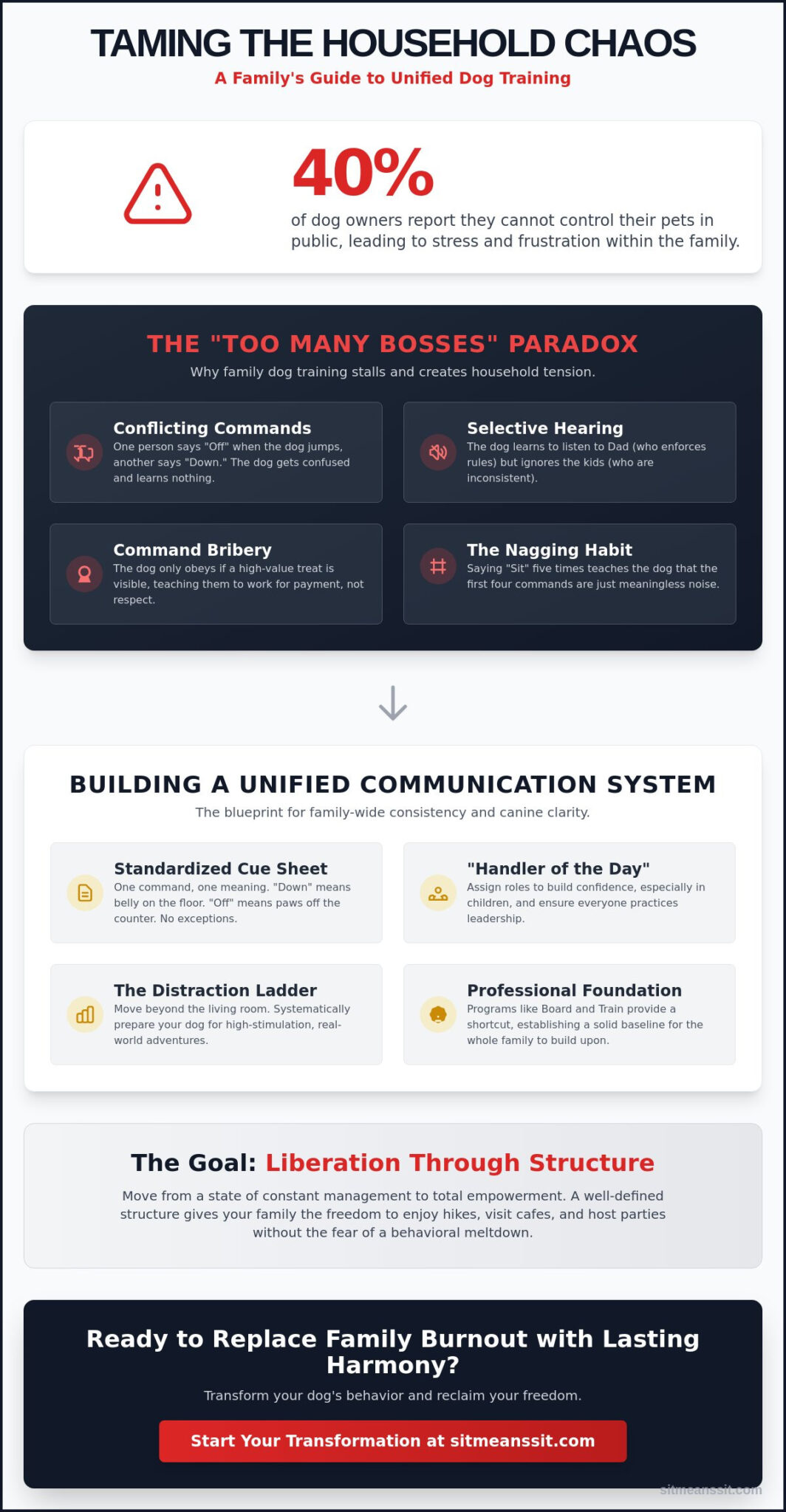
Nearly 40% of dog owners in 2026 report they cannot control their pets in public spaces. This staggering statistic highlights a massive breakdown in communication, especially within busy households. You likely feel the weight of this reality every time your dog ignores your spouse or scares the kids with rowdy behavior. Effective dog training for the whole family isn’t just about teaching “sit” or “stay.” It’s about building a unified communication architecture where every person in the house leads with absolute confidence.
It’s exhausting to be the only person the dog listens to while the rest of the family feels overwhelmed. You’ve seen how conflicting methods cause your pet to regress, and you’re ready for a permanent solution. We’re going to transform your household from a place of stress into a model of controlled harmony. This guide reveals how to align your entire family with professional-grade strategies that produce real results. Get ready to master the tools for total off-leash control and reclaim the freedom to take your dog on family adventures without the headache.
Key Takeaways
- Eliminate the “Too Many Bosses” paradox by identifying how conflicting feedback from different family members causes behavioral plateaus.
- Build a unified communication system using a standardized “Cue Sheet” to ensure your dog understands every command from every person in the house.
- Master dog training for the whole family by assigning clear roles and using the “Handler of the Day” concept to build confidence in children.
- Move past simple backyard obedience and use the “Distraction Ladder” to prepare your dog for stress-free adventures in high-stimulation environments.
- Discover why professional foundations like Board and Train programs provide the ultimate shortcut to replacing family burnout with lasting harmony.
The “Too Many Bosses” Paradox: Why Family Dog Training Often Stalls
You want a dog that listens to everyone, yet your household often feels like a chaotic committee meeting where no one is in charge. This is the “Too Many Bosses” paradox. It happens when multiple family members provide conflicting feedback to the same dog. One person allows the dog on the couch; another yells “off.” One person uses a treat to lure a sit; another expects it immediately. This inconsistency doesn’t just slow down progress. it stops it entirely. Understanding the foundational principles of dog training is essential for any household looking to move past this chaos. Dogs thrive on clarity, and when that clarity disappears, selective hearing takes its place.
Canine confusion leads directly to behavioral plateaus. If your dog doesn’t know which set of rules to follow, they will eventually stop following any of them. This creates a massive emotional toll on the family. You feel frustrated when your dog ignores a command during a high-stress moment, like when a guest walks through the door or a squirrel darting across the street. That frustration often turns into tension between family members. Consistency is not a suggestion or a “nice-to-have” feature of your routine. It is a non-negotiable requirement for reliable obedience. Successful dog training for the whole family depends on everyone playing by the exact same rules, every single time.
The Symptoms of Handler Inconsistency
Does your dog listen perfectly to Dad but completely ignore the kids? This is a classic symptom of handler inconsistency. It often stems from “command bribery,” where the dog has learned to only work for specific people who carry high-value treats. If the reward isn’t visible, the dog decides the work isn’t worth it. Another common trap is the “nagging” habit. When you repeat a command five times before the dog finally sits, you’ve taught them that the first four times are just white noise. They learn to wait for the final, loudest version of the command before they actually move. This makes the dog appear stubborn, but they’re actually just following the pattern you’ve created.
The Goal: Liberation Through Structure
Total control in a busy, multi-person household means your dog respects boundaries set by any family member, regardless of the environment. We want to move you from a state of constant management to a state of total empowerment. When your dog understands the structure, you gain the freedom to go on hikes, visit outdoor cafes, or host parties without the fear of a behavioral meltdown. Our philosophy is simple: a directive is a definitive agreement, not a suggestion. By establishing this clear communication architecture, every member of your family becomes a capable leader. This structure doesn’t restrict your dog’s life; it’s the key that unlocks a more adventurous and joyful lifestyle for everyone involved.
Building a Unified Communication System for Your Household
To achieve household harmony, you must establish a unified communication system. It starts with a standardized vocabulary. In a typical home, one person says “down” when the dog jumps, while another says “off.” This creates total chaos for the animal. Effective dog training for the whole family requires one word and one meaning, every single time. We use a “Cue Sheet 2.0” to map out every verbal, visual, and physical signal. This ensures that whether Mom, Dad, or the kids are giving a command, the dog receives the exact same message. Timing is the final piece of this puzzle. Everyone must reward or correct at the precise moment the behavior occurs to ensure the dog makes the right association.
Consistency across handlers is the only way to prevent selective hearing. If your dog learns they can ignore the children but must listen to you, the system has failed. You need a bridge that connects every family member to the dog’s understanding. This level of synchronization turns a disorganized household into a high-functioning team. By following a professional-grade communication architecture, you replace confusion with confidence. It’s about creating a language that the dog can’t misunderstand, regardless of who is speaking.
Standardizing the Command Set
Precision is your best friend. Never use “Down” and “Off” interchangeably. “Down” means belly on the floor; “Off” means paws off the counter or a guest. Keep your language short and declarative. Avoid “conversational” training where you ask the dog “would you like to sit for me?” They don’t speak English. they speak clarity. We recommend creating a family “Command Contract.” Everyone signs it. Everyone follows it. This level of commitment ensures no one accidentally undermines the progress made during your Board and Train program.
The Remote Training Collar: A Family Equalizer
One of the biggest hurdles in family training is the physical difference between handlers. A young child cannot physically correct a large, rowdy dog the same way an adult can. This is where the Remote Training Collar becomes a universal bridge. It’s not a punishment. it’s a tap on the shoulder. It allows a child to communicate with the same clarity and authority as an adult, regardless of their size. By using this tool, you remove the physical barrier to leadership. Specialized hardware requires professional instruction to ensure it’s used safely and effectively. When used correctly, it transforms the dog’s focus, making them attentive to every member of the household.
Engaging the Whole Family: Roles, Rules, and Safety
Effective dog training for the whole family requires more than just shared words. it requires a clear division of labor. You cannot have four people shouting commands at once. This leads to burnout for the humans and a total shutdown for the dog. Establish boundaries early. Determine who is allowed to give specific commands and in what context. To ensure everyone gets focused practice, implement the “Handler of the Day” concept. This person takes the lead on feeding, walking, and reinforcing commands for a set period. It builds a direct bond and ensures the dog respects each family member individually. When everyone has a role, the household moves from chaos to a synchronized team.
Safety is your top priority. You must establish non-negotiable rules for how children interact with the dog. Small wins are the foundation of confidence. When a child successfully directs a dog to its “place,” they feel a sense of mastery that changes the entire household dynamic. That empowerment transforms the relationship from one of fear or frustration to one of mutual respect. You aren’t just training the dog; you’re teaching your children how to lead with calm, assertive energy. This structure creates a safe environment where both the pet and the children can thrive together.
Age-Appropriate Training Tasks
Matching tasks to capability is essential for success. Toddlers shouldn’t be handling commands. Their job is to learn how to respect the dog’s personal space and practice gentle interactions. School-age children can start leading simple commands like “Sit” or “Place.” This gives them a sense of responsibility without the risk of being overwhelmed. Teenagers are ready for full participation in dog obedience training. They can handle longer walks and more complex drills, becoming true partners in the dog’s development and long-term success.
The “No-Go” Zones: When to Step In
High-arousal situations are “No-Go” zones for kids. If the doorbell rings or another dog approaches on a walk, an adult must take the lead immediately. You need to intervene in these moments without undermining the child’s authority. Simply step in calmly and take the leash. Teach your children to read canine body language. They should know that a stiff tail, pinned ears, or a furrowed brow means the dog needs space. Preventing over-stimulation is the best way to keep everyone safe. By recognizing these triggers early, you maintain control and protect the bond between your children and your pet.
Beyond the Living Room: Training for Real-World Family Adventures
“Backyard obedience” is a common trap for many owners. Your dog listens perfectly in the quiet of your kitchen, but that control vanishes the moment you hit the local park or a crowded beach. Real-world success requires moving beyond the living room and into high-stimulation environments. We use the “Distraction Ladder” to bridge this gap. This method involves gradually increasing environmental difficulty in a structured way. You start in the hallway, move to the driveway, then the sidewalk, and finally the local park. Achieving the ultimate Sit Means Sit goal means having total off-leash reliability anywhere your family goes. Whether you are at a chaotic Little League game or a busy outdoor cafe, your dog must remain focused and responsive to every family member.
Effective dog training for the whole family prepares your pet for the adventures you actually want to take. Imagine a camping trip where your dog stays in “Place” while you set up the tent. Visualize a patio dining experience where your pet rests calmly under the table despite passing waiters and other dogs. This isn’t a dream. it is the direct result of professional-grade training and steady practice. Discipline is the key to a more adventurous and joyful life. By establishing these boundaries, you replace the stress of management with the freedom of inclusion. Your dog becomes a partner in your lifestyle rather than a distraction from it.
Mastering the High-Distraction Environment
Proofing commands against squirrels, other dogs, and running children is the ultimate test of your communication system. We use the “Place” command as a portable boundary for these moments. By teaching your dog that a specific mat or towel is their designated zone, you can create a familiar boundary in any new environment. This tool is essential for family outings where you need the dog to stay settled while the kids play nearby. Total off-leash control isn’t just a safety measure. it’s the foundation of a more adventurous and joyful life where your dog can safely explore the world by your side. If you’re ready to test these skills in the real world, join our Group Classes to practice in a controlled, high-distraction setting.
Family Vacation Prep: The Ultimate Test
A family vacation should be a time of relaxation, not a stressful exercise in damage control. Prepare your dog for car rides and hotel or Airbnb etiquette long before you leave the driveway. You want your dog to be a welcome guest, not a liability that leads to complaints or extra fees. Practice “travel manners” at home by reinforcing quiet behavior and crate reliability in different rooms. Maintain your training routine even while on the road. A quick five-minute drill at a rest stop keeps the dog’s mind sharp and reinforces that the rules don’t change just because the zip code does. Mastery on the road is the final proof that your training has truly taken hold.
The Professional Shortcut: Why Families Choose Sit Means Sit
DIY training sounds like a fun weekend project, but for most busy households, it quickly turns into a source of burnout and frustration. You’re juggling work, school schedules, and home life. Finding the hours required to break deep-seated behavioral habits is often impossible. This is why professional dog training for the whole family is a game-changer. We don’t just teach your dog new tricks; we establish a rock-solid foundation of reliability that you can actually maintain. A Board and Train program offers the ultimate advantage by allowing experts to handle the heavy lifting of the initial learning phase.
Our trainers “train the humans” just as much as the dog. The most critical part of our process is the hand-off phase. This is where we transition the dog back into your home and teach every family member how to use the new communication tools. We ensure you feel confident and capable before we ever step away. This professional shortcut replaces months of trial and error with a proven system that works. You get the results you need without the exhaustion of trying to figure it out on your own. It’s about empowering your family to lead with authority and pride.
Immersive Solutions for Busy Households
A two-week immersive program can solve behavioral struggles that have plagued a family for months. When a dog enters our facility, they start with a “blank slate.” We remove them from the environment where they’ve learned bad habits and replace those behaviors with clear, definitive responses. This immersive approach is far more effective than sporadic weekend sessions. For those starting with a new pet, our puppy training classes provide a critical head start. These programs ensure your newest family member learns the right way from day one, preventing the “Too Many Bosses” paradox before it even begins.
Your Path to Empowerment and Pride
The long-term ROI of a well-behaved dog is immeasurable. You aren’t just paying for obedience; you’re investing in a lifetime of joy and significantly less stress. Imagine the pride you’ll feel when your dog walks calmly through a crowded festival or remains in “Place” during a busy family dinner. We replace your frustration with a genuine sense of mastery. You deserve a dog that enhances your lifestyle rather than restricting it. Stop managing the chaos and start leading your pack. Take the first step toward household harmony today by choosing a professional-grade strategy that delivers real-world results.
Reclaim Your Household Harmony Today
Consistency is the bedrock of a well-behaved pet. By standardizing your commands and defining clear roles for every family member, you move from managing chaos to leading with confidence. Dog training for the whole family isn’t a hobby; it’s a lifestyle change that unlocks a future of stress-free adventures. You’ve seen how a unified communication architecture prevents regression and builds mutual respect between your children and your dog. Structure is the key to a more joyful life for everyone in the house.
Sit Means Sit brings over 25 years of professional training excellence to your home. We use proprietary Remote Training Collar technology to create a universal bridge of communication that even the youngest family members can master. Our results-oriented programs are specifically designed to handle real-world distractions like crowded parks and busy streets. You don’t have to settle for selective hearing or household tension. Choose a path that prioritizes the bond with your animal while maintaining the boundaries you need.
Empower your family and transform your dog, schedule your free evaluation today!
Your journey toward a more adventurous and joyful life starts with a single decision. Let’s build a future where your dog is your greatest companion, not your biggest stressor. You have the tools to succeed. Now is the time to lead.
Frequently Asked Questions
Can my young children really help with dog training?
Yes, children can play a vital role in the process by following age-appropriate tasks. Toddlers should focus on respecting the dog’s personal space, while older children can lead simple commands like “Sit” or “Place.” This involvement builds a direct bond and ensures the dog learns to respect every member of the household. Our approach to dog training for the whole family empowers kids to lead with calm confidence rather than fear.
What if my spouse and I have different views on dog discipline?
You must align on a single command set to prevent canine confusion and behavioral plateaus. Conflicting rules are the primary cause of selective hearing in pets. We recommend creating a “Command Contract” that standardizes every verbal and visual cue used in the house. Following a professional protocol established during your training sessions ensures that both partners provide the same clear feedback every time.
How long does it take for a dog to listen to everyone in the family?
Results depend on the program you choose and your household’s consistency. An immersive 2-week Board and Train program provides a massive jumpstart by establishing professional foundations. Once the dog returns home, the “hand-off” phase ensures they transition their focus to every family member. Total household harmony is usually achieved within a few weeks of steady, unified practice following the initial professional instruction.
Is the remote training collar safe for my children to use under supervision?
The Remote Training Collar is a safe and effective communication tool when used under adult supervision. It acts as a gentle tap on the shoulder rather than a punishment. This technology is a great equalizer because it allows a child to communicate with the same clarity and authority as an adult. It removes the need for physical strength, making dog training for the whole family accessible and successful for everyone.
My dog only listens when I have treats. how do I fix this for the whole family?
Transition from a reward-based “bribe” system to a directive-based architecture. When a command is a definitive agreement rather than a suggestion, the dog learns to work for leadership instead of snacks. Use the Remote Training Collar to maintain focus and reinforce boundaries in high-distraction environments. This shift ensures the dog responds to the command itself, regardless of whether a treat is present or who is giving the order.
What is the best way to introduce a new puppy to a family with kids?
Start with immediate structure by enrolling in a Puppy Preschool program. Establish clear boundaries by teaching your children that the puppy’s crate is a “no-go” zone where the pet can rest undisturbed. Early socialization and consistent rules prevent the development of bad habits. By setting these expectations on day one, you ensure the puppy grows into a respectful and well-behaved member of the family.
Should we all attend the dog training classes together?
Yes, we highly encourage the entire family to participate in Group Classes or Private Lessons. When everyone attends, you ensure that no one accidentally uses the wrong commands or reinforces bad behaviors. It builds a unified front and allows our professional trainers to coach each family member on their specific handling skills. This shared experience is the fastest way to achieve total household control.
How do we handle a dog that is protective of one family member over others?
Break the cycle of “one-person” loyalty by rotating the “Handler of the Day” responsibilities. Have the family member the dog is less responsive to take over feeding, walking, and training drills for a set period. This reinforces that the dog must respect and obey every person in the house. Establishing clear boundaries and professional structure prevents resource guarding and ensures the dog views every human as a leader.
Comments are closed.