
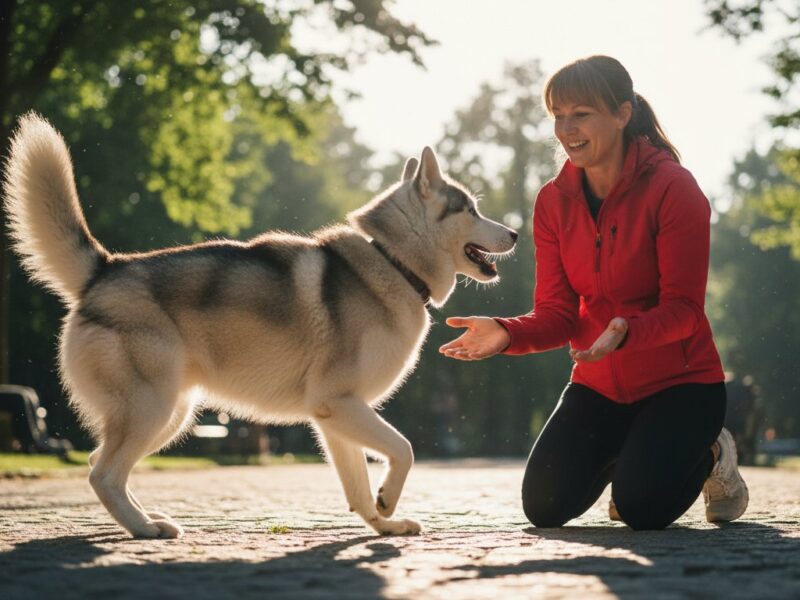
Your dog isn’t actually stubborn; they are just waiting for a leader who speaks their language. It is a common frustration to have a dog that performs perfectly in the kitchen but suddenly develops “selective hearing” the moment you step out the front door. You have likely felt that sting of embarrassment when they ignore your calls in public or felt a wave of anxiety about their safety near a busy road. If you have already spent money on trainers who rely solely on treats, you know that snacks are rarely enough to compete with the distractions of the real world.
We understand that training a stubborn dog breed requires a shift in how you capture and keep their attention. It is time to stop managing resistance and start mastering the relationship. You are about to discover how to break through that independent streak and achieve total, off-leash control using professional attention-based techniques. This article provides the definitive roadmap to move from frustrating resistance to absolute reliability. We will show you how to build a deeper bond where your dog comes every time they are called, giving you the peace of mind and freedom you deserve during every walk.
Key Takeaways
- Stop viewing resistance as a personality trait and start seeing it as a signal that your communication isn’t breaking through the noise.
- Escape the “Treat Trap” by learning how to maintain your dog’s focus when the environment is more exciting than a snack.
- Discover how tools like the Remote Training Collar create the clarity needed for training a stubborn dog breed in high-stimulation areas.
- Implement a structured four-step loading phase to ensure your dog understands exactly how to learn before you increase the pressure.
- Understand why immersive Board and Train programs provide the fastest path to total reliability for independent thinkers.
What Is a ‘Stubborn’ Dog Breed Really?
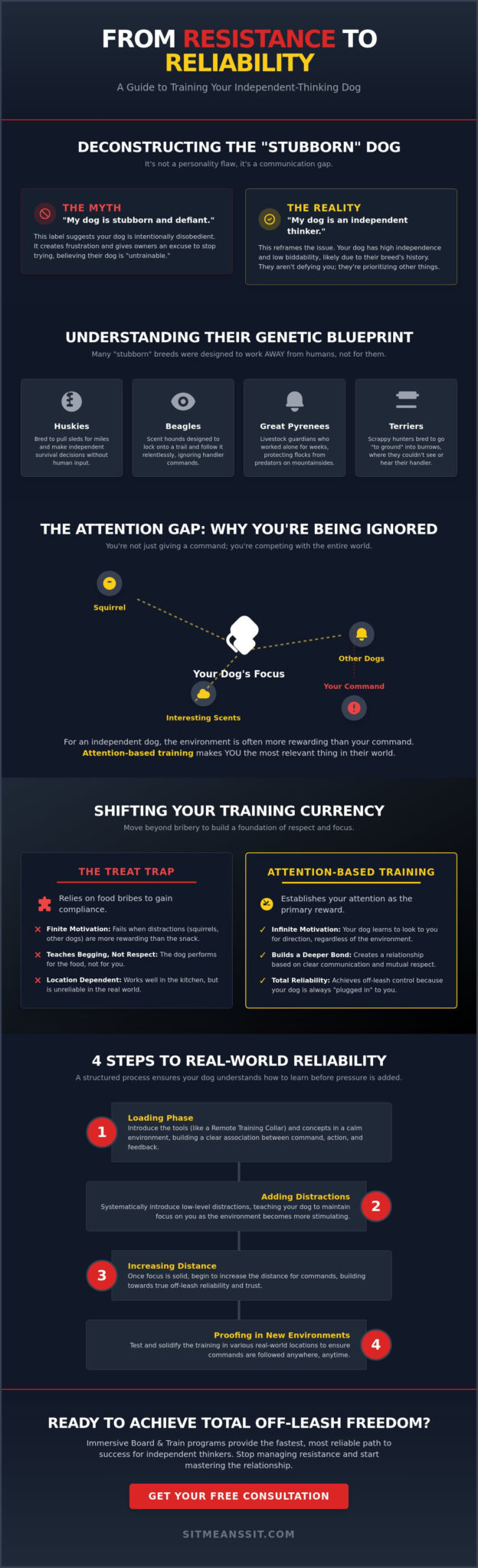
Most owners use the word “stubborn” when their dog refuses to listen. In reality, what you are seeing is a combination of high independence and low biddability. These dogs aren’t trying to spite you. They simply don’t see a reason to prioritize your request over the squirrel in the tree or the scent on the wind. Training a stubborn dog breed is not about “breaking” their spirit; it is about providing a logical reason for them to pay attention to you.
Many of the most challenging breeds were specifically developed to work away from humans rather than directly for them. Consider the following examples:
- Huskies: Bred to pull sleds for miles across frozen tundra, often making split-second survival decisions without human input.
- Beagles: Scent hounds designed to lock onto a trail and follow it regardless of what their handler says.
- Great Pyrenees: Livestock guardians who spent weeks alone on mountainsides protecting sheep from wolves.
- Terriers: Scrappy hunters bred to go “to ground” into burrows where they couldn’t even hear a command if one was given.
These dogs are genetic masterpieces of self-reliance. When they ignore you, they are just doing what they were born to do. You don’t have a bad dog; you have a dog with a different set of priorities.
Intelligence vs. Biddability
A common mistake is assuming that a dog who doesn’t listen isn’t smart. Often, the opposite is true. A highly intelligent dog is frequently the hardest to train without a professional system because they are constantly calculating the “cost-benefit” of every command. Understanding The Intelligence of Dogs helps clarify that a breed’s ability to solve problems is separate from their desire to follow commands. Biddability is the willingness to accept human direction. A dog can be a genius at escaping a fenced yard but have zero interest in sitting on command. You aren’t fighting a lack of brains. You are fighting a lack of motivation.
The Myth of the ‘Bad’ Dog
Labels like “stubborn” or “untrainable” are dangerous. They give owners an excuse to stop trying. When you reframe resistance as a need for clearer boundaries, the entire dynamic changes. Training a stubborn dog breed requires you to understand that their genetics dictate how they perceive rewards. For an independent thinker, the environment is often more rewarding than a piece of kibble. Your job is to become the most relevant thing in their world. Structure isn’t a restriction. It is the foundation of a joyful, adventurous life where your dog can finally be trusted off-leash because the communication is crystal clear.
The Attention Gap: Why Your Dog Ignores You
Your dog isn’t ignoring you because they are mean. They are ignoring you because you are losing the competition. Every time you step outside, your voice competes with every scent, sound, and movement in the environment. Training a stubborn dog breed is essentially a battle for focus. If your dog’s attention is locked on a passing cyclist, your “come” command is just background noise. You aren’t being heard because you haven’t established yourself as the most relevant thing in their world. When their natural drives take over, a weak command simply cannot compete with the thrill of a squirrel or the smell of a neighbor’s trash.
Many owners fall into “The Treat Trap.” You carry a bag of high-value snacks, hoping to bribe your way to obedience. This works in your living room. It fails the moment a distraction appears. For an independent breed, the thrill of the chase is a much higher reward than a piece of chicken. Food motivation is finite. True reliability requires attention-based training. This methodology ensures your dog looks to you for direction regardless of what is happening around them. When training a stubborn dog breed, you must move beyond the cookie-cutter approach of relying solely on treats and start building a foundation of respect.
The Currency of Training
Attention is the only currency that matters. Before you give a command, you must have engagement. If your dog is staring at a neighbor, they aren’t ready to listen. You must wait for that split second of eye contact before speaking. Stop nagging. Repeating a command five times teaches your dog that the first four are optional. It actually trains them to ignore you. If you’re struggling to get that initial focus, professional coaching can help you identify exactly where the communication is breaking down. We focus on building that foundation of focus so your dog is always “plugged in” to you, even when the world gets loud.
Environmental Thresholds
Every dog has a threshold. This is the point where high arousal literally shuts down the listening part of the brain. When a stubborn breed hits this state, they aren’t “choosing” to ignore you; they physically cannot process your voice. Their nervous system has taken over. Traditional leash pressure often fails here because these breeds have high pain tolerances or simply lean into the tension. You need a way to break through that mental fog and regain control instantly. Without a tool that provides clear, long-distance communication, you are just shouting into a storm. Mastering these thresholds is the key to moving from frustrating resistance to total reliability.
Breaking Through: Strategies for Independent Thinkers
Stop bribing your dog. When you rely on treats to get a response, you aren’t leading; you’re negotiating. For an independent thinker, negotiations are optional. Training a stubborn dog breed requires a shift from asking for permission to providing a clear directive. You must become a leader who offers consistent, undeniable feedback that cuts through the noise of the environment. This isn’t about being harsh. It’s about being clear. When your dog knows that a command is a definitive agreement rather than a suggestion, the frustration on both ends of the leash disappears.
We use the Remote Training Collar as a sophisticated communication tool to bridge the gap between you and your dog. Think of it as a wireless leash that works at a distance. It allows you to provide a gentle “tap” to redirect your dog’s focus back to you when they are distracted. This physical cue is the key to breaking the mental fog we discussed earlier. It provides a way to say “hey, listen to me” without shouting or yanking on a leash. It turns a chaotic walk into a structured conversation.
The Power of Clear Feedback
Consistency is the enemy of stubbornness. If you only enforce a command half the time, you are teaching your dog that “maybe” is an option. A Remote Training Collar provides the fair, consistent feedback necessary to eliminate confusion. It acts like a tap on the shoulder across a crowded park. This feedback is never a mystery. It is always fair, always consistent, and always followed by high-energy praise or a reward when the dog complies. This clarity builds trust because the dog never has to guess what you want. You are replacing resistance with a shared language that works every single time.
Structure Equals Freedom
Many owners avoid discipline because they think it’s restrictive. The opposite is true. A comprehensive dog obedience training program is the only path to true liberation. When you can trust your dog to come every time they are called, you can finally take them to the beach, the hiking trail, or the park without a leash. Training a stubborn dog breed isn’t about control for the sake of control. It is about creating a safer, more adventurous life. Structure provides the boundaries that allow your dog’s personality to shine in high-stimulation environments without the risk of them running into danger. Firm, loving leadership is exactly what an independent breed needs to thrive.
4 Steps to Real-World Reliability in 2026
Transformation doesn’t happen by accident. It happens through a proven, repeatable process. When training a stubborn dog breed, success depends on a structured progression that builds confidence rather than confusion. You cannot skip the basics and expect results in a high-distraction environment. This four-step system transforms training a stubborn dog breed into a predictable science, moving you from the living room to the local park with absolute certainty.
- Step 1: The Loading Phase. Teach your dog how to learn. You must establish the communication foundation before adding pressure. This phase is about showing the dog that your cues have a direct, positive outcome.
- Step 2: Command Mastery. Move the conversation outside. Once your dog understands the directive in the house, take it to the backyard. You are teaching them that “sit” means “sit” regardless of the change in scenery.
- Step 3: Distraction Proofing. Introduce controlled chaos. This is where you test the bond by adding noise, other animals, or moving objects. You are proofing the behavior to ensure it holds up when the world gets loud.
- Step 4: The Off-Leash Transition. Use your tools to ensure 100% recall. This final stage gives your dog the freedom they were bred for while maintaining the safety you require.
Mastering the ‘Sit Means Sit’ Standard
A command must be a definitive agreement, not a suggestion. We don’t ask our dogs to listen; we tell them what is expected. This standard ensures your dog maintains focus even when a cat runs across their path or a car backfires nearby. The “release” command is just as vital as the initial directive. Your dog stays in the command until you give them permission to move. This level of discipline creates a calm, focused animal that respects your boundaries without hesitation.
Proofing in High-Stimulation Environments
Most owners fail because they move too fast. They expect a dog to listen at a crowded festival before they can listen in a quiet driveway. Slowly increase the difficulty of your sessions to build a resilient mindset. Starting with puppy training classes is a great way to build social focus early on. These classes provide a safe, controlled environment to practice engagement around other dogs. If you want to stop the guessing game and start seeing results, find a professional training location near you today and take the first step toward total reliability.
Professional Solutions for Stubborn Breeds
While DIY advice is everywhere, most owners don’t have hours every day to spend wrestling with a headstrong dog. Training a stubborn dog breed is an intensive process that requires absolute precision and timing. If you’ve hit a wall where your dog simply refuses to engage, it isn’t a sign of failure. It’s a sign that you need a professional to establish the communication foundation first. Sit Means Sit Dog Training specializes in taking the “hard cases” and turning them into the most reliable dogs on the block. By letting an expert set the ground rules, you bypass the cycle of frustration and move straight to the results.
Our Board and Train programs are total game-changers for difficult breeds. We remove the dog from their usual environment where they’ve learned exactly how to ignore your commands. In our care, they receive immersive structure and consistent feedback throughout the day. This reset allows us to install a new operating system of focus and reliability. We don’t just teach tricks. We build a mindset of biddability. Once the foundation is solid, the transition process begins. We train you, the owner, to maintain these new skills so the transformation lasts a lifetime.
Sit Means Sit Dog Training tailors every program to the specific temperament of your individual dog. We know that a high-drive Terrier requires a different motivational strategy than a territorial guardian breed. We identify the environmental factors that trigger your dog’s independent streak and use them to build a bridge of respect. Our goal is to replace your dog’s resistance with a desire to work alongside you.
Why Professional Help Is a Shortcut, Not a Failure
An expert has already seen every trick your dog is currently using to avoid listening. When you work with our team, you benefit from a dog behaviorist mindset that looks beyond the surface resistance. We address the biological drives behind the behavior. This approach saves you months of trial and error. You don’t have to spend your weekends feeling embarrassed in public. We get the methodology right the first time, giving you a clear path to the adventurous lifestyle you’ve always wanted with your pet.
The Sit Means Sit Dog Training Difference
We focus on real-world results, not just classroom manners. It doesn’t matter if your dog listens in a quiet living room; they must listen at the park, the beach, and the front door. Training a stubborn dog breed is only successful if it holds up under extreme pressure. Our clients enjoy lifetime support and a community of owners who value the same level of excellence. Replace your frustration with empowerment. Contact Sit Means Sit Dog Training today and let us help you achieve the total reliability and joyful bond your dog is capable of delivering.
Reclaim Your Freedom and Focus Today
You now have the roadmap to move beyond selective hearing and environmental distractions. We have explored how independence is a genetic trait to be managed, not a character flaw to be punished. By implementing the four-step proofing process and utilizing precise communication tools, you are no longer just hoping for compliance; you are guaranteeing it. Training a stubborn dog breed is the gateway to the lifestyle you envisioned when you first brought your pet home.
Sit Means Sit Dog Training brings over 25 years of industry-leading experience to your doorstep. Our specialized Remote Training Collar technology has helped thousands of owners turn resistance into total reliability. Stop settling for a dog that only listens when they feel like it. Contact Sit Means Sit Dog Training for a Free Evaluation and see the transformation for yourself!
It is time to replace your anxiety with the empowerment that comes from absolute confidence. Your dog is ready for the clarity of a structured life and the joy of off-leash freedom.
Frequently Asked Questions
Is my dog too old to be trained if they are already stubborn?
Your dog is never too old to learn new behaviors or respect clear boundaries. While older dogs may have more established habits, the process of training a stubborn dog breed remains the same at any life stage. It is simply a matter of replacing old, resistant patterns with new, reliable responses through consistent practice and professional structure. We have successfully transformed dogs of all ages into focused, obedient companions.
What are the most stubborn dog breeds to train?
Breeds like Huskies, Beagles, Great Pyrenees, and various Terriers are frequently labeled as the most stubborn. These dogs were historically bred for independent work, meaning they are genetically wired to make their own decisions rather than waiting for human input. Success with these breeds requires a training system that prioritizes attention and clear feedback rather than just simple food rewards. You must become more interesting than the environment.
Do remote training collars hurt the dog?
No, modern remote training collars do not hurt your dog when used correctly by a professional. The technology uses a micro-pulse similar to a TENS unit used in human physical therapy to create a “tap on the shoulder” sensation. This physical cue serves as a neutral communication tool to redirect your dog’s focus back to you. It is a clear, fair way to provide feedback without causing pain or fear.
How long does it take to see results with an independent breed?
You will often see a significant shift in engagement during your very first professional session. While initial breakthroughs happen quickly, achieving total reliability with an independent thinker typically requires several weeks of steady practice. Programs like our Board and Train can accelerate this timeline by establishing a solid communication foundation in a matter of days. Consistency is the key to making these changes permanent.
Can a stubborn dog ever be trusted off-leash?
Yes, even the most independent breeds can achieve reliable off-leash control with the right training system. The key is ensuring your dog views your command as a definitive agreement rather than a suggestion. By using tools that provide clear, long-distance communication, you can give your dog the freedom they crave while maintaining absolute safety. This level of reliability is the ultimate goal of our programs.
Why does my dog listen to my partner but not to me?
Dogs often listen to the person who provides the most consistent boundaries and clear directives. If one person is firm and another is negotiable, the dog will naturally choose to ignore the weaker communication. This is a common struggle for many families. We help you bridge this gap by teaching you how to project authority and mastery to ensure your dog respects everyone in the household equally.
What is the difference between a stubborn dog and an aggressive dog?
Stubbornness is a lack of biddability or focus, while aggression involves a proactive intent to harm or a reaction rooted in fear. A stubborn dog simply has different priorities than you do at that moment. Identifying the difference is crucial. Training a stubborn dog breed focuses on building engagement and leadership, while aggression requires a specialized approach to address behavioral triggers and safety management.
Can I train a stubborn dog without using treats?
Yes, you can and should train beyond the use of treats to achieve real-world reliability. While snacks are a helpful starting point, they often fail when your dog encounters a high-stimulation environment. Our attention-based methodology relies on clear feedback and a strong bond. This ensures your dog listens because they respect your leadership and understand the command, not just because they are waiting for a cookie.
Comments are closed.