

What if the key to your dog’s ultimate freedom wasn’t a longer leash, but a more sophisticated way to talk to them? Most owners feel the same sting of frustration when their dog bolts after a squirrel or ignores a desperate recall. You want to offer your pet a life of adventure, but the fear of losing control keeps you tethered to a stressful walking experience. Learning how to choose the right training collar is the definitive shift from managing your dog’s behavior to mastering your communication.
We believe that discipline is the path to liberation, and you deserve a dog that listens with enthusiasm. This guide promises to transform your perspective on training tools. We’ll replace confusion with a system where every directive becomes a definitive agreement between you and your pet. We’ll review current industry standards, local regulations, and top-performing models like the Dogtra 280X or the SportDOG SportHunter 825X. Get ready to build a partnership where off-leash reliability is your new reality.
Key Takeaways
- Stop viewing collars as simple restraints and start seeing them as essential communication bridges that build focus and reliability.
- Master the process of how to choose the right training collar by matching specific hardware to your dog’s unique personality and prey drive.
- Use our 5-step framework to assess environmental factors like bolting risk and stimulation levels before you commit to a device.
- Understand why professional integration through programs like Private Lessons ensures your new tool leads to transformation rather than frustration.
- Gain the confidence to explore high-stimulation environments with your dog, knowing you have a clear system they finally understand.
Beyond Restraint: Reimagining the Training Collar as a Communication Bridge
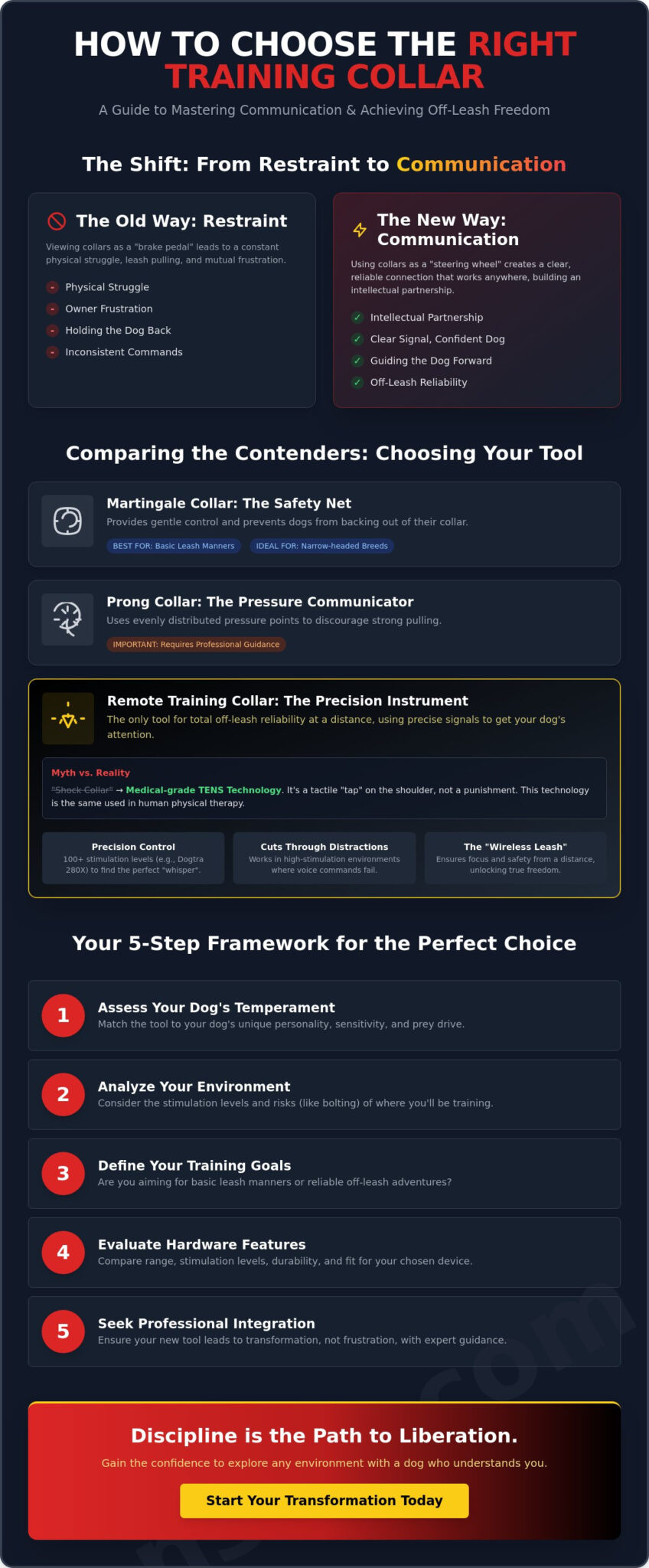
Most owners view a collar as a way to stop their dog from doing something. They see it as a brake pedal or a restrictive anchor. We see it as a steering wheel and a clear conversation starter. When you are learning how to choose the right training collar, you are actually learning how to build a reliable connection that works across a crowded park just as well as it works in your quiet living room. It’s about shifting the focus from physical restraint to mental engagement.
At Sit Means Sit, we believe that structure is the foundation of a joyful, adventurous life. Discipline isn’t a restriction; it’s the ticket to the beach, the hiking trail, and the local café. We help owners transition from the heavy weight of a physical tether to the clarity of a “wireless leash.” This invisible connection ensures your dog remains focused on you, even when the environment is full of high-stimulation distractions. You gain the confidence to let them run because you know they’ll listen when it matters most.
The Difference Between a Pet Collar and a Training Collar
Think of a flat collar as a piece of jewelry. It holds ID tags and looks great, but it’s rarely the right tool for teaching complex behaviors or ensuring off-leash safety. Relying on a standard collar for control often leads to a cycle of leash pulling and owner frustration. You pull back, the dog pulls harder, and the bond suffers. There are many Dog Collar Types designed for various purposes, but a true training tool serves a specific instructional role. The psychological shift is massive. You stop “holding the dog back” and start “guiding the dog forward.” It changes the dynamic from a physical struggle to an intellectual partnership where your dog understands exactly what is expected of them.
Communication vs. Correction: A Vital Distinction
Modern training has moved far beyond the “jerk and pull” methods of the past. Today’s technology allows us to “tap” a dog on the shoulder rather than jerking them by the neck. This is about capturing attention. If you don’t have your dog’s focus, you don’t have their behavior. A communication bridge is a tool that translates human intent into canine understanding. When you understand how to choose the right training collar, you select a device that speaks your dog’s language with precision. This clarity eliminates the guessing game for your pet. They stop wondering what you want and start responding with confidence because the signal is consistent, fair, and impossible to ignore. Mastery of this tool replaces your frustration with a sense of empowerment and pride in your dog’s performance.
Comparing the Contenders: Pressure-Based vs. Technology-Based Tools
Selecting the correct gear is about matching a tool’s mechanism to your dog’s specific needs. In professional circles, we focus on three main categories: the Martingale, the prong collar, and the remote training collar. Each offers a different level of feedback and control. Understanding these differences is the first step in learning how to choose the right training collar for your lifestyle. You aren’t just buying a piece of hardware; you’re selecting the medium for your future conversations.
The Martingale is the ultimate safety-first choice. It’s designed with a limited-slip loop that tightens just enough to prevent a dog from backing out of the collar. This is essential for narrow-headed breeds like Greyhounds or Salukis who can easily slip a standard flat collar. It provides a gentle physical boundary without the risk of choking, making it a reliable entry-point for basic leash manners.
The Evolution of the Remote Training Collar
We need to clear the air about the “shock collar” myth. Modern remote training collars utilize medical-grade TENS technology, the same gentle stimulation used in human physical therapy. This isn’t about punishment. It’s about a tactile “tap” that cuts through the noise of a busy environment. A Study on Training Collar Efficacy explores how these tools function within professional training frameworks to improve response reliability.
Technology has transformed these devices into precision instruments. Models like the Dogtra 280X offer 100 distinct levels of stimulation, allowing you to find the exact “whisper” your dog responds to. This personalization ensures the tool is never too harsh or too weak. Because these tools work via radio frequency, they are the only option for total off-leash reliability at a distance. Whether you’re using a SportDOG SportHunter 825X with its half-mile range or a Garmin Alpha TT 25 that reaches up to 9 miles, you maintain a clear connection even when your dog is far out of reach.
Mechanical Advantage: Prong and Martingale Collars
The prong collar is a mechanical powerhouse that mimics a mother dog’s natural correction. It uses distributed pressure around the neck to provide immediate, clear feedback. Unlike a choke chain that concentrates pressure on the trachea, a properly fitted prong collar protects the dog’s throat. Fit is everything here. A loose prong collar is ineffective and can be unsafe. It must sit high on the neck, right behind the ears, to function as intended.
A professional trainer might recommend a pressure-based tool when a dog needs immediate physical feedback to break through high-arousal behaviors. However, the goal is always to move toward the most refined communication possible. If you want to see how these tools look in action, our Private Lessons offer a hands-on environment to test different options. Mastering how to choose the right training collar means finding the balance between physical guidance and digital precision to unlock your dog’s full potential.
The Temperament Test: Matching the Collar to Your Dog’s Personality
A “one-size-fits-all” approach is the number one reason why training fails. Your dog is an individual with unique motivations, drives, and fears. If you treat a timid Beagle like a stubborn Malinois, you’ll likely destroy the bond you’re trying to build. Learning how to choose the right training collar requires an honest assessment of who your dog is when the leash comes off. We categorize dogs into behavioral profiles to ensure the tool matches the temperament.
- The Social Butterfly: This dog loves everyone. Every neighbor, leaf, and squirrel is a potential best friend. They aren’t being defiant; they’re just overstimulated. They need a tool that functions as a gentle tap on the shoulder to remind them you’re still there.
- The Strong-Willed Explorer: These dogs have a massive prey drive and live for the chase. When they see a rabbit, they often “blow off” verbal commands entirely. They require a tool with high-end reliability that can cut through a heavy adrenaline spike.
- The Sensitive Soul: These dogs are easily worried by loud noises or sudden movements. A harsh correction will shut them down. They need the softest possible touch to stay confident and engaged.
We believe in using the right tool for the right dog. This is why we focus on Positive Reinforcement Training as the primary driver of behavior. The collar isn’t a replacement for rewards; it’s a communication tool that ensures those rewards are possible even when your dog is distracted.
Drive vs. Sensitivity: Finding the “Working Level”
We define the “Working Level” as the lowest possible setting your dog perceives without showing signs of stress. It’s a tickle, not a sting. High-drive dogs often have a higher threshold for perception when their adrenaline is pumping. You need a device that allows for instant, precise adjustment. The goal is empowerment. We want your dog to feel capable of making the right choice in high-pressure moments because they clearly understand the signal you’re sending.
Environmental Factors: Where Do You Train?
Your location dictates your gear needs. A city dog needs a tool that manages tight spaces, heavy traffic, and sudden noises. Conversely, a rural dog needs a device like the Garmin Alpha with its 9-mile range to ensure safety in the woods. This is the “Distraction Ladder.” A flat collar works in your kitchen because there’s zero competition for your dog’s brain. The park is a different story. Check out our guide on Dog Obedience Training to learn more about achieving total control in high-distraction environments. Knowing how to choose the right training collar based on your specific environment is what separates a frustrated owner from a proud one.
The 5-Step Selection Framework for Real-World Reliability
Stop guessing and start selecting. Mastery begins with the right equipment. Learning how to choose the right training collar is simpler when you follow a proven framework. We use this 5-step system to ensure every owner walks away with a tool that provides total reliability and a stress-free walking experience. It is about replacing your frustration with a sense of empowerment.
- Step 1: Define Your Ultimate Goal. Decide if you want basic leash manners or total off-leash freedom. If you dream of hiking without a tether, you need a technology-based remote collar.
- Step 2: Assess the Bolting Risk. Fast dogs cover ground quickly. A 400-yard range is often insufficient for a dog with high prey drive. They can outrun that signal in seconds.
- Step 3: Evaluate Durability. Your lifestyle is active. Your collar must be too. Choose a model that is fully submersible for the beach, the pool, or the rain.
- Step 4: Verify Precision. More levels mean more nuance. Look for a device with at least 100 stimulation levels to find that perfect “whisper” for your dog’s specific temperament.
- Step 5: Prioritize Professional Support. Hardware without a plan is just a plastic box. You need an expert to show you how to integrate the tool into a clear communication system.
Technical Specs That Actually Matter
Range is non-negotiable. While a half-mile might sound like plenty, environmental factors like hills or trees can cut that distance in half. Battery life is equally critical. You need a tool that is always ready for a “Sit Means Sit” moment. Reliable models like the SportDOG SportHunter 825X offer 50 to 70 hours of battery life per charge. This ensures you aren’t left without a connection during a critical training session. Always prioritize waterproofing over “water resistance” to ensure the device survives every adventure.
When traveling to remote spots for these adventures, it’s equally important to ensure your vehicle and expensive training gear are protected; Safe & Sound Mobile offers nationwide installation of high-quality security systems to give you total peace of mind while you’re focused on your dog.
The “User Interface” for the Owner
Can you operate the remote without looking down? If you have to fumble with buttons, you’ll miss the moment to capture your dog’s attention. Ergonomics are vital for real-world success. Simplicity in the hand leads to clarity in the field. We recommend tools with “Lock and Set” features. This prevents accidental over-stimulation and ensures your communication remains fair and consistent. When you have a remote that feels like an extension of your own hand, your confidence travels straight to your dog. Ready to master these tools? Our Remote Training Collar programs provide the expert guidance you need to unlock total off-leash reliability.
Why Professional Integration Outperforms Standalone Hardware
Hardware alone won’t fix a behavioral struggle. Many owners think that learning how to choose the right training collar is the end of the journey. In reality, it’s just the beginning of the conversation. Buying a collar on a whim from a big-box retailer without a professional methodology is a recipe for frustration. You end up with a device you don’t understand and a dog that remains confused. A tool is only as effective as the person holding the remote. Without a plan, you’re just guessing, and guessing leads to inconsistency.
The Sit Means Sit advantage is about mastery. We don’t just sell a tool; we provide the expertise required to turn that hardware into a clear communication system. Our Board and Train programs are designed to do the heavy lifting for you. We establish the foundation of success by teaching your dog the language of the remote collar in an immersive environment. This transformation turns a disobedient pet into a reliable partner who can handle any distraction. You stop reacting to their mistakes and start directing their success.
The Transfer of Authority: From Trainer to Owner
Training isn’t just for the dog. It’s for you. Our private lessons ensure you are as confident with the remote as our professional trainers. We hold every dog to the Sit Means Sit standard. This means a command is a definitive agreement, not a suggestion. When you say “Come,” it happens every time, regardless of squirrels, cyclists, or other dogs. The emotional payoff is massive. Imagine the pride of walking your dog off-leash through a crowded park with absolute confidence. That is the liberation we provide. You gain a new lifestyle where your dog is a welcome participant in every adventure.
Take the First Step Toward Liberation
Waiting for better behavior to happen on its own is a losing game. Procrastination usually leads to deeper, worse habits that are harder to break later. You have the power to replace your current frustration with total empowerment today. Don’t settle for a life restricted by a six-foot leash. When you understand how to choose the right training collar and combine it with our expert instruction, you unlock a world of adventure for your pet. Our team has encountered every possible challenge and remains unfazed. We’re ready to help you achieve the reliability you’ve always wanted. Schedule your free consultation and see the Remote Training Collar in action!
Master the Art of Off-Leash Freedom
You’ve discovered that the right tool isn’t about restriction; it’s about building a bridge of understanding between you and your dog. By matching your pet’s unique temperament with the right technical specs, you’ve taken the first step toward a more adventurous life. Mastering how to choose the right training collar is the foundation of a partnership built on trust and reliability. It’s time to stop managing your dog’s behavior and start leading it with absolute confidence.
At Sit Means Sit, we bring over 25 years of results-oriented training to every household. Our national network of expert behavioral trainers utilizes proprietary Remote Training Collar technology to ensure your success is built on a proven system. We replace your daily frustration with a sense of pride that only comes from a perfectly behaved companion. You deserve a dog that listens the first time, every time, in any environment. A command should be a definitive agreement, not a suggestion.
Experience the Power of Professional Training—Schedule Your Free Demo!
Your journey toward liberation and adventure starts today. We’re ready to help you unlock the joyful life you and your dog have been waiting for.
Frequently Asked Questions
Is a remote training collar the same as a shock collar?
No, modern remote collars use TENS technology, which is the same gentle stimulation used in human physical therapy. They provide a tactile “tap” to capture attention rather than a painful shock. This distinction is vital when learning how to choose the right training collar. It’s a communication tool designed for clarity, not a device meant for punishment or fear.
Will using a training collar change my dog’s personality?
Yes, it will change your dog’s personality by replacing confusion and anxiety with confidence and focus. Structure doesn’t suppress a dog’s spirit; it liberates it. You’ll see a happier, more adventurous partner because they finally understand the rules of the game. Clear communication strengthens your bond and allows their true personality to shine, even in high-stimulation environments.
At what age can I start using a training collar with my puppy?
Most professional programs recommend waiting until a puppy is at least five to six months old before introducing a remote collar. However, you can start building the foundation much earlier with our Puppy Preschool. Focus on engagement and basic commands first. Ensure your pup has the cognitive maturity to understand the “tap” as a directive before moving to advanced off-leash tools.
How tight should a training collar be for it to work properly?
A training collar must be snug enough that the contact points consistently touch the skin without being restrictive. You should be able to fit one or two fingers between the strap and your dog’s neck. If the fit is too loose, the signal becomes inconsistent and frustrating for your pet. Proper placement high on the neck ensures clear, reliable communication every time.
Can I use a remote training collar for multiple dogs at once?
Yes, many professional remote systems allow you to control two or more collars from a single handheld transmitter. This is an essential factor when deciding how to choose the right training collar for a multi-dog household. You can toggle between dogs instantly to provide individual guidance. It ensures you maintain mastery over the entire pack during your off-leash adventures.
What happens if my dog doesn’t respond to the collar stimulation?
If your dog ignores the signal, you likely haven’t found their “Working Level” for that specific environment. Adrenaline can raise a dog’s perception threshold during a chase or a distraction. You must adjust the level to cut through the noise. This is why we prioritize tools with 100 levels of stimulation. It allows for the precision needed to regain focus without causing stress.
Do I need to use the training collar forever, or is it temporary?
Think of the collar as a permanent “seatbelt” for off-leash safety. While your dog will eventually respond to verbal commands alone, the collar provides a fail-safe in unpredictable situations. It’s about maintaining total reliability for the life of the dog. Most owners continue using it because the peace of mind and freedom it provides are far more valuable than the alternative.
Is a prong collar safer than a flat collar for a dog that pulls heavily?
Yes, a properly fitted prong collar is often safer because it protects the dog’s trachea from the concentrated pressure of a flat collar. It distributes pressure evenly around the neck, providing immediate feedback that stops the pulling cycle. This mechanical advantage prevents the gasping and choking often seen with dogs that strain against standard equipment. It is a professional choice for superior control.
Comments are closed.