

What if the leash you rely on for control is the very thing holding your dog back from their full potential? You’ve put in the hours and seen the results that clear boundaries provide, yet you still feel tethered to a physical connection. You’re likely experiencing the frustration of inconsistent recall at a distance or the sudden spike of anxiety when a high-distraction environment tests your dog’s focus. Transitioning from prong collar to e-collar is the definitive solution to these hurdles. It’s not a change in your discipline; it’s an evolution from physical restraint to sophisticated digital communication.
We understand that you want more than just obedience. You want an adventurous lifestyle where your dog is perfectly behaved without a leash in sight. This guide will show you how to master the move from leash pressure to modern, low-level TENS technology for total off-leash reliability. We’ll preview the exact steps to bridge the gap between these tools, ensuring your dog stays confident and responsive in every situation. Get ready to replace your frustration with absolute pride in your dog’s performance and enjoy the freedom you both deserve.
Key Takeaways
- Break through the “glass ceiling” of physical leashes by evolving from mechanical pressure to precise digital signals.
- Master the exact protocol for transitioning from prong collar to e-collar to expand your control from six feet to over half a mile.
- Learn the “neutral association” phase to ensure your dog connects the remote training collar with high-value rewards and happy engagement.
- Discover how 100 levels of digital adjustment provide a more precise and humane way to communicate than standard mechanical pressure.
- Understand why expert guidance is critical for perfecting your button-timing and achieving total off-leash reliability in high-distraction environments.
Why Transitioning from a Prong Collar to an E-Collar is the Key to Off-Leash Freedom
You’ve done the hard work. Your dog understands the walk, respects the boundaries of the prong, and listens when the leash is taut. But you feel stuck. You’ve hit a “glass ceiling” where your control ends exactly where the leash does. If your dog is six feet away, you’re a team. If they’re twenty yards away chasing a ball, you’re just a person shouting into the wind. Transitioning from prong collar to e-collar is the definitive way to shatter that ceiling and claim the lifestyle you’ve always imagined.
The prong collar is an elite physical foundation. It teaches your dog the universal language of pressure and release. However, it relies on a physical tether. When you move to a modern e-collar, you aren’t switching to a punishment device. You’re upgrading to a digital communication tool. You stop reacting to bad behaviors and start guiding great ones. You replace a heavy leash with a clear, low-level signal that works whether your dog is at your heel or across a football field.
The Natural Evolution of Obedience
View this transition as a graduation, not a replacement. The skills your dog learned on a prong collar are the essential “pre-requisites” for remote training. They already understand how to yield to a cue. Now, you’re simply removing the cord. This evolution is vital for reliability. Structure is the only thing that creates true liberation. By maintaining clear expectations through a remote training collar, you give your dog the freedom to explore the world while keeping them safely dialed into your commands.
Breaking the Physical Tether
It’s common to feel a surge of anxiety the first time you think about dropping the leash. You’ve used that physical connection as a safety net for months. But physical restraint is an illusion of control. If your dog decides to bolt at a high-distraction environment, a leash can snap or slip. Transitioning from prong collar to e-collar requires a mindset shift for you as much as the dog. You’re moving from being a handler who holds a strap to a leader who shares a language.
This shift replaces your worry with absolute confidence. Imagine the pride of watching your dog navigate a crowded park, fully off-leash, yet hanging on your every word. We help you bridge this emotional gap by turning that “what if” anxiety into “I know” certainty. You’ll stop managing your dog’s environment and start mastering their attention. The result is a more adventurous, joyful life for both of you.
The Science of Communication: Moving from Physical Pressure to Electronic Cues
Effective dog training relies on a universal principle: pressure and release. When you use a prong collar, you apply mechanical pressure to signal a command. Your dog learns that moving into the desired position, like a “sit” or a “heel,” removes that tactile pressure. It is a clear, physical conversation. The Science of Communication shows that successful training depends on this consistency. Transitioning from prong collar to e-collar simply changes the medium of the message. You’re moving from a physical “tug” to a digital “tap.”
Low-level stimulation is the secret to this transformation. You aren’t looking for a startle reaction; you’re looking for calm recognition. Modern e-collars allow for 100 levels of adjustment. This precision lets you find the exact “whisper” your dog needs to stay focused in high-distraction environments. If you want to see this precision in action, our private lessons provide the hands-on coaching needed to perfect these subtle cues. You’ll move from managing your dog’s body to guiding their mind.
The ‘Bridge’ Method: Overlapping Cues
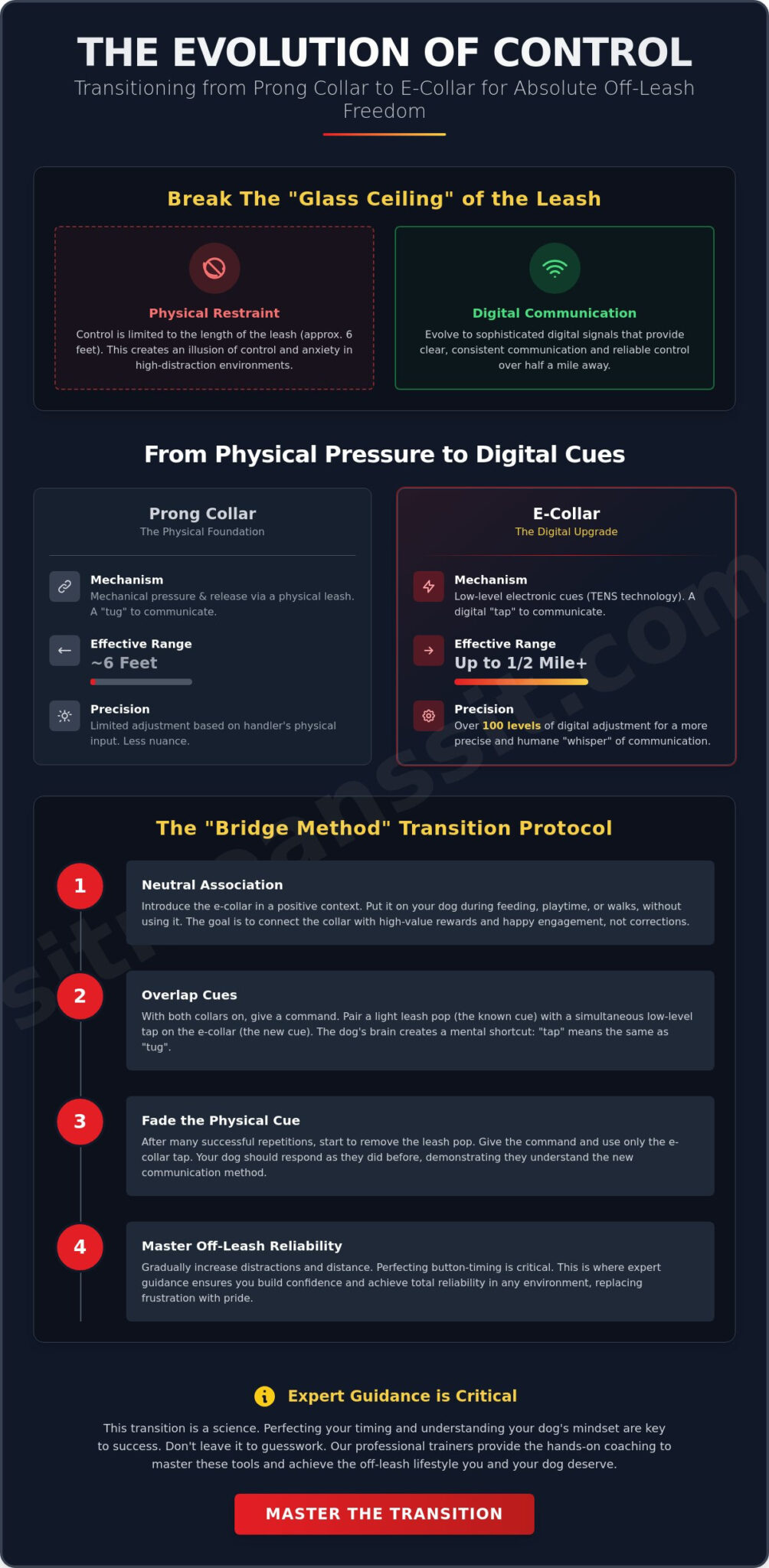
Don’t swap collars overnight. Use the “Bridge” method to ensure your dog understands the new signal. Put both collars on your dog during your initial sessions. When you give a command, pair a light leash pop with a simultaneous tap on the remote training collar. You’re overlapping the known physical cue with the new electronic one. Your dog’s brain quickly creates a mental shortcut. They realize the “tap” means the same thing as the “tug.” After several successful repetitions, start fading the physical pressure. Eventually, the electronic cue becomes the primary signal. This prevents confusion and keeps your dog’s confidence high throughout the process.
Understanding the E-Collar Sensation
Forget the outdated “shock” terminology. Modern devices use Transcutaneous Electrical Nerve Stimulation (TENS) technology. It’s the same technology used in human physical therapy. It feels like a rhythmic pulse or a light tap on the shoulder. Your goal is to find the “working level.” This is the lowest setting where your dog shows a slight ear flick or a head tilt. It’s a calm recognition. Proper timing ensures this sensation is linked directly to your command. Mastery of this sensation turns every walk into a focused, joyful adventure. You’ll stop worrying about the leash and start enjoying the freedom of a perfectly dialed-in connection.
Prong vs. E-Collar: Bridging the Gap in Your Dog’s Training Journey
Choosing the right tool isn’t about picking a side; it’s about matching the tool to your goals. A prong collar is a masterclass in tactile, immediate feedback. It provides a physical sensation that helps your dog understand leash manners within a six-foot radius. But what happens when you want to play fetch at the park or hike a mountain trail? This is where transitioning from prong collar to e-collar changes the game. You move from the physical limit of a leash to a communication range that often exceeds half a mile. You aren’t just training for the sidewalk anymore; you’re training for the world.
Precision is the second major differentiator. A prong collar relies on mechanical pressure, which can be difficult to fine-tune in high-stimulation environments. In contrast, modern remote training collars offer 100 levels of digital adjustment. This allows you to find a “working level” so subtle that it’s barely perceptible to humans but perfectly clear to your dog. When comparing Prong vs. E-Collar effectiveness, the ability to dial in the exact amount of communication needed for a specific environment is a massive advantage for safety and reliability.
When to Make the Switch
Timing is everything. Don’t rush the process. Your dog is ready for the transition when they’ve mastered basic commands on a leash with high reliability. They should understand how to turn off prong collar pressure by complying with your direction. If your dog still lunges or ignores basic “sit” and “stay” commands, you need to tighten up your foundation. A solid dog obedience training program is non-negotiable. You must also assess your own handling skills. Remote training requires better timing and more focus than leash-pulling. If you’re ready to be a more attentive leader, your dog is ready for the collar.
The Pros and Cons of Each Tool
Both tools have their place in a successful training journey. The prong collar is excellent for initial teaching because it’s tactile and immediate. It’s difficult for a dog to “tune out” a physical correction when they’re right next to you. However, it fails the moment the leash is dropped. The e-collar wins on range and subtlety. It provides a “safety net” that prevents bolting or dangerous off-leash situations. By combining both tools during the initial transition phase, you ensure there’s no loss in reliability. You maintain the physical boundary while introducing the digital one. This creates a seamless bridge to the off-leash lifestyle you’ve been working toward.
Step-by-Step Protocol: How to Safely Introduce the Remote Training Collar
Rushing into off-leash work is the fastest way to confuse your dog and erode the trust you’ve built. Transitioning from prong collar to e-collar requires a systematic approach that prioritizes clarity over speed. You’ve already established a foundation of respect. Now, you must teach your dog that the new digital signal carries the same weight as the physical leash. This process turns a potentially stressful change into an empowering experience for your pet.
Start your sessions in a low-distraction environment like your living room. You want your dog to focus entirely on the new sensation without competing with squirrels or neighbors. Once they reliably respond to known commands like Sit, Place, and Heel using the remote, you can begin generalizing the behavior. Move to the backyard, then the front porch, and finally the park. This gradual increase in environmental stimulation ensures that your dog’s reliability remains absolute, no matter where your adventures take you.
The First 48 Hours: Building Positive Associations
The most common mistake owners make is activating the collar the moment it comes out of the box. Stop. Your dog needs to wear the device for at least 48 hours without any activation. This prevents “collar-smart” behavior, where a dog only listens when they feel the weight of the device. Put the collar on before meals, walks, and play sessions. You want the collar to signal that something great is about to happen. Ensure a proper fit high on the neck, just below the jawline. It should be snug enough that the contact points touch the skin but loose enough that you can fit two fingers underneath the strap. Consistent contact is the key to clear communication.
The Transfer Session: From Leash to Remote
When you’re ready to begin active training, use the “double-leash” technique. Keep the prong collar and leash attached as a safety net while you introduce the remote signal. Give a command, tap the button at your dog’s specific level, and use the leash to guide them into the position if they hesitate. The Working Level is the lowest level of stimulation that your dog notices. If your dog appears confused, don’t panic. Simply go back to basics with the prong collar to provide the physical guidance they understand. You are building a bridge between two tools, not burning the old one before the new one is secure. If you want to accelerate this process with expert help, our Board and Train programs provide the professional immersion needed for a flawless transition.
Mastering the Transition with Professional Guidance from Sit Means Sit
Success in transitioning from prong collar to e-collar isn’t just about the hardware. It’s about the handler. You’ve established the rules; now you’re moving into a more sophisticated realm of communication. Professional coaching is the bridge that carries you across. Without it, many owners fall into the trap of button-timing errors. If your timing is off by even a second, your dog receives a mixed message that creates confusion rather than clarity. We provide the expert eye needed to ensure every signal is meaningful, clear, and fair.
Our philosophy at Sit Means Sit centers on happy engagement. We don’t want a dog that obeys out of fear or robotic habit. We want a dog that chooses to pay attention because they find the interaction rewarding and the boundaries clear. This shift in focus replaces your old frustrations with a sense of absolute empowerment. You aren’t just managing a pet; you’re leading a partner. This mastery allows you to move beyond the tools and embrace a lifestyle of boundless adventure and total reliability.
Why Professional Instruction Matters
Expert implementation is the only way to avoid collar-wise behavior. This common pitfall happens when a dog realizes they only need to listen when the device is active. Our trainers prevent this by integrating the technology into a broader framework of respect and focus. We customize the process to fit your dog’s unique temperament. Every dog processes stimulation differently. Some require a delicate whisper, while others need a firmer hand. We deliver the same precision found in service dog training to every family pet we work with. Professional coaching makes transitioning from prong collar to e-collar a seamless experience that respects your dog’s emotional well-being.
Your Journey to Off-Leash Reliability
If you want to see results fast, our board and train programs offer the ultimate immersion. We handle the technical heavy lifting of the initial transition. You receive a dog that already understands the digital language, allowing you to focus on the joy of off-leash freedom. Imagine the pride of a perfect recall at a crowded park or a steady heel on a hiking trail. This is the liberation we promise. The next step is simple: find your local Sit Means Sit expert. Stop feeling tethered to the leash and start living the life you’ve imagined. Schedule your free evaluation today to see the Sit Means Sit difference and claim the off-leash freedom you both deserve.
Claim Your Off-Leash Future Today
True freedom isn’t the absence of rules; it’s the presence of clear, reliable communication. By transitioning from prong collar to e-collar, you trade a six-foot physical tether for a digital connection that spans distances you once thought impossible. You’ve learned how to bridge the gap between mechanical pressure and subtle electronic cues using a proven protocol. This evolution ensures your dog remains focused and responsive in any environment, from a quiet living room to a bustling city park.
Don’t let hesitation hold you back from the adventurous lifestyle you and your pet deserve. We bring over 25 years of professional training experience and a proprietary remote collar methodology to every session. With a nationwide network of expert trainers, we provide the authority and expertise to transform your relationship. Ready for off-leash freedom? Schedule your Free Consultation with Sit Means Sit today! It’s time to replace frustration with the absolute pride of a perfectly behaved dog. Your journey to total liberation starts now.
Frequently Asked Questions
Is an e-collar more painful for my dog than a prong collar?
Modern e-collars are designed for communication rather than pain. While a prong collar uses mechanical pressure to get a dog’s attention, a remote training collar uses TENS technology, which feels like a light tapping or pulsing sensation. It is the same technology used in human physical therapy. When used at the correct working level, it is a subtle signal that guides your dog without causing distress or harm.
Can I use an e-collar on a puppy that hasn’t used a prong collar yet?
You can certainly start a puppy on a remote collar once they have a basic understanding of commands. We generally recommend waiting until a puppy is at least four to six months old and has completed a program like our Puppy Preschool. The goal is to ensure they understand what is being asked of them before you introduce the digital signal. This ensures the transition remains a positive experience for your growing pet.
How do I know if my dog is ‘collar-wise’ and how do I fix it?
Your dog is collar-wise if they only obey commands when they feel the weight of the device on their neck. You can fix this by having your dog wear the collar for several hours every day without ever turning it on. Put it on for meals, play, and naps. This breaks the mental link between the tool and the requirement to listen. It ensures they respect your leadership whether the collar is present or not.
What level should I set my e-collar to during the transition?
You should always use the “working level,” which is the lowest possible setting your dog can perceive. Every dog is an individual; some may respond at a level 4 while others need a level 12. Find this number by starting at zero and slowly increasing the level until you see a subtle physical sign like an ear flick or a head tilt. Transitioning from prong collar to e-collar effectively depends on this precise, low-level communication.
Do I still need to use a leash once my dog is trained on an e-collar?
You should always carry a leash to comply with local laws and for safety in high-traffic areas. However, a properly trained dog treats the remote collar as a digital leash. It provides the same reliability and control at a distance of half a mile as a physical leash does at six feet. The goal of our training is to give you the confidence to drop the leash in appropriate off-leash environments while maintaining total control.
What happens if my dog ignores the e-collar stimulation?
If your dog ignores the signal, it typically means the distraction level is too high for their current training or the stimulation level is set too low. Do not keep pressing the button. Instead, move closer to your dog or increase the level slightly until you regain their focus. If they are consistently failing, go back to basics with a physical leash to reinforce the command. Reliability is built through steady practice and clear expectations.
Can an e-collar cause burns or skin irritation?
E-collars do not produce enough heat to cause electrical burns. However, skin irritation or “pressure necrosis” can occur if the collar is left in the same spot for too long. You must rotate the receiver every few hours and remove it entirely at night. Keep the contact points and your dog’s neck clean to prevent bacteria buildup. Proper fit and placement are the best defenses against any skin issues.
How long does the transition from prong to e-collar typically take?
Most owners achieve total off-leash reliability within two to three weeks of consistent daily practice. The timeframe for transitioning from prong collar to e-collar depends heavily on your dog’s existing foundation and your own handling skills. If your dog already understands leash pressure, they will likely pick up the digital cues very quickly. Our Private Lessons can help you master this timeline and get you outdoors faster.
Comments are closed.