
Your perfectly trained puppy didn’t just break; they evolved into a teenager. Most owners treat this stage like a natural disaster they have to hide from, but that is a mistake that costs you years of reliability. Learning how to survive puppy adolescence phase requires more than just patience. It requires a professional shift from simple management to total mastery. Behavioral problems remain the leading cause of death for dogs under three years old, proving that “waiting it out” is never a winning strategy.
We understand the frustration of sudden selective hearing and the return of destructive chewing. It feels like the hard work you put into Puppy Preschool vanished into thin air. We are here to replace that stress with absolute confidence and pride. This guide provides a professional framework to transform your dog’s impulsivity into reliable obedience, even when the environment is full of distractions. You don’t have to settle for a chaotic household.
You are about to learn how to bridge the gap between erratic puppyhood and a calm, dependable adult life. We will explore the science of the developing canine brain and the necessity of steady, structured practice. Let’s move past the teenage rebellion and build a bond based on clear boundaries and adventurous joy.
Key Takeaways
- Identify the “regression” phenomenon where previously mastered commands seem to vanish during the bridge between six months and two years.
- Gain insight into the biology of impulse control to understand how hormonal shifts drive your dog’s sudden urge to roam or mark.
- Learn how to survive puppy adolescence phase by replacing passive patience with proactive leadership and unwavering, black-and-white boundaries.
- Implement five non-negotiable rules for daily survival, including the vital transition from treat-based rewards to high-level engagement and play.
- Discover how professional board and train programs act as a behavioral reset button to create a lasting foundation of reliability.
The Teenage Transformation: Why Your “Good Puppy” Suddenly Stopped Listening
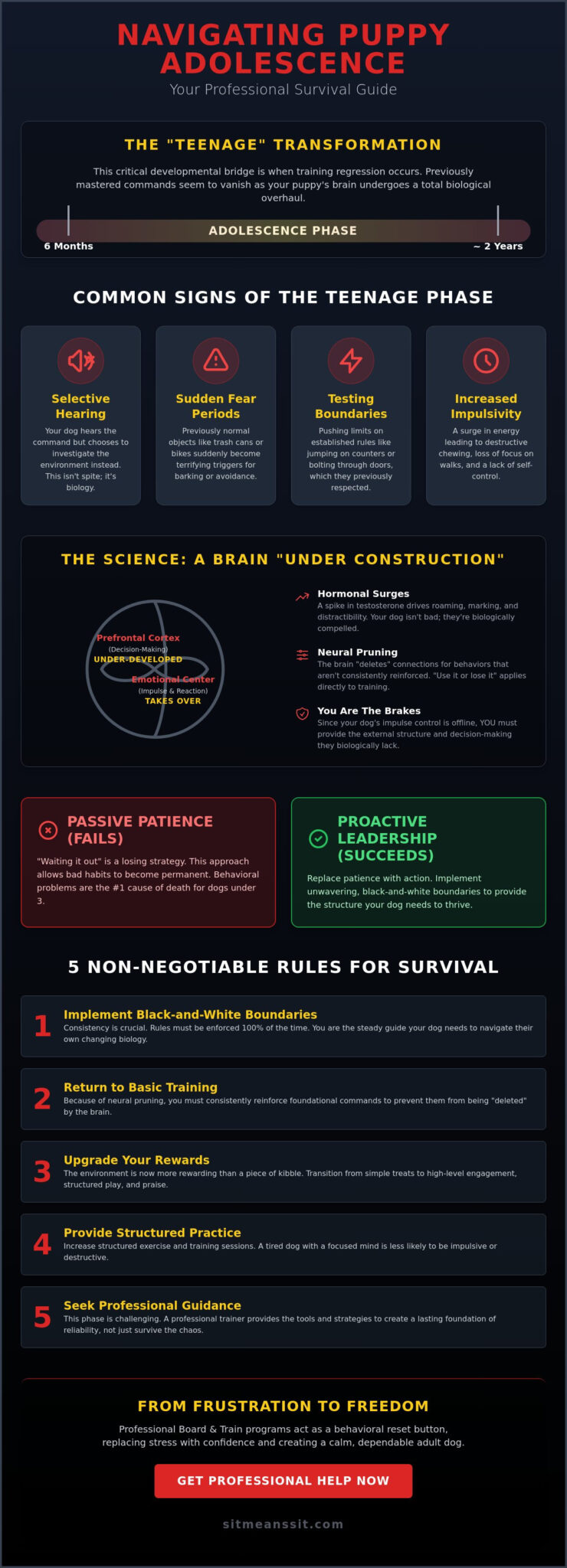
Your star pupil didn’t just forget their manners; they entered a new stage of life. This developmental bridge, lasting from six months to two years, represents a total biological overhaul. If you are searching for how to survive puppy adolescence phase, start by understanding that this isn’t a failure of your previous work. It is a natural regression where rock-solid commands seem to evaporate. At Sit Means Sit Dog Training, we’ve helped thousands of owners navigate this shift. Clear, authoritative communication is the only way to bridge the gap between a chaotic teen and a reliable adult dog. You don’t have to accept the chaos as your new normal.
Signs Your Puppy Has Hit the Teenage Phase
The transition into the teenage months is rarely subtle. You will likely notice a sharp shift in how your dog interacts with both you and the world. Watch for these specific indicators that the “puppy” brain is evolving:
- Selective hearing: Your dog looks directly at you, hears the command, and chooses to investigate a squirrel instead.
- Sudden fear periods: Objects like trash cans, statues, or bicycles suddenly become terrifying triggers for barking or avoidance.
- Testing boundaries: They begin pushing the limits on rules they previously respected without question, such as jumping on counters or bolting through doors.
- Increased impulsivity: A sudden surge in physical energy often leads to destructive chewing or a total loss of focus during walks.
The “Selective Hearing” Myth
It is easy to assume your dog is being spiteful or stubborn. This is a common misconception. During various puppy development stages, the canine brain is biologically wired to prioritize independence and environmental exploration. They aren’t ignoring you because they’re mean; they’re ignoring you because the environment has become a more powerful reward than your standard praise.
Environmental rewards like new scents, other dogs, or moving objects now carry more weight than a piece of kibble. To maintain reliability, you need a more sophisticated set of tools and engagement strategies. Sit Means Sit Dog Training replaces your frustration with a sense of mastery. We ensure every directive is a definitive agreement rather than a suggestion. This period of transition is the perfect time to tighten your structure and prove that your leadership remains the most interesting thing in their world.
The Science of the Adolescent Brain: Hormones and Impulse Control
Your dog’s brain is undergoing a massive renovation. The prefrontal cortex, which governs decision-making and impulse control, is the last part of the canine mind to fully develop. While this area matures, the emotional centers of the brain take the wheel. This leads to the unpredictable and often frustrating actions we see in common adolescent dog behaviors. You aren’t dealing with a lack of love. You are dealing with a biological lack of brakes. Mastery starts with understanding that your dog isn’t choosing to be difficult; they are simply lacking the hardware to be consistent.
Hormones add fuel to the fire. Male dogs experience a massive surge in testosterone, which drives behaviors like scent-marking and an intense desire to roam. Female dogs undergo similar hormonal shifts that can lead to irritability or sudden distractibility. During this time, the brain begins “pruning” neural pathways. If a behavior isn’t consistently reinforced, the brain literally deletes the connection to make room for new growth. This is why returning to the basics of your puppy training classes is a non-negotiable requirement for long-term reliability.
Since your dog’s brain is currently “under construction,” you must provide the external structure they lack. You are the prefrontal cortex for your dog right now. Learning how to survive puppy adolescence phase means becoming the steady, reliable guide they need to navigate their own changing biology. Structure is not a restriction. It is the safety net that allows your dog to grow into a confident, adventurous adult.
Why Training Regression Happens
Adolescence creates a direct conflict between a dog’s growing exploratory drive and their previous handler focus. Stress hormones like cortisol spike more easily now, which makes it significantly harder for your dog to settle or focus when faced with new sights and sounds. Regression is a biological reorganization of the brain, not a permanent loss of intelligence. This shift requires you to be more interesting than the environment, demanding a higher level of engagement than you needed during the early puppy months.
The Role of Impulse Control
Impulse control is the ability to think before barking, bolting, or jumping. At this age, high-arousal moments often render simple lures and treats useless because the environment is simply more exciting than a piece of food. The most valuable skill you can cultivate right now is Attention. If you don’t have their eyes, you don’t have their mind. If you find your dog’s focus is slipping away, our Private Lessons provide the targeted strategy you need to regain command in any environment.
Passive Patience vs. Proactive Leadership: Why “Waiting It Out” Fails
Stop waiting for the storm to pass. The most dangerous advice you can follow is to “just be patient” while your dog ignores your every word. Patience without a plan is just permission for bad behavior to take root. If you want to know how to survive puppy adolescence phase, you must trade passive waiting for proactive leadership. This means establishing black and white boundaries that never shift, regardless of how much your teenager tests them. While your dog’s brain is chaotic, your expectations must remain crystal clear.
There is a massive difference between managing your dog and training them. Management is about preventing a mess, like putting up a baby gate so they don’t chew the couch. Training is about teaching the correct choice, ensuring they understand that staying on their bed is the better option. Advanced dog obedience training is most critical exactly when your dog is least likely to listen. This is the moment you build a foundation of reliability that lasts a lifetime. You aren’t just getting through the day; you are conditioning an adult dog who respects your lead.
The Danger of Calcified Bad Habits
Ignoring bad behavior doesn’t make it go away. It makes it permanent. When an adolescent dog pulls on the leash or barks at neighbors, they are self-rewarding. Every time they “get away with it,” that habit calcifies into an adult personality trait. You need to provide immediate, clear feedback. This prevents the behavior from becoming a lifelong struggle. Consistency is your greatest weapon. If one family member allows jumping while another forbids it, the dog learns to gamble with the rules. Stop the gambling and start the mastery.
Structure as the Key to Freedom
Structure is the gateway to liberation. Owners often worry that rules restrict a dog’s life. The opposite is true. A dog that follows a definitive agreement can enjoy off-leash hikes, patio dining, and family vacations. A dog without structure is confined to a crate or a backyard because they can’t be trusted. We view a command as a contract, not a suggestion. By maintaining a structured daily routine, you actually reduce the anxiety caused by your dog’s fluctuating hormones. They don’t have to guess what you want; they already know. This clarity is how to survive puppy adolescence phase and emerge with a dog you are proud to take anywhere.
Mastering the Chaos: 5 Non-Negotiable Rules for Survival
Mastery is not about luck; it is about the relentless application of structure. If you want to know how to survive puppy adolescence phase, you must stop hoping for good behavior and start demanding it through these five non-negotiable rules. These aren’t suggestions. They are the definitive framework for transforming a chaotic teenager into a reliable adult partner. Implement them immediately to reclaim your household peace.
- Rule 1: Re-evaluate your rewards. Adolescent dogs often find the environment more exciting than a piece of kibble. Transition from simple treats to high-level engagement and play. If you aren’t the most interesting thing in the park, you’ve already lost.
- Rule 2: Tighten the leash. Maintain control in high-distraction areas. This is both literal and figurative. Do not give your dog the opportunity to fail by granting freedom they haven’t earned.
- Rule 3: Increase mental stimulation. A three-mile walk might tire a dog’s legs, but it won’t touch their adolescent energy. You must tire the brain to see real results.
- Rule 4: Proof your commands. A “sit” in the kitchen isn’t the same as a “sit” at a busy intersection. Generalize every behavior by practicing in increasingly difficult environments.
- Rule 5: Seek professional assessment. Know when your dog’s drive is outmatching your current skill set. There is no shame in calling the experts before a bad habit becomes a permanent liability.
Environmental Proofing and Distraction Training
Training in a vacuum is useless. To achieve total reliability, you must move your practice from the living room to the real world. Use the “Three Ds” to guide your progress: Distance, Duration, and Distraction. Start by asking for a command from a short distance; then increase the time they must hold it; finally, introduce a distraction like a bouncing ball or another dog. Learn to use the environment as a reward. If your dog executes a perfect “heel,” reward them by allowing them to go sniff that interesting tree. This turns potential competitors for attention into powerful motivators for obedience.
Mental Mastery: Beyond the Walk
Physical exercise is vital, but it often just builds a more athletic “monster.” Mental stimulation is the ultimate tool for reducing destructive adolescent energy. Short, intense bursts of structured training are far more effective than long, mindless walks. Introduce “Place” work as a high-level impulse control exercise. Requiring your dog to remain on a specific boundary while life happens around them builds the mental muscle they need for adulthood. If you’re ready to stop managing and start mastering, join our Group Classes to proof your dog’s skills in high-stimulation environments.
From Frustration to Freedom: Professional Solutions for Adolescence
You have applied the rules and tightened the leash, but sometimes the biological drive of a teenage dog outpaces your current skill set. This is the moment to call in the experts. Learning how to survive puppy adolescence phase doesn’t mean you must endure months of stress and household destruction. Sit Means Sit Dog Training provides the ultimate reset button through our immersive programs. We specialize in taking dogs that seem “unmanageable” and transforming them into reliable, focused companions. We don’t just stop the bad habits; we build a new foundation of communication that makes life together a joy instead of a chore.
Professional immersion is the fastest path to results because it provides the 24/7 consistency that is often impossible to maintain in a busy household. While previous sections highlighted the importance of boundaries, our board and train model takes that concept to the highest level. We remove the dog from the environment where they have practiced their rebellion and place them in a structured setting where every interaction is a teaching moment. This rapid momentum creates a reliable adult dog in a fraction of the time it takes for once-a-week classes to show progress.
The Board and Train Advantage
A typical day in our adolescent boot camp involves multiple high-intensity training sessions, social proofing, and impulse control exercises. We take the “Agreement” mindset discussed earlier and make it a physical reality in every environment. The most important part of this process is the owner hand-off. We spend significant time training you to handle your dog’s new skills. You’ll learn exactly how to sustain the results we achieve, ensuring the transition back to your home is seamless and successful. We provide the tools and the confidence you need to lead with authority.
Achieving Off-Leash Reliability
The ultimate goal of our program is liberation through structure. Our industry-leading Remote Training Collar methodology provides a reliable safety net for independent-minded teenagers. This tool allows for clear, instant communication that cuts through the mental fog of surging hormones and environmental distractions. It is the key to transitioning from backyard obedience to real-world freedom. When you can trust your dog to listen every single time, even off-leash at a busy park, your life changes. Ready to stop surviving and start enjoying your dog? Schedule your free evaluation today!
Reclaim Your Peace and Build a Lifetime Bond
Adolescence is a demanding but necessary bridge to the dog you’ve always wanted. You now have the professional framework required to move past the frustration of “selective hearing” and behavioral regression. By choosing proactive leadership and consistent structure, you are ensuring that these challenging months lead to a lifetime of freedom and adventure. Understanding how to survive puppy adolescence phase is about more than just getting through the day; it’s about establishing a definitive agreement that stands up to every real-world distraction.
Sit Means Sit Dog Training is here to ensure you succeed. With over 150 locations nationwide and our industry-leading remote collar methodology, we have the expertise to handle even the most intense teenage behaviors. We replace your stress with absolute confidence and pride in your pet. Transform your adolescent dog into a reliable companion—Book your FREE Sit Means Sit Dog Training evaluation today! We offer free initial behavioral evaluations to help you find the perfect path toward off-leash mastery. Your dog’s best years are just ahead. Let’s make them legendary together.
Frequently Asked Questions
When does the puppy adolescence phase finally end?
Adolescence typically concludes between 18 and 24 months of age, depending on the breed. Larger breeds often take longer to reach full emotional and cognitive maturity. While the most intense phase usually peaks around 12 months, you must maintain consistent structure until the brain’s prefrontal cortex is fully developed. Don’t let your guard down early; steady practice ensures these teenage years lead to a reliable adult life.
Why is my previously house-trained puppy having accidents again?
Regression in house training is often caused by the massive hormonal shifts and brain reorganization occurring during this stage. Your dog isn’t “forgetting” their training; they are simply more distracted by new internal drives like scent-marking. Return to the basics of a strict potty schedule immediately. Treating the situation like they are a brand new puppy helps you regain control and reinforces the house rules they previously mastered.
Is it too late to start training if my dog is already a teenager?
It is never too late to start training, but you are now working against established habits rather than a blank slate. Adolescence is actually the most critical time to implement a professional framework because the dog is actively testing their independence. Starting now prevents bad behaviors from becoming permanent adult traits. We specialize in helping owners discover how to survive puppy adolescence phase by replacing confusion with a clear, results-oriented training plan.
Will neutering or spaying my dog fix their adolescent behavior problems?
Neutering or spaying may reduce hormonally driven behaviors like roaming or marking, but it is not a cure for a lack of discipline. Behavioral issues are rooted in habits and a lack of clear boundaries, which surgery cannot change. You must pair any medical decisions with a structured training program. Mastery comes from consistent leadership and engagement, not just biological changes, ensuring your dog remains a well-behaved companion.
My dog was social as a puppy but is now barking at other dogs. Is this normal?
This shift is a common part of the second fear period that occurs between 6 and 14 months of age. Your dog is becoming more aware of their environment and may use barking as a way to create distance from things that make them feel insecure. This is the perfect time to transition from Puppy Preschool to more advanced Group Classes. Professional guidance helps you navigate these social challenges before they escalate into lifelong reactivity.
How much exercise does an adolescent dog actually need?
Most adolescent dogs need a balance of physical activity and high-level mental stimulation to truly settle. While a daily walk is important, 15 minutes of structured training often tires a teenage dog more effectively than an hour of running. Use mental games and obedience practice to drain their “thinking” energy. This prevents the destructive behaviors that stem from boredom and ensures your dog is tired in both mind and body.
Can a board and train program really fix teenage rebellion?
A board and train program serves as a powerful behavioral reset by providing 24/7 consistency and professional immersion. This environment removes the dog from the triggers of their home life where they have learned to ignore commands. Our expert trainers establish a foundation of reliability that allows you to reclaim your leadership. It is the most efficient way to learn how to survive puppy adolescence phase when your dog’s drive outmatches your current skills.
What should I do if my adolescent puppy starts growling or showing aggression?
You must address any signs of aggression or growling immediately with a professional evaluation. Adolescence is a period where dogs test their status and boundaries; ignoring these signals can lead to dangerous adult behaviors. Do not attempt to “wait it out” or use harsh punishment. Instead, seek an expert assessment to create a plan based on clear communication and structure. Taking decisive action now protects your bond and ensures household safety.
Comments are closed.