
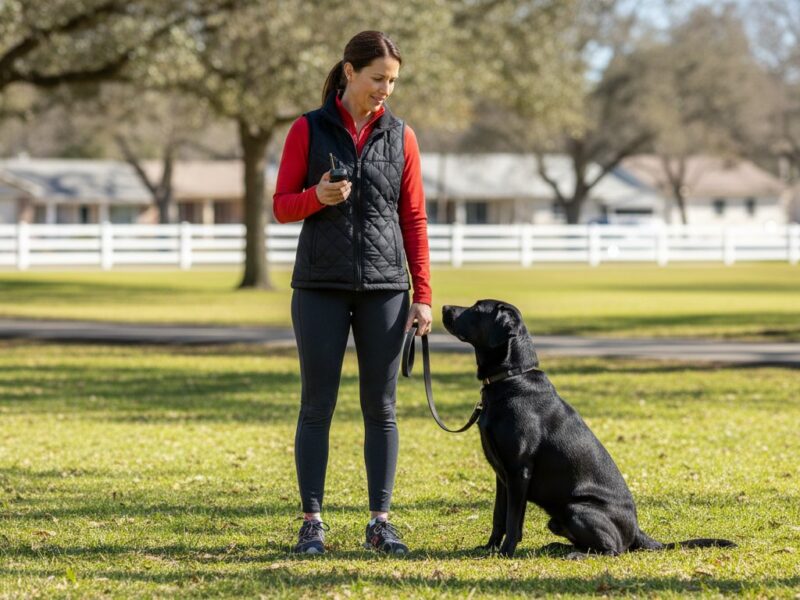
What if you could whisper to your dog from a hundred yards away and get a perfect response every single time? Most owners feel a mix of hesitation and fear when they first pick up a remote training collar, worried they’ll cause pain or choose a setting that’s far too high. It’s time to replace that frustration with absolute confidence. Mastering how to find the right working level on an e-collar isn’t about finding a static number; it’s about dialing into your dog’s unique recognition level for a seamless, silent conversation.
We understand the pressure of wanting reliable off-leash control without compromising your bond. You want a dog that listens because they understand the cue, not because they’re startled. This guide promises to transform your training by showing you exactly how to identify the subtle body language signs, like an ear flick or a head tilt, that indicate your dog has felt the signal. We’ll walk through the essential steps to calibrate your device for different environments, ensuring your communication remains crystal clear whether you’re in the living room or a crowded park. Get ready to unlock a new level of freedom and structure for your family pet.
Key Takeaways
- Master the “Two-Finger Rule” to ensure a snug fit and prevent the inconsistent training results caused by a loose collar.
- Follow our step-by-step process for how to find the right working level on an e-collar by starting at zero and watching for subtle recognition cues.
- Adjust for the “Adrenaline Factor” using the Distraction Dial to keep your dog focused in high-stimulation environments like busy parks.
- Solve common troubleshooting issues like “Collar Wise” behavior to ensure your dog listens reliably even when the receiver is off.
- Transition from correction to communication by using the remote training collar as a sophisticated attention-gathering tool that strengthens your bond.
The Foundation: Proper Fit and Preparation Before You Dial
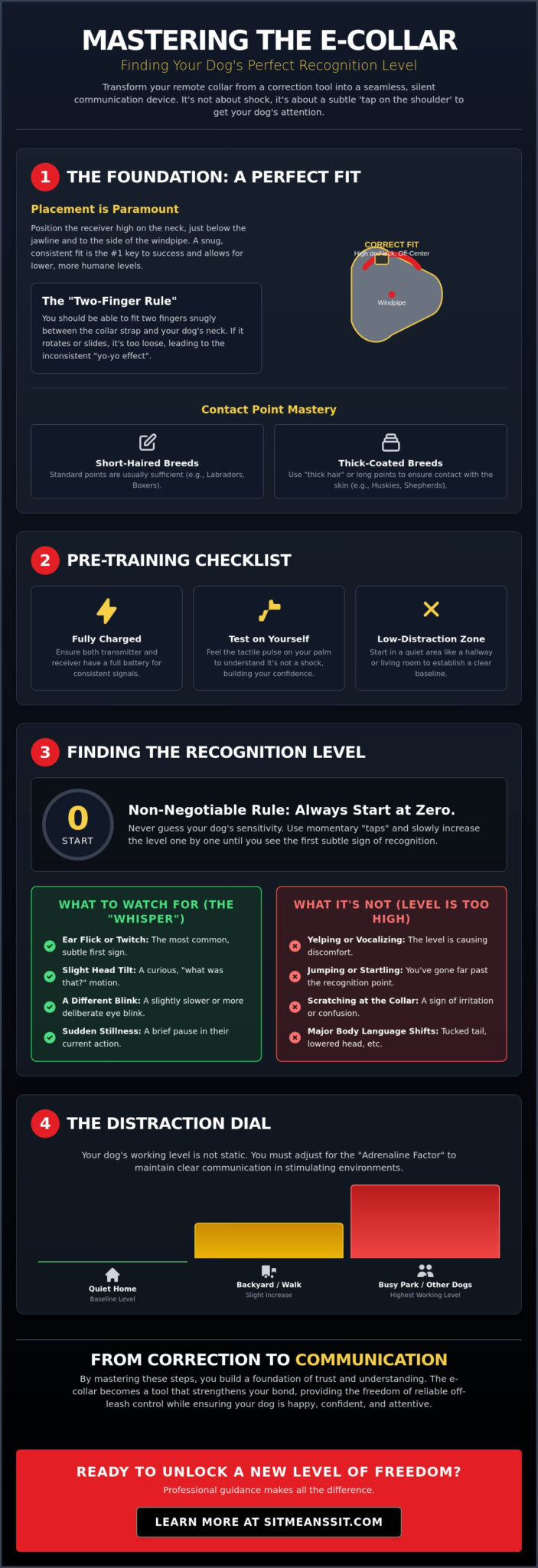
Success starts before you even touch the dial. Most owners struggle with how to find the right working level on an e-collar simply because the receiver isn’t making consistent contact. A loose collar is the primary reason for inconsistent responses. If the device shifts, the signal breaks. You turn the level up, the collar shifts back, and suddenly the signal is too intense. We avoid this “yo-yo” effect by ensuring a perfect fit from the start. Precision in placement is the first step toward reliable off-leash control.
Position the receiver high on the neck, just below the jawline. This area is more sensitive and less likely to be obstructed by thick neck muscles. It should sit to the left or right of the windpipe, never directly on the throat. Use the Two-Finger Rule. You should be able to fit two fingers snugly between the strap and your dog’s neck. If the collar slides around or rotates easily, it’s too loose. While some critics of the Shock collar focus on signal intensity, professional trainers know that proper fit actually allows for much lower, more humane levels. A snug fit ensures the points stay in one place, preventing skin irritation and ensuring the signal is delivered exactly where it’s needed.
Contact Point Mastery: Short vs. Long
Your dog’s coat is a natural insulator. For short-haired breeds like Labradors, standard contact points work perfectly. However, for thick-coated breeds like Huskies or Shepherds, you must use “thick hair” or long contact points. If the points don’t reach the skin, you’ll experience “ghosting.” This is where the dog doesn’t feel anything until the level is cranked too high, leading to a startled reaction. Choose the right length to ensure a clear, low-level “whisper” reaches the skin every time. If you can’t feel the skin with your fingertips through the fur, the contact points won’t reach it either.
The Pre-Flight Checklist
Don’t skip the basics. Verify that both your transmitter and receiver are fully charged before you begin. A low battery leads to weak or erratic signals. This makes it impossible to learn how to find the right working level on an e-collar with any accuracy. Test the sensation on the palm of your own hand first. This builds your confidence and helps you understand exactly what your dog will feel. It isn’t a shock; it’s a tactile pulse. Finally, start your session in a quiet, low-distraction area like your hallway or living room. You can’t find a baseline if your dog is already focused on a squirrel or a passing car.
Consistency is the key to transformation. If you find yourself constantly adjusting the strap, you’ll never establish a reliable communication channel. Check the fit every time you put the collar on. Dogs can change slightly in weight or coat thickness throughout the year, so don’t assume the same notch on the buckle will always work. Mastery requires attention to these small details. Once the fit is perfect, you’re ready to find that sweet spot of recognition.
Finding Your Dog’s Recognition Level: The Step-by-Step Process
Forget the old-school idea of using a remote collar for punishment. We are here to build a bridge of understanding. Finding your dog’s recognition level is the most critical step in this journey. It’s the difference between a “bolt of lightning” and a gentle “tap on the shoulder.” When you learn how to find the right working level on an e-collar, you are essentially finding the lowest volume at which your dog can hear your whisper. This is where true communication begins.
Always start at zero. This is our non-negotiable rule. You never want to guess where your dog’s sensitivity lies. Every dog is an individual; a level that works for a bold German Shepherd might be far too high for a sensitive Border Collie. We use the “tapping” method, or momentary stimulation, to find this baseline. It’s a quick, tactile pulse designed to get attention, not to cause a physical reaction like a jump or a yelp. While organizations like the American Veterinary Society of Animal Behavior emphasize the importance of humane training and warn against high-intensity aversives, our goal is to stay well below that threshold. We focus on perception, not pain.
Body Language Cues to Watch For
You must become a student of your dog’s behavior. The signs of recognition are often incredibly subtle. Look for the “Ear Twitch.” One or both ears might flick back or rotate toward the collar. Watch for the “What was that?” expression. This is usually a slight head tilt or a puzzled look as they process the new sensation. Finally, notice “The Freeze.” If your dog is sniffing the grass and suddenly pauses for a split second, they’ve felt the tap. That pause is your signal to stop dialing. If you feel unsure about reading these signs, our private lessons provide the hands-on guidance you need to get it right.
The Dial-Up Method
Start with your transmitter at level one. Tap the button once. Wait two to three seconds. This delay is vital; it gives your dog time to process and react. If you see nothing, move to level two. Repeat this process, incrementing by single digits. Do not rush. If you move too fast, you’ll blow right past the recognition level and end up at a level that startles them. The moment you see that first ear flick or pause, you’ve found it. This is your baseline working level for a low-distraction environment. Mastering how to find the right working level on an e-collar ensures your dog remains happy and engaged throughout the process.
The Distraction Dial: Adjusting Levels for the Real World
Finding your dog’s baseline in a quiet hallway is just the beginning. The real magic happens when you can maintain that same level of focus in the middle of a bustling park. Many owners get frustrated when their dog “ignores” the collar outside, but the truth is usually simpler: the dog’s perception threshold has shifted. Understanding how to find the right working level on an e-collar means accepting that your “Level 5” at home might need to become a “Level 15” when a squirrel enters the chat. This is the “Adrenaline Factor.” When excitement or stress rises, the brain effectively tunes out low-level tactile signals. You aren’t being mean by dialing up; you’re staying relevant.
The Hierarchy of Distraction
Think of the world in three distinct zones. Each zone requires a different calibration to maintain clear communication. If you don’t adjust, you’re just whispering into a hurricane. Use this framework to stay ahead of your dog’s focus:
- Low Distraction: This is your home or a quiet garage. Use your baseline recognition level here. This is where you build the muscle memory for commands.
- Medium Distraction: Your backyard or a familiar sidewalk. Neighbors, birds, or distant cars add “noise.” You’ll likely need to bump your level up by 5 to 10 points to keep your dog’s attention.
- High Distraction: The local park, a pet-friendly store, or a trail with off-leash dogs. In these environments, your dog’s adrenaline is pumping. Don’t be afraid to dial up significantly to ensure they hear your “tap” through the excitement.
Proactive vs. Reactive Level Changes
The secret to mastery is anticipation. Don’t wait for your dog to bolt before you touch the dial. Watch for the “glazed over” look or the intense stare. When your dog’s body goes stiff and their ears forward, they’ve stopped listening to you and started listening to the environment. Dial up immediately to regain their focus. This proactive approach keeps the training session productive and prevents the need for a much higher “correction” later. Once the distraction passes and your dog’s body language softens, return to your baseline level. This constant adjustment ensures you’re always using the least amount of pressure necessary to get the job done.
There is a major difference between a “Working Level” and an “Emergency Level.” Your working level is for daily communication and commands. An emergency level is for life-saving moments, like your dog running toward a busy street. In those rare seconds, you do what is necessary to stop the movement. For everything else, use the distraction dial to stay in sync. If you’re struggling to manage high-stimulation environments, our Group Classes offer the perfect controlled setting to practice these real-world adjustments. Master the dial, and you master the environment.
Troubleshooting: Why Your Dog Isn’t Responding to the Collar
Frustration is the enemy of progress. If you feel like your communication has hit a wall, stop and breathe. Usually, the issue isn’t the dog or the technology; it’s a simple break in the connection. If you have already followed our guide on how to find the right working level on an e-collar but your dog seems to be “ignoring” you, it is time to audit your setup. Silence the noise and find the solution. A few technical or physical adjustments can replace your confusion with total control.
The “Dead Spot” myth is often the first hurdle. Owners frequently believe their dog has a spot on their neck that simply doesn’t feel the signal. In reality, the receiver has likely rotated away from the optimal contact point. If the unit slides to the back of the neck or hangs too low, the connection breaks. Check the fit immediately. Another common trap is “Collar Wise” behavior. This happens when a dog only obeys when they feel the weight of the device. To fix this, have your dog wear the collar during all active hours, even when you don’t plan on using the transmitter. This builds a lifestyle of structure rather than a temporary reaction to a tool.
Physical Barriers to Success
Don’t let a thick undercoat stand in the way of your dog’s freedom. For breeds with dense fur, simply using long contact points might not be enough. Use thinning shears to carefully thin out the hair where the points sit. Never shave the area, as this can lead to skin irritation. Your goal is a direct path to the skin. Additionally, ensure your equipment is actually functioning. Use your test light tool to verify the receiver is firing. A dead battery is a dead end. Finally, remember to rotate the collar every two to three hours. This prevents pressure sores and ensures the skin remains healthy and receptive to the signal.
Communication Gaps
Timing is the heartbeat of effective instruction. If you are tapping the button two seconds after the command, you’ve already lost the moment. The “tap” must be synonymous with the directive. Aim for one-second precision. Furthermore, ensure you aren’t over-stimulating your dog. If the level is too high, a dog’s brain may “shut down” or go into a flight response, making it impossible for them to learn. If you see signs of panic rather than recognition, you have moved past the working level. Dial back down and reset. If these hurdles feel overwhelming, our Remote Training Collar programs are designed to coach you through these exact challenges with professional precision.
Mastery is a journey of steady practice. Technical glitches and communication gaps are just data points telling you where to adjust. Once you clear these physical and psychological barriers, you will find that the path to reliable off-leash recall is wider than you thought. Stay disciplined, stay confident, and keep the channel clear.
Mastering Communication with the Sit Means Sit Approach
Training your dog is about more than just stop-and-start commands. It is about building a bridge of understanding that lasts a lifetime. At Sit Means Sit, we transform the remote training collar from a piece of hardware into a sophisticated language. We move beyond the outdated concept of “correction” and embrace the power of “attention-gathering.” This shift in perspective is what changes a frustrated owner into a confident leader and a confused dog into a happy, focused partner. Structure is not a cage; it is the path to total freedom.
When you master the dial, you unlock a world of adventure. You gain the peace of mind that comes from knowing your dog will listen, even in high-stimulation environments. This isn’t just about safety; it’s about the joy of off-leash hikes, patio dinners, and stress-free walks. Our expert coaches specialize in teaching you how to find the right working level on an e-collar with absolute precision. We replace the guesswork with a proven system that prioritizes your dog’s emotional well-being and your shared bond.
The Sit Means Sit Methodology
The foundation of our success is the “Attention” command. Before we ask for a sit or a stay, we ensure the dog is tuned in to the owner. We integrate the remote collar seamlessly with our comprehensive dog obedience training to create a reliable communication loop. Our trainers are experts at reading canine body language. We can help you identify your dog’s unique recognition threshold in minutes. This professional guidance ensures you never use more pressure than necessary, keeping the training sessions upbeat and effective. We focus on clear, consistent boundaries that your dog can actually understand.
Ready for Real-World Results?
If you are tired of inconsistent results and want to accelerate your progress, our board and train programs are the gold standard for transformation. These immersive experiences allow our professionals to do the heavy lifting, establishing a solid foundation of behavior in a controlled environment. We then transfer those skills to you, ensuring you are fully equipped for the real world. When you stop wondering how to find the right working level on an e-collar and start using it as a gentle tap on the shoulder, your dog’s world opens up. Stop settling for a “good enough” relationship. Find a Sit Means Sit trainer near you today! and start your journey toward liberation through structure.
Claim Your Freedom and Lead with Confidence
You now have the blueprint for clear, humane communication. By mastering the two-finger rule for a perfect fit and learning to spot the subtle ear flick of recognition, you’ve moved from guesswork to true mastery. Understanding how to find the right working level on an e-collar across changing environments is what separates a frustrated owner from a confident leader. This structure isn’t about restriction; it is the key to a more adventurous and joyful life for you and your dog.
We’ve helped thousands of families achieve this transformation through professional guidance. With over 150 locations nationwide and industry-leading remote collar technology, we deliver proven results with all breeds and behaviors. You don’t have to navigate this journey alone. Take the next step toward reliable off-leash control and a stronger bond with your pet. Get a Free Evaluation from a Professional Dog Trainer today. Your dog is ready for a life of more adventure; let’s start the transformation together.
Frequently Asked Questions
Will an e-collar burn my dog’s skin if the level is too high?
No, modern e-collars do not use enough heat or electrical energy to cause thermal burns. Any skin irritation is typically “pressure necrosis” from a collar that is too tight or left in one position for too long. Avoid this by rotating the receiver every two to three hours. Modern blunt pulse technology ensures the signal is a gentle tactile pulse rather than a sharp or burning sensation.
How do I know if the e-collar is actually touching my dog’s skin?
Check the fit using the two-finger rule. If you can’t feel the skin through the fur with your own fingertips, the contact points won’t reach it either. If you are following how to find the right working level on an e-collar and get no reaction at higher levels, your points are likely blocked. Switch to longer contact points for thick-coated breeds to ensure a clear signal gets through the hair barrier.
Should I use the vibrate or tone setting instead of static stimulation?
Use the setting that provides the clearest communication for your specific dog. Many dogs actually find vibration more startling or aversive than a low-level tactile pulse. Tone is excellent as a “Pavlovian” cue for a command they already know well. Experiment in a low-distraction zone to see which signal your dog responds to with calm recognition rather than confusion or panic.
What do I do if my dog yelps when I find the working level?
Dial down immediately and reset to zero. A yelp indicates the level is far too high for a “whisper” and has moved into a “shout” that startled your pet. Start the process over with even slower increments. Your goal is a subtle ear twitch or a momentary pause in sniffing. If your dog is consistently sensitive, focus on the lowest possible settings to maintain a positive, stress-free training environment.
Can I find the working level while my dog is barking or running?
No, you must establish the baseline in a calm, quiet environment. Adrenaline and high arousal mask the signal, which often leads owners to dial the level up much too high. Find the recognition level in a quiet room while your dog is relaxed. Once you have that baseline number, you can adjust for the “Adrenaline Factor” when you transition to high-stimulation environments like a busy park.
How often should I re-evaluate my dog’s working level?
Check your dog’s recognition level at the start of every single training session. It only takes a few seconds to verify the baseline. This ensures your communication remains accurate as the environment or your dog’s focus changes. Consistent re-evaluation is the hallmark of a professional approach. It prevents the frustration of using a level that is either too weak to be heard or too intense for the situation.
Is it normal for the working level to change from day to day?
Yes, it is completely normal for the number to fluctuate based on environmental factors. Humidity, your dog’s energy level, and even a slightly different collar placement can affect perception. This is why learning how to find the right working level on an e-collar is a dynamic skill rather than a one-time setting. Stay flexible and watch your dog’s body language rather than just the number on the transmitter screen.
Can I use an e-collar on a puppy to find their level?
Wait until your puppy is at least six months old before introducing a remote collar. Puppies need time to develop mentally and learn basic commands through positive reinforcement first. Our Puppy Preschool programs focus on building this essential foundation. Once your dog is mature enough, you can introduce the collar as a communication tool to enhance the structure and freedom you have already built together.
Comments are closed.