
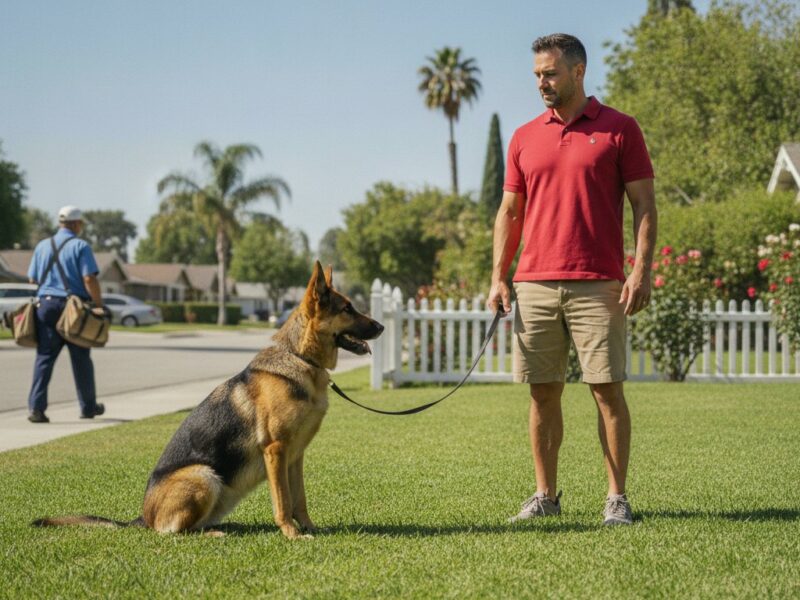
You’re relaxing at home when a delivery driver steps onto the porch. Suddenly, your living room erupts into a chaotic symphony of frantic yaps and lunging at the window. You feel your blood pressure spike as you scramble to settle the noise before the neighbors complain. It’s a frustrating cycle that makes you feel like a hostage in your own house. Stop the embarrassment and the fear of noise fines. Finding a professional dog trainer for excessive barking is the definitive way to reclaim your home and your peace of mind.
We agree that you shouldn’t have to live in a state of constant alert. You deserve a dog that listens the first time, every time. This guide will show you how professional structure and clear communication can transform that noise into reliable silence and focus. We’ll explore how specialized Board and Train programs and the Remote Training Collar serve as the ultimate reset button for your pet’s behavior. Get ready to replace your frustration with a sense of mastery and pride as you build a stronger, more adventurous bond with your dog.
Key Takeaways
- Understand why your dog barks and identify the leadership vacuum that often fuels excessive noise.
- Break the barking loop by moving past “positive-only” management and reactive yelling that actually reinforces the behavior.
- Discover how a professional dog trainer for excessive barking uses the Remote Training Collar to redirect focus and establish clear communication.
- Explore how immersive Board and Train programs act as a definitive reset button for chronic, high-arousal barkers.
- Reclaim your home and your peace of mind by choosing a training path that prioritizes structure and reliable results.
Beyond the Noise: Identifying Why Your Dog Barks Excessively
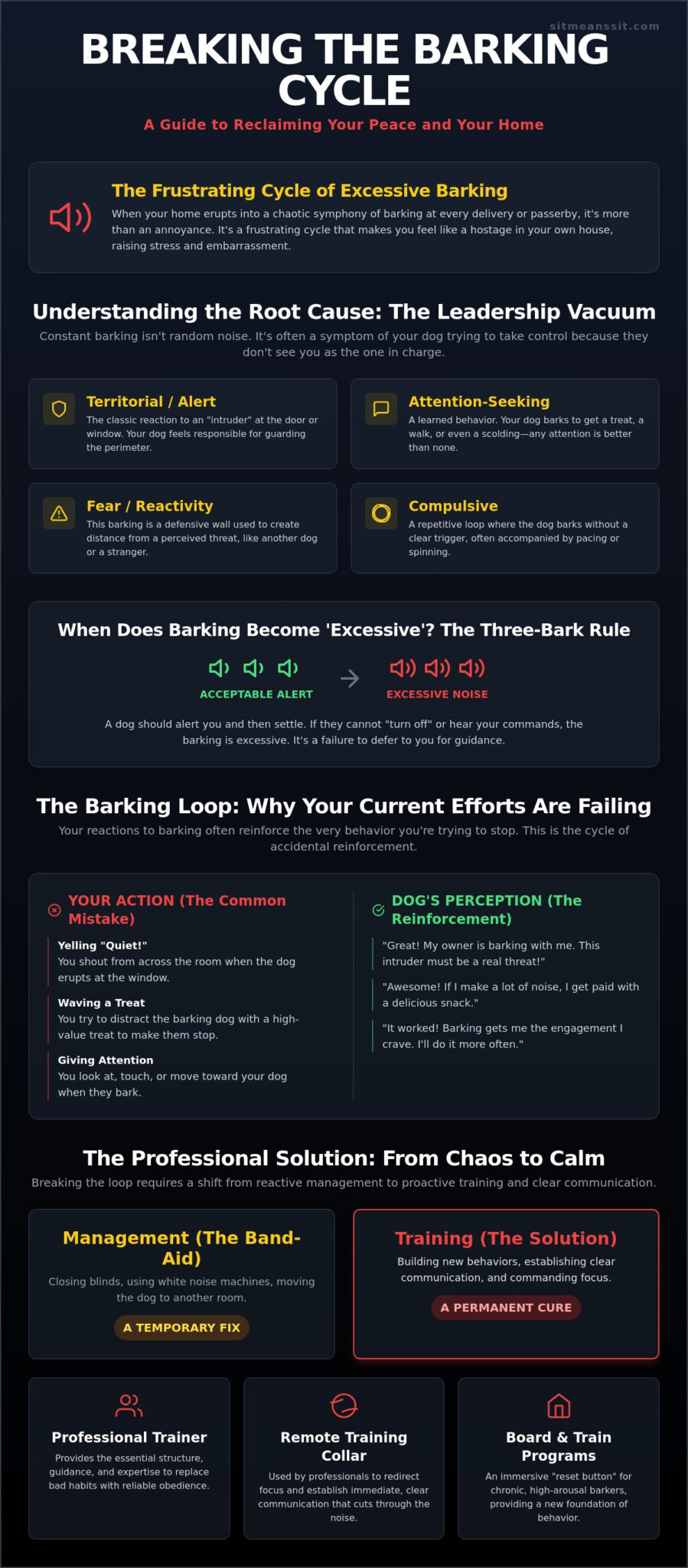
Barking is a natural tool for your dog, but it shouldn’t be the background track to your life. When the noise becomes constant, it’s rarely just about the mailman. It’s about a leadership vacuum. Your dog is trying to handle a situation because they don’t see you as the one in control. Finding a qualified dog trainer for excessive barking is about more than just quiet; it’s about restoring the hierarchy in your home. Research shows many reasons for excessive barking, including boredom and territorial instincts. Understanding the “why” is the first step toward the “how” of fixing it.
There is a massive difference between alert barking and demand barking. Alert barking says, “Hey, someone is here!” Demand barking says, “Pay attention to me right now.” When your dog uses noise to manipulate your behavior, the roles have flipped. This creates a state of constant mental arousal. A dog that barks out of boredom isn’t just “annoying”; they are suffering from a lack of mental structure. This takes a heavy emotional toll on everyone. You feel stressed and embarrassed, while your dog feels the weight of a job they aren’t equipped to handle. Structure provides the liberation you both need.
The Four Most Common Barking Triggers
- Territorial/Alert: This is the classic reaction to the “intruder” at the door or window. Your dog feels responsible for guarding the perimeter.
- Attention-Seeking: This is a learned behavior. Your dog barks to get a treat, a walk, or even a scolding, because any attention is better than none.
- Fear/Reactivity: This barking is a defensive wall. Your dog is trying to create distance between themselves and a perceived threat, like another dog on a walk.
- Compulsive: This is a repetitive loop. The dog barks without a clear external trigger, often accompanied by pacing or spinning.
When Does Barking Become ‘Excessive’?
Most owners can handle a few seconds of noise. We call this the “Three-Bark Rule.” A dog should be able to alert you to a visitor and then immediately settle once you acknowledge the situation. It becomes excessive when it turns into an endless spiral. If your dog cannot “turn off” after the trigger is gone, or if the intensity is so high they can’t hear your commands, you have a problem. Ultimately, excessive barking is a failure of the dog to defer to the owner for guidance. When they don’t look to you for the next move, they keep making their own noise. A dog trainer for excessive barking can help you regain that focus and restore order, which is particularly crucial in managed residential blocks where firms like AM Surveying & Block Management ensure that noise levels remain within communal standards.
The Barking Loop: Why Your Current Efforts Are Failing
You’ve tried yelling. You’ve tried treats. You’ve probably even tried ignoring it until your ears rang. Yet, the noise persists. Most owners find themselves stuck in a cycle where their attempts to stop the noise actually fuel the fire. This is the “Barking Loop.” It is a frustrating cycle of accidental reinforcement that leaves you feeling powerless and your dog feeling more reactive than ever. Breaking this loop requires a shift from reacting to your dog’s noise to proactively commanding their focus.
The biggest pitfall is the “Quiet!” trap. When your dog erupts at the window and you shout from the other room, they don’t hear a correction. They hear you joining in. To a dog, you are simply barking along with them at the intruder. This high-energy interaction validates their excitement. Similarly, attempting to get your dog to stop barking by waving a treat in their face is often interpreted as a reward for the outburst. You aren’t calming them; you’re paying them to be loud. Every uncorrected bark is a rehearsal. The more they practice the behavior, the more it becomes their default setting.
The Science of Accidental Reinforcement
Dogs crave engagement. If your dog barks and you look at them, touch them, or move toward them, you’ve just provided a reward. Even negative attention is still attention. Beyond your reaction, barking itself provides an intrinsic “high” for many breeds. It releases adrenaline and creates a self-satisfying loop. To stop this, you need immediate, clear communication that cuts through the noise. Working with a professional dog trainer for excessive barking helps you identify these subtle reinforcements and replace them with a new standard of behavior. If you are ready to stop the cycle, consider how Private Lessons can provide the one-on-one coaching you need to succeed.
Management vs. Training: The Critical Difference
Many owners rely on management. They close the blinds, move the dog to another room, or use white noise machines. These are bandages, not cures. Management is about avoiding the trigger; training is about mastering it. A dog trainer for excessive barking focuses on building a foundation of obedience that works even when the blinds are open and the distractions are high. You shouldn’t have to hide from the world to have a quiet home. True liberation comes when your dog can see a distraction and choose to look at you for guidance instead of reacting with noise. Transitioning from avoidance to mastery is the only way to achieve long-term peace.
Why You Need a Professional Dog Trainer for Barking
DIY training often hits a wall because you’re too close to the situation. A professional dog trainer for excessive barking acts as an objective observer. They see the micro-movements, the ear twitches, and the weight shifts that happen seconds before the first bark erupts. While you’re reacting to the noise, an expert is reacting to the intention. This outside eye is critical for identifying the specific environmental triggers that set your dog off, allowing for a proactive rather than reactive approach.
Expert trainers don’t just treat the symptoms. They address the underlying state of mind. If your dog is anxious, fearful, or over-stimulated, simply telling them to be quiet won’t work long-term. You need a strategy that shifts their emotional response to the environment. Cornell University highlights the importance of professional insight when training a dog that barks excessively. By changing how the dog feels about a trigger, you remove the need for them to bark in the first place. This creates a transformation that is both deep and lasting.
Structure is your best friend in this process. In a professional facility, your dog enters a zone where they cannot rehearse bad habits. Every interaction is intentional and every boundary is clear. This creates a reliable foundation where commands like “quiet” or “place” become non-negotiable agreements rather than mere suggestions. This level of reliability ensures your dog remains focused and silent even in high-stakes, off-leash environments where distractions are at their peak.
Customized Behavioral Blueprints
A one-size-fits-all approach is a recipe for failure. A vocal Beagle has different motivations than a reactive German Shepherd. Your trainer will tailor corrections and reinforcements to match your dog’s specific temperament and energy levels. If you’re unsure who to call for your specific situation, check out our guide on Dog Behaviorist vs. Trainer to find the right expert for your household. We replace guesswork with a definitive plan for success.
The Value of Immersive Learning
Progress happens fast when distractions are controlled and consistent. Professional facilities allow trainers to introduce “real-world” triggers in a safe, manageable way. Instead of hoping a neighbor walks by with a dog so you can practice, we create that scenario intentionally and repeatedly. This accelerated learning path is why many owners choose a dog trainer for excessive barking for rapid, visible results. The process concludes with owner education, ensuring you have the confidence to maintain that peaceful, adventurous lifestyle at home.
The Sit Means Sit Approach: Communication Through Focus
We don’t just manage the noise; we master the mind. Most owners try to stop barking by blocking the dog’s view or yelling, but these are reactive bandages. At Sit Means Sit, we know that focus is the ultimate foundation. A dog that is actively looking at you cannot be barking at the door. By shifting your pet’s attention from the distraction to your guidance, we bridge the communication gap that causes chaos. This is why a dog trainer for excessive barking must focus on engagement rather than just suppression.
Our philosophy is simple: Every command is a definitive agreement. It isn’t a suggestion or a request. When you give a directive, your dog understands that following through is the only option. This clarity replaces their anxiety and frustration with a sense of purpose. We build a relationship based on respect and structure. This discipline doesn’t restrict your life; it liberates it. With a focused dog, you gain the freedom to go on more adventures without the fear of a noisy outburst ruining the day.
Mastering the Remote Training Collar
The Remote Training Collar is the cornerstone of our methodology. We don’t use it for punishment. Think of it as a digital “tap on the shoulder” that works at a distance. It provides a clear, consistent signal that cuts through the mental fog of a barking dog, instantly redirecting their attention back to you. This tool allows us to achieve off-leash reliability even in high-stimulation environments. Whether the doorbell rings or a squirrel sprints across the yard, you maintain the ability to communicate with your dog instantly and non-verbally. This is the difference between hoping for quiet and demanding it with confidence.
The Power of the ‘Place’ Command
Teaching the “Place” command is like giving your dog a physical reset button. When a trigger appears, you don’t just tell them to be quiet; you give them a job to do. Sending your dog to a designated “Place” creates a hot zone for relaxation. It forces them to settle their body, which in turn settles their mind. They learn to defer to your judgment rather than reacting to every sound. For those seeking Dog Obedience Training, this command is essential for total control. If you’re tired of being held hostage by the noise, contact us today to see our methodology in action and transform your dog’s behavior forever.
Choosing Your Path to a Quiet Home: Training Programs
Every dog is an individual, and every household has unique needs. Finding the right dog trainer for excessive barking means selecting a program that matches your lifestyle and your dog’s specific challenges. Whether you need a complete behavioral overhaul or just a few sessions to sharpen your communication, we have a definitive solution. Our programs are designed to move beyond simple management and deliver total off-leash reliability in the real world. We replace the leadership vacuum with clear boundaries and reliable focus.
If you prefer to be the primary handler from day one, Private Lessons provide intensive, one-on-one coaching tailored to your specific home environment. You’ll work directly with a dog trainer for excessive barking to master the Remote Training Collar and the “Place” command. Once that foundation is set, Group Classes allow you to test your dog’s silence and focus in high-distraction social settings. For those with younger pets, Puppy Preschool is the ultimate preventative measure. We stop vocal habits before they ever take root, ensuring your puppy grows into a focused, well-behaved adult.
Is Board and Train Right for Your Barking Dog?
For many owners, the constant noise has reached a breaking point. If you’re facing pressure from neighbors or just feel overwhelmed by your dog’s reactions at the window, our Board and Train program offers an immersive reset. Your dog stays with us for 24/7 professional reinforcement, allowing our experts to break the barking loop in a controlled environment. This is the fastest path to transformation. It’s ideal for busy owners who need the heavy lifting done by professionals. We address the chronic rehearsal of bad habits and return a dog that understands that silence is the new standard.
Taking the First Step Toward Silence
The journey to a quiet home starts with a professional conversation. During your initial evaluation, we’ll assess your dog’s temperament and identify the specific triggers causing the noise. We don’t guess; we observe and create a customized behavioral blueprint. This process requires a commitment from you to maintain the structure we provide, but the reward is a lifetime of adventurous freedom with your pet. You’ll no longer feel held hostage by your dog’s reactions. Instead, you’ll feel a sense of mastery and pride. Contact Sit Means Sit today for a free evaluation!
Reclaim Your Peace and Master the Silence
You don’t have to live with the constant stress of a reactive home. Excessive barking isn’t a permanent character flaw; it’s a communication gap that we bridge through professional structure. By identifying the leadership vacuum and replacing it with clear commands, you transform your dog’s state of mind from anxious to focused. Whether you choose immersive training or private coaching, you are investing in a lifestyle of freedom and confidence. Discipline is the key that unlocks a more adventurous and joyful life for both you and your pet.
Choosing a dog trainer for excessive barking means trusting experts who understand the emotional state of your animal. Sit Means Sit brings over 25 years of professional training experience to every session. We utilize a specialized off-leash communication methodology that delivers proven results even in high-distraction environments. Stop the embarrassment at the door and start a new chapter of pride in your pet’s behavior. The silence you crave is within reach.
Schedule Your Free Barking Evaluation with Sit Means Sit Today!
Take control of your home and rediscover the joy of a perfectly behaved companion. We’re ready to help you achieve the reliable results your family deserves. Let’s start this transformation together.
Frequently Asked Questions
Can a professional trainer really stop a dog from barking at the doorbell?
Yes, a professional can absolutely stop your dog from erupting at the doorbell. We replace the reactive guarding instinct with a specific command like “Place.” This shifts your dog’s focus from the visitor to your instruction. By establishing a definitive agreement that you are in control of the door, your dog learns to remain silent and calm while you greet your guests.
How long does it take to see results with a dog trainer for barking?
You will often see a visible shift in your dog’s focus during the very first session. Long term reliability depends on the program you choose and your commitment to the process. An immersive Board and Train acts as a rapid reset button for chronic barkers. Private Lessons build mastery over several weeks as you learn to lead your dog through real world distractions.
Is a remote training collar safe for a dog that barks out of anxiety?
The Remote Training Collar is a safe and highly effective tool for anxious dogs. We don’t use it as a punishment; it serves as a gentle tap on the shoulder that cuts through the mental fog of anxiety. By providing clear, non-verbal communication, the collar reduces your dog’s stress. It gives them a predictable structure to follow when they feel overwhelmed by their environment.
Will my dog stop barking entirely if I hire a trainer?
No, your dog won’t stop barking entirely, and they shouldn’t. Barking is a natural form of communication. Our goal is to eliminate excessive, out of control noise that disrupts your life. Hiring a dog trainer for excessive barking ensures you have the power to turn off the noise once you’ve acknowledged the trigger. You regain control while respecting your dog’s nature.
What is the best age to start training a dog to stop excessive barking?
The best time to start is right now. We offer Puppy Preschool to prevent vocal habits from ever forming. Starting early establishes a foundation of focus and leadership before your dog learns to use barking as a tool for manipulation. However, any dog at any age can benefit from learning a better way to communicate and defer to their owner.
Can older dogs be trained to stop barking, or is it too late?
It is never too late to train an older dog. While senior dogs may have practiced their barking loops for years, they are still capable of incredible transformation. Our methodology focuses on the dog’s current state of mind rather than their age. We replace old, noisy habits with new, structured behaviors that provide your senior pet with a much needed sense of calm and purpose.
How much does professional training for excessive barking cost?
The investment for a dog trainer for excessive barking varies based on the intensity and duration of the program you select. An immersive Board and Train requires a different commitment than a series of Private Lessons or Group Classes. We recommend a professional evaluation to determine which path fits your specific goals and budget. We focus on providing long term value that restores peace to your household.
What should I do if my dog starts barking again after the training ends?
Consistency is the key to maintaining your results. If your dog begins to test boundaries, immediately return to the foundational commands and tools you learned during training. Use your Remote Training Collar to redirect their focus the moment the first bark starts. Most relapses happen when the owner stops enforcing the structure. Stay disciplined, and your dog will stay reliable.
Comments are closed.