
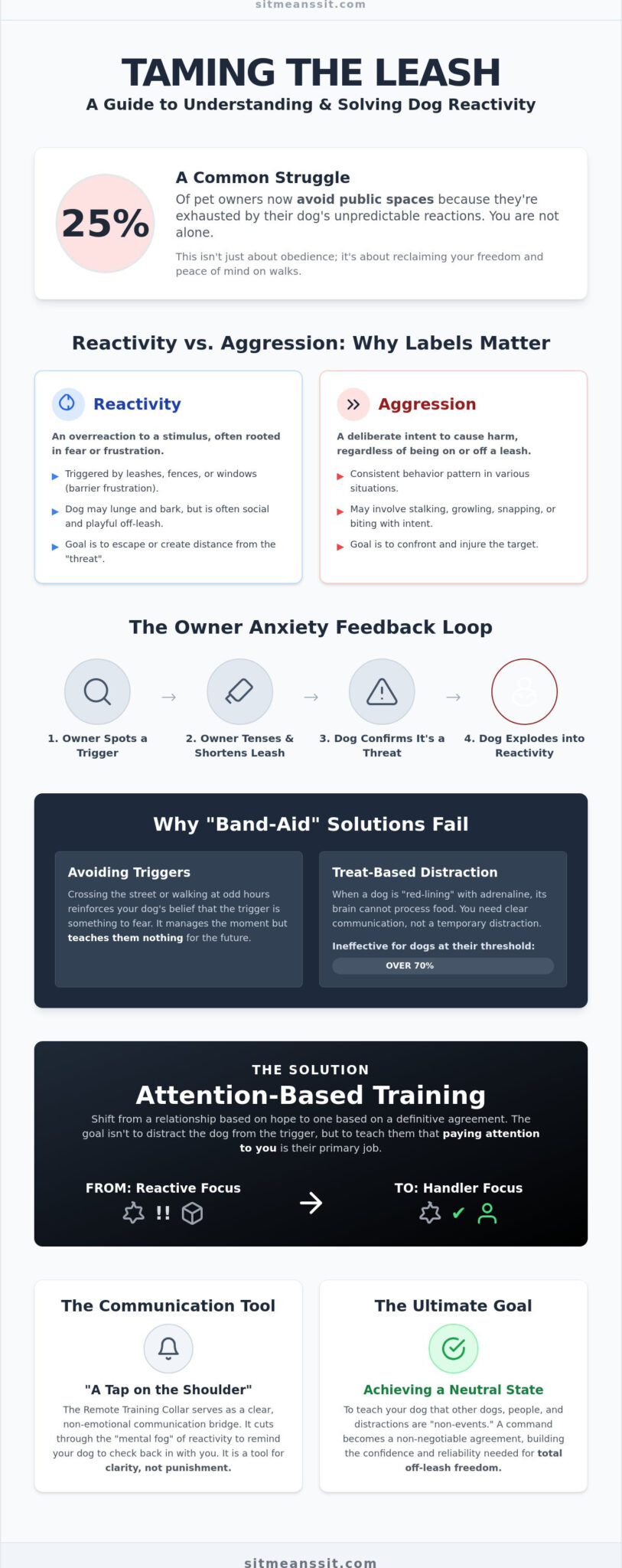
Recent industry data shows that 25% of pet owners now avoid public spaces because they’re exhausted by their dog’s unpredictable reactions. If you’ve ever felt the physical strain of a sudden lunge or the stinging embarrassment of a barking fit in your own neighborhood, you aren’t alone. You want to enjoy the outdoors, but instead, you’re scanning every corner for potential triggers. This is why effective leash reactive dog training is about more than just obedience. It’s about reclaiming your freedom and your pride.
We understand the fear of liability and the frustration of feeling out of control. It’s time to stop managing the problem and start solving it. You can replace that reactive behavior with reliable focus using a proven, attention-based training methodology. This guide shows you how to transform your walk from a stressful ordeal into a peaceful experience. We’ll explore how structured communication leads to total control in high-distraction areas and, ultimately, the off-leash reliability you’ve always dreamed of.
Key Takeaways
- Understand the critical difference between fear-based overreactions and true aggression to better address your dog’s specific needs.
- Master the fundamentals of leash reactive dog training by shifting your dog’s focus back to you during high-stress encounters.
- Learn how the Remote Training Collar serves as a clear communication tool to maintain control in any environment.
- Discover how to identify and manage your dog’s threshold to build successful repetitions and lasting confidence.
- Evaluate different training paths like immersive Board and Train programs to find the fastest route to off-leash reliability.
Leash Reactive Dog Training: Understanding the Root of Reactivity
Leash reactivity isn’t a personality trait. It’s a communication breakdown. At its core, reactivity is an overreaction to external stimuli while your dog is restrained. When a dog is on a leash, they lose their ability to choose “flight.” This leaves them with “fight” as their primary defense mechanism. Understanding Leash Reactivity helps us see that most lunging and barking is actually rooted in frustration or fear, not a genuine desire to attack. You aren’t walking a “bad” dog; you’re walking a dog that feels trapped and overwhelmed.
Many owners suffer through “barrier frustration.” This phenomenon occurs when a social dog wants to greet another animal but can’t because of the leash. That pent-up energy has nowhere to go, so it explodes into a display of noise and pulling. This often creates a feedback loop with owner anxiety. You see a trigger, you tense up, and you shorten the leash. Your dog feels that tension instantly. In their mind, you just confirmed that the oncoming dog is a threat. This cycle turns every walk into a high-stress battle of wills.
Reactivity vs. Aggression: Why Labels Matter
Words have power. Mislabeling a reactive dog as “aggressive” leads to fear-based decisions and ineffective training choices. Aggression is defined by an intent to harm, while reactivity is a frantic response to a stimulus. If your dog lunges and barks but plays well at the park, they are reactive, not aggressive. Because these behaviors look similar, you should seek a professional evaluation by a dog behaviorist or an expert trainer. They can help you identify if your dog is truly dangerous or simply lacks the tools to handle environmental pressure.
The Failure of Traditional Management
Stop relying on band-aid solutions. Crossing the street to avoid every trigger might keep the peace today, but it teaches your dog nothing. It actually reinforces the idea that the trigger is something to fear. Treat-based distraction also has a high failure rate in leash reactive dog training. Recent data from 2026 shows that over 70% of owners found treats completely ineffective once a dog reached its boiling point. When a dog is “red-lining,” their brain literally cannot process food. They need clear, physical communication and a definitive agreement on what behavior is expected. Tightening the leash only transmits your stress; you need a methodology that builds confidence through structure.
The Sit Means Sit Methodology: Attention as the Antidote
Traditional advice often tells you to distract your dog with a high-value treat. But when a high-energy dog is locked onto a trigger, a piece of chicken usually isn’t enough to break that focus. That’s why our approach to leash reactive dog training centers on attention-based training. We don’t just wait for the reaction to happen. We build a foundation where your dog’s primary job is to watch you. If your dog is focused on your leadership, they simply don’t have the mental bandwidth to worry about the environment. Structure isn’t a restriction. It’s a safety net that allows your dog to relax because they know you’re in charge. You’re shifting from a relationship based on hope to one based on a definitive agreement.
Reactive dogs live in a state of constant hyper-vigilance. They’re scanning for threats because they don’t trust the person at the other end of the leash to handle the situation. Our methodology flips this script. By providing clear boundaries, you reduce your dog’s anxiety. They no longer feel the need to scream at every passing dog because they understand their job is to remain focused on you. This is how we move beyond simple management and into true behavioral mastery.
The Remote Training Collar: A Tool for Clarity
Think of the Remote Training Collar as a “tap on the shoulder.” It’s a clear communication bridge that cuts through the mental fog of a reactive state. When your dog sees a trigger, they often enter a zone where they can’t hear your voice. Low-level stimulation provides a physical reminder to check back in. This isn’t about punishment. It’s about providing the clarity your dog needs to make a better choice. By mastering this tool, you stop the reaction before the first bark even happens. This precision is exactly what paves the way for total off-leash freedom. You can find more about how we implement these tools at Sit Means Sit.
Achieving a Neutral Emotional State
We want your dog to view other animals and distractions as “non-events.” This means teaching them that a command is an agreement that must be kept, even under pressure. Whether you’re in a quiet park or a crowded street, the goal is a dog that remains calm and responsive. Experts in managing reactive behavior often emphasize the need for consistent cues, and our methodology takes that to the next level. You’re building a dog that looks to you for direction the moment they feel unsure. This transformation replaces defensive instincts with a sense of calm reliability. It turns every walk into an opportunity for pride rather than a source of embarrassment. Steady practice in leash reactive dog training ensures that your dog remains neutral regardless of what’s happening around them.
Professional Training Formats: Which Path Solves Reactivity?
Choosing the right environment is the first step toward success. If your dog explodes the moment you step off the porch, you’re fighting an uphill battle. Professional intervention provides the structure needed to break these habits quickly. It isn’t just about stopping the bark; it’s about resetting the dog’s expectations of the world. Removing a dog from their home triggers allows them to focus entirely on new communication patterns without the baggage of past failures. This immersive approach accelerates the learning process and builds a foundation of neutrality that you can’t always achieve on your own.
Intensity matters when selecting a program. A dog that occasionally grumbles at a distance requires a different strategy than a dog that lunges at every moving object. You need to be honest about your dog’s current state and your own ability to manage it. Professional leash reactive dog training is designed to meet you where you are while pushing you toward where you want to be. It turns the “impossible” walk into a manageable, and eventually enjoyable, daily routine.
Board and Train: The Immersive Reset
For severe cases, a Board and Train program is the gold standard. This immersive format allows professional trainers to handle the heavy lifting of desensitization in a controlled, neutral setting. It provides 24/7 consistency that most busy households simply can’t replicate. While your dog is with us, they learn that every interaction is governed by clear rules. This intensive conditioning builds a massive “bank account” of successful repetitions. When they return home, the “mental fog” of reactivity has cleared, leaving you with a dog that is ready to listen and follow your lead.
Private Lessons: Personalized Skill Building
If you want to be in the driver’s seat from day one, private dog lessons are the answer. We customize these sessions to the specific triggers you face every day, like that one neighbor’s barking dog or the busy intersection near your house. This format focuses on owner empowerment. You learn exactly how to use the Remote Training Collar to redirect focus before a reaction starts. This foundational dog obedience training creates a bond of trust and a shared language between you and your pet. It gives you the hands-on experience needed to handle any situation with absolute confidence.
Regardless of the format, your involvement is the key to lasting results. A trainer can show the dog the way, but you must lead the walk every single day. Organizations dedicated to Training Leash-Reactive Dogs agree that consistency across all environments is vital for long-term success. Investing in professional leash reactive dog training isn’t just about fixing a problem. It’s about buying back your freedom to walk anywhere without fear. Decide today which path leads to the lifestyle you and your dog deserve.
For those who want to ensure their dog receives expert care and consistent reinforcement during their daily outings, check out H&H Dog for professional dog walking and training services.
Real-World Socialization and Threshold Management
Mastering leash reactive dog training requires a deep understanding of your dog’s “threshold.” This is the specific distance where your dog can see a trigger but still remain focused on your commands. Many owners make the mistake of staying so far away that the dog never learns to cope. We don’t want you to hide forever. The goal is to gradually decrease that distance through thousands of successful, calm repetitions. By using the Remote Training Collar as a gentle “tap on the shoulder,” you help your dog realize that the world isn’t a threat. You’re building the mental muscle needed for total focus.
Forget the myth of the dog park. These environments are often chaotic and unpredictable. For a reactive dog, a dog park is a recipe for a massive setback. Instead, we focus on “Neutral Socialization.” This means teaching your dog to exist in the same space as other animals without the need to interact, lunge, or bark. It’s about creating a dog that is perfectly bored by the presence of others. This state of mind is the ultimate achievement in behavioral reliability. It turns a walk through a busy park into a relaxing stroll rather than a tactical mission.
Controlled Exposure in Group Settings
Group classes provide the perfect “safe” social environment for leash reactive dog training. Here, every owner is working toward the same goal of controlled focus. You aren’t dealing with the unpredictability of a neighborhood sidewalk or an untrained stray. This structured setting allows you to practice obedience under professional supervision. Whether you’re transitioning from puppy training classes or starting as an adult, group sessions are where you prove your dog’s reliability. It’s the final testing ground before you take your skills to the real world with absolute confidence.
Advocating for Your Dog in Public
You must be your dog’s leader and protector. When an “off-leash” dog approaches, you need the confidence to handle the situation without tensing up. Your dog feels every ounce of your stress through the leash. By maintaining a calm, assertive posture, you show your dog that you have the situation under control. Choose your practice environments wisely. Start in low-stimulation areas and work your way up as your skills grow. If you’re ready to stop avoiding the world and start enjoying it, find a Sit Means Sit location near you to begin your transformation.
Taking the Lead: Your Path to a Stress-Free Future
Living with a reactive dog causes a specific kind of emotional burnout. You feel isolated, embarrassed, and physically drained after every walk. It’s easy to lose hope and assume this is just your dog’s personality. But reactivity is a solvable communication problem. With the right tools and professional guidance, you can replace that constant anxiety with absolute confidence. Leash reactive dog training isn’t just about stopping a bark; it’s about reclaiming your lifestyle. You deserve to enjoy the outdoors without scanning every corner for a potential conflict.
Imagine a future where you don’t check the clock to find the “quietest” time for a walk. Picture yourself enjoying a Saturday morning at a crowded outdoor cafe with your dog resting calmly at your feet. Visualize off-leash hiking where your dog remains responsive to your every command despite the distractions of the trail. This level of reliability is the ultimate goal of our programs. We move you from a state of frustration to a state of pride. Structure creates a narrative where discipline leads to a more adventurous and joyful life for both you and your pet.
Why Professional Help is the Responsible Choice
Attempting to fix severe reactivity on your own carries significant risks. DIY methods often rely on timing that owners haven’t mastered yet, which can lead to accidental setbacks or increased fear in the dog. Expert trainers identify subtle body language cues, like a stiffening tail or a fixed stare, that most owners miss until it’s too late. By the time the lunging starts, the learning window has closed. Finding a dog trainer near me who specializes in results-oriented methodology ensures your dog receives clear, fair instruction. Professional intervention is the fastest and safest route to a peaceful neighborhood walk.
Your First Step Toward Liberation
Every dog and owner dynamic is unique. That’s why our process begins with a comprehensive evaluation to assess your dog’s specific temperament and triggers. During your Sit Means Sit consultation, we demonstrate how our attention-based methodology applies to your real-world challenges. We don’t offer generic advice; we provide a tailored roadmap to success. This assessment is vital because a command must be a definitive agreement between you and your dog, not a suggestion. Stop dreading your walks and start looking forward to them. Contact us for a free evaluation today and take the first step toward a life of off-leash freedom and total control. Your journey in leash reactive dog training starts here.
Reclaim Your Freedom and Your Dog’s Focus
You don’t have to live with the stress of lunging and barking. We’ve shown you that reactivity is simply a communication breakdown, not a permanent character flaw in your dog. By mastering attention-based training and setting clear boundaries, you replace fear with focus. Our methodology provides the structure your dog needs to feel safe and secure in any environment. This is about more than obedience. It’s about building a life where you can go anywhere with absolute confidence.
With over 25 years of professional expertise and specialized off-leash communication tools, we’ve perfected a results-oriented approach for all breeds. Our leash reactive dog training programs transform your daily routine into a source of pride. Stop managing the chaos and start enjoying the bond you were meant to have. You have the power to change your dog’s future today.
Transform Your Walks Today—Schedule Your Free Evaluation!
The peaceful, adventurous life you want is within reach. Take the first step toward liberation and watch your dog thrive under your confident leadership. We’re ready to help you every step of the way.
Frequently Asked Questions
Can a leash reactive dog ever be cured?
Reactivity is a manageable behavior that can be transformed into calm neutrality through consistent training. While “cured” implies a medical fix, we focus on behavioral mastery and reliable obedience. By replacing reactive instincts with a focused engagement on the owner, your dog learns that external triggers are non-events. This transformation allows you to reclaim your pride and enjoy peaceful walks in any environment.
Is my dog too old to start leash reactive dog training?
Dogs of any age can successfully complete leash reactive dog training. Whether your pet is a young pup or a senior, they are capable of learning new communication patterns. Older dogs often have more practiced habits, but our attention-based methodology cuts through years of bad behavior. We tailor the approach to your dog’s physical abilities and temperament to ensure they feel empowered rather than overwhelmed.
How long does it take to see progress with a reactive dog?
You will often see a shift in your dog’s engagement during the very first session. However, building total off-leash reliability in high-distraction environments typically takes several weeks of steady practice. The timeline depends on the intensity of the reactivity and your commitment to the daily homework. Immersive programs like Board and Train can accelerate this process significantly by providing 24/7 consistency that is hard to achieve at home.
Will a remote training collar make my dog more reactive?
A Remote Training Collar will not increase reactivity when used correctly as a communication bridge. It acts as a “tap on the shoulder” to redirect your dog’s focus back to you before they reach their breaking point. By providing clear direction, you actually reduce the dog’s anxiety and frustration. This clarity replaces the mental fog of reactivity with a sense of calm understanding and reliable focus.
What is the difference between reactivity and aggression?
Reactivity is a frantic overreaction to a trigger, while aggression is a calculated intent to cause harm. Most dogs seen lunging on a leash are actually experiencing fear or barrier frustration. They use noise and movement to create distance from something that makes them uncomfortable. Distinguishing between the two is vital for choosing the right training path and ensuring everyone’s safety during the rehabilitation process.
Can I train my reactive dog myself at home?
While basic obedience can start at home, true reactivity usually requires professional intervention. Owners often struggle with timing and reading subtle body language cues, which can lead to accidental setbacks or increased tension. An expert trainer provides the controlled environment and neutral distractions necessary for safe desensitization. Professional help is the fastest and most responsible route to a stress-free future for you and your dog.
How much does professional training for a reactive dog cost?
Training costs depend on the format you choose, such as immersive Board and Train programs or personalized Private Lessons. Specialized behavior modification for leash reactive dog training typically requires more expertise and safety protocols than basic obedience classes. We recommend a free evaluation to determine which program fits your dog’s needs. This allows us to provide a clear roadmap for your specific situation and lifestyle goals.
Should I use a harness or a collar for a reactive dog?
We recommend using a collar for better communication and physical control. Harnesses were originally designed for pulling, and they often give a reactive dog more leverage to lunge and ignore your commands. A collar allows for more precise direction and clearer signals. When paired with our attention-based methodology, the right tool helps your dog understand exactly what you are asking of them during every walk.
Comments are closed.