
The closest dog trainer isn’t always the best one. That’s a hard truth most owners discover only after spending money on sessions that produced zero lasting change. If you’ve typed “dog trainer near me” into a search bar feeling desperate for a real solution, you already know the frustration of a dog that pulls, bolts, ignores commands, and turns every walk into a public embarrassment.
You’re not alone, and it’s not your fault. Most owners have been let down by trainers who taught their dog to perform in a quiet classroom but couldn’t prepare them for the real world: the busy park, the open gate, the squirrel that appears out of nowhere. That gap between “trained in a session” and “reliable everywhere” is exactly where results fall apart.
This guide cuts through the noise. You’ll discover exactly what separates a trainer who delivers genuine off-leash control from one who simply takes your money, what questions to ask before you commit, and what a proven methodology actually looks like in practice. By the end, you’ll know how to find a professional who can transform your dog into a confident, attentive companion you’re proud to take anywhere.
Key Takeaways
- Searching for a dog trainer near me requires more than checking proximity — you need to verify that a trainer follows proven, real-world methodologies that produce reliable off-leash results beyond the training environment.
- Attention is the foundation of every obedience command, and without it, even well-trained dogs will fail the moment a distraction appears — understanding why this happens is the first step to fixing it.
- Immersive programs like Board and Train can accelerate behavioral transformation dramatically compared to once-a-week lessons, making them a powerful option for dogs with serious or persistent issues.
- Before committing to any trainer, asking the right questions — including requesting a live demonstration — can reveal whether their results are real or just rehearsed classroom performances.
- Sit Means Sit’s attention-based methodology and Remote Training Collar technology are designed to work for every dog, regardless of breed, age, or behavioral history, delivering the total control owners actually need.
What Should You Look for in a Professional Dog Trainer Near You?
A professional dog trainer isn’t just someone who likes dogs. They’re a behavioral architect, someone who designs a systematic path from chaos to control and can prove it works in the real world. That distinction matters enormously when you’re searching for a dog trainer near me and staring at a list of options that all sound equally convincing on paper.
The word “near” is doing a lot of heavy lifting in that search. Proximity feels practical, but it’s the wrong filter to lead with. What you actually need is a trainer who operates at a national standard of quality, regardless of how many miles separate you from their facility. A trainer ten minutes away who produces inconsistent results will cost you far more in time, money, and frustration than one who requires a longer drive but delivers genuine transformation.
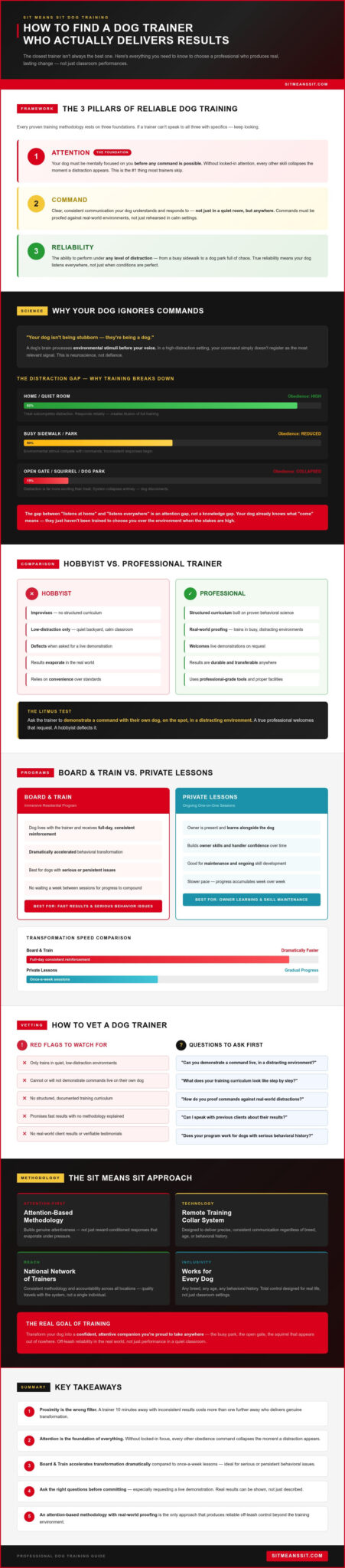
Every reliable training methodology is built on three core pillars:
- Attention: Your dog must be focused on you before any command is possible. Without attention, every other skill collapses under pressure.
- Command: Clear, consistent communication that your dog understands and responds to, not just in a quiet room, but anywhere.
- Reliability: The ability to perform under any level of distraction, from a busy sidewalk to a dog park full of chaos.
If a trainer can’t speak to all three of these pillars with specifics, keep looking.
The Difference Between a Hobbyist and a Professional
A hobbyist improvises. A professional follows a structured curriculum built on proven behavioral science and refined through thousands of hours of real-world application. The clearest test? Ask a trainer to demonstrate a command with their own dog on the spot, in a distracting environment. A true professional welcomes that request. A hobbyist deflects it. Professional-grade tools and proper facilities aren’t optional extras; they’re signals that the trainer takes results seriously.
Why Results-Oriented Training Trumps Convenience
Convenient trainers often operate exclusively in low-distraction environments, a quiet backyard, a calm classroom, a familiar hallway. That’s where the illusion of progress is easiest to manufacture. The moment your dog hits the real world, that progress evaporates. A national network like Sit Means Sit provides consistent methodology and accountability across locations, meaning the quality standard travels with the system, not with a single individual’s good intentions. Driving a little further for that level of reliability isn’t a sacrifice. It’s the smartest investment you can make.
The Science of Attention: Why Your Dog Ignores Commands
Here’s the uncomfortable truth most trainers won’t tell you: your dog isn’t being stubborn. They’re being a dog. When your dog ignores you at the park after performing perfectly in your kitchen, that’s not disobedience. That’s neuroscience. A dog’s brain processes environmental stimuli before it processes your voice, and in a high-distraction setting, your command simply doesn’t register as the most relevant signal in the environment.
Attention is the prerequisite for everything else. Before a sit, before a stay, before any reliable recall, your dog has to be mentally present with you. Without that locked-in focus, every command you give is essentially a whisper into a hurricane. Treat-based training works beautifully in low-stimulation environments because the treat temporarily outcompetes the distraction. The moment the distraction is more exciting than the treat, the system collapses entirely.
That’s the core flaw in most conventional training approaches. They condition a response to a reward, not a relationship of genuine attentiveness. The result is a dog that performs on cue when the conditions are perfect and completely disconnects the moment real life shows up.
Breaking Through Environmental Distractions
The gap between “listens at home” and “listens everywhere” is an attention gap, not a knowledge gap. Your dog already knows what “come” means. What they don’t have is a trained habit of choosing you over the environment when the stakes are high. An Attention-First methodology addresses this directly by teaching the dog that engaging with their owner is the most rewarding and consistent option available, regardless of what else is happening around them. Professional trainers build this through systematic, graduated exposure to distractions, not avoidance of them. Off-leash communication tools make it possible to reinforce that focus at a distance, where a treat or a verbal cue simply can’t reach.
The Role of the Remote Training Collar in Modern Obedience
The Remote Training Collar is one of the most misunderstood tools in professional dog training. It’s not a shock device. It’s a communication device. Think of it as a tap on the shoulder: a consistent, low-level signal that cuts through environmental noise and redirects your dog’s attention back to you, instantly, regardless of distance or distraction level.
That consistency is what makes it so effective. Your dog receives the same clear signal whether they’re five feet away or fifty, whether they’re in your backyard or a crowded trail. There’s no confusion, no mixed messages, no escalating frustration on either end of the leash. Clear communication reduces canine anxiety, because a dog that understands exactly what’s being asked of them is a calmer, more confident dog.
This is the “liberation through structure” principle at the heart of Sit Means Sit’s methodology. The collar doesn’t restrict your dog’s freedom; it’s what makes genuine freedom possible. Off-leash hikes, open fields, busy public spaces: these become accessible precisely because reliable communication exists. If you’re searching for a dog trainer near me who can actually deliver that kind of real-world reliability, ask specifically whether they teach attention as a foundational skill before any other command. The answer will tell you everything.
Choosing the Right Program: Board and Train vs. Private Lessons
Not every dog needs the same solution. Not every owner does either. The program that transforms a reactive rescue into a calm, reliable companion might be completely different from what a first-time puppy owner needs. Understanding what each format actually delivers, and who it’s built for, is how you stop guessing and start getting results.
Think of it this way: once-a-week lessons are like attending a language class every seven days without practicing in between. Progress happens, but slowly, and the gaps between sessions give bad habits room to creep back in. Immersive programs eliminate those gaps entirely.
Immersive Board and Train: The Fast Track to Success
Board and Train is a full behavioral reboot. Your dog lives and trains with a professional, building new habits through consistent repetition across every part of their day, not just a dedicated training window. That 24/7 conditioning is what makes the difference for complex issues like aggression, extreme anxiety, or deeply ingrained reactivity. These aren’t problems that respond well to a one-hour session once a week. They require sustained, expert intervention.
The transition process is just as critical as the training itself. A quality Board and Train program doesn’t hand your dog back and wish you luck. It teaches you, the owner, how to maintain everything your dog has learned. You step into a structured handoff, practicing commands with your trainer present, so the new behaviors transfer seamlessly into your home environment.
For owners searching for a dog trainer near me who can deliver rapid, lasting change, Board and Train is often the highest-ROI option available, particularly when behavioral issues are serious or time is limited.
Private Lessons and Group Classes
Private Lessons are the right fit when the owner wants to be the primary trainer. One-on-one coaching puts the professional’s full attention on your specific dog, your specific challenges, and your handling technique. It’s targeted, efficient, and builds your confidence alongside your dog’s.
Group Classes serve a different but equally important purpose: they’re the real-world stress test. A dog that performs beautifully in a quiet session has to prove it can hold that focus around other dogs, unfamiliar people, and competing distractions. That social pressure is exactly what group settings are designed to create.
For puppies, puppy training classes aren’t just about teaching basic commands. They’re about prevention. The habits a puppy forms in their first months become the behaviors an adult dog defaults to under pressure. Starting early means you’re building the right foundation instead of dismantling the wrong one later.
Busy professionals who can’t commit to consistent weekly sessions should ask about Day Training, a middle-ground format where a trainer works with your dog during the day and coaches you on maintenance during pickup. Same professional-grade results, built around a demanding schedule.
How to Vet a Dog Trainer: Red Flags and Essential Questions
Choosing the wrong trainer doesn’t just waste money. It costs you months of your dog’s development and can actually reinforce the behaviors you’re trying to eliminate. Before you commit to any program, run every candidate through a deliberate vetting process. Not a quick Google scan. An actual evaluation with specific questions that separate professionals from performers.
Questions to Ask During Your Consultation
Three questions cut through the noise faster than anything else:
- “Can you show me a dog you’ve trained performing off-leash with distractions present?” This is the non-negotiable opener. A trainer who has genuinely produced results will welcome this request. They’ll have a dog ready, a distracting environment available, and the confidence to demonstrate without preparation time. Hesitation here is your answer.
- “What’s your plan if my dog doesn’t respond to treats or praise?” This question exposes the limits of a treat-dependent methodology. High-drive dogs, anxious dogs, and dogs with serious behavioral histories often don’t respond to food rewards in real-world conditions. A professional has a structured answer. A hobbyist goes quiet.
- “How do you make sure the training sticks once my dog comes home?” The handoff matters as much as the training itself. Any trainer who can’t describe a clear owner-education component is handing you a dog with skills you don’t know how to maintain. Results don’t live in the dog alone; they live in the system the owner continues to apply.
Red Flags to Watch For
Some warning signs are obvious. Others are easy to miss when a trainer is charming and confident-sounding during a consultation.
- They can’t demonstrate their skills live. Excuses like “my dog is resting today” or “I’d need to set that up in advance” are disqualifying. A professional’s results are always on display.
- Vague promises without a structured plan. Phrases like “we’ll work on it” or “every dog is different” aren’t methodologies. They’re deflections. Ask what the training progression looks like week by week. If they can’t tell you, they’re improvising.
- They only train in controlled, private environments. A trainer who never takes your dog into the real world is training for a world that doesn’t exist. Real reliability means performing at a busy park, a crowded trail, or a public space with unpredictable stimuli.
When reading reviews, look past comments like “we had such a great experience” and find the ones that describe specific behavioral transformations: a dog that used to bolt now holds a reliable recall, a reactive dog that can walk calmly past other dogs. That’s the evidence that matters. When you’re searching for a dog trainer near me who can back up their claims, this vetting process is what protects your investment and your dog’s future.
Ready to work with trainers who can demonstrate exactly what you’ve just read about? Find your nearest Sit Means Sit location and ask to see the results for yourself.
Achieving Total Control with Sit Means Sit Dog Training
Since 1998, Sit Means Sit has been rewriting what owners believe is possible with their dogs. This isn’t a franchise built on feel-good sessions and participation ribbons. It’s a national network of professional trainers united by a single, non-negotiable standard: real results, in the real world, with every dog that walks through the door. Breed doesn’t matter. Age doesn’t matter. Behavioral history doesn’t matter. The methodology is built to work across all of it.
That universality is the revolution. Most training systems are designed for the easy cases, the young, eager-to-please dog with no baggage. Sit Means Sit was built for every other dog too: the stubborn, the anxious, the reactive, the one you’ve been told is “untrainable.” Those dogs exist in every neighborhood, and they deserve a solution that actually works.
The Sit Means Sit Methodology in Action
The system starts with attention and builds outward from there. Every command, every behavioral correction, every off-leash milestone is anchored to that foundational focus. The Remote Training Collar is the tool that makes it scalable, delivering clear, consistent communication at any distance without confusion or frustration on either end. The outcome isn’t a robot dog that performs on command out of fear. It’s a happy, obedient dog that genuinely engages with its owner because the relationship is built on clarity, not conflict.
That balance between discipline and joy is what separates Sit Means Sit from programs that produce compliance without confidence. A well-trained dog isn’t a suppressed dog. It’s a dog that knows exactly what’s expected, trusts its owner completely, and moves through the world without anxiety. The national support system behind every Sit Means Sit location means that standard is consistent whether you’re working with a trainer in a major metro area or a smaller market. When you’re searching for a dog trainer near me who operates within a proven, accountable system, that network matters.
Start Your Journey to a Better Life with Your Dog
Professional training isn’t an expense. It’s an investment in your dog’s safety, your peace of mind, and the quality of every single day you spend together. The leash-bound life, the white-knuckle walks, the constant management of a dog you can’t fully trust: none of that has to be permanent.
Stop managing the problem. Start solving it. The difference between where you are now and the off-leash freedom you actually want is a single conversation with a trainer who can show you what’s possible.
Find your nearest Sit Means Sit location and book a free demo today. See the results firsthand. Then decide.
Your Dog’s Transformation Starts with One Decision
The difference between a dog that embarrasses you and one you’re proud to take anywhere isn’t luck. It’s the right trainer, the right methodology, and the right commitment to real-world results.
Everything covered in this guide points to the same truth: attention comes first, program format has to match your dog’s specific needs, and the trainer you choose must be able to prove their results outside a controlled classroom. Proximity is never a good enough reason to settle.
With over 25 years of professional experience, a national network of expert trainers, and an attention-based methodology built to work for every dog regardless of breed, age, or behavioral history, Sit Means Sit exists to close the gap between where your dog is now and where you need them to be.
Don’t keep searching for a dog trainer near me and hoping the next option is better. Know it is. Schedule Your Free No-Obligation Consultation and Demo Today! and see firsthand what genuine transformation looks like. Your best days with your dog are still ahead.
Frequently Asked Questions About Finding a Dog Trainer Near Me
How Much Does Professional Dog Training Cost?
Training costs vary depending on the program format, the trainer’s experience level, and your dog’s specific needs. Private lessons, group classes, and Board and Train programs each carry different price points, with immersive programs typically representing a larger upfront investment. The better question isn’t what training costs; it’s what continuing to live with an untrained dog costs you in stress, damaged property, and missed experiences.
Contact your nearest Sit Means Sit location directly for accurate pricing. Most locations offer a free consultation or demo so you can see the methodology in action before making any financial commitment.
Is My Dog Too Old to Be Trained?
No. Age is not a barrier to training. Adult dogs and seniors absolutely learn new behaviors when the right methodology is applied consistently. The idea that older dogs can’t change is one of the most persistent myths in dog ownership, and it keeps a lot of families stuck with problems that are completely solvable. Sit Means Sit’s attention-based approach is designed to work across all ages and breeds without exception.
Puppies benefit from early foundation-building, but an eight-year-old dog with deeply ingrained habits can still be transformed. The process may require more consistency during the initial stages, but the outcome is the same: a reliable, attentive dog you’re genuinely proud to have around.
What Is the Difference Between a Dog Behaviorist and a Trainer?
A dog behaviorist typically holds an academic credential in animal behavior or veterinary behavioral medicine and focuses on diagnosing and treating complex psychological conditions. A professional dog trainer focuses on teaching specific skills, commands, and behavioral patterns through structured methodology. For the vast majority of owners dealing with pulling, reactivity, poor recall, or disobedience, a highly skilled trainer is exactly what’s needed.
If a veterinarian has identified a clinical condition requiring medical intervention, a behaviorist may be part of the solution. In most real-world cases, though, what looks like a behavioral disorder is actually a training gap, and that’s precisely what a results-driven professional trainer is built to close.
How Long Does a Typical Board and Train Program Last?
Program length depends on your dog’s starting point, the behaviors being addressed, and the specific goals you’ve set. Most Board and Train programs run anywhere from one to several weeks. Dogs with more complex or deeply ingrained issues generally benefit from longer immersive stays, while dogs needing foundational obedience may progress faster. Your trainer will give you a realistic timeline during the initial consultation based on an honest assessment of your dog.
What matters as much as the duration is what happens at the end. A quality program includes a structured handoff where you practice commands alongside your trainer, so the skills your dog built during the program transfer directly into your daily life at home.
Do You Use Treats or Clickers in Your Training?
Sit Means Sit’s methodology is built around the Remote Training Collar as a communication tool, not food rewards or clickers as the primary driver of compliance. Treats have a real limitation: they stop working the moment a distraction is more exciting than the food. For dogs that need to perform reliably in high-stimulation environments, a treat-dependent system isn’t a complete solution.
That doesn’t mean positive reinforcement has no place. Praise, play, and affection are all part of building a strong relationship with your dog. The difference is that Sit Means Sit’s system doesn’t collapse when the treats run out or when a squirrel appears at exactly the wrong moment.
Can You Help With Aggressive Dogs or Biting Issues?
Yes. Aggression and biting are among the most serious behavioral issues a dog can present, and they require experienced, professional intervention rather than a wait-and-see approach. Sit Means Sit trainers are equipped to work with dogs that have histories of reactivity, resource guarding, fear-based aggression, and bite incidents. The methodology is built for exactly these cases, not just the easy ones.
If you’re searching for a dog trainer near me because your dog has shown aggressive behavior, don’t delay. Aggression issues don’t resolve on their own, and they tend to escalate without structured intervention. Contact a Sit Means Sit location and be upfront about your dog’s history so the trainer can design the right program from day one.
Will I Still Be Able to Bond With My Dog if Someone Else Trains Them?
Absolutely. This concern comes up often, and it’s completely understandable. The truth is that a well-trained dog bonds more deeply with its owner, not less. Confusion, conflict, and unpredictability are what strain relationships. When your dog understands what’s expected and you have the tools to communicate clearly, every interaction becomes calmer and more enjoyable for both of you.
Board and Train programs include owner education as a core component. You’re not handing your dog off and stepping away from the relationship. You’re stepping into a stronger one, equipped with the skills to maintain what your dog has learned and continue building on it every day.
What Happens if the Training Doesn’t Seem to Work at Home?
If results aren’t transferring to your home environment, the most common cause is inconsistency in how commands are being applied after the program ends. Dogs thrive on clarity and repetition. When the rules shift or commands are applied differently by different family members, even a well-trained dog will start testing boundaries again. This isn’t a failure of the training; it’s a signal that the maintenance system needs tightening.
A reputable trainer doesn’t disappear after the final session. Sit Means Sit locations provide ongoing support to help owners work through exactly these situations. Reach out to your trainer, describe what you’re seeing specifically, and get back on track. The foundation is already there; sometimes it just needs reinforcement.
Comments are closed.