

Your cocker spaniel was bred to be a world-class hunting partner, but right now, they might just be the world-class champion of barking at the mailman. It is a common struggle for owners of this “merry” breed. You deal with the frantic energy, the separation anxiety, and the constant worry that they will bolt the second the leash drops. You crave a dog that listens the first time, every time, even when the environment gets loud and distracting.
We understand that frustration, and we know exactly how to fix it. True freedom for your dog does not come from a lack of rules. It comes from the confidence of knowing exactly what is expected of them. By implementing a structured training approach, you can replace that chaotic excitability with calm, focused obedience. It is about building a bond based on clear communication rather than guesswork. Discipline is the key to a more adventurous life together.
This guide delivers the ultimate roadmap for mastering life with your dog in 2026. You will discover how to navigate new regulations like California’s electronic CVI requirements and manage an annual grooming budget that can reach 900 dollars. We will show you how to use professional methodology and tools to achieve total off-leash reliability. We are going to turn your sensitive companion into a bold, well-behaved partner ready for any adventure.
Key Takeaways
- Understand the “merry” disposition of the cocker spaniel and how to channel their natural hunting instincts into focused obedience.
- Learn to conquer separation anxiety and distractibility by establishing a clear communication system that replaces confusion with confidence.
- Discover how low-level “whisper” communication with a Remote Training Collar provides the reliability needed for off-leash freedom in high-stimulation environments.
- Master a structured care routine that balances high grooming needs with the mental and physical exercise required to keep this breed calm and satisfied.
- Identify when to move beyond basic lessons and utilize immersive Board and Train programs to build a permanent foundation of reliability.
The Cocker Spaniel: Understanding the “Merry” Breed Standard
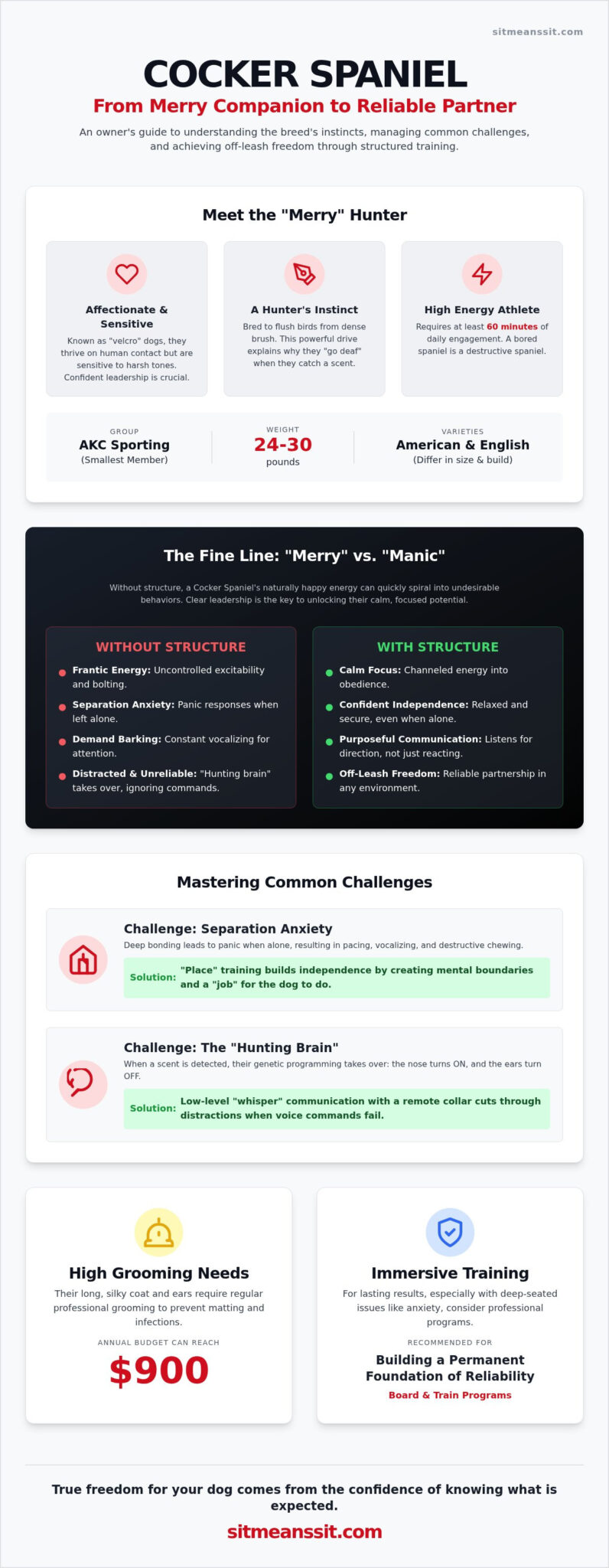
The Cocker Spaniel holds a unique title as the smallest member of the AKC Sporting Group. Don’t let their compact size fool you. These dogs were built for the field, specifically for flushing out woodcocks from dense brush. This history is exactly why your dog might suddenly go “deaf” when they catch a scent. They aren’t ignoring you; they are doing what they were bred to do for centuries. Their instincts are powerful, and they require a leader who understands how to channel that drive.
You’ve likely heard the term “merry” used to describe this breed. It is the official label for their temperament, referring to their constantly wagging tail and upbeat attitude. However, there’s a fine line between “merry” and “manic.” Without the right structure, that happy energy can quickly spiral into frantic barking or hyper-excitability. You need to distinguish between the American and English varieties too. The American version is typically smaller with a shorter muzzle and more “glamour” coat, while the English version is taller and retains a more rugged, athletic appearance suited for longer days in the field. Both versions possess a high level of intelligence that can be used for either cooperation or clever manipulation.
Temperament: Affectionate but Highly Sensitive
These dogs are the ultimate “velcro” companions. They thrive on human touch and will follow you from room to room just to stay close. This deep bond is a double-edged sword. Because they are so attuned to your emotions, they are incredibly sensitive to your tone of voice. A harsh correction can shut a cocker spaniel down completely, leading to submissive urination or fear-based retreats. This is why we emphasize clear, low-level communication. If you don’t provide a confident lead, their “merry” nature often transforms into separation anxiety. They need to know you are in control so they can finally relax and enjoy their environment.
Physical Characteristics and Energy Levels
Most adults weigh between 24 and 30 pounds, making them a manageable size for most households. Their iconic long, silky ears are beautiful, but they serve a functional purpose: stirring up scents on the ground to help the dog track. Do not make the mistake of treating them like a sedentary lapdog. They are true athletes. They require at least 60 minutes of daily engagement to burn off their high energy. A bored spaniel is a destructive spaniel. Their compact frame hides surprising strength, which you probably notice the moment they see a squirrel and attempt to pull you down the street. Consistent exercise is the foundation of a calm home.
Common Cocker Spaniel Behavioral Challenges
Your cocker spaniel is a powerhouse of emotion. While their “merry” reputation is well-earned, that same intensity often manifests as significant behavioral hurdles. Owners frequently report common health and behavioral issues like separation anxiety. Because they bond so deeply with their humans, they can become frantic when left alone. This isn’t just “missing you.” It’s a genuine panic response that requires a professional strategy to resolve.
Then there is the “hunting brain.” When your dog catches a scent, their biology takes over. The nose turns on and the ears turn off. You aren’t being ignored out of spite. Your dog is simply locked into a genetic drive that dates back centuries. Managing this requires more than just treats. It requires a structured communication system that cuts through the noise of the environment. You must provide a clear “why” for them to listen when their instincts tell them to chase.
Managing Separation Anxiety and Barking
Anxiety in this breed is rarely quiet. You might return home to find shredded pillows or hear from neighbors about hours of non-stop vocalizing. Look for these specific symptoms:
- Persistent pacing or an inability to settle even after exercise.
- High-pitched vocalizing or “demand barking” at doors and windows.
- Destructive chewing focused on your personal items or exit points.
To fix this, you must build independence through structure. “Place” training is your most effective tool. By teaching your dog to stay on a designated bed or mat, you create a mental boundary. They learn that they can be “away” from you while still being in the same house. A threshold is the specific point where a dog’s emotional state shifts from calm to reactive or panicked.
The Sensitivity Scale: Submissive Urination and Fear
Many owners believe that because a cocker spaniel is sensitive, they cannot handle discipline. This is a dangerous misconception. A lack of structure actually creates more fear. However, traditional scolding is a disaster for this breed. If you yell, you will likely see submissive urination. This isn’t a house-training failure. It is a physical manifestation of extreme stress and a lack of confidence.
Confidence is built through small, successful wins. We use clear markers to tell the dog exactly when they are right. This eliminates the guesswork that leads to anxiety. Investing in professional dog obedience training provides the stability these dogs crave. It replaces their fear with a sense of mastery over their environment. You don’t have to live with a nervous dog. You can transform that sensitivity into focus. If you want to accelerate this transition, a Board and Train program offers the immersion needed for lasting change.
Training Your Cocker Spaniel for Real-World Reliability
Treats are a fantastic starting point, but they often fail the moment a cocker spaniel catches a scent or spots a squirrel. Relying solely on food-based rewards creates a “fair-weather” listener. You need a dog that responds because they understand the command, not just because you have a biscuit in your pocket. Real-world reliability requires a transition from bribery to clear, structured communication. We bridge this gap by using a system that cuts through the noise of the environment, ensuring your dog stays focused on you regardless of what is happening around them.
Follow these steps to achieve mastery with your dog:
- Establish a Marker System: Use a consistent word or click to tell your dog exactly when they have performed correctly. This removes all guesswork.
- Introduce the Remote Training Collar: We use this tool at very low levels to provide “whisper” communication. It acts like a tap on the shoulder, getting their attention without causing stress.
- Proof Against Distractions: Gradually move your training from the living room to the park. Practice commands while other dogs walk by or kids play nearby.
- Transition to Off-Leash: Once your dog is reliable in controlled environments, start off-leash work. This is where true freedom begins.
- Attend Group Classes: Consistency is everything. Regular practice in a group setting reinforces skills and keeps your dog sharp.
The Power of Early Socialization
Don’t wait for behavioral problems to appear before you start training. The “critical window” for socialization is between 8 and 16 weeks of age. During this time, your puppy’s brain is like a sponge, forming permanent associations with the world. Enrolling in puppy training classes is vital for preventing the fearfulness and reactivity common in this breed. Safely introduce your dog to various sounds, like vacuum cleaners and sirens, and different surfaces, such as gravel and metal grates. Positive exposure now means a confident, stable adult dog later.
Achieving Total Off-Leash Control
The biggest challenge for any cocker spaniel owner is the breed’s intense nose-to-ground hunting instinct. When that nose turns on, their ears often turn off. Our methodology is designed specifically to overcome this genetic drive. By using the Remote Training Collar as a gentle communication tool, we ensure your dog listens even when they are hot on a trail. You shouldn’t have to worry every time you open the front door. We give you the confidence to take your dog off-leash, knowing they will return to you every single time you call. This isn’t just about control. It’s about giving your pet the freedom to explore the world safely.
Living with a Cocker Spaniel: Exercise, Grooming, and Health
A cocker spaniel is a high-performance athlete in a compact package. If you don’t give them a job, they will find one. Usually, that job involves destructive chewing or demand barking. You must provide at least 60 minutes of active engagement every single day. This isn’t just a leisurely stroll around the block. It’s about heart-pumping activity that drains their physical battery. A tired dog is a well-behaved dog. When their physical needs are met, they are far more receptive to the structure you provide in your training sessions. High energy is an asset, not a burden, when you know how to direct it.
Health management is a non-negotiable part of spaniel ownership. This breed is prone to chronic ear infections due to those beautiful, heavy flaps that trap moisture. You also need to watch for hip dysplasia and Progressive Retinal Atrophy (PRA). In 2026, repairing hip dysplasia can cost between 3,500 and 7,000 dollars. This is why pet insurance, which averages around 550 dollars annually, is a smart investment. Staying ahead of these medical issues ensures your dog remains an active, happy partner in your daily adventures. Prevention is always more effective than a cure.
Grooming as a Behavioral Experience
Many owners view grooming as a chore. We view it as a behavioral milestone. Your cocker spaniel requires professional grooming every 4 to 6 weeks to manage their thick, fast-growing coat. This can cost between 200 and 900 dollars annually. If your dog fights the brush or snaps at the groomer, the experience becomes a trauma rather than a routine. You must train your dog to accept handling from day one. Touch their paws, ears, and belly daily. Use your marker system to reward calm behavior during these sessions. When your dog is comfortable with being handled, grooming becomes a stress-free bonding experience. If you’re struggling to balance your dog’s energy with your daily schedule, our Day Training programs can help you establish a routine that works.
Mental Work: Scent Games and Obedience
Mental work is just as exhausting as a long hike. Sporting breeds have a natural “flushing” instinct that needs an outlet. Scent games like “find it” allow them to use their nose in a controlled, productive way. Integrate obedience commands like “sit” or “stay” into these games to reinforce your leadership during play. Mental enrichment for sporting breeds is the intentional use of problem-solving tasks that satisfy their genetic drive to hunt and retrieve. This structured play prevents the boredom that leads to anxiety. It turns a “merry” dog into a focused, reliable companion.
Professional Support: Why Immersive Training Works
You’ve done the research. You understand the exercise needs, the grooming costs, and the unique “merry” temperament of your cocker spaniel. Now, it’s time to talk about the most efficient way to achieve the results you deserve. Sometimes, the gap between a chaotic home and a peaceful one feels too wide to cross alone. Professional intervention isn’t a sign of failure. It’s a strategic decision to accelerate your dog’s transformation. While DIY methods can work, they often lack the consistency required to overcome deep-seated instincts like a high prey drive or separation anxiety.
Deciding who to trust with your dog is the first step toward mastery. You might wonder if you need a dog behaviorist or a professional trainer. Generally, a behaviorist handles severe psychological issues like extreme aggression or debilitating phobias. A professional trainer, however, focuses on reliability, environmental neutrality, and off-leash control. For most owners, a structured training program provides the clear boundaries and communication tools needed to stabilize a sensitive breed. We don’t just teach tricks. We build a foundation of focus that lasts a lifetime.
The Board and Train Advantage
For busy families, a Board and Train program is the ultimate solution. This immersive experience places your dog in a professional environment 24/7, allowing for hundreds of successful repetitions every single day. This accelerates the learning curve significantly. We handle the heavy lifting of breaking bad habits and establishing new, positive behaviors. Once the foundation is set, we bring you into the process. The transition phase is where we teach you how to maintain those results. You’ll learn the exact handling skills needed to lead your sensitive dog with confidence and poise.
Finding a Trainer Who Delivers Results
Don’t settle for “good enough” when it comes to your pet’s safety and your peace of mind. When searching for a dog trainer near me, look for transparency. You should always see a live demonstration of their work before committing to a program. A trainer who can’t show you a well-behaved dog in a high-distraction environment isn’t the right fit for your cocker spaniel. At Sit Means Sit, we provide a national standard of reliability. Our methodology ensures that your dog listens because they want to, not because they’re afraid.
Consistency is the final piece of the puzzle. Once you’ve completed an immersive program or private lessons, Group Classes provide the perfect environment to proof your dog’s skills. Practicing around other dogs and people reinforces socialization and ensures that your dog remains focused on you, regardless of the environment. Stop struggling with the “what ifs.” Take the lead and give your dog the structure they crave. A better life for both of you starts with a single, decisive step toward professional training.
Take the Lead and Transform Your Life Together
You now have the tools to master the “merry” but sensitive nature of your dog. True liberation for your pet comes through the structure you provide. By implementing a consistent marker system and meeting the high exercise demands of this sporting breed, you replace chaotic energy with calm focus. Your dog wants to succeed in every environment; they just need you to provide the clear boundaries that allow them to shine. Discipline is not a restriction. It is the path to a safer, more adventurous life.
Stop settling for a life limited by a short leash or a frantic bark. We specialize in transforming sensitive breeds into focused, reliable partners who listen the first time. With over 150 locations nationwide, we deliver industry-leading off-leash results through customized programs designed for every unique temperament. We replace your frustration with a sense of empowerment and pride. It’s time to unlock a more joyful lifestyle for both you and your pet. You’ve seen the potential; now it’s time to achieve it.
Transform your Cocker Spaniel with a FREE training consultation! Your journey toward total reliability and a deeper bond starts today. We have encountered every possible challenge and remain ready to help you achieve mastery.
Frequently Asked Questions
Are Cocker Spaniels easy to train?
Cocker Spaniels are highly trainable because they are naturally intelligent and eager to please their owners. However, their extreme sensitivity means they don’t respond well to harsh corrections or inconsistent rules. You must use a structured approach that combines professional methodology with clear, low-level communication to see real results. They are fast learners when they understand exactly what you want from them.
Do Cocker Spaniels bark a lot?
Cocker Spaniels can become excessive barkers if they lack a structured routine or suffer from separation anxiety. They often use vocalization to demand attention or alert you to environmental changes. You can resolve this behavior by establishing clear boundaries and using “place” training to build their independence. A dog that knows their role in the home is a much quieter companion.
How much exercise does a Cocker Spaniel need daily?
Your cocker spaniel requires at least 60 minutes of active engagement every day to stay healthy and calm. This should include a mix of physical activities like brisk walks and mental work like scent games or obedience drills. Remember that a bored spaniel often becomes a destructive one. Meeting their energy needs is the first step toward a well-behaved dog.
Are Cocker Spaniels good with children and other pets?
Cocker Spaniels are generally excellent with children and other pets due to their affectionate and social nature. Their “merry” disposition makes them patient playmates, but they are sensitive to rough handling. Teach children to respect the dog’s space and handle them gently to prevent fear-based reactions. Proper socialization during the critical puppy window ensures they remain confident in a busy household.
How do I stop my Cocker Spaniel from pulling on the leash?
Stop leash pulling by establishing yourself as the leader and using a Remote Training Collar for gentle, effective communication. These dogs are easily distracted by scents, so you must teach them to focus on you regardless of the environment. Consistent practice and clear markers will turn a chaotic walk into a controlled, enjoyable experience. Don’t let the dog dictate the direction of your journey.
Is the Cocker Spaniel a good choice for first-time dog owners?
The cocker spaniel is a fantastic choice for first-time owners who are ready to embrace a structured lifestyle. They are affectionate and manageable in size, but they do require a commitment to regular grooming and exercise. If you are willing to invest in professional training early on, you will have a loyal partner for years. It is all about starting with the right foundation.
Why does my Cocker Spaniel pee when I come home?
Submissive urination usually happens because the dog is overstimulated or intimidated during greetings. It is a physical response to an emotional state that has crossed a specific threshold. To fix this, ignore your dog when you first walk through the door and wait until they are completely calm before offering affection. Lowering the intensity of your homecoming helps the dog maintain control of their bladder.
How often should a Cocker Spaniel be professionally groomed?
Schedule professional grooming every 4 to 6 weeks to manage their thick, fast-growing coat. This breed is prone to painful matting and chronic ear infections if their hygiene is neglected. Expect to spend between 200 and 900 dollars annually on these appointments. Regular maintenance is a non-negotiable part of their care and ensures your dog stays comfortable and healthy.
Comments are closed.