
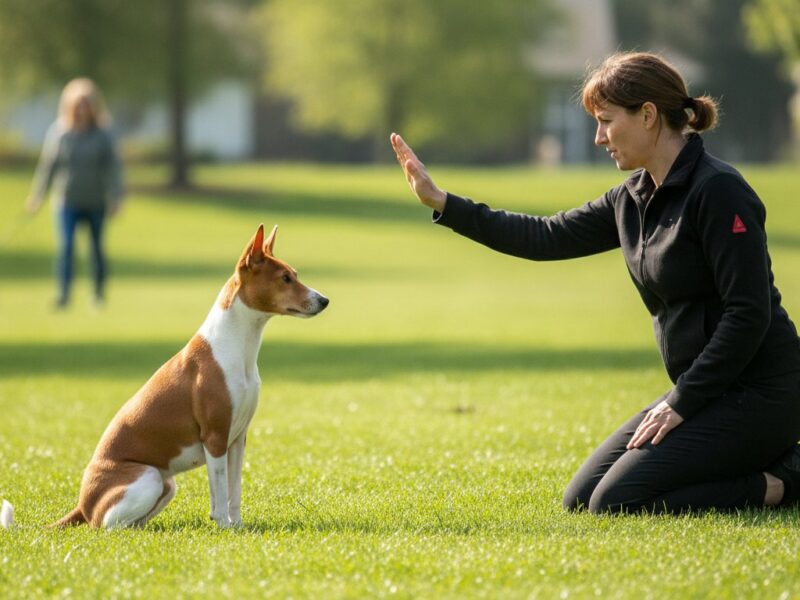
Your Basenji isn’t stubborn or spiteful; they are simply weighing your command against five thousand years of primitive hunting instinct. It’s a common realization for owners who find that their “cat-like” companion views a recall request as a negotiable opening offer. You likely feel the sting of frustration when your dog bolts after a squirrel or stares blankly as you call their name. We understand that living with a breed this independent can feel like a constant battle of wills. It’s time to replace that exhaustion with absolute confidence and pride.
This guide promises to help you master the unique challenges of the basenji by using professional training strategies built for their specific temperament. You’ll learn how to achieve reliable behavior even in high-distraction environments. We’re going to dive into the mechanics of their “barkless” communication, provide solutions for destructive boredom, and show you how structure actually creates more freedom for your pet. By the end of this article, you’ll have a clear roadmap to transform your relationship from a struggle for control into a partnership based on clarity and mastery. Let’s turn your independent hunter into a focused, reliable companion for the modern world of 2026.
Key Takeaways
- Understand the primitive logic of the basenji to replace frustration with a training approach that respects their independent hunting heritage.
- Master off-leash reliability using the Remote Training Collar as a clear communication tool that works across long distances and high distractions.
- Secure early boundaries in Puppy Preschool to stop destructive habits before they start and set the stage for a well-behaved companion.
- Utilize immersive Board and Train programs to achieve total mastery and the reliable results that high-energy primitive breeds require.
- Decode “cat-like” behaviors and unique vocalizations to build a partnership based on mutual respect and clear, decisive directives.
Understanding the Basenji: Africa’s Ancient and Independent Hound
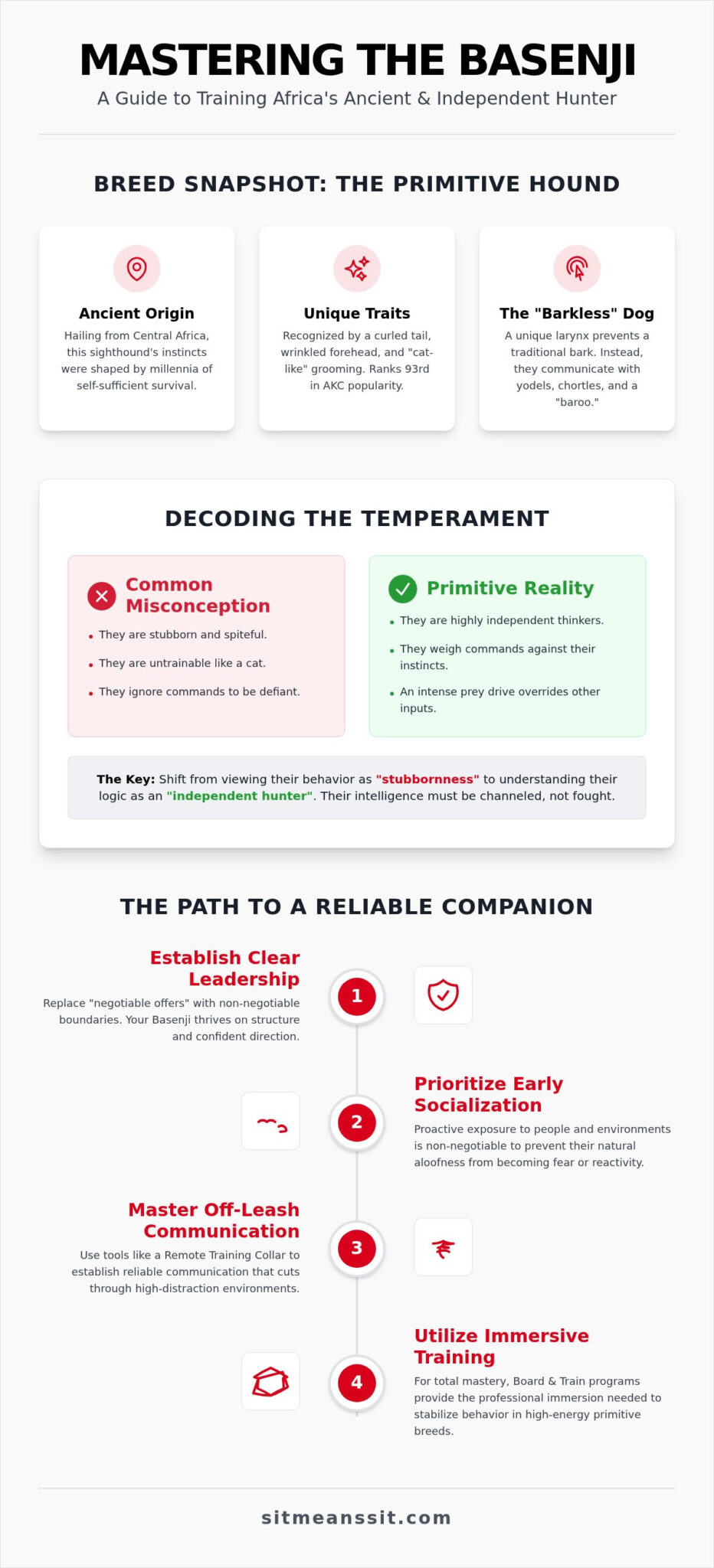
The Basenji isn’t your typical neighborhood dog. This ancient sighthound hails from Central Africa, where survival required extreme intelligence and a high degree of independence. They are immediately recognizable by their tightly curled tails, wrinkled foreheads, and fastidious, cat-like grooming habits. In the 2025 AKC rankings released in March 2026, they held their ground as the 93rd most popular breed, remaining a top choice for owners seeking an athletic, unique companion. However, their primitive roots mean they don’t operate on the same frequency as modern working breeds. Understanding this dog requires looking past their elegant appearance and into the instincts that kept them alive for millennia.
The “Barkless” Dog: Yodels, Baroos, and Communication
Most owners are drawn to the famous lack of a traditional bark. This occurs because the basenji larynx is shaped differently than other breeds, which prevents them from producing a standard “woof.” Instead, they communicate through a variety of unique sounds, most notably the “baroo.” This melodic yodel usually signals excitement, joy, or a desire for attention. Don’t mistake their quiet nature for a lack of intensity. Their silence was an evolutionary advantage that allowed them to track prey without detection. In a home setting, this means their high-alert hunting drive is often masked by a quiet exterior until they decide to bolt.
Primitive Instincts in a Modern World
Survival in Central Africa required a dog that could think for itself. This independent hunting history makes them naturally skeptical of commands that don’t offer an immediate benefit. They possess an intense environmental awareness, constantly scanning their surroundings for even the slightest movement. This ancient lineage creates a deep-seated need to investigate everything in their path. Managing this intense prey drive is the biggest hurdle for suburban owners. A squirrel across the street isn’t just a distraction; it’s a target that triggers thousands of years of predatory DNA. Mastering this drive requires a transition from owner frustration to structured leadership. We focus on bridging the gap between their primitive needs and your modern lifestyle.
The Basenji Temperament: Why “Cat-Like” Doesn’t Mean Untrainable
Stop calling your dog stubborn. The basenji is often labeled as “impossible” by owners who expect the eager-to-please nature of a Golden Retriever. These dogs are self-interested, tactical thinkers who prioritize their own safety and comfort. This trait is hardwired into this ancient dog breed, marking them as one of the most genetically distinct lineages on the planet. Their intelligence is immense, but it’s focused on survival. When that brainpower isn’t directed by a structured “job,” it manifests as destructive chewing, ingenious escape attempts, or a total disregard for your presence.
Independence vs. Stubbornness
Reframing the relationship is the first step toward mastery. This breed isn’t ignoring you to be rude; they are simply performing a cost-benefit analysis of your command. We replace this skepticism with a clear, reliable system of communication that removes the guesswork. Motivation for this breed requires a high-energy approach and high-value rewards that go beyond standard kibble. You must step into the role of a confident, assertive leader who provides unwavering boundaries. When the rules are definitive agreements rather than suggestions, the “stubbornness” vanishes. It’s about mastering their unique logic rather than fighting it.
Basenjis and Socialization Needs
Isolation is the enemy of a well-behaved basenji. Early and frequent exposure to diverse people, environments, and other animals is a non-negotiable requirement for this breed. Without proactive socialization, their natural aloofness can quickly spiral into fear-based aggression or extreme reactivity. If you’re struggling to manage these intense instincts in high-stimulation environments, our Board and Train programs offer the professional immersion needed to stabilize their behavior. Integrating them into a multi-pet home requires a structured, supervised approach to ensure safety. Success comes from showing your dog that you are in control of the environment, which allows them to finally relax and follow your lead.
Achieving Total Off-Leash Control with Your Basenji
Most owners are told that a basenji must live its entire life on a six-foot leash. This “leash-only” myth stems from a lack of effective communication tools rather than a deficit in the dog’s ability. While the Basenji temperament and characteristics include a high degree of independence, they are fully capable of learning a rock-solid recall. Reliability isn’t a suggestion; it’s a requirement for safety. We move past the idea of “hoping” they listen and transition into knowing they will respond the first time you call, every single time.
The Role of the Remote Training Collar
The Remote Training Collar serves as a vital bridge between your command and your dog’s intense focus. Think of it as a physical “tap” on the shoulder that cuts through the mental noise of a scent or a squirrel. This tool isn’t about punishment or pain; it’s about providing a clear signal over long distances. By using consistent, low-level feedback, you reach a definitive agreement with your pet. They understand exactly what is expected, regardless of how far away they are. This structure provides the liberation they need to explore the world safely without the restriction of a physical tether.
Training for High-Prey Drive Situations
Proofing your dog against distractions is where mastery truly happens. We start in low-stimulation environments to build a foundation of success before moving into the real world. You must become more interesting than the environment to maintain their engagement. This involves a step-by-step approach to dog obedience training that specifically targets high-prey triggers. Success is built through these specific phases:
- Establish a neutral response to moving objects in controlled settings.
- Increase distance and duration of commands gradually.
- Introduce real-world distractions like local parks and wildlife.
- Reward the choice to engage with the owner over the distraction.
Achieving this level of control requires steady practice and professional guidance. A basenji that listens every time is a dog that enjoys a much more adventurous and joyful life. You no longer have to fear an open door or a broken leash. Instead, you gain the confidence to share high-energy activities with a companion who respects your boundaries and prioritizes your voice over the hunt.
Structured Training Programs: From Puppy Preschool to Mastery
Standard obedience classes often fail the basenji because they lack the intensity and clarity this breed demands. These dogs don’t just need to learn “sit.” They need a comprehensive behavioral framework that accounts for their high-energy, independent nature. We replace the frustration of failed home sessions with a definitive path toward reliability. Whether you are starting with a new addition or rehabilitating an older hound, the right program structure is the difference between a chaotic household and a joyful partnership. Discipline is the key to a more adventurous and joyful life for both you and your pet.
The Power of Board and Train for Basenjis
Immersive environments are the fastest way to break through the initial skepticism of a primitive breed. A board and train program places your dog in a 24/7 learning state where boundaries are clear and consistent. Professional trainers are experts at handling the initial “testing” phase, where a basenji will try to find loopholes in your instructions. We establish a rock-solid foundation so that when your dog returns home, the rules are already part of their routine. This removes the burden of the initial heavy lifting from busy owners and ensures the results are permanent and reliable.
Puppy Socialization and Early Manners
Don’t wait for adult hunting instincts to kick in before you start setting expectations. Our puppy training classes are designed to instill essential manners like “place,” “sit,” and “heel” during the critical developmental window. Early intervention is essential to prevent common breed issues like separation anxiety and destructive boredom. By teaching these skills before the hunting drive matures, you build a bond based on focus rather than conflict. We help your puppy gain the confidence needed to navigate high-stimulation environments without fear or reactivity.
Focusing amidst chaos is a skill that must be practiced. Group classes provide the high-distraction environment necessary to proof your dog’s obedience around other animals. If your dog has specific quirks or behavioral triggers, private lessons offer a customized plan tailored exactly to your lifestyle. We don’t believe in a one-size-fits-all approach. Every program we offer is designed to transform your dog into a reliable companion that you can take anywhere with absolute pride. Contact us today to find the perfect training program for your Basenji.
Why Sit Means Sit is the Ultimate Choice for Basenji Owners
You’ve likely been told that your basenji is simply untrainable. You’ve heard the myths that they are too independent for off-leash life or too primitive to care about your commands. We prove those labels wrong every day. We specialize in the high-energy behavioral challenges and “difficult” breeds that leave other trainers scratching their heads. Our results-oriented approach replaces your daily frustration with a sense of absolute empowerment and pride. We don’t just hand you a trained dog; we coach you to become the confident leader your dog needs for a lifetime of success. Experience the true liberation of a companion that is reliable in the park, at the beach, or on the busiest city sidewalk.
Liberation Through Structure
Structure is not a restriction. It is the key to a more adventurous and joyful life for both you and your pet. When your dog understands that a directive is a definitive agreement rather than a suggestion, the entire world opens up to them. Our Sit Means Sit promise is simple: we deliver reliable control even in the highest-stimulation settings. Whether you are navigating a crowded neighborhood or a trail filled with high-prey triggers, your dog will remain focused and responsive. You’re joining a dedicated community of owners who have achieved what others said was impossible. We use the Remote Training Collar as a communication bridge to reach that primitive mind, ensuring total clarity across any distance and in any environment.
Start Your Transformation Today
Stop settling for a “cat-like” roommate that ignores you and start living with a reliable partner. Book a consultation today to see our methodology in action with your own basenji. We provide a range of customized training packages, from immersive Board and Train programs to personalized Private Lessons, all designed to fit your specific lifestyle and goals. Every dog has its own personality, but our commitment to reliability is universal. We take the stress out of your training journey and replace it with the confidence that comes from professional mastery. Your journey toward a better relationship starts with a single decision to prioritize structure. We are ready to help you turn your independent hunter into a perfectly behaved companion.
Transform your Basenji’s behavior with Sit Means Sit!
Master the Adventure with Your Reliable Companion
Living with a basenji should be a source of pride, not constant stress. You’ve learned that their primitive instincts are a puzzle to solve rather than an obstacle to avoid. By implementing clear communication through our proprietary remote training collar methodology, you bridge the gap between their independent nature and your expectations. Reliability in high-distraction environments is no longer a distant dream but a definitive reality waiting to be claimed. Structure is the key that unlocks a more adventurous and joyful life for both you and your pet.
With over 25 years of professional training excellence, we’ve built a national network of expert behavioral trainers dedicated to your success. We replace the “cat-like” indifference with a partnership built on mutual respect and unwavering boundaries. It’s time to stop managing your dog’s limitations and start enjoying the freedom that comes with professional mastery. Ready for a perfectly behaved Basenji? Schedule your free consultation today! We are excited to help you transform your lifestyle and unlock a more joyful future together.
Frequently Asked Questions
Do Basenjis really not bark at all?
Basenjis do not produce a traditional bark due to the unique, flat shape of their larynx. Instead, they make a variety of sounds often described as yodels, chortles, or a “baroo.” While they are quieter than most breeds, they are certainly not mute. They use these vocalizations to express excitement or demand your attention. Understanding this unique communication style is key to managing their emotional state without frustration.
Are Basenjis good with children and other pets?
Basenjis can thrive with children and other pets if they receive early, structured socialization. Their independent nature and high prey drive mean they require clear boundaries from the start of the relationship. We recommend supervised interactions and consistent training to ensure they respect the household hierarchy. When raised with discipline, they become loyal family members who can navigate a multi-pet environment with absolute confidence and poise.
How much exercise does a Basenji need every day?
A basenji requires at least 60 to 90 minutes of vigorous physical and mental exercise every single day. This breed is built for endurance and high-speed hunting, so simple walks around the block often aren’t enough. Incorporate scent work, off-leash running in secure areas, or structured play to drain their energy. Without this vital outlet, they will find their own “jobs,” which usually results in destructive behavior.
Can a Basenji be left alone at home for long periods?
Leaving a basenji alone for long periods is generally not recommended without proper crate training and mental stimulation. They are highly intelligent and easily bored, which can lead to severe separation anxiety and property damage. If your schedule requires long absences, consider our Day Training programs. We help build the confidence and independence your dog needs to remain calm and relaxed while you are away from home.
What are the most common health issues for Basenjis in 2026?
The most common health concerns for this breed in 2026 include Fanconi syndrome, progressive retinal atrophy (PRA), and hip dysplasia. Responsible breeders use DNA screening to minimize these risks before any puppies are born. Regular veterinary checkups and a high-quality diet are essential for maintaining their long-term well-being. Always verify that your breeder has performed these specific health clearances to ensure you are starting with a healthy companion.
Why are Basenjis so difficult to housebreak?
Housebreaking challenges often stem from the Basenji’s independent nature and their famous dislike for wet or cold weather. They are fastidious animals but may see no immediate benefit in following your schedule over their own comfort. Success requires a rigid routine and immediate, high-value rewards for every success. Our immersive training methods replace this selective cooperation with a definitive agreement, making the housebreaking process much faster and more reliable.
Can I really trust my Basenji off-leash after training?
Yes, you can achieve total off-leash reliability with a basenji by using the right communication tools. While many claim this breed must always be tethered, our proprietary remote training collar methodology cuts through their intense hunting focus. We proof their recall against high-prey triggers like squirrels or moving vehicles. This structure provides the liberation they need to explore safely while ensuring they return to you the first time you call.
What is the best age to start training a Basenji puppy?
Start training your puppy as early as 8 to 10 weeks of age to maximize their learning potential. This critical developmental window is the best time to set boundaries and prevent bad habits from taking root. Our Puppy Preschool program focuses on socialization and basic manners before their primitive hunting instincts fully mature. Early intervention ensures your dog grows into a confident, well-behaved adult that is ready for any adventure.
Comments are closed.