

What if the tool you’re most afraid of is actually the secret to your dog’s confidence? If you’ve been asking, can you train a sensitive dog with an e-collar, the answer is a definitive yes. You love your dog’s gentle spirit, but you’re likely tired of feeling trapped by a long leash or worrying about their safety the moment you step outside. It’s common to feel a wave of guilt or confusion when you see conflicting advice online, especially with 2025 bans in France and Colombia making headlines. You want a way to communicate that doesn’t involve shouting or stress.
Discover how a remote training collar can actually build confidence and provide the clarity your sensitive dog needs to thrive off-leash. We’ll show you how this system replaces the “guessing game” with a reliable communication loop that doesn’t rely on fear. This article previews the transformation from a nervous pet to a happy, reliable companion through steady practice and clear boundaries. Get ready to trade your frustration for a lifestyle of adventure and empowerment. It’s time to see how discipline is the key to a more joyful life for your dog.
Key Takeaways
- Identify why sensitive dogs thrive on the neutral clarity of a remote collar compared to high-pressure verbal cues.
- Discover how to find your dog’s unique perception level for a communication system that feels like a gentle tap rather than a correction.
- Address the core question—can you train a sensitive dog with an e-collar—by learning how clear boundaries eliminate the uncertainty that causes shutdowns.
- Follow a proven framework for collar conditioning that builds a positive, rewarding association with the tool from day one.
- Understand why immersive professional guidance ensures your soft dog receives the steady practice required for reliable off-leash mastery.
Understanding the ‘Sensitive’ Dog: Why Temperament Isn’t a Barrier to Success
Sensitive dogs are often misunderstood as fragile or difficult. In reality, a “soft” dog is simply one with high environmental awareness and lower emotional resilience. They notice every change in your tone and every shift in your body language. This level of focus is actually a gift. It means your dog is incredibly intelligent and deeply eager to please you. When owners ask, can you train a sensitive dog with an e-collar, they are often worried about breaking that bond. The truth is that structure doesn’t break a dog. It liberates them from the weight of uncertainty.
Common Signs Your Dog Has a ‘Soft’ Temperament
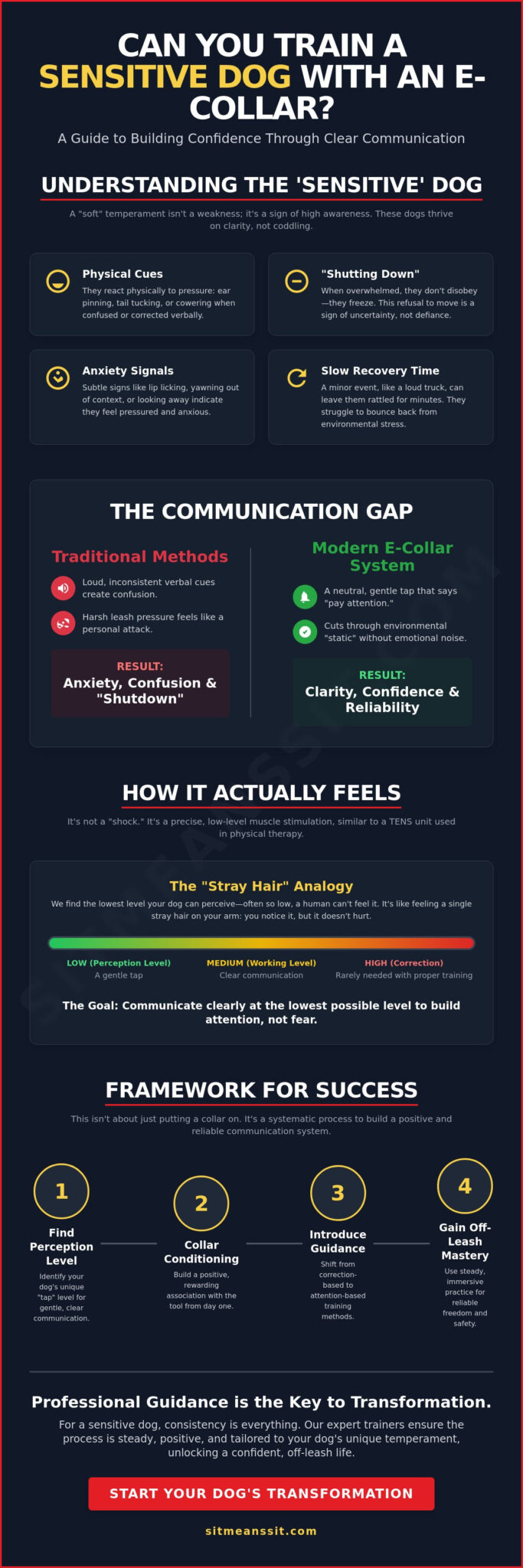
Identifying a sensitive dog is the first step toward mastery. These dogs don’t just ignore you; they feel the weight of your expectations. Look for these specific physical cues that indicate a soft temperament:
- Ear pinning or tucking the tail at a slightly firm verbal correction.
- Cowering or rolling over to show a submissive belly when they’re confused.
- “Shutting down” or refusing to move when they feel they’ve made a mistake.
- Lip licking, yawning, or looking away when they feel pressured.
One major marker is the “slow recovery” phenomenon. If a loud truck passes and your dog stays rattled for ten minutes, they have a soft temperament. This isn’t disobedience. It is a state of being overwhelmed. You need a communication system that provides a safety net of clear expectations without the emotional “noise” of human frustration. Professional training replaces that panic with a predictable rhythm of instruction.
The Communication Gap in Traditional Training
Traditional training often relies on physical leash pressure or loud verbal cues. For a sensitive dog, these methods create massive amounts of “static.” A sharp tug on a leash feels like a personal attack to a soft dog. It creates a cloud of anxiety that prevents actual learning. To understand the history of these tools, you can research What an E-Collar Is and how technology has evolved into the modern remote collars used today. Modern tools are about precision, not punishment.
Inconsistent verbal commands are another hurdle. If you say “sit” three different ways, a sensitive dog gets confused and anxious. They want to get it right, but the “static” gets in the way. This is where a dog behaviorist or professional trainer becomes essential. They help you identify these nuances and bridge the gap. You’ll learn that can you train a sensitive dog with an e-collar effectively when you remove the emotion and replace it with a neutral, consistent signal. Clarity is the ultimate kindness for a dog that feels everything deeply.
The Science of Low-Level Communication: How Remote Collars Speak ‘Dog’
Think of the remote training collar as a high-definition hearing aid for your dog. In a world full of squirrels, barking neighbors, and blowing leaves, your dog’s focus is constantly pulled in a dozen directions. For a soft-tempered dog, this sensory overload leads to confusion and anxiety. Traditional training methods often try to shout over that noise. We do things differently. By using a low-level pulse, we provide a clear signal that cuts through the environmental “static” without adding stress. This is how can you train a sensitive dog with an e-collar while actually lowering their heart rate and increasing their focus.
Our approach at Sit Means Sit shifts the focus from correction-based training to attention-based training. We don’t wait for the dog to fail so we can correct them. Instead, we use the collar to initiate a conversation. It’s a neutral, physical cue that says, “Hey, look at me.” Once we have their attention, we can guide them toward the right choice. This method respects the dog’s emotional state, ensuring that the training process remains a positive experience that strengthens your bond. If you want to see this transformation in action, our private lessons offer the perfect environment to master these subtle techniques.
The ‘Stray Hair’ Analogy: Understanding the Sensation
One of the biggest hurdles for owners is imagining what the collar feels like. It is not a sharp sting. It is a tapping sensation, very similar to a TENS unit used in human physical therapy to stimulate muscles. Imagine the feeling of a single stray hair tickling your neck. You notice it immediately, but it isn’t painful. That is the perception threshold. The perception threshold is the gentle whisper of dog training.
This “tap” is far less jarring than a sudden jerk on a standard neck collar. A leash correction involves a physical pull that can be scary for a sensitive dog. In contrast, the remote collar provides a consistent, predictable sensation. Research into the Welfare Consequences and Efficacy of various training methods shows that when tools are used at these low, communicative levels, dogs remain engaged and stress-free. It’s about finding the lowest point where your dog notices the signal, ensuring they stay calm and receptive.
Neutrality: Removing the ‘Human Emotion’ from Training
Sensitive dogs are experts at reading human frustration. If you’ve ever felt your blood pressure rise because your dog isn’t listening, your dog felt it too. They hear the “angry” edge in your voice and see the tension in your shoulders. This often causes a soft dog to shut down because they feel they’ve upset their “person.”
The remote collar removes this emotional baggage. The signal is identical every single time, regardless of whether you’re tired, stressed, or running late. It is a purely neutral piece of information. By removing the “static” of human emotion, you make the right answer easy for your dog to find. This consistency builds immense trust. Your dog learns that the signal isn’t a threat; it’s a reliable guide that helps them navigate the world with total confidence.
Debunking the ‘Shutdown’ Myth: Why Clarity Reduces Anxiety
The biggest fear for owners of soft dogs is the “shutdown.” You’ve likely read online comments claiming that remote collars make dogs freeze or become terrified. This is a myth born from poor technique, not the tool itself. When you ask, can you train a sensitive dog with an e-collar, you’re really asking if it’s possible to maintain their spirit. The answer is yes. Clarity is the ultimate antidote to anxiety. Anxiety doesn’t come from a clear signal. It comes from uncertainty. Imagine trying to drive a car while someone constantly nudges the steering wheel without telling you where to go. That’s what “nagging” on a leash feels like to a sensitive dog. It’s a constant, confusing pressure that never stops.
A remote collar replaces that constant tugging with a single, understandable tap. It’s like a light switch. It’s either on or off. This level of predictability is incredibly reassuring for a dog that is easily overwhelmed. When the rules of the world are clear, the dog can finally relax. They no longer have to guess what you want. They just listen and respond. This transformation is the core of effective dog obedience training. We create a world where your dog feels safe because they know exactly what to expect from you.
Correction vs. Direction: The Sit Means Sit Philosophy
We don’t use the collar to punish mistakes. We use it to guide the dog into the correct position. It’s a directional signal, not a reprimand. When the dog feels the tap, they know exactly what action to take to earn a reward. We pair this technology with high-value motivators like favorite toys or tasty treats. This creates a “win-win” scenario. The dog learns that following the signal leads to a reward every time. This approach builds a dog’s confidence by showing them exactly how to “win” at training. They become active participants in the process rather than passive targets of correction.
Recognizing and Avoiding Emotional Overload
Working with a sensitive temperament requires a surgeon’s precision. A professional trainer knows how to read “pre-shutdown” signals before they escalate. They watch for subtle shifts that an untrained eye might miss:
- A slight slowing of the dog’s response time
- Avoiding eye contact or looking at the ground
- A change in the dog’s tail position from neutral to low
- Yawning or lip licking between commands
DIY e-collar training is risky because an amateur might miss these cues and accidentally overwhelm a soft dog. When you have a sensitive pet, less is always more. We find the lowest possible level of communication and stay there. This structured foundation prevents the emotional overload that leads to freezing. We ensure the dog always feels capable and empowered during every session.
A Framework for Success: Introducing the Collar to Your Sensitive Dog
Success with a soft-tempered dog isn’t about luck. It’s about a proven framework that prioritizes trust over force. Many owners hesitate because they fear the tool, but the right introduction transforms the collar into a symbol of freedom. This process starts in a low-distraction environment, like your living room, where your dog feels safest. By following a structured approach, you ensure your pet understands that their behavior controls the sensation. This is the definitive answer to how can you train a sensitive dog with an e-collar without sacrificing their happy personality.
Mastery begins with conditioning. We teach the dog that the collar is a precursor to everything they love. Once the dog understands the communication, we graduate to the “Real World” where high-stimulation environments like parks or busy streets become manageable. If you’re ready to start this journey, our Remote Training Collar programs provide the expert oversight you need to succeed.
Step 1: The Positive Association Phase
Start by putting the collar on your dog without turning it on. This prevents “collar sensitivity,” where a dog only behaves when they see the device. Pair the sight of the remote with mealtime, favorite games, or a session of belly rubs. You want your dog to wag their tail when the collar comes out of the drawer. Ensure your pet is happy and relaxed before any stimulation is ever introduced. This phase builds a foundation of “Good things are coming,” making the tool a positive part of their daily routine.
Step 2: Finding the ‘Whisper’ (Perception Level)
Every dog has a unique “working level.” For a sensitive breed, this level is often significantly lower than for a high-drive or “stubborn” dog. We find this “whisper” by slowly dialing up the remote from zero while watching for a subtle physical reaction. Look for a quick ear flick, a slight head tilt, or a change in their blinking pattern. The goal is a ‘tap on the shoulder,’ not a ‘shout’. This ensures the signal is informative rather than startling, maintaining the dog’s calm emotional state throughout the session.
Step 3: Transferring Known Commands
Once the perception level is set, use the collar to reinforce commands your dog already knows, such as Sit, Come, or Place. The sensation begins when you give the command and stops the instant the dog complies. This teaches the “off switch,” showing the dog that they have total control over the communication. Always use a clear “Release” word to signal the end of a command. This structure provides the liberation Sit Means Sit is known for, giving your sensitive dog the confidence to thrive off-leash in any environment. Discipline isn’t a restriction; it’s the key to your dog’s most adventurous life.
Why Professional Guidance is the Key to Your Sensitive Dog’s Transformation
The difference between a stressed dog and a confident one often comes down to a fraction of a second. If you’ve been wondering, can you train a sensitive dog with an e-collar, you must understand that timing is your most powerful tool. An amateur might miss the subtle shift in a dog’s posture, leading to a signal that feels like “noise” rather than “news.” Professional trainers possess a refined “eye” for reading these micro-expressions. They know exactly how much pressure to apply and, more importantly, exactly when to release it. This precision prevents miscommunication. It ensures your soft dog never feels overwhelmed. When you realize that can you train a sensitive dog with an e-collar effectively only with professional help, you unlock their full potential.
Expert guidance turns fear into focus. We don’t just teach commands; we build a new way for you and your dog to exist together. This isn’t about trial and error. It’s about a proven methodology that has encountered every possible challenge and remains unfazed. You deserve the peace of mind that comes from knowing your dog is in the hands of an assertive authority who remains a friendly peer. We replace your frustration with a sense of mastery and pride.
The Immersive Advantage: Board and Train for Sensitive Dogs
An immersive board and train program is often the perfect solution for dogs with a soft temperament. In this environment, your pet receives 24/7 structure that helps them “reset” their expectations of the world. It removes the “static” of daily life and replaces it with consistent, predictable interactions. This setup also removes your own anxiety from the initial learning phase. If you’re nervous about using the tool, your dog will feel that tension. By letting an expert handle the foundation, your dog learns with absolute clarity. Once the foundation is solid, we provide a seamless “hand-off” process. We teach you exactly how to maintain this new communication so you can step into your role with absolute confidence.
Achieving the ‘Sit Means Sit’ Lifestyle
Imagine a future where your sensitive dog doesn’t shrink away from the world but charges into it with you. This is the “Sit Means Sit” lifestyle. Picture yourself hiking off-leash on a crowded trail. Your dog checks in with you constantly because they want to, not because they’re afraid of a leash tug. This is the transformation of sensitivity into a superpower. A high-awareness dog that is properly trained becomes the ultimate partner in adventure. You no longer have to live a restricted life. You can go anywhere, do anything, and trust that your dog is safe and happy. Stop feeling trapped by your dog’s temperament. Replace your frustration with empowerment today. Your journey to a more adventurous and joyful life starts with a single decision. Structure is not a restriction; it’s the key to your dog’s liberation.
Unlock Your Dog’s Full Potential Today
Stop letting fear dictate your dog’s world. You now know that can you train a sensitive dog with an e-collar by focusing on low-level communication and neutral signals. Clarity is the ultimate gift you can give a soft-tempered pet. It replaces the “static” of uncertainty with a reliable safety net of structure. By choosing professional guidance, you ensure that every tap is a whisper of direction rather than a shout of correction. This precision builds the deep trust your dog needs to navigate high-stimulation environments with ease.
Our results-oriented approach works for every breed and temperament. With over 25 years of professional training experience and our specialized Remote Training Collar methodology, we have helped thousands of owners trade frustration for empowerment. You don’t have to navigate this journey alone. It’s time to turn your dog’s sensitivity into their greatest strength and start living a life of off-leash adventure. Discipline is the path to freedom for both of you.
Ready to transform your sensitive dog’s life? Find a Sit Means Sit trainer near you!
Your dog’s most joyful and liberated life is just one decision away. Believe in the process and watch your companion thrive with newfound confidence.
Frequently Asked Questions
Is a remote training collar the same as a shock collar?
No, they are not the same. Modern remote collars use medical grade TENS technology, which is the same tapping sensation used in human physical therapy. This is a neutral, physical signal designed for communication. Old shock collars relied on high intensity, unregulated electricity meant to cause pain. Our system focuses on a gentle “tap on the shoulder” that your dog understands instantly.
Can an e-collar cause my sensitive dog to become aggressive?
No, an e-collar used with the Sit Means Sit methodology does not cause aggression. Aggression in sensitive dogs almost always stems from fear, confusion, and a lack of clear boundaries. By providing a predictable communication system, you remove the uncertainty that leads to reactive behavior. Structure creates a sense of safety that allows your dog’s true, friendly personality to shine through.
What is the best age to start e-collar training for a sensitive puppy?
We generally recommend starting formal remote collar conditioning between 4 and 6 months of age. At this stage, puppies have the cognitive maturity to handle structured instruction. However, you should begin building a foundation much earlier. Our Puppy Preschool focuses on engagement and positive reinforcement to prepare your pup for the clear communication of a remote collar later on.
How do I know if the level is too high for my dog?
Watch for overreactions. If your dog yelps, jumps, or shows signs of frantic distress, you have exceeded their perception threshold. You are looking for a subtle physical acknowledgement, such as an ear flick or a slight head tilt. Finding this “whisper” is critical for success. We teach you how to dial in the exact level your dog needs to stay calm and focused.
Will my dog always have to wear the collar to listen?
No, the collar is a bridge to total off-leash control. It serves as a teaching tool to instill reliable habits and deep focus. Once your dog understands the commands and your bond is solidified through steady practice, the collar becomes a safety net. You’ll eventually reach a point where your dog listens because the rules of the world are clear and ingrained.
Can I use an e-collar on a dog with separation anxiety?
An e-collar isn’t a direct “fix” for separation anxiety, but it is a powerful tool for building overall confidence. Separation anxiety is often rooted in a lack of structure and emotional over-dependence. The discipline and mastery your dog gains through our programs help them feel more secure in their own skin. This newfound independence often leads to a significant reduction in anxiety when you leave.
What if my dog ‘shuts down’ as soon as they feel the stimulation?
A shutdown is a sign of a communication gap, not a failure of the tool. If this happens, we immediately lower the level and reintroduce high-value rewards to rebuild trust. This is a primary reason why professional guidance is vital for those asking, can you train a sensitive dog with an e-collar. We ensure the process remains positive and empowering so your dog never feels the need to freeze.
How long does it take to see results with a sensitive dog?
You will see a visible shift in your dog’s focus during the very first session. While immediate changes are exciting, true transformation requires consistency. Achieving total off-leash reliability typically takes a few weeks of steady practice and immersive training. We replace your daily frustration with a sense of pride as you watch your dog master high-distraction environments with absolute confidence.
Comments are closed.