
What if your dog’s constant pulling isn’t a sign of stubbornness, but a simple failure in communication? You’ve likely tried the heavy duty harnesses and stuffed your pockets with high-value treats, yet your shoulders still ache and your wrists feel the strain after every trip around the block. It’s incredibly frustrating to feel like your dog is completely ignoring you the moment a squirrel or another pet enters the frame. You want to enjoy the outdoors together, but right now, every exit from the front door feels like a stressful battle of wills.
We understand that you’re looking for more than just a temporary fix. Finding a professional dog trainer for leash pulling is about reclaiming your peace of mind and building a lasting bond based on mutual respect. You can replace that daily exhaustion with a structured communication system that delivers real-world results and reliable off-leash control. This article explores how professional training methods, including immersive Board and Train programs and specialized Remote Training Collar techniques, turn chaotic walks into confident strides. Discover how to move past the failed gear of the past and embrace a lifestyle where your dog chooses to focus on you, regardless of the environment.
Key Takeaways
- Understand that leash pulling is a focus problem rather than a strength contest. Learn how to redirect your dog’s attention from the environment back to you.
- Discover how a professional dog trainer for leash pulling uses a structured communication system to replace frustration with reliable, real-world control.
- Explore the “liberation through structure” philosophy. See how clear boundaries and the Remote Training Collar provide your dog with more freedom, not less.
- Compare the rapid results of immersive Board and Train programs with the personalized approach of Private Lessons to find your perfect training fit.
- Master practical techniques like the “Three-Second Rule” to handle high-distraction environments and stop lunging before it starts.
Why Dogs Pull on the Leash: Understanding the Drive Behind the Tension
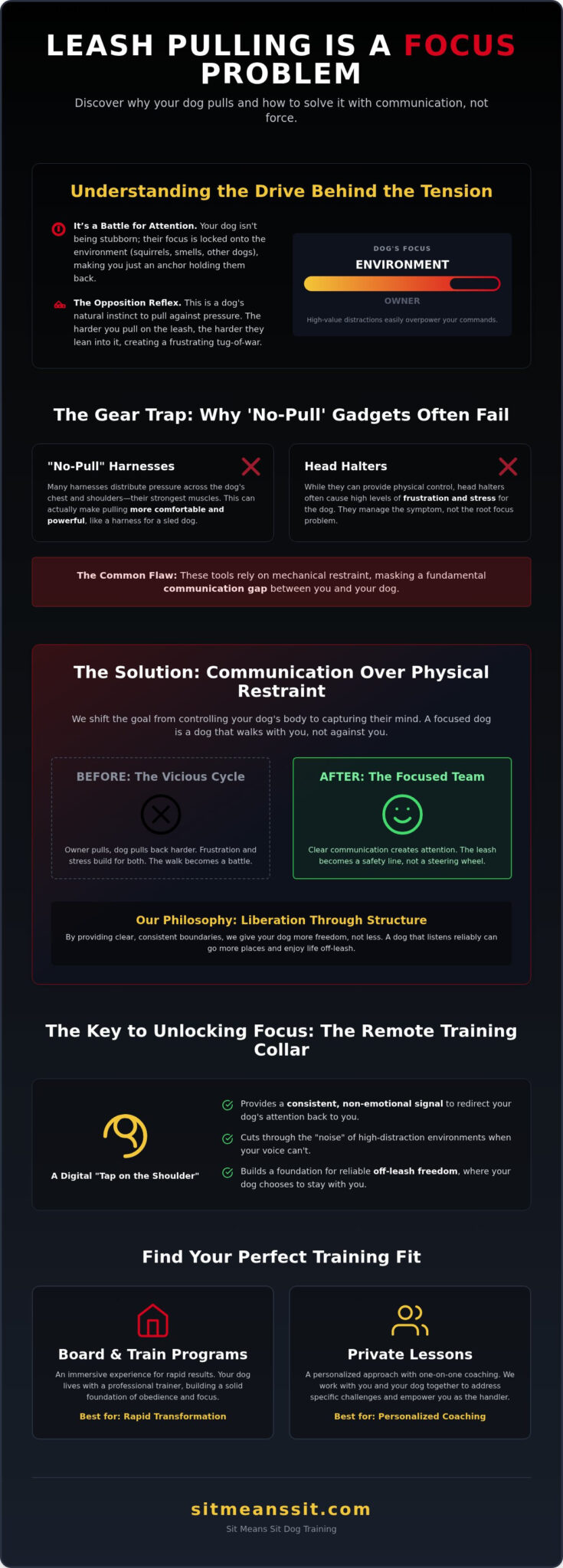
Leash pulling is a focus problem. It’s that simple. When your dog lunges toward a squirrel or drags you down the sidewalk, they aren’t trying to be “bad” or dominant. They’re simply entirely focused on the environment rather than you. At this moment, you’re just an anchor holding them back from what they want. This tension is fueled by the opposition reflex, which is a biological urge to pull back whenever they feel pressure. The harder you pull, the harder they lean in. It’s a physical response that turns every walk into a frustrating tug-of-war.
Stop trying to win through brute force. Shouting or yanking on the leash often backfires by increasing your dog’s arousal and frustration. They don’t understand the “no,” they only feel the stress. This is why a skilled dog trainer for leash pulling focuses on mental engagement rather than physical restraint. Think of the leash as a safety net, not a steering wheel. Its job is to keep your pet safe, but your communication should be what guides their movement. When you shift your perspective from controlling the dog’s body to capturing their mind, the tension disappears.
The Drive for Exploration vs. Owner Engagement
Squirrels, neighborhood smells, and other dogs offer massive biological rewards that a simple biscuit can’t match. When your dog hits the end of that leash, they often experience a “tunnel vision” effect. They literally lose their ability to “hear” your commands because their brain is locked onto a high-value target. Physical strength becomes irrelevant once you capture their mental attention. A professional dog trainer for leash pulling teaches you how to become the most interesting thing in the environment. This ensures your dog chooses to check in with you instead of checking out.
Why Traditional ‘No-Pull’ Gear Often Fails
Many owners turn to harnesses or head halters, hoping for a quick fix. Unfortunately, many harnesses actually make pulling more comfortable for the dog by distributing the pressure across their strongest muscles. It’s like putting a sled dog in a racing kit. Head halters often cause high levels of frustration and rarely lead to long-term behavioral changes because they don’t address the underlying drive. You’re using mechanical restraint to mask a communication gap. True transformation happens when you move away from gadgets and toward a structured system that prioritizes clear, mutual understanding.
The Sit Means Sit Methodology: Communication Over Physical Restraint
Forget about wrestling with your dog’s body. The secret to a calm walk isn’t a stronger arm; it’s a sharper focus. Most owners spend their entire walk trying to stop the pull, but a professional dog trainer for leash pulling focuses on gaining the dog’s attention instead. If your dog is looking at you, they aren’t looking for a squirrel to chase. This shift in perspective is the core of the Sit Means Sit Dog Training “liberation through structure” philosophy. By providing clear, consistent boundaries, you actually give your dog more freedom. A dog that listens is a dog that can go more places, meet more people, and enjoy a much more adventurous life.
Success begins before you even touch the door handle. You must establish a “working state of mind” while you’re still in the living room. If your dog is spinning in circles and barking the moment the leash comes out, you’ve already lost the battle. We teach you how to set expectations early so the walk starts with calm focus rather than chaotic excitement. This consistent feedback is the only way to break through environmental distractions and keep your dog engaged with you, no matter what’s happening on the other side of the street.
The Role of the Remote Training Collar
The Remote Training Collar is our primary tool for this transformation. Think of it as a digital “tap on the shoulder” that redirects your dog’s attention back to you. It provides a consistent, non-emotional signal that cuts through the noise of a busy world. Unlike a voice that might sound frustrated or a leash that might yank, this signal is clear and neutral. It allows the dog to hear you over the “noise” of squirrels and other pets. Our ultimate goal isn’t just a better walk on a leash. We’re training for a world where the leash is optional, and your dog stays by your side because they want to, not because they’re forced to.
Building a Foundation of Attention
We don’t just want your dog to obey commands; we want them to “check in” with you voluntarily. Using tools like the “Place” command helps build incredible impulse control and calm. When a dog learns to stay on a specific boundary despite distractions, that skill translates directly to the sidewalk. This is why our Private Lessons focus on real-world scenarios rather than sterile training rooms. We train where life happens, ensuring your dog can handle high-stimulation environments without breaking their focus. This mastery is what makes Sit Means Sit Dog Training the premier dog trainer for leash pulling for families who want real results.
Board and Train vs. Private Lessons for Leash Pulling Mastery
Choosing the right path is the first step toward a peaceful walk. Every dog is unique, but the goal remains the same: total focus. When you hire a dog trainer for leash pulling, you generally choose between immersive programs and hands-on coaching. Immersive programs deliver weeks of progress in just a few days. They work because they provide a 24/7 environment of consistency that most busy families simply can’t replicate at home. You aren’t just paying for a service; you’re investing in a behavioral reset that changes the trajectory of your life together.
Removing your dog from their habitual environment is a powerful catalyst for change. At home, your dog has “muscle memory” for pulling. They know exactly where the squirrels hide and when they can get away with lunging. A new environment provides a “clean slate” where a professional can handle the hundreds of repetitions needed to install new habits. This professional head start makes the transition back to your home much smoother, as the heavy lifting of the initial learning phase is already complete.
Board and Train: The Immersive Solution
This is the fastest way to reset deep-seated pulling habits. A professional trainer manages every interaction, ensuring your dog never “wins” by pulling. This constant structure builds a reliable foundation much faster than intermittent training. If your dog has high reactivity or extreme pulling power, this is often the best choice. Learn more about how this works in our Board and Train: The Ultimate Guide to Immersive Dog Training. Remember, you aren’t being replaced. You’re getting a dog that is ready to listen when they come home, allowing you to step into a leadership role with confidence and pride.
Private Lessons and Group Practice
Some owners prefer to be “in the driver’s seat” from the very first session. Private Lessons provide one-on-one coaching where you learn the mechanics alongside your pet. It’s a great fit for dogs with moderate pulling issues or owners who have the time to commit to daily homework. Once you master the basics, Group Classes allow you to “proof” those leash manners around other dogs and people. This real-world practice is essential for achieving Dog Obedience Training: Achieving Total Off-Leash Control in 2026. By training in high-stimulation environments, you ensure your dog remains focused on you, regardless of the noise of the world.
How do you decide which is best? Consider your dog’s reactivity level and your own schedule. If they are lunging at every car or pet, the immersive reset of a Board and Train is usually the most effective option. If they just need a little polish and you enjoy the process of daily drills, Private Lessons will get you there. Either way, working with a professional dog trainer for leash pulling ensures you stop guessing and start seeing real results.
How to Handle High-Distraction Environments Without Breaking a Sweat
Training in a quiet living room is the easy part. The real challenge begins when you step onto a busy sidewalk filled with squirrels, cyclists, and other pets. Most owners fail because they only practice when there are zero distractions. A professional dog trainer for leash pulling helps you identify your dog’s threshold. This is the exact distance where your dog can still acknowledge your existence before they’re “lost” to the environment. We teach you how to push this boundary, slowly closing the gap until your dog can walk calmly past a barking neighbor without losing their cool.
Master the “Three-Second Rule” to stop trouble before it starts. If your dog stares at a trigger for more than three seconds, they’re preparing to lunge. Interrupt that fixated gaze immediately. By catching the thought before it becomes a physical action, you maintain control without a struggle. Remember that your energy travels straight down the leash. If you see a distraction and instantly choke up on the lead, you’re telling your dog there’s something to worry about. Keep your grip relaxed and trust the communication system you’ve built.
Focus on mental stimulation rather than just physical exercise. A high-energy dog can run for miles and still have the stamina to drag you home. Engaging their brain with focus drills is far more exhausting. It puts them in a calm, working state of mind that carries over to the walk. If you’re ready to stop the tug-of-war, consider our Board and Train program for a complete behavioral reset.
Strategic Management at Home
Success starts at the front door. If your dog is allowed to bolt outside the moment the door opens, you’ve already lost the walk. Practice “door manners” by requiring a sit and a focus check before anyone crosses the threshold. Use the “Place” command to keep your dog calm while you get your shoes and leash ready. This prevents the frantic “zoomies” that often lead to pulling. Incorporate short mental enrichment games like “find it” or basic obedience drills in the hallway. These exercises tire the dog out mentally, making them much more receptive to your guidance once you’re on the sidewalk.
Navigating the “Squirrel Factor”
When your dog spots a squirrel, don’t just pull back. Use a quick, neutral signal to redirect their attention back to you. The goal is “neutrality.” You want your dog to see other animals as part of the background scenery, not as targets for engagement. This takes steady practice in real-world environments. If your dog has deep-rooted reactivity that feels beyond basic pulling, you might need a specialized approach. Understanding the difference between a trainer and a dog behaviorist can help you find the right expert for your specific needs. Mastery means your dog chooses you over the squirrel every single time.
Off-Leash Freedom: Why Structure Leads to Liberation
Imagine the shift from being dragged down the street to walking with a confident, focused partner. This transformation is the heartbeat of what we do. When you work with a professional dog trainer for leash pulling, you aren’t just fixing a behavior; you’re rebuilding your relationship. Structure isn’t a cage. It’s the foundation of trust that allows your dog to experience the world safely. Clear boundaries remove the guesswork for your pet, replacing anxiety with a deep sense of security. You’re moving from a state of constant tension to a state of mutual respect.
The ultimate goal of our programs is a dog that chooses to stay by your side because they want to be there. This isn’t about physical force or mechanical restraint. It’s about a mutual understanding that creates a deeper bond than you ever thought possible. Professional help is the fastest and safest route to this peaceful life. You don’t have to struggle through trial and error when a proven system is ready to deliver the results you deserve. We take the frustration out of the equation and replace it with a sense of pride in your dog’s behavior.
What Your Professional Assessment Will Reveal
Every dog has unique triggers and a distinct temperament. During an initial assessment, a professional identifies exactly why your dog chooses the environment over you. You’ll see a live demonstration of how our communication tools, like the Remote Training Collar, work specifically for your dog’s personality. We don’t believe in one-size-fits-all solutions. Instead, we help you design a customized plan that fits your lifestyle, whether that involves immersive Board and Train or hands-on Private Lessons. This is where your journey toward a better life together begins.
The Joy of the Perfect Walk
Picture yourself walking through a crowded park on a Saturday afternoon. There are squirrels, other dogs, and children playing nearby. Your leash is loose, and your dog is focused entirely on you. You feel a sense of empowerment as neighbors comment on your pet’s discipline. This isn’t a dream; it’s the reality our clients experience every day. You’ve reclaimed your walk and your peace of mind. You’re no longer the owner being “dragged along,” but the leader your dog respects.
Ready to start your journey toward liberation? Find a professional dog trainer near you today! Our team is ready to help you transition from daily frustration to total mastery. Don’t wait for another painful walk to make a change. Take the first step toward a more adventurous and joyful life with your pet right now. By hiring an expert dog trainer for leash pulling, you’re investing in years of happy, stress-free adventures.
Step Into a Future of Stress-Free Walks
Your walks should be the highlight of your day, not a source of physical pain and anxiety. You now understand that leash pulling is a focus problem that requires a structured communication system rather than mechanical restraint. By choosing a professional dog trainer for leash pulling, you’re opting for a proven path toward total environmental control and mutual respect. True liberation comes from the structure and clarity you provide for your pet.
Sit Means Sit Dog Training brings over 25 years of professional training excellence to every client. Our specialized off-leash communication methodology is designed to deliver reliable results in high-distraction environments. We aim to replace your frustration with a sense of pride as your dog learns to choose you over every squirrel or distraction in the park. This transformation is about more than just obedience; it’s about building a bond that lasts a lifetime.
Don’t spend another day being dragged around the block. Take the first step toward a more adventurous and joyful life with your pet. Stop the pulling and start enjoying your walks again; schedule your free consultation today! We’re ready to help you transform your relationship and reclaim your peace of mind. You and your dog deserve the freedom of a perfect walk.
Frequently Asked Questions
Is my dog too old to learn how to stop pulling on the leash?
Your dog is never too old to learn. We’ve successfully transformed senior dogs that have spent a decade pulling their owners down the street. It’s about replacing ingrained habits with a new, structured communication system. While an older pet might have more muscle memory to overcome, our results-oriented approach works regardless of age. You’ll see a definitive change as long as you remain consistent with the boundaries we establish together.
How long does it take for a dog trainer to fix leash pulling?
Results happen fast when you use the right methodology. An immersive Board and Train program can reset years of pulling in just a few days. Private Lessons typically take a few weeks of consistent practice to reach total mastery. Hiring a professional dog trainer for leash pulling accelerates the process by removing the guesswork. You’ll notice a significant difference in your dog’s focus during the very first session.
Do no-pull harnesses actually work for training?
No-pull harnesses are temporary bandages, not long-term solutions. They use mechanical restraint to physically stop the dog, but they don’t teach the dog to pay attention to you. Many dogs simply learn to pull through the discomfort or the awkward gait. Our goal is to move beyond gear that restricts movement. We focus on behavioral transformation so your dog chooses to walk beside you without needing a restrictive harness.
Will a remote training collar hurt my dog during leash training?
Absolutely not. We use the Remote Training Collar as a neutral, digital tap on the shoulder. It’s a communication tool used at very low levels to get your dog’s attention, not to punish them. Think of it like a gentle vibration on a smartphone. It cuts through environmental noise and provides a clear signal that your dog understands. This creates a stress-free learning environment for both you and your pet.
Why does my dog listen in the house but pull as soon as we go outside?
Your house is a low-distraction environment where you are the most interesting thing in the room. Once you step outside, the world competes for your dog’s attention with squirrels, smells, and other pets. Most dogs haven’t been taught how to handle this environmental noise. We bridge this gap by proofing commands in high-stimulation areas. This ensures your dog maintains their focus on you regardless of where the walk takes you.
Can a dog trainer help with a dog that lunges at other dogs?
Yes, we specialize in high-distraction reactivity and lunging behaviors. Lunging is often the result of a dog being over-threshold and losing their mental connection to the owner. A professional dog trainer for leash pulling addresses the root cause by capturing the dog’s mind before the physical lunge occurs. We teach your dog neutrality. They learn to acknowledge other dogs as part of the background rather than a target for engagement.
What is the difference between a board and train and private lessons for pulling?
Board and Train is an immersive reset where a professional handles the initial, difficult repetitions 24/7. It’s the fastest route to results for extreme pullers. Private Lessons involve one-on-one coaching where you learn the mechanics alongside your dog. Both paths lead to the same goal of total off-leash control. The choice depends on your dog’s reactivity level and how much time you can commit to daily practice.
Will my dog still get enough exercise if they aren’t allowed to pull ahead?
Your dog will actually be more tired after a structured walk. Mental engagement is far more exhausting for a dog than mindless pulling. When your dog has to focus on your pace and check in regularly, their brain is working overtime. A 20-minute walk with perfect leash manners provides better physical and mental enrichment than an hour of frantic pulling. You’re trading chaotic energy for calm, productive exercise.
Comments are closed.