
What if the secret to your dog’s perfect recall isn’t hidden in a bag of expensive liver treats? If you’re struggling with how to train a dog that is not food motivated, you’ve likely felt the sting of being ignored while holding a handful of high-value snacks. It’s exhausting to feel held hostage by a piece of kibble. You want a partner, not a mercenary who only works when the price is right. You’re tired of the public embarrassment and the fear that your dog might bolt toward danger because they simply don’t care about the cookie in your hand.
We agree that your relationship should be built on more than just a transaction. We’ll show you how to gain your dog’s absolute focus using professional communication techniques that create total reliability. You’ll learn how to move beyond the bowl and establish a bond that works in high-stimulation environments. This article explores the shift from bribery to leadership, highlighting how structured Private Lessons and Remote Training Collars provide the clarity your dog needs. Stop the frustration now and replace it with a sense of pride and a lifestyle of true off-leash freedom.
Key Takeaways
- Identify the “Attention Gap” to understand why your dog values the environment more than the treats in your hand.
- Discover how to train a dog that is not food motivated by leveraging high-octane functional rewards like tug and fetch.
- Use a Remote Training Collar as a neutral communication tool to cut through the noise and get your dog’s attention.
- Master the “Proofing” phase to ensure your dog ignores distractions and stays locked on your commands.
- Shift from bribery to leadership to achieve the ultimate goal of absolute off-leash freedom and safety.
Why Your Dog Ignores Treats: Identifying the ‘Attention Gap’
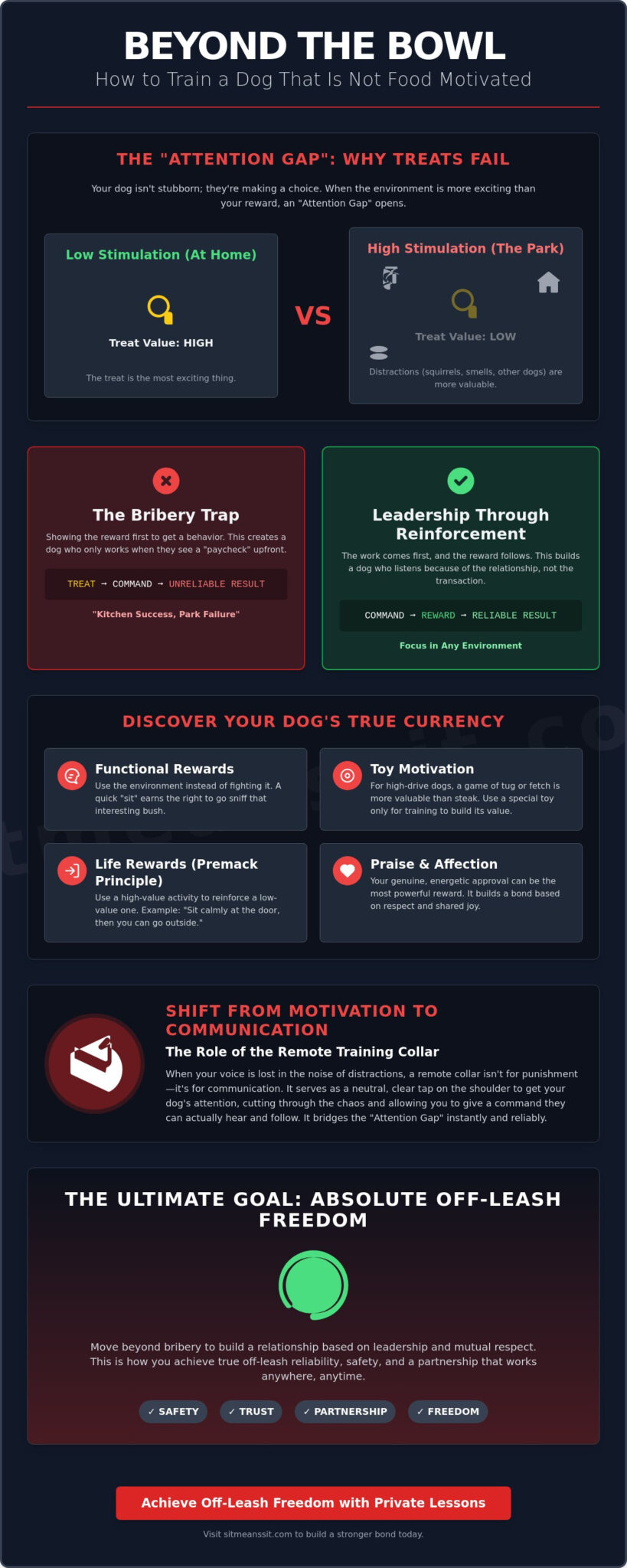
Your dog isn’t broken, and they aren’t “untrainable.” They are simply making a logical choice. When you are at home in your kitchen, a piece of chicken is the most exciting thing in the room. Once you step outside, that chicken has to compete with squirrels, barking neighbors, and the scent of every dog that walked by that morning. This is the “Attention Gap.” It occurs the moment environmental distractions outweigh the value of your reward. If you want to learn how to train a dog that is not food motivated, you must first bridge this gap by changing your communication strategy.
Most owners fall into the trap of bribery. They show the dog the food first to get them to sit. This creates a dog that only listens when they see a “paycheck” upfront. Professional dog training methods focus on reinforcement instead. Reinforcement means the work comes first, and the reward follows. When you lead with food, you aren’t training; you’re negotiating. High-drive or independent breeds, like Huskies or Akitas, will quickly realize when you don’t have the goods and will choose to ignore you. This leads to the “Kitchen Success/Park Failure” syndrome, where your dog is a star in the living room but completely deaf at the local park.
The Psychology of ‘Opting Out’
Dogs are masters of cost-benefit analysis. If your dog is “free-fed” and has a full bowl of food waiting at home, a tiny piece of kibble has zero leverage against a running squirrel. You’ve removed the necessity of the reward. Additionally, high-stimulation environments trigger adrenaline. When a dog is over-stimulated, their digestive system literally shuts down. They aren’t being stubborn; their bodies are telling them that eating isn’t a priority during a “high-stakes” moment. You can’t out-snack a biological response.
Ruling Out Medical and Emotional Blocks
Before you overhaul your routine, ensure your dog is physically healthy. A sudden loss of appetite can signal dental pain, digestive issues, or metabolic changes. If your dog is healthy but still refuses food, look at their emotional state. A dog paralyzed by environmental anxiety isn’t “ignoring” you. They are in survival mode. Distinguish between a dog that is choosing the environment and a dog that is too scared to function. Ultimately, the Attention Gap is a failure of communication, not a lack of hunger. We replace that gap with clear, firm structure that gives your dog the confidence to focus on you, regardless of what is happening around them.
Beyond the Bowl: High-Value Alternatives to Food Rewards
Finding what truly drives your dog is the key to mastering how to train a dog that is not food motivated. We call these “Functional Rewards.” Every dog has a currency. For some, it is the chance to chase a ball. For others, it is the opportunity to sniff a specific patch of grass. If your dog is pulling toward a bush, that sniff is their current highest value. Use it. Require a sit or a brief heel before giving the “Go Sniff” command. You are now using the environment as a reward rather than fighting against it. This shift transforms you from a treat dispenser into a gatekeeper of everything fun.
Professional organizations like the American Veterinary Medical Association advocate for using non-food rewards for dogs to maintain health and build engagement. Praise and physical affection can be powerful, but they must be earned. Your approval should be the ultimate paycheck. When your dog completes a difficult task, your energy should explode with excitement. A high-pitched “Good!” or a vigorous chest scratch can often outweigh a dry biscuit. This builds a bond based on mutual respect and shared joy rather than a simple transaction.
Toy Motivation: Turning Play into Progress
High-drive dogs often prefer a game of tug over a piece of steak. Select a specific training toy, like a long jute tug or a ball on a rope, that stays hidden until work begins. This exclusivity builds intense value. You must master the “Out” command to maintain control and keep the session moving. If the game doesn’t stop when you say so, the training loses its structure. Keeping the toy “yours” ensures that you remain the center of the excitement. If you’re struggling to find that leverage, our Private Lessons can help you identify exactly what makes your dog tick.
Life Rewards: The Premack Principle
The Premack Principle is a cornerstone of reliable behavior in 2026. It is simple: use a high-value activity to reinforce a low-value one. Want to get the leash off at the park? Your dog must sit and make eye contact first. Want to go through the front door? They must wait for your release. You are the gatekeeper to their world. By controlling access to the things they love, you create a dog that looks to you for permission. Freedom is the ultimate reinforcement. When a dog learns that coming when called leads to more off-leash time, you’ve achieved total reliability without a single treat.
The Attention-First Training Framework: 5 Steps to Focus
Stop trying to out-compete the world. You will lose every time you try to be more interesting than a deer or a speeding car. Instead, build a framework where attention is the only way your dog gets what they want. This five-step process is the blueprint for how to train a dog that is not food motivated by prioritizing engagement over snacks. Success starts with structure, not treats.
- Step 1: Control the Environment. Start in a “boring” room with zero distractions. No toys on the floor and no other pets allowed. If you are the only thing happening in the room, your dog will eventually look at you. You win by default.
- Step 2: Name Recognition. Say your dog’s name once. The moment they make eye contact, mark it with a crisp “Yes!” and reward. You are rewarding the “Look” itself, which is the foundation of all future commands.
- Step 3: Adding Mild Distractions. Introduce small changes to your boring room. Drop a set of keys or have a family member walk through the hallway. If your dog stays locked on you despite the noise, they’ve earned their reward.
- Step 4: The ‘Check-In’. This is the holy grail of training. Wait for your dog to look at you without being prompted. When they choose you over the environment on their own, use alternatives to food rewards like a quick game of tug or opening the door for a walk.
- Step 5: Generalization. Move the training to the front yard. Then the driveway. Finally, head to the park. If the training collapses, go back one step. You are building a reliable habit that works anywhere.
Training the Brain, Not the Stomach
Shift your dog’s mindset from “What’s in it for me?” to “What are we doing next?” This is the “Engagement Game.” You want to be the center of your dog’s universe. High-level dog obedience training must prioritize this mental connection over flashy tricks. When your dog is mentally “plugged in” to you, commands become a collaborative effort rather than a transactional one. This makes you the most relevant thing in their life, regardless of distractions.
Building Duration and Distance
Master the 3 D’s of training: Distance, Duration, and Distraction. Start by asking for three seconds of solid eye contact. Then five. Then ten. Slowly increase the physical distance between you and your dog while maintaining that focus. Finally, add the chaos of the real world. You are gradually increasing the “work” required before a reward is given. Focus is a muscle that must be exercised daily. By pushing these boundaries, you ensure that your dog’s reliability isn’t limited to the living room.
Professional Tools: Using Communication to Replace Motivation
When treats lose their value, you need a communication system that doesn’t rely on your dog’s appetite. Many owners feel stuck because they don’t know how to train a dog that is not food motivated once the distractions of the real world take over. This is where professional tools change the game. We utilize the Remote Training Collar not as a tool of punishment, but as a neutral, clear method of communication. It acts as a “tap on the shoulder” that your dog can feel even when they are fifty yards away. It cuts through the environmental noise and brings their focus back to you instantly.
Think of the remote collar as a hearing aid for a dog that has tuned you out. It provides a physical sensation that replaces the need for a bribe. In the Sit Means Sit methodology, we prioritize clear and fair communication above all else. We want your dog to understand exactly what is expected of them without the confusion of shifting moods or varying treat quality. Modern remote training is about gaining attention. It is the bridge that connects your command to your dog’s brain when their stomach isn’t interested in listening. In our system, a directive is a definitive agreement between you and your pet; it is never a suggestion.
The Remote Collar Advantage
The biggest advantage of a remote collar is the ability to “reach out and touch” your dog at a distance. When food is ignored, you often have no way to physically guide your dog back to a state of focus. The collar provides that guidance. This level of reliability is why this technology is a cornerstone of service dog training. For those dogs, reliability is a matter of safety and independence. By using the collar to redirect attention, you ensure that your dog remains responsive even in high-stakes environments where a piece of kibble would be ignored.
Consistency Through Technology
Humans are inconsistent. We get frustrated. We shout. We change our tone based on our day. A remote collar removes this human error from the equation. The signal is always the same. It is neutral, consistent, and predictable. This consistency builds trust because the dog knows exactly what the signal means every time. It creates a safety net for off-leash adventures, giving you the confidence to explore the world together. Professional instruction is essential to ensure these tools are introduced correctly. Experience the difference for yourself by enrolling in our Private Lessons to start your transformation today. We turn frustrated owners into confident leaders by providing the tools for total mastery.
Real-World Mastery: Taking Obedience Beyond the Living Room
Your living room is a laboratory; the real world is a battlefield of distractions. You’ve learned the basics of how to train a dog that is not food motivated, but the true test happens when a cat dashes across the street or a cyclist zooms past. This is the “Proofing” phase. Proofing isn’t about teaching new commands. It’s about ensuring your dog follows the ones they already know, regardless of the environment. Reliability isn’t real if it only happens when it’s quiet. You need a dog that chooses your voice over the chaos of the neighborhood every single time.
Transitioning to off-leash control is the ultimate goal of our communication system. When you remove the physical tether of a leash, you rely entirely on the mental bond and the clarity of your tools. If you’ve been struggling with a dog that “forgets” their training the moment they see a squirrel, an immersive board and train program is the fastest way to jumpstart your results. These programs allow professional experts to handle the heavy lifting of distraction training, handing you back a dog that is ready for any adventure. In 2026, dog ownership is about more than just walks; it’s about a lifestyle of shared freedom.
Distraction Training 101
Success in high-stimulation environments requires a gradual approach. Don’t jump from your hallway to the middle of a busy dog park. Start in your driveway. Move to the sidewalk. Stand fifty feet away from the dog park fence and practice your focus drills there. Master the “Emergency Recall” by practicing in short, high-energy bursts. You want your dog to turn on a dime when they hear their name. Remember, “Sit Means Sit” is a lifestyle, not just a command. It’s a commitment to a standard of behavior that keeps your dog safe and your stress levels low.
- Driveway Drills: Practice basic commands with the garage door open.
- The Perimeter Walk: Heel your dog around the outside of a park before entering.
- The ‘Look’ Marker: Mark and reward every time your dog ignores a distraction to look at you.
Your Path to a Better Life
Imagine a future where you can take your dog to an outdoor cafe or a hiking trail with total confidence. You don’t have to scan the horizon for “triggers” or feel embarrassed by a barking, lunging pet. Professional guidance turns a “difficult” dog into a dream companion by replacing confusion with clear boundaries. You’ve already taken the first step by moving beyond the bowl. Now, it’s time to finish the job. Find a dog trainer near me to start your transformation and experience the liberation that comes with a perfectly behaved dog. Your new life starts with one decisive choice.
Unlock Your Dog’s Off-Leash Potential
You no longer have to feel frustrated by a dog that ignores your treats. By identifying the attention gap and leveraging functional rewards, you’ve discovered the path to a more meaningful connection. We’ve explored exactly how to train a dog that is not food motivated by replacing bribery with structured, professional communication. Real-world mastery is possible when you prioritize focus over food. This transition isn’t just about obedience; it’s about building a bond that survives the chaos of the real world.
Sit Means Sit has transformed the lives of thousands of dogs across the US using industry-leading remote collar technology. Our methods focus on off-leash reliability and delivering results that hold up in high-stimulation environments. You deserve the pride of a perfectly behaved companion. Your dog deserves the freedom that comes with discipline. Stop the guesswork and start your transformation with the experts today.
Transform your dog’s behavior today—Schedule your FREE consultation!
Your journey toward a more adventurous and joyful life together starts now. We are ready to help you achieve the total reliability you’ve always wanted.
Frequently Asked Questions
Is it possible to train a dog that doesn’t like treats?
Yes, it is absolutely possible to train any dog without using food. Many owners struggle with how to train a dog that is not food motivated because they believe treats are the only currency. We replace the treat with a clear communication system that relies on your attention and leadership. Once your dog understands the rules, they will work for your approval and the freedom that comes with good behavior.
What do you do if your dog is not food motivated and won’t play with toys?
You must identify what your dog actually values in their environment. If food and toys don’t work, use functional rewards like the opportunity to sniff, go for a walk, or receive physical praise. Every dog has something they want. By becoming the gatekeeper to these life rewards, you gain the leverage needed to drive focus and obedience.
How do I get my dog to listen to me outside with distractions?
You must bridge the attention gap by using a neutral communication tool like a Remote Training Collar. Outside distractions are often more exciting than you are. The collar acts as a tap on the shoulder to remind your dog to look back at you. Start in low-distraction areas like your driveway before moving to high-traffic zones like a park to ensure reliability.
Can you use a remote collar on a dog that isn’t food motivated?
Yes, a remote collar is the most effective tool for dogs that ignore food. Using a Remote Training Collar is a game changer when learning how to train a dog that is not food motivated. It provides a consistent signal that doesn’t depend on your dog’s appetite or the quality of a treat. This technology allows you to maintain a connection at a distance, ensuring your dog hears your command every time.
Why does my dog listen at home but ignore me at the park?
Your dog listens at home because the environment is boring and predictable. At the park, the cost of listening to you increases because the distractions are much more rewarding. This is a common failure of traditional treat-based training. You need to proof your commands in different environments using a system that demands focus, ensuring your dog understands that a command is a definitive agreement everywhere.
What are some high-value rewards for dogs that aren’t food?
High-value rewards include a game of fetch, vigorous praise, or the “Go Sniff” command. Freedom is also a massive motivator. Allowing your dog to run off-leash as a reward for a perfect recall is often more powerful than any biscuit. Identify your dog’s specific drives and use them as the paycheck for their hard work.
How long does it take to train a dog using the Sit Means Sit method?
You will see a noticeable change in your dog’s focus during your very first session. While every dog is different, our immersive Board and Train programs or Private Lessons are designed to jumpstart results quickly. Total reliability requires consistent practice, but our methodology provides the clear structure needed to achieve mastery faster than traditional methods.
Is my dog too old to learn new communication methods?
No dog is too old to learn how to communicate effectively with their owner. Older dogs often thrive under a structured system because it removes the confusion they may have felt for years. We adapt our training to your dog’s physical abilities and emotional state. You can replace years of frustration with a new sense of pride and adventure at any stage of your dog’s life.
Comments are closed.