
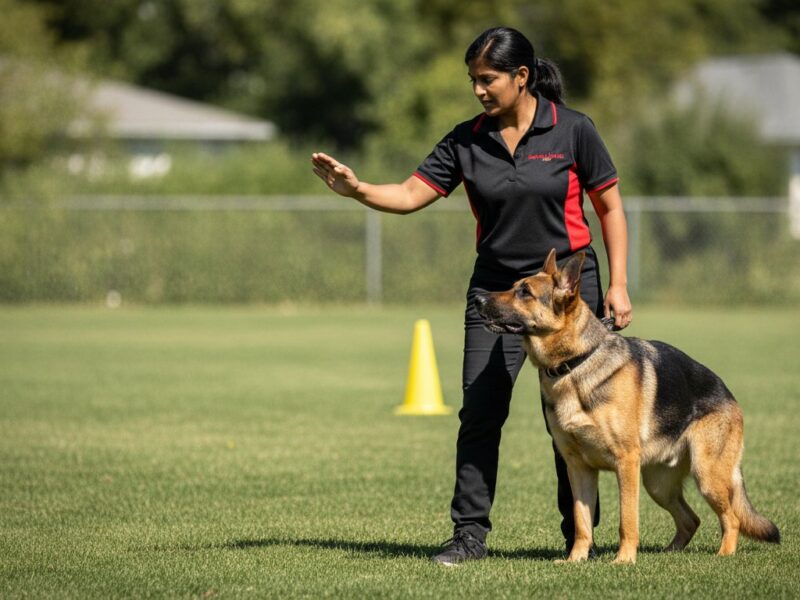
What if the terrifying incident that shattered your confidence wasn’t a character flaw, but a desperate communication failure? You love your dog, yet you’re living in a state of constant high alert, trapped between the guilt of their behavior and the fear of what might happen next. It’s a heavy burden to carry, especially when you’re facing conflicting advice and the looming threat of rehoming. You deserve a home that feels like a sanctuary, not a minefield. Rehabilitating a dog with a bite history is possible when you replace guesswork with absolute structure and professional expertise.
We’re here to turn your frustration into empowerment by showing you exactly how to bridge the communication gap. This guide provides the professional framework for assessing risk, managing your environment, and training for reliable results that restore your peace of mind. You’ll learn how to interpret the Ian Dunbar Dog Bite Scale, understand the legal landscape of liability, and discover why an immersive Board and Train program is the most effective way to hit the reset button on your dog’s behavior. It’s time to stop living in fear and start building a future defined by control, confidence, and joy.
Key Takeaways
- Use the Ian Dunbar Dog Bite Scale to objectively assess the severity of an incident and determine the best path forward for your family.
- Shift your focus from temporary management to a permanent solution for rehabilitating a dog with a bite history through clear, declarative structure.
- Identify the key indicators of a successful prognosis, including the level of bite inhibition and the depth of owner commitment required for change.
- Master the immediate safety protocols and documentation steps needed to secure your environment and prevent future incidents.
- Discover why immersive Board and Train programs provide the 24/7 consistency needed to break old habits and restore reliable results.
Understanding the Severity: The Ian Dunbar Dog Bite Scale
Objectivity is your best weapon against fear. When a bite occurs, emotions run high and clarity disappears. You need a professional way to measure what actually happened so you can decide how to move forward. The Ian Dunbar Dog Bite Scale is the industry standard for assessing the severity of an incident. It removes the guesswork and provides a clear map of your dog’s current behavioral state. Rehabilitating a dog with a bite history starts with this honest assessment.
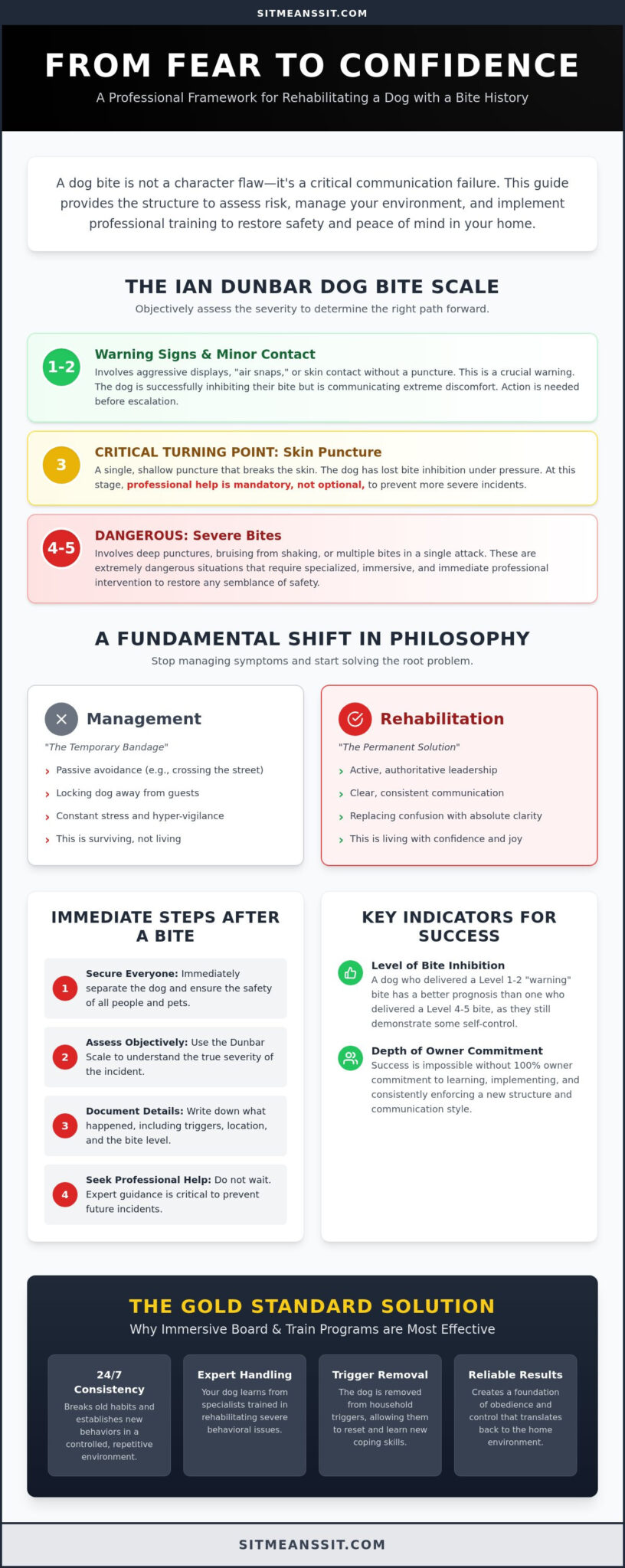
- Level 1 and 2: These involve aggressive displays, “air snaps,” or skin contact without a puncture. These are warning shots. Your dog is successfully inhibiting their bite, but they’re telling you they’ve reached a breaking point.
- Level 3: This is the critical turning point where the skin is broken by a single, shallow puncture. The dog has lost their bite inhibition under pressure. Professional help is no longer optional; it’s mandatory.
- Level 4 and 5: These levels involve deep punctures, bruising from shaking, or multiple bites in a single incident. These are dangerous situations that require specialized, immersive intervention to restore any semblance of safety.
Why Dogs Bite: Instinct vs. Intent
Dogs don’t bite to be “mean.” Most incidents are rooted in fear-based reactivity or, less commonly, predatory aggression. We often see a phenomenon called trigger stacking. This is where multiple stressors, like a loud noise, a strange person, and a sudden movement, build up until the dog finally snaps. Understanding Dog bite statistics and prevention reveals that “biting out of nowhere” is almost always a myth. There were signs; they were just missed or ignored. Our job is to teach you how to read those signs before the pressure boils over.
The Myth of the “Aggressive Breed”
Forget the stereotypes you see on the news. Any dog, from a tiny Chihuahua to a massive Guardian breed, can develop a bite history if they lack structure and clear boundaries. Temperament is an individual trait, not a breed standard. We focus on the dog in front of us, assessing their specific history and environmental triggers rather than their DNA. Size only changes the potential for damage, not the necessity of the training. Rehabilitation is the deliberate process of retraining a dog’s response to stress through consistent, professional conditioning. It’s about replacing an impulsive reaction with a reliable, commanded behavior.
The Philosophy of Rehabilitation: Communication Over Management
Stop managing the symptoms and start solving the problem. Management is a temporary bandage. It involves crossing the street to avoid other dogs or locking your pet in a crate when guests arrive. This isn’t living; it’s surviving. Rehabilitating a dog with a bite history requires a fundamental shift in how you communicate. You must move from passive avoidance to active, authoritative leadership. Our goal is to remove the dog’s perceived need to bite by replacing their confusion with absolute clarity.
The approach at Sit Means Sit Dog Training replaces owner frustration with total confidence. Many “positive only” methods fail aggressive dogs because they lack the necessary boundaries to handle high-stimulation triggers. A dog in a reactive state isn’t looking for a cookie; they’re looking for direction. We build a foundation where every command is a definitive agreement. Your dog doesn’t just “kind of” sit. They sit because they understand it is the only path to a successful outcome. This clarity creates a narrative where discipline leads to liberation for both the pet and the owner.
The Role of Clear Feedback
Consistency is the bedrock of trust. We utilize the Remote Training Collar to provide a clear, tactile communication channel that works even when the dog is highly distracted. This tool isn’t for punishment. It’s a tap on the shoulder that says, “Listen to me now.” It allows us to move beyond a simple “no” and provide a roadmap for the dog’s behavior. We aim for total reliability, ensuring your dog responds to commands even when they are off-leash or facing their biggest triggers. While doctors focus on the medical management of dog bites to heal the physical wounds, we focus on the behavioral transformation that prevents future trauma. If you need immediate, tailored guidance for your specific situation, our Private Lessons provide the one-on-one coaching necessary to master these communication techniques.
Structure as the Key to Confidence
Anxious dogs are often dogs who feel they are in charge of everything. They feel the need to guard the door, the couch, and their food bowl because no one else is setting the rules. This self-imposed responsibility is exhausting for the animal and dangerous for the family. Structure is the antidote to this anxiety. By creating predictable routines and firm boundaries, you tell the dog that you are handling the big decisions. This allows them to settle into a calm, submissive state. A structured life isn’t a boring one; it’s a life where your dog can safely join you at the park, the patio, or on a hiking trail without the risk of an incident.
Is My Dog a Candidate for Rehabilitation? Assessing the Prognosis
Rehabilitating a dog with a bite history is a journey that requires an honest look at the odds. We don’t believe in false hope. We believe in data-driven results. While the Dunbar Scale tells us what happened in the past, your prognosis depends entirely on what happens next. Several variables determine if your dog can safely return to a life of freedom and adventure. We evaluate every case with absolute confidence to ensure you have a clear path to success.
Owner commitment is the absolute number one factor in this process. You are the leader of the team. If you aren’t prepared to enforce new boundaries or maintain a consistent routine, even the best training will eventually fail. We provide the professional mastery, but you provide the daily practice. Success happens when your dedication matches our expertise. It’s about taking pride in the work and seeing the transformation happen in real-time. You must be willing to change your habits to help your dog change theirs.
We also look closely at bite inhibition and risk factors for dog bites to understand the severity of the behavior. A dog that snaps and misses is showing restraint, even in a state of high stress. A dog that bites deep without warning presents a much higher risk level. We analyze the frequency of these incidents to see if we’re dealing with an isolated mistake or a deeply ingrained habit. Patterns are harder to break, but they aren’t impossible. Finally, we evaluate your home environment. Can you control the triggers while we work through the retraining phase? If you can provide a stable environment, we can provide the solution.
When to Seek a Professional Dog Behaviorist
Don’t try to DIY a bite history. Basic obedience won’t fix a dog that uses its teeth to solve problems. You need an assertive authority figure who understands the psychology behind the aggression. Understanding the difference between a Dog Behaviorist vs. Trainer is essential for finding the right expert for your dog. A behavioral specialist looks beyond the sit and stay to address the underlying emotional state of the animal. They handle the heavy lifting so you can focus on rebuilding the bond with your pet.
The Importance of Professional Evaluation
An expert must observe your dog’s body language in a controlled, high-stimulation setting. We look for subtle red flags like whale eyes, stiffening, or low-frequency growls that an average owner might miss. These indicators tell us if a dog is a candidate for private coaching or if they need the intensive, 24/7 immersion of a Board and Train program. We identify the triggers and build a plan to neutralize them. A professional assessment provides the roadmap for safety. It gives you the clarity needed to stop worrying and start training.
Immediate Steps to Take After a Bite Incident
Action creates clarity. The seconds following a bite incident are often a blur of fear and confusion. Take control immediately. Your first move is simple: secure the dog. Place them in a crate or a separate room with a solid door. This isn’t about punishment. It’s about establishing an immediate safety zone so you can think clearly. Rehabilitating a dog with a bite history requires a calm, methodical approach, and that starts with absolute containment.
Next, document the incident with clinical precision. Write down exactly what occurred in the minutes leading up to the bite. Note the environmental triggers, the people involved, and the dog’s specific body language. This documentation is vital for your professional trainer to build an effective rehabilitation plan. Following this, consult your veterinarian. Aggression is frequently a symptom of underlying physical pain or neurological issues. You must rule out medical causes before behavioral retraining can begin.
Implement a “Zero Stimulus” period for the next 48 to 72 hours. Your dog’s system is flooded with stress hormones like cortisol. Any additional excitement or pressure could trigger another incident. Keep routines boring and predictable. This decompression phase is the first step toward a new baseline of communication. It allows the animal to reset and prepares them for the structured work ahead.
Securing the Environment
Control the space to prevent future accidents. Use muzzles and double-leashing as temporary but essential safety tools during necessary movements. Restrict all access to visitors and children until a professional assessment is complete. We recommend the “Two-Door” rule: ensure there are always two physical barriers between your dog and the outside world. This creates a safety buffer that prevents accidental escapes or unintended interactions. These layers of security protect your family and your pet while you formulate a long-term plan.
In addition to physical barriers, managing visual triggers through glass is often overlooked; to further fortify your home’s safety and reduce reactivity, you can discover Sunshield Group for advanced protective window solutions.
Finding the Right Training Program
You shouldn’t handle this alone. You need a professional partner who specializes in high-stimulation behavioral transformation. Our Private Lessons provide the hands-on coaching you need to maintain safety in your home environment. When searching for a Dog Trainer Near Me, prioritize experience with bite histories over general obedience. You need a results-oriented approach that replaces your fear with empowerment. If you’re ready to hit the reset button and restore peace to your household, our Board and Train programs offer the intensive conditioning required for lasting change.
Professional Solutions: Why Board and Train is the Gold Standard
When your home has become a place of tension and fear, you need a solution that works fast and sticks. Board and Train is the definitive “reset button” for aggressive behavior. It’s the most effective method for rehabilitating a dog with a bite history because it removes the animal from the environment where the problem started. By taking the dog out of your house, you immediately eliminate the risk of another incident while we do the heavy lifting. This creates a safe space for your family to breathe and for your dog to learn without the weight of past mistakes.
Immersion is the secret to behavioral transformation. In a controlled, professional setting, we break old habits by replacing them with thousands of successful repetitions. You might have an hour a day to train; we have an entire team dedicated to your dog’s progress 24/7. This level of consistency is something even the most dedicated owner can’t replicate at home. For a deep dive into how these programs function, check out our Board and Train: The Ultimate Guide. Our goal is to move the dog from a state of reactive impulse to one of commanded reliability.
The Sit Means Sit Dog Training Board and Train Advantage
We don’t just teach your dog to sit. At Sit Means Sit Dog Training, we establish a new baseline of communication using the Remote Training Collar. This tool allows us to reach the dog even in high-stimulation scenarios that would normally trigger a bite. We prepare your pet for the real world, testing their obedience around distractions they’ll actually face. The most critical part of our program is the transition phase. We spend dedicated time coaching you, the owner, so you have the mastery required to maintain these results the moment your dog walks back through your front door.
Achieving Long-Term Reliability
Success isn’t just about the weeks spent with us; it’s about the years that follow. Our Group Classes serve as the final step in proofing your dog’s new skills around other people and pets. It’s where we turn training into a lifestyle. You gain access to a professional support network that remains available for the life of your dog, ensuring you’re never alone if a new challenge arises. Rehabilitating a dog with a bite history is a permanent lifestyle change, not a one-time fix. It’s a commitment to a future where structure leads to a more adventurous and joyful life for you both.
Take Control of Your Future Today
Living in fear is no longer your only option. You now understand that a bite incident is a starting point for change, not a dead end. By using objective assessments like the Dunbar Scale and implementing strict safety protocols, you’ve already begun the process of reclaiming your household. True transformation happens when you replace temporary management with permanent mastery. Rehabilitating a dog with a bite history requires the right tools and a professional partner to bridge the communication gap forever.
Sit Means Sit Dog Training has delivered proven results with thousands of difficult behavioral cases. We use our proprietary Remote Training Collar technology to establish a clear, tactile dialogue that cuts through the noise of high-stress moments. Our specialized Board and Train programs provide the rapid transformation needed to hit the reset button on your dog’s behavior. Don’t wait for another incident to happen. Contact Sit Means Sit Dog Training for a Professional Evaluation and start your journey toward a life of liberation through structure. You can have a dog that is a joy to live with and a home that feels like a sanctuary once again. Take the lead and reclaim your peace of mind today.
Frequently Asked Questions
Can a dog be truly rehabilitated after biting someone?
Yes, rehabilitation is entirely possible when you address the root cause of the behavior through absolute structure. Most bites are communication failures that can be corrected with professional guidance and a new baseline of obedience. By establishing clear boundaries, you remove the dog’s perceived need to use its teeth to solve problems. Success depends on your commitment to maintaining the new routines we establish during the training process.
Is it ever too late to start training an aggressive dog?
It is never too late to begin a behavioral transformation. Older dogs are often highly receptive to structure because it provides the clarity they have lacked for years. While habits may be deeply ingrained, our immersive programs act as a reset button for the animal’s brain. We focus on the dog in front of us today, regardless of their age or previous history, to build a safer and more joyful future.
How much does it cost to rehabilitate a dog with a bite history?
The cost of rehabilitating a dog with a bite history is an investment in your family’s safety and your dog’s life. Specialized programs for aggression require more intensive resources and professional expertise than standard obedience training. While specific costs vary based on the severity of the behavior and the length of the program, the long-term value of a safe, controlled home environment far outweighs the potential legal and medical costs of another incident.
Will my dog always have to wear a muzzle in public?
A muzzle is a valuable temporary tool for safety, but it isn’t always a lifetime requirement for every dog. Our goal is to move beyond passive management and achieve active, reliable control through professional conditioning. Through consistent practice and clear feedback, many dogs reach a level of obedience where a muzzle is no longer necessary in everyday situations. We train for real-world results that restore your confidence in high-stimulation environments.
What is the most effective training tool for aggressive dogs?
The Remote Training Collar is the most effective tool for establishing clear communication in high-stress moments. It provides a consistent, tactile signal that your dog can understand even when they are distracted or reactive. This tool allows us to give directions from a distance, ensuring your dog remains under control without the need for physical force. It is about mastery and reliability, not punishment.
Is a bite history a legal liability for the owner?
Yes, a bite history carries significant legal weight and potential financial consequences. Depending on your state, you may face strict liability laws where owners are responsible for damages regardless of the dog’s past behavior. New regulations, such as Arizona’s 2025 “Bite and Run” law, also increase owner accountability for providing contact information. Professional training is your best defense because it demonstrates a proactive commitment to public safety and responsible ownership.
Much like how individuals in industrial sectors check out Training Combined to secure accredited high-risk work licensing, owners of reactive dogs must seek out professional training to ensure public safety and legal compliance.
Can I rehabilitate my dog at home without professional help?
We strongly discourage attempting to fix serious aggression without professional help. DIY methods often lack the necessary safety protocols and can accidentally reinforce the very behaviors you are trying to stop. A professional trainer provides the assertive authority and technical mastery required to handle dangerous triggers safely. Professional intervention ensures that you aren’t just guessing; you are following a proven framework that prioritizes the well-being of everyone involved.
How long does the rehabilitation process typically take?
The initial phase of rehabilitating a dog with a bite history often takes two to three weeks in an immersive, professional program. However, true rehabilitation is a continuous process that requires lifelong commitment. While we establish the foundation and solve the immediate behavioral crisis, you must commit to maintaining that structure at home. Think of it as a lifestyle change that evolves as your dog gains more confidence and reliability in different real-world scenarios.
Comments are closed.