
What if the secret to a perfect walk had nothing to do with your dog’s physical strength and everything to do with their focus? If you’ve ever felt the sharp sting of a sore shoulder or the burning embarrassment of being dragged down your own street, you aren’t alone. With 70 percent of U.S. households now sharing their lives with pets, millions of owners are currently losing the daily battle for sidewalk supremacy. You want to enjoy the outdoors, but instead, you’re constantly worried about your dog bolting or tripping you into the pavement.
It’s time to end the struggle. Effective dog training for leash pulling isn’t about better restraints; it’s about building a reliable communication bridge. We’ll show you how to transform your frustrating walks into a stress-free bonding experience by mastering the art of attention-based control. This guide reveals the exact steps to turn a pulling machine into a calm partner that stays by your side even in high-distraction environments. You’ll gain the tools to replace chaos with discipline and regain total confidence in your dog’s focus. Get ready to reclaim your freedom and turn every walk into the highlight of your day.
Key Takeaways
- Identify the biological “opposition reflex” that triggers pulling and learn how to replace it with voluntary focus.
- Master the attention-first framework for dog training for leash pulling to ensure your dog chooses you over environmental distractions.
- Utilize the Remote Training Collar as a sophisticated communication tool to maintain a perfect “Heel” in any setting.
- Practice high-stakes drills like the “About-Turn” and “Squirrel Test” to build total confidence during every neighborhood walk.
- Recognize when professional Board and Train programs are the fastest path to achieving a lifelong stress-free bond.
Why Your Dog Pulls on the Leash: Understanding the Root Cause
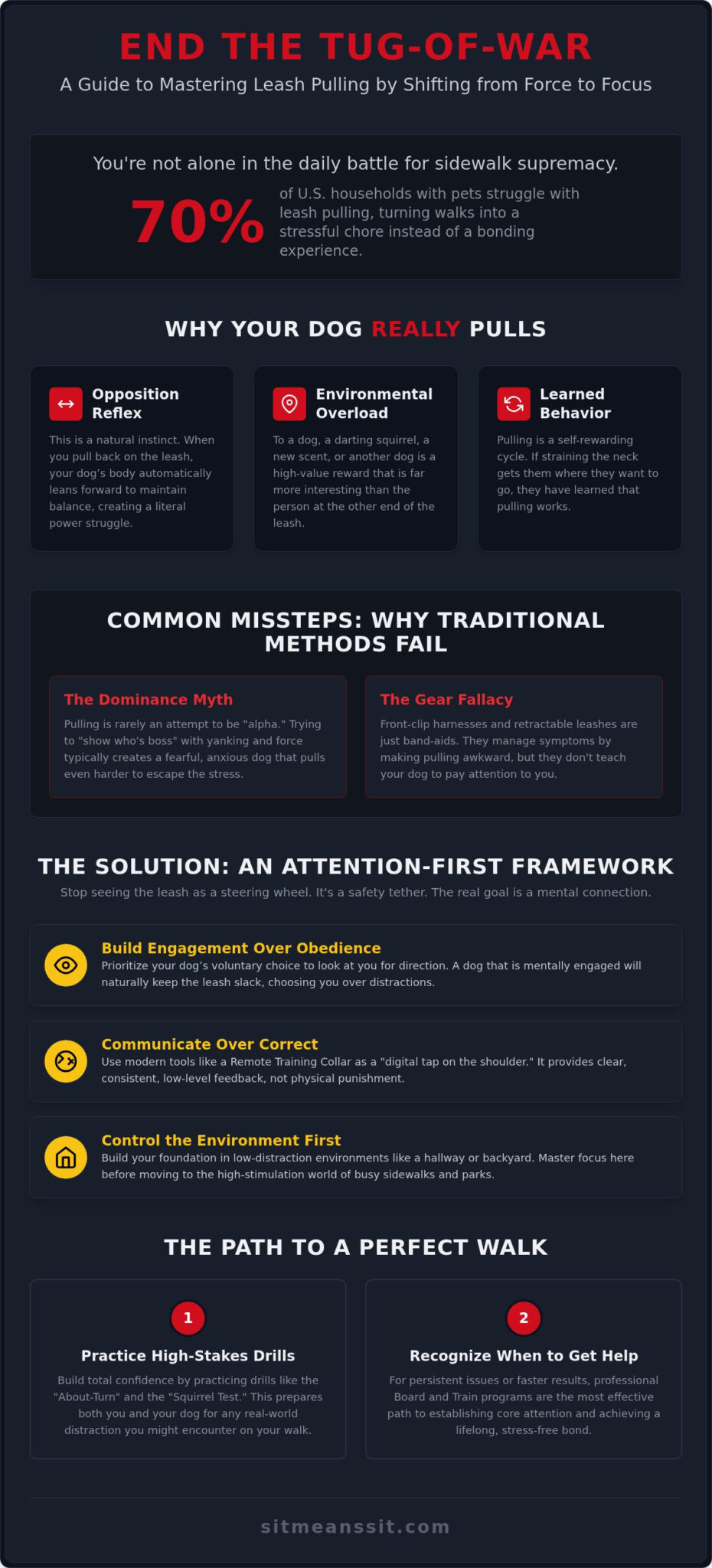
Your dog isn’t trying to ruin your afternoon. They aren’t trying to “win” the walk or assert authority over the neighborhood. Most owners fail at dog training for leash pulling because they misunderstand the biology behind the behavior. To stop the tug-of-war, you must first identify the three primary drivers: instinct, environment, and reinforcement. Your dog is a creature of habit and reflex, not a calculated rebel.
The most common culprit is the opposition reflex. This is a natural physical response where a dog instinctively pulls against pressure. When you tug the leash back, your dog’s body automatically leans forward to maintain balance. It’s a biological loop that creates a literal power struggle. Beyond instinct, the “great outdoors” provides massive environmental overstimulation. To a dog, a darting squirrel or a fresh scent is a high-value reward that is far more interesting than a frustrated human. Finally, pulling is a self-rewarding cycle. If your dog pulls and you keep walking, they just learned that straining their neck gets them exactly where they want to go. They aren’t “bad,” they are simply tuned out and focused on the wrong things.
Debunking the Alpha and Dominance Myths
Forget the outdated “alpha” rhetoric that suggests your dog is trying to take over the household. Pulling is rarely an attempt to dominate you. When owners try to “show them who is boss” by yanking or pinning, they usually just create a fearful, anxious animal that pulls even harder to escape the stress. Effective Basic obedience training replaces these power struggles with clear, consistent communication. You don’t need to be a dictator; you need to be a leader who provides a predictable structure. When your dog knows what to expect, the desire to charge ahead vanishes.
The Failure of Conventional Gear
Many owners turn to front-clip harnesses as a quick fix. While these tools can reduce the physical strain on your arm, they are often just a band-aid for the symptoms. They don’t teach the dog to pay attention; they just make pulling more awkward. Retractable leashes are another common culprit. These devices actually train your dog that tension on the leash is the “green light” to keep moving. This confuses the boundaries of the walk and makes dog training for leash pulling significantly harder. Relying on gear alone often leads to neck strain and mounting frustration. True transformation requires a shift in focus, not just a new piece of equipment.
The Attention-First Methodology: A New Training Framework
Stop looking at your leash as a steering wheel. It’s a safety tether, not a remote control. Most traditional dog training for leash pulling fails because it focuses on the physical connection rather than the mental one. We use an attention-first methodology. This means we prioritize the “check-in,” which is your dog’s voluntary decision to look at you for direction. When a dog is mentally engaged with their owner, the leash naturally goes slack. It’s a shift from forcing a behavior to fostering a partnership.
Engagement is far superior to blind obedience. A dog that obeys only for a treat will eventually find a squirrel that is more rewarding than a biscuit. You need a dog that finds value in simply being near you. Building this bond starts in low-distraction environments like your hallway or backyard. By removing environmental noise, you create a space where your dog can actually hear your instructions. This foundation is critical before you ever step onto a busy sidewalk or enter a crowded park. If you’re struggling to get that initial focus, our Board and Train program can establish that core attention for you in a professional setting.
Communication Over Correction
We view the Remote Training Collar as a digital tap on the shoulder. It isn’t a punisher; it’s a communication bridge that provides absolute clarity. Old-school “jerk and pull” methods rely on physical discomfort to stop a behavior, which often leads to confusion or shut-down. Our approach uses consistent, low-level feedback to help the dog understand exactly what we want. This creates a language you can use even at a distance, ensuring reliability whether the leash is on or off.
Setting Environmental Boundaries
Your walks shouldn’t be a constant free-for-all. Establish a “working zone” where your dog stays in a focused heel and a “sniffing zone” where they can explore. Use clear verbal cues to signal when it’s time to work and when they are on a break. While a humane society guide to loose leash walking can offer basic tips on managing tension, we focus on rewarding the dog’s choice to remain attentive. Discipline isn’t a restriction. It is the key to a more adventurous and joyful life together.
Core Techniques for Reliable Loose Leash Walking
Stop being a passive observer on your walks. Many people suggest “becoming a tree” by standing still when a dog pulls, but for high-energy breeds, this is a waste of time. It doesn’t teach them anything except that the walk has paused. Instead, use the About-Turn method. The moment you feel tension, pivot 180 degrees and walk in the opposite direction. This move immediately breaks their environmental hyper-focus and forces them to re-engage with you. It turns the walk into a game of follow-the-leader where you are always the one in charge.
We use the Remote Training Collar to reinforce the Heel command through the pressure-release concept. Think of the collar’s signal as a question and the dog’s return to your side as the answer. When the dog drifts out of position, a low-level “tap” provides a gentle reminder. The second they move back toward you, the signal stops. This is the core of effective dog training for leash pulling. It provides instant, clear feedback that a physical leash simply cannot match. Consistency is your only rule. If you allow pulling on the way to the park but expect a perfect heel on the way home, you’re lying to your dog. Clear boundaries create confident pets.
Step-by-Step: Your First Focused Walk
Don’t start your training on a busy street. Begin in your driveway or a quiet hallway where you are the most interesting thing in the room. While some step-by-step leash training techniques focus on slow “red light, green light” patterns, we prefer keeping the energy high and the pace brisk. Keep these initial sessions short, ideally between 5 and 10 minutes. This ensures your dog stays mentally sharp without burning out. Always finish the session on a “win” with a successful heel to build their confidence and your own.
Transitioning to Off-Leash Control
Mastering the leash is just the beginning. Reliable walking is the essential foundation for achieving total off-leash control. Once your dog understands the Heel command under tension, you can bridge the gap to freedom using a long line. This allows them more space while you maintain the ability to reinforce the Come command if they get distracted. By combining the Heel and the Come commands, you create a safety net that works in any environment. You aren’t just training a walk. You’re training a lifestyle of adventure and trust.
Conquering Real-World Distractions and High-Stimulation Areas
Training in your living room is just the rehearsal. The real performance happens on the street. High-stimulation environments are the ultimate test of your communication bridge. If your dog training for leash pulling only works when it’s quiet, it doesn’t really work. You must prepare for the “Squirrel Test.” This isn’t about ignoring the squirrel; it’s about your dog choosing you over the chase. When the environment gets loud, your communication must remain clear and decisive. Don’t just manage the chaos. Train through it.
Strategic socialization is the fastest way to proof these skills. By attending group dog training classes, you expose your dog to other animals and people in a controlled, professional environment. This is where you move from basic mechanics to total environmental mastery. Handling a “bolter” or a lunging dog requires immediate intervention. If your dog lunges, don’t just pull back. Use the pressure-release techniques established earlier to redirect their focus instantly. For reactive pullers, desensitization is the key. We move toward the trigger in controlled increments, rewarding calm behavior before they hit their breaking point. This transforms a stressful encounter into a successful training moment.
The Three D’s: Distance, Distraction, and Duration
Mastering focus requires a strategic approach. We use the Three D’s to proof your training and ensure reliability. Start with distance. Keep your dog far enough away from a distraction so they stay under their “threshold” of excitement. As they succeed, gradually increase the distraction’s intensity. Finally, focus on duration. A short, perfect heel is far more valuable than a long, messy walk. Focus on the quality of the attention. Duration of focus matters more than the distance of the walk. Build their mental stamina one block at a time.
Public Manners and Social Etiquette
Your dog should be a welcome addition to the neighborhood, not a nuisance. Teach your dog to “Place” or sit calmly when you stop to talk to a neighbor. This creates a clear boundary between “working” and “waiting.” Navigate tight spaces and busy sidewalks with absolute confidence by keeping your dog in a tight, focused heel. Be an advocate for your dog in public. If a situation is too intense, lead them away decisively. You are the leader, and your dog relies on your direction to feel safe. Ready to transform your daily routine? Contact us today to start your journey toward a perfectly behaved companion.
Professional Solutions: When to Call the Experts
Sometimes the DIY approach hits a brick wall. If you’ve tried every harness on the market and your shoulder still aches after every walk, it’s time to stop experimenting. Leash pulling isn’t just a nuisance; it’s a significant safety risk. When a dog is powerful enough to pull you into traffic or trip you on the pavement, the situation has moved beyond a “behavioral quirk.” You need a definitive resolution. Professional dog training for leash pulling provides the structure and expertise required to regain control before an accident happens. We don’t just fix the walk; we empower you to lead with absolute confidence.
Expert instruction replaces your frustration with a sense of pride. You shouldn’t have to plan your walks around “quiet times” just to avoid neighborhood distractions. A professional trainer looks past the symptoms to address the root of the attention gap. By working with an expert, you gain access to a proven methodology that has been refined over decades. This isn’t about temporary management. It’s about a total behavioral transformation that lasts for the life of your pet. Discipline is the path to a more adventurous and joyful life for both of you.
The Board and Train Advantage
Immersive training is the fastest way to break deep-seated habits that have been reinforced for years. In a Board and Train program, professional trainers handle the heavy lifting of initial conditioning. We establish the foundation of focus in a controlled environment so you don’t have to struggle through the messy beginning stages alone. When searching for help, it’s vital to understand the distinction between a dog behaviorist and a results-oriented trainer. You need a partner who delivers practical, reliable communication tools that work in the real world, not just a classroom.
Private Lessons vs. Group Classes
Choosing the right environment depends on your dog’s specific personality and your personal goals. Private lessons provide a customized roadmap tailored to your home environment and the specific triggers in your neighborhood. It’s one-on-one coaching that focuses entirely on your success. Conversely, group classes offer the ultimate distraction training. They provide a safe space to practice focus while other dogs and people are present. Both paths lead to the same goal: a dog that chooses to walk by your side because they value your leadership. Ready to stop the tug-of-war for good? Schedule your free consultation with Sit Means Sit today!
Reclaim Your Freedom and Master the Walk Today
You now have the roadmap to turn every walk into a victory. Remember that effective dog training for leash pulling starts with your dog’s mind, not their neck. By prioritizing the “check-in” and using clear communication tools, you replace the physical struggle with a mental connection. Consistency in your technique ensures that your dog remains a calm, attentive partner even when the neighborhood gets loud. Structure isn’t a limitation; it’s the key to a safer and more joyful life together.
Don’t settle for another day of frustration. With over 140 locations nationwide, our expert trainers are ready to help you achieve the results you deserve. Many of our programs include our specialized Remote Training Collar to bridge the communication gap instantly. Take the first step toward a more adventurous life and Master the walk and reclaim your freedom; find a Sit Means Sit trainer near you! We offer free initial consultations to help you find the perfect path forward. You have the power to transform your relationship. We have the expertise to make it happen.
Frequently Asked Questions
Why does my dog pull so hard on the leash?
Dogs pull because of a biological trigger called the opposition reflex. When they feel the leash tighten, their natural instinct is to lean forward and pull back against the pressure. Additionally, the environment is full of high-value rewards like scents and other animals. If your dog pulls and succeeds in reaching those rewards, they learn that straining against the collar is the most effective way to get what they want.
Will a harness stop my dog from pulling?
A harness is a physical management tool, not a behavioral solution. While some designs make it harder for the dog to drag you down the street, they don’t teach the dog to look to you for direction. In fact, many dogs feel more comfortable pulling in a harness because the pressure is distributed across their chest. True transformation requires teaching focus rather than just adding more straps and physical restraints.
How long does it take to train a dog to walk on a loose leash?
Timeline results vary based on your dog’s history and your level of consistency. You can often see an immediate improvement in focus during your first session with the right methodology. Achieving total reliability in busy public spaces generally requires four to six weeks of steady practice. If you need faster results, an immersive Board and Train program can complete the heavy lifting of initial conditioning in a professional environment.
Is it too late to train an older dog to stop pulling?
Older dogs are fully capable of learning new walking habits. It’s a myth that you can’t teach an old dog new tricks; in many cases, senior dogs have better focus than high-energy puppies. While you’re working against years of reinforced pulling, the same principles of dog training for leash pulling apply. Clear communication and consistent boundaries will empower your older dog to walk calmly by your side regardless of their age.
Can I train my dog to stop pulling without using treats?
Yes, you can achieve a perfect heel without relying on food rewards. While treats are a common lure, they often fail when a dog encounters a high-level distraction like a squirrel or another pet. We prioritize a communication-based approach using tools like the Remote Training Collar. This methodology focuses on the relationship and the “check-in,” ensuring your dog listens because they respect your leadership, not just because they want a snack.
What is the best collar for a dog that pulls?
We recommend a Remote Training Collar as the most effective tool for long-term success. Unlike standard flat collars that can cause neck irritation or harnesses that encourage the opposition reflex, this tool provides a gentle, digital tap on the shoulder. It offers precise feedback that helps the dog understand exactly where they should be in relation to you. This clarity is essential for transforming a stressful walk into a calm experience.
How do I handle a dog that lunges at other dogs during walks?
Lunging is often a sign of over-arousal or reactivity that requires a proactive response. You must intervene the moment you see your dog’s body language stiffen, well before the actual lunge occurs. Use a quick redirection, such as an “About-Turn,” to break their focus on the other dog. Consistent dog training for leash pulling helps your pet understand that you are in control, which reduces their perceived need to react defensively.
Should I let my dog sniff during a walk if they are a puller?
Sniffing is an important part of a dog’s mental health, but it must happen within a structured framework. Don’t let your dog pull you toward every interesting scent they find. Instead, require a focused heel first, then use a release command like “Okay” or “Break” to allow them to explore. This teaches your dog that sniffing is a reward for their attention, which keeps you in charge of the walk’s pace and direction.
Comments are closed.