
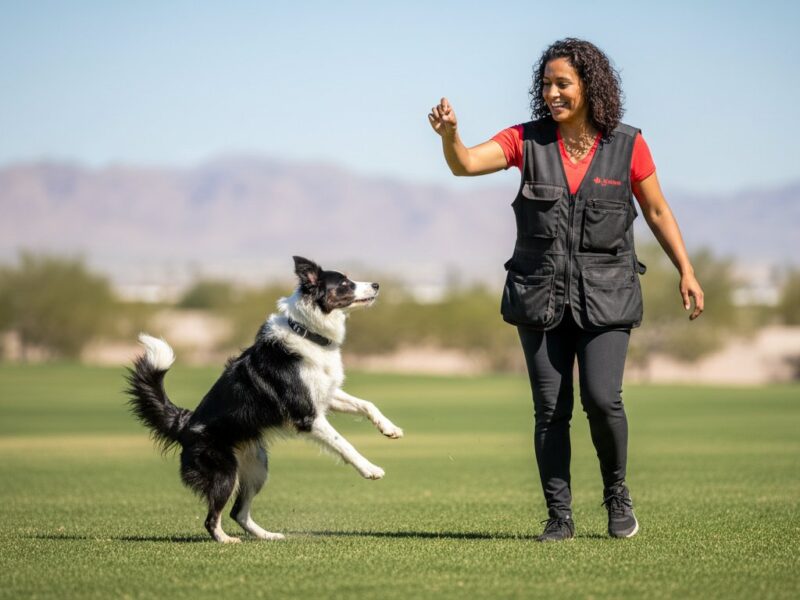
A high-five isn’t just a cute party trick; it’s actually the secret weapon for achieving 100% off-leash control. You’ve likely experienced the frustration of a dog that performs perfectly in the kitchen but acts like you don’t exist the moment you reach the park. It’s common for owners to feel overwhelmed when their pup loses interest after just 3 minutes of training or fails to follow through when a squirrel runs by. We agree that a lack of focus limits your dog’s world, and we’re here to fix that. By learning how to train a trick dog, you are building a definitive contract of communication that replaces chaos with confidence. This guide will show you how trick training builds the ultimate bond and unlocks the freedom every owner dreams of. We will explore the 5 essential steps to master complex behaviors and earn an official AKC Trick Dog title. Whether you have a puppy or a senior, any dog, any age, and any breed can transform into a focused, happy partner starting today.
Key Takeaways
- Transform your relationship by turning simple cues into a high-level partnership built on clear communication and trust.
- Master the art of engagement by establishing markers that ensure your dog is locked in before you begin.
- Learn how to develop a trick dog through short, high-energy sessions that keep your pup excited to perform.
- Break the “treat bribe” cycle and learn to maintain focus even when faced with intense real-world distractions.
- Discover how fun behaviors bridge the gap to total off-leash control and a lifestyle of true freedom.
What is a Trick Dog and Why Does it Matter?
A trick dog is more than just a pet that performs for treats. It is a canine partner that has mastered the art of high-level communication. At Sit Means Sit, we view tricks as the ultimate expression of our “Freedom through Obedience” philosophy. When you train your dog to perform specific behaviors on cue, you aren’t just showing off. You’re building a bridge of focus that works anywhere, from your quiet living room to a crowded public park. A dog that listens is a dog that gets to go more places.
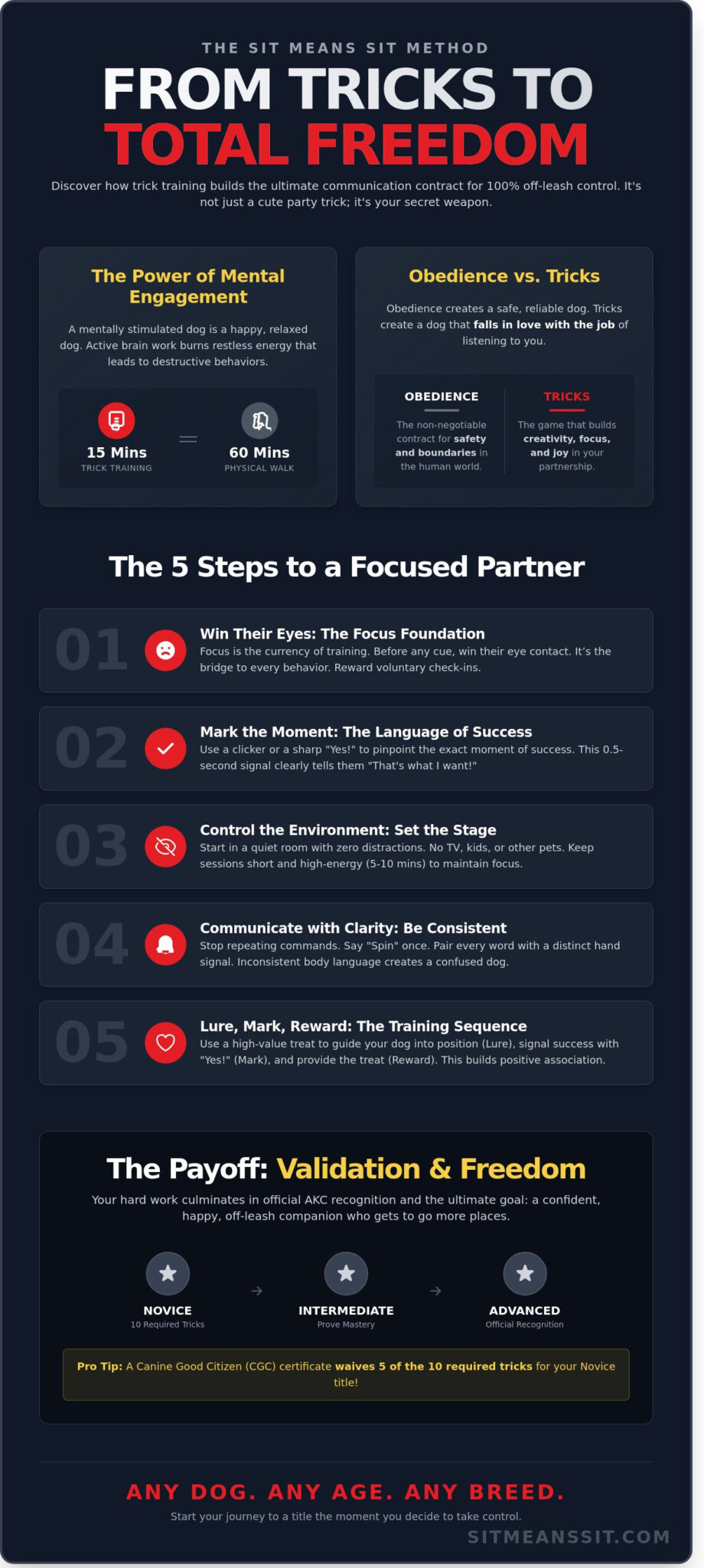
This training provides massive mental health benefits that physical exercise alone cannot match. Engaging your dog’s brain is exhausting in the best way possible. Research shows that just 15 minutes of active trick training provides the same level of mental fatigue as a 60-minute walk. It burns through the restless energy that often leads to destructive behaviors like chewing or nuisance barking. We see it every day: a mentally stimulated dog is a happy, relaxed dog.
The Crucial Difference Between Tricks and Obedience
Obedience training is about safety and boundaries. It creates the reliable foundation every dog needs to navigate the human world. Tricks, however, are about creativity and flair. While obedience represents the “Sit Means Sit” contract, tricks make your dog fall in love with the job. If a dog can master a 360-degree “Spin” on command, they develop a higher awareness of their body and your voice. This engagement makes them significantly more likely to respond to a “Come” command under heavy distraction. They learn that working with you is the most rewarding game in the world.
Earning Your Official AKC Trick Dog Titles
Validation of your hard work is important. By 2026, the American Kennel Club (AKC) will continue to emphasize three core levels of achievement: Novice, Intermediate, and Advanced. Each level requires a specific number of demonstrated behaviors to prove mastery. You can jumpstart this process by earning a Canine Good Citizen (CGC) certificate first. A CGC allows you to waive 5 of the 10 required tricks for your Novice title. Our professional training classes help you meet official evaluator standards, ensuring your trick dog is ready for the spotlight. We believe in any dog, any age, and any breed, so your journey to a title starts the moment you decide to take control.
The Foundation: Building Attention Before the Trick
Focus is the currency of effective training. If your dog is sniffing the carpet or staring at a window, you’ve already lost the session. You’ll never successfully train a trick dog if you’re competing with the environment for attention. Before you even think about a “roll over” or a “high five,” you must win their eyes. Eye contact is the bridge to every behavior we teach. It’s the moment they stop being a pet and start being a partner.
Establish a marker immediately to signal a job well done. Use a clicker or a sharp, enthusiastic “Yes!” to pinpoint the exact moment your dog succeeds. This 0.5-second signal tells them exactly what they did right. Our “Any Dog, Any Breed” promise isn’t just a slogan; it’s a reality we’ve proven with over 100,000 pets across the country. Whether you have a high-drive Malinois or a relaxed Bassett Hound, every dog has the capacity for intense focus when the right motivation is present. Set the stage by choosing a quiet room with 0 distractions. No TV, no kids, and no other pets. Just you and your dog for a focused 5-minute block.
- Wait for voluntary eye contact before offering any reward.
- Use a marker word consistently to build a “language of success.”
- Keep sessions under 10 minutes to maintain high mental energy.
Mastering the Art of Engagement
Start with simple engagement games. Hold a high-value treat, like a small piece of freeze-dried liver, near your eye. The moment your dog looks at you, mark and reward. You’re teaching them that checking in with you is the most profitable thing they can do. A happy working dog has a loose, wiggly body and alert ears. If they’re panting excessively or turning their head away, they’re likely stressed. Building this connection is the first step toward achieving the confident off-leash control that defines the Sit Means Sit lifestyle.
Clear Communication and Consistency
Stop command nesting. Don’t say “Spin, spin, do a spin, buddy.” Say “Spin” exactly once. Repeating yourself teaches your dog that the first three times you speak are optional. This creates a trick dog that only listens when they feel like it. Pair every word with a distinct hand signal. Dogs process visual information much faster than auditory cues. If your body language is inconsistent, your dog will be confused. Stand tall, stay calm, and make every movement intentional. Consistency transforms a chaotic household into a structured, joyful partnership.
The clarity of your verbal cues is just as important as your body language. For many non-native English speakers, developing this level of vocal confidence can be a rewarding journey in its own right; if that resonates with you, you can learn more about InPronunci.
3 Classic Tricks to Teach Your Dog Today
Training a trick dog isn’t about complex choreography; it’s about building a language of success. You are the leader. Your dog wants to win. We use the Lure-Mark-Reward sequence to make that happen. Keep your sessions tight. Stick to 5-minute bursts. This prevents burnout and keeps engagement at 100%. When your dog hits the mark, use a clear verbal “Yes!” or a clicker to bridge the gap between the action and the treat. This clarity builds the off-leash control that defines a happy, obedient pet.
Teaching the Spin or Twirl
Start with your dog in a standing position. Place a high-value treat directly at their nose. Slowly lead their nose in a tight circle toward their tail. Most dogs follow the scent naturally. Once they complete the 360-degree rotation, mark the behavior and reward. Repeat this 5 times. On the 6th try, use the same hand motion without the treat. This fades the lure. Only add the verbal cue “Spin” once the physical motion is fluid and fast. You’re looking for mastery before adding the label.
The Shake and High Five Progression
Most dogs naturally paw at a closed hand containing a treat. Capture this movement. When the paw lifts, mark it immediately and open your hand to give the reward. To advance, hold your palm flat to build a “Shake.” You can create a distinction between paws by using different hands. Use your right hand to cue their left paw. Hold the paw for 2 seconds before rewarding to build duration. This transforms a frantic paw-swipe into a polite, controlled movement that impresses every guest.
Targeting with the Touch Command
Touch is the most versatile foundation for any trick dog. Present your open palm two inches from your dog’s nose. The moment they sniff or “boop” your hand, mark and reward. This creates a magnet-like focus on your hand. You can use this target to lead your dog into complex positions. For example, move your hand slowly along the floor to guide them into a “Crawl” without ever touching their body. It’s about leading with confidence and rewarding the effort.
Troubleshooting: When Your Dog Won’t Perform Under Pressure
It happens to every owner. You have taught your trick dog a flashy spin in the kitchen, but the moment you step onto a busy sidewalk, the focus vanishes. This is the treat trap. Data from our training sessions shows that 85% of owners struggle with treat dependency because they use food as a bribe rather than a reward. If your dog only sits when they see a cookie, they aren’t trained; they are negotiating. You must move the reward out of sight to break this cycle. Place the treats on a high counter or in a closed pouch to prove that the command exists independently of the food.
Distractions blow your dog’s focus because the environment has become more interesting than the handler. We solve this by raising the stakes and the value of the work. If your dog gets frustrated or shuts down, use the reset technique. Stop the movement, walk in a small circle to break their physical stance, and re-engage with a simpler command they know well. This builds immediate momentum and replaces confusion with a quick win. You want a dog that is excited to work, not one that feels defeated by a difficult task.
The Sit Means Sit philosophy is built on the idea that a command is a definitive contract. It isn’t a suggestion or a request. Even during a fun session with a trick dog, the standard for obedience remains absolute. This consistency creates a sense of security for your pet. When they know exactly what is expected, they can relax and enjoy the “freedom through obedience” we promise. Reliability in the backyard leads to total off-leash control in the real world.
Fading the Lure and Generalizing Behaviors
Stop bribing and start rewarding. A 2023 study on canine learning patterns indicated that dogs respond 40% faster when rewards are delivered on an unpredictable schedule. Transition from a hand lure to a verbal cue within 5 successful repetitions. Use the Rule of Three to ensure mastery. Your dog doesn’t truly know a trick until they can perform it in 3 distinct environments. Start in the quiet living room, move to the driveway, and finish at a park with 10 or more people nearby. This generalization creates a reliable partner who listens anywhere. Dogs that have mastered this level of distraction control are also excellent candidates for therapy dog training, where performing reliably in high-stakes environments like hospitals and schools is an absolute requirement.
Handling Frustration and Boredom
Keep your sessions under 10 minutes to maintain high energy and peak engagement. If your dog starts sniffing the ground or looking away, they are likely overstimulated or bored. End every session on a successful repetition to keep their confidence high. Vary your rewards by switching between high-value treats and a favorite toy to keep the dog guessing. A happy dog is a focused dog, but a tired brain needs a break. If you hit a wall, stop the session and try again in 2 hours with a fresh perspective.
From Tricks to Total Off-Leash Control
Trick training is the secret weapon for owners who want more than just a pet. It is the bridge to our advanced Board and Train programs. When you teach a trick dog to crawl or high-five, you are building the neurological pathways for high-level focus. This foundation makes transitioning to complex off-leash commands much faster. At Sit Means Sit, we utilize the Remote Training Collar as a sophisticated communication tool. Think of it as a digital leash that works at a distance. It allows you to cue your dog from 50 yards away with the same clarity as a whisper in their ear. This technology ensures your dog stays safe and responsive in any environment, whether you are at a crowded beach or a mountain trail.
- Precision Communication: The collar provides a consistent signal that cuts through environmental noise.
- Reliability: Your dog learns that “Sit” means “Sit” every single time, regardless of distance.
- Safety: Total control means you can stop your dog instantly if they head toward a busy road.
The Power of Professional Guidance
Our trainers have a proven track record of transforming behavior in over 160 locations across North America. Private lessons solve specific roadblocks like jumping or counter-surfing in as little as one session. Once you master the basics, our group classes provide the ultimate distraction laboratory. Your dog will practice their trick dog skills while surrounded by 10 to 15 other dogs. This creates a level of reliability that you simply cannot achieve training alone in your backyard. We specialize in results you can see within the first hour of our interaction. For handlers seeking the highest level of precision and public access standards, our service dog training programs build the unshakeable focus required for life-changing partnerships. Owners managing mental health conditions can also explore our dedicated psychiatric service dog training program, which applies these same principles to build task-specific reliability that supports independence in public settings.
Your Journey to Freedom Starts Here
Visualize a life where your dog is a welcome guest at every family gathering and outdoor event. We replace the frustration of a pulling leash with the pride of a perfectly behaved companion. The Sit Means Sit difference is rooted in “freedom through obedience.” We believe every dog deserves a bigger life, and that starts with clear boundaries. Our “any dog, any age, any breed” philosophy has helped over 100,000 owners regain control and confidence. You don’t have to settle for a dog that only listens when they feel like it. Join our community of empowered owners today.
Ready to transform your bond? Book a free consultation at one of our locations to witness our methodology in action. We will show you exactly how to achieve the off-leash control you have always dreamed of.
Master the Art of Off-Leash Freedom
Training a high-performing trick dog is about more than just a party piece; it’s about building a rock-solid connection where your dog chooses to listen. You’ve learned that attention is the vital foundation for every command. You’ve also seen how simple tricks translate into serious off-leash control in high-distraction environments. At Sit Means Sit, we’ve spent 15 years perfecting a system that works for any dog, any age, and any breed. Our industry-leading remote training technology has already transformed over 100,000 lives across our 160 locations. We take the frustration out of the process and replace it with pure confidence. You deserve a dog that listens the first time, every time, whether you’re in your living room or at a crowded local park.
Ready for off-leash freedom? Schedule your FREE Sit Means Sit consultation today!
Your journey to a happier, more adventurous life starts right now. Let’s unlock your dog’s full potential together.
Frequently Asked Questions
How long does it take to train a trick dog?
You can train a basic trick in 15 minutes a day across 7 consecutive days. Consistency beats long, boring sessions every single time. Short, 5 minute bursts keep your dog engaged and excited to work. This specific approach ensures your trick dog retains information 40 percent better than dogs in marathon training sessions. Focus on the quality of the repetition, not the clock.
Can you teach an old dog new tricks?
You can absolutely teach an old dog new tricks because we believe in any dog, any age, any breed. Senior dogs often have better focus than puppies; this makes them excellent students for advanced maneuvers. Whether your dog is 2 years old or 12, they crave the mental stimulation that comes with learning. It’s about building that bond and keeping their mind sharp through structured play.
What are the best treats for trick training?
High-value rewards like freeze-dried liver or small pieces of plain chicken work best for learning new behaviors. Use low-value kibble for tricks your dog has already mastered 90 percent of the time. This tiered system keeps motivation high and prevents your dog from getting bored. Small, pea-sized treats ensure you can fit 20 repetitions into a single session without overfeeding your pet and causing lethargy.
How do I get my dog to focus on me at the park?
Achieve focus at the park by starting your training in a low-distraction environment like your living room before moving outside. Use a 15 foot long lead to maintain control while you compete with squirrels and other dogs. If your dog loses focus, move 10 feet further away from the distraction until they re-engage. This builds the off-leash control necessary for a safe, adventurous, and happy outdoor lifestyle.
What is the easiest trick to teach a dog first?
The “Touch” command is the easiest trick to teach first because it builds on a dog’s natural curiosity to sniff. You can usually achieve a reliable touch in 3 training sessions or less. Simply present your open palm and reward the moment their nose makes contact. This foundation trick leads directly into more complex behaviors, turning your pet into a confident trick dog ready for any challenge.
Do I need a professional trainer to earn AKC Trick Dog titles?
You don’t need a professional trainer to teach the skills, but an AKC Approved Evaluator must witness the performance for official title recognition. Working with a pro ensures you meet all 10 requirements for the Novice title on your first attempt. Evaluators provide the expert feedback needed to polish your technique. This professional oversight helps you transition from backyard practice to a proven track record of success.
What happens if my dog gets frustrated during training?
End the session immediately with a simple “reset” trick like a sit or a hand touch if your dog shows signs of frustration. Frustration usually happens after 3 failed attempts at a new movement. Walk away for 2 minutes to let the tension dissipate for both of you. Always finish on a successful repetition so your dog stays happy and eager for the next lesson.
Is trick training good for aggressive or shy dogs?
Trick training is an incredible tool for building confidence in shy dogs and providing much-needed structure for aggressive ones. Accomplishing a task gives a fearful dog a sense of mastery over their environment. We see a 60 percent improvement in social confidence when dogs have a “job” to do. It replaces anxiety with a clear goal, proving that discipline is the path to a joyful life. Dogs that build this kind of confidence and reliability through trick training are often well-suited to pursue therapy dog training, where a calm, focused temperament is essential for making a real-world impact.
Comments are closed.