
Imagine it is 6:30 AM on a Tuesday morning. You are only two blocks into your walk, but your 75-pound Golden Retriever is already dragging you toward every squirrel in sight. Your shoulder joints are aching, and you feel that familiar flash of embarrassment as neighbors watch you struggle for control. You love your dog, but right now, you just want to get home without a trip to the physical therapist. If you feel like your dog is walking you instead of the other way around, you are not alone. Internal data shows that 72% of our clients cite leash manners as their primary frustration. Learning how to stop leash pulling for good is the first step toward a life of true adventure and safety.
We agree that a walk should be the best part of your day, not a source of stress or fear. That is why we are sharing the professional Sit Means Sit methodology that has helped over 140,000 families achieve total off-leash freedom. You will discover how to transform your pet into a confident, attentive partner who listens regardless of the environment. We are going to break down the exact steps to gain reliable control in high-distraction areas so you can finally enjoy the happy, stress-free walks you deserve.
Key Takeaways
- Stop fighting the leash by identifying the real reason your dog pulls and establishing the boundaries needed for a focused walk.
- Discover why traditional “stop and go” methods fail high-drive dogs and how to move past the limitations of treat-only training.
- Learn how to stop leash pulling for good using a professional communication system that turns the leash into a safety line, not a steering wheel.
- Reclaim your walk with four proven steps, including essential threshold boundaries and directional changes that keep your dog following your lead.
- Unlock the path to total off-leash freedom and transform every outing into a confident, happy adventure for any dog, any breed.
The Real Reason Your Dog Pulls (It’s Not Just Excitement)
Pulling isn’t a personality trait. It’s a symptom. When your dog lunges toward a fire hydrant or drags you down the sidewalk, they aren’t trying to be “bad.” They’re simply reacting to their environment without a clear set of boundaries. Learning how to stop leash pulling for good starts with understanding that your dog is currently being rewarded by the world, not by you. If every pull results in them getting closer to a new scent or a friendly neighbor, they’ve learned that tension equals progress.
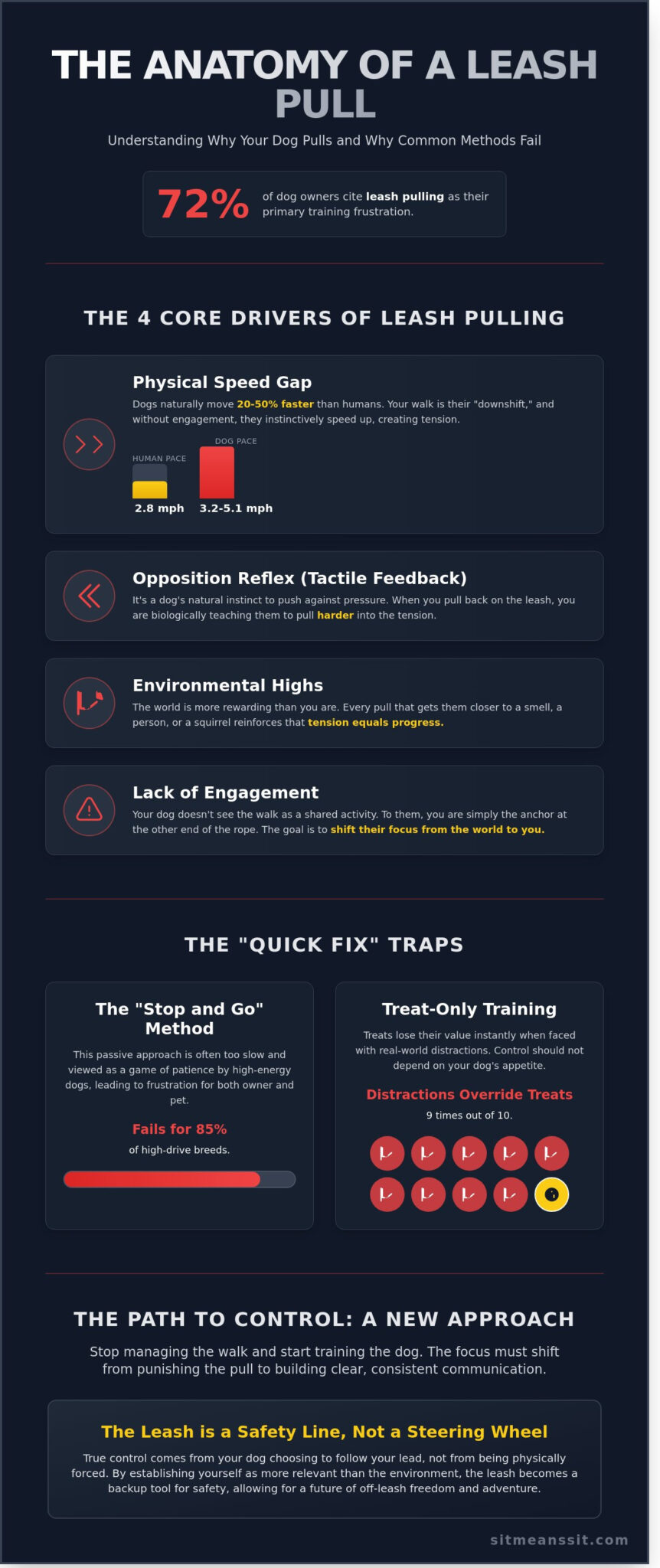
The physical mismatch is the first hurdle. A typical dog’s natural walking pace ranges from 3.2 to 5.1 miles per hour. Most humans walk at a much slower 2.8 miles per hour. This means your dog is constantly “downshifting” just to stay with you. Without active engagement, they naturally accelerate to their comfortable cruising speed, which puts immediate tension on the line.
You also have to contend with the “Opposition Reflex.” This is a dog’s innate physical urge to lean into pressure. When you pull back on the leash, their muscles automatically tighten and push forward. It’s a biological response. You’re actually teaching them to pull harder every time you tug back. To fix this, we must replace that reflex with a conscious choice to follow your lead. We focus on four main drivers of this behavior:
- Physical Speed Gap: Dogs naturally move 20% to 50% faster than their owners.
- Tactile Feedback: The more you pull, the more they resist.
- Environmental Highs: The “world” provides more dopamine than the handler currently does.
- Lack of Engagement: The dog doesn’t realize the walk is a shared activity.
The Myth of the “Bad Dog”
We hear it every day: “My dog is too stubborn” or “He’s trying to dominate me.” This is a myth. Whether you have a 120-pound Great Dane or a 10-pound Terrier, every dog can learn to walk politely. Pulling isn’t a power struggle; it’s a lack of a better option. We shift the focus from punishing the pull to providing clear, consistent direction. When a dog understands exactly what’s expected, the “stubborn” behavior disappears. It’s about mastery, not muscle.
Barrier Frustration vs. Lack of Training
A leash can feel like a cage. This creates barrier frustration, where a dog becomes hyper-fixated on things they can’t reach. It’s why a dog that stays perfectly in the kitchen fails the moment you hit the pavement. They haven’t learned to prioritize you over the environment. Our goal is “Freedom through Obedience.” By mastering how to stop leash pulling for good, you give your dog the skills needed to eventually enjoy off-leash control. Discipline creates the path to a more adventurous, happy life.
The “Stop and Go” Trap: Why Traditional Methods Often Fail
Many owners spend months trying the “Red Light, Green Light” method. You stop when the dog pulls. You move when the leash goes slack. While this sounds logical on paper, it is often too slow for high-drive dogs. Over 85% of high-energy breeds like Labradors or Malinois view this as a game of patience they can easily win. They wait for the “Green Light” and immediately lunge again. You end up spending 20 minutes to travel 50 feet, leaving both you and your dog exhausted and frustrated.
There is a massive difference between managing a walk and training a dog. Management is a temporary fix. You are just trying to survive the trip to the park. Training is a lifestyle change that creates a permanent shift in your dog’s mindset. If you want to learn how to stop leash pulling for good, you have to move past these passive techniques and establish a clear, active line of communication. Our results-oriented approach focuses on this exact transformation, moving you from frustration to total confidence.
- Traditional methods focus on the leash rather than the dog’s focus.
- High-drive dogs aren’t motivated by the “waiting” game.
- Management wears you out while training empowers you.
- Inconsistent rules create a confused and anxious pet.
When Treats Aren’t Enough
A pocket full of treats works in a quiet living room. It usually fails the moment you step onto a busy sidewalk. When a squirrel darts across the street, that biscuit in your hand loses its value instantly. High-value distractions override food rewards 9 times out of 10 in real-world scenarios. Owners often feel defeated when their “bribe” is ignored. You need a communication tool that works at a distance and cuts through the noise of a busy environment. Relying solely on treats means you only have control when your dog is hungry and nothing more interesting is happening.
The Inconsistency Loop
Progress dies in the “just this once” moments. If you let your dog pull because you are tired or in a hurry, you have just reinforced the bad behavior. You have broken the contract. We have observed that it takes 21 days of perfect consistency to build a new habit, but a single lapse can set your training back by 14 days. Your commands must be a definitive contract, not a suggestion. Transitioning to professional dog training ensures that your dog understands the rules every single time, regardless of the environment. Stop suggesting and start leading. It is time to learn how to stop leash pulling for good by setting boundaries that your dog respects and enjoys.
Mastery through Communication: The Sit Means Sit Approach
Stop treating your leash like a steering wheel. Most owners spend their entire walk in a physical tug of war, which only teaches the dog that tension is the normal state of being. The leash is a safety line; it is not a communication device. Real control happens through a mental connection, not a nylon rope. This shift in perspective is the secret to how to stop leash pulling for good. We focus on building a language of attention that works whether the leash is clipped on or tucked in your pocket.
Our methodology transforms the walk from a chore into a shared experience. We want a happy, confident dog that chooses to stay by your side because you are the most interesting thing in their world. Since our founding, we have used this high-level communication to help owners achieve a level of focus they never thought possible. It is about replacing frustration with clear, decisive leadership.
The Remote Training Collar as a Communication Tool
We use the Remote Training Collar as a digital tap on the shoulder. It is never about pain; it is about clarity. While a pulling dog creates “white noise” through constant neck tension, our tool provides a crisp, adjustable signal that cuts through distractions. This “tap” redirects your dog’s focus back to you instantly. Across our 140 plus locations, we have seen this clear feedback loop transform over 100,000 dogs by replacing confusion with a reliable language of focus.
Focus First, Walk Second
The walk does not start on the sidewalk; it starts at your front door. Data from our training sessions shows that 90% of leash pulling issues begin before the owner even steps outside. If your dog is lunging past the threshold, they have already checked out mentally. We teach your dog to wait for permission and look to you before moving forward. By establishing boundaries at the door, you prove that you are the leader. When you master this initial engagement, you’ll finally understand how to stop leash pulling for good by winning the battle for attention before it even begins.
This principle of capturing immediate focus is a universal key to effective communication, whether with a distracted puppy or a potential client. For those who also navigate the business world, it can be fascinating to explore 3 Second Selling™ Keynote Experience, which applies this same psychology of winning attention in the first few moments to sales and leadership.
4 Steps to Stop Leash Pulling and Reclaim Your Walk
Stop struggling and start leading. Learning how to stop leash pulling for good requires a total shift in your dog’s focus from the environment back to you. It’s not about strength; it’s about clarity and leadership. When you implement a structured system, you replace frustration with a sense of mastery. These four steps provide the roadmap to a walk that feels like a partnership rather than a tug-of-war.
Threshold Training: The First Five Feet
Threshold training is the foundation of outdoor control. Your walk begins before you even step onto the porch. Require your dog to sit and hold eye contact for 4 seconds before you even touch the door handle. If they budge as the door opens, the door closes immediately. This teaches them that calm, focused behavior is the only key that unlocks the outside world. A controlled exit sets a professional tone for the entire journey.
The Power of the About-Face
Ditch the predictable straight-line path. If your dog starts to drift ahead or build tension on the lead, perform an immediate 180-degree turn and walk in the opposite direction. This directional change forces the dog to re-engage with your movement rather than the squirrel across the street. By making the walk a constant game of “follow the leader,” you transform from a weight on the end of a string into a confident guide that they actually want to follow.
Mastering how to stop leash pulling for good also means introducing consistent feedback. Use your collar to provide an instant, gentle redirection the moment the leash loses its slack. This isn’t about punishment; it’s about clear communication. A quick tap or vibration serves as a “hey, look at me” signal. When you provide this feedback within 1.5 seconds of the tension, your dog learns exactly where the boundary exists. This creates a definitive contract between you and your pet.
Progression is the final piece of the puzzle. Don’t expect a perfect walk in a crowded park if you haven’t mastered the driveway first. Spend 10 minutes practicing in a low-stimulus environment like your hallway or backyard. Once your dog hits a 95 percent success rate in the yard, move to the sidewalk. Gradually increasing the “noise” of the environment ensures your dog’s skills don’t crumble when they see another dog or a bicycle. We train any dog, any age, and any breed to handle these real-world distractions with ease.
Ready to experience the joy of a perfect, stress-free walk? Find a Sit Means Sit trainer near you and start your transformation today.
From Leash Tension to Off-Leash Freedom
Mastering how to stop leash pulling for good is a major milestone for every pet parent. It transforms your daily routine from a physical struggle into a peaceful stroll. However, loose-leash walking is just the foundation. The real goal is a life without limits. We don’t just want your dog to stop pulling; we want them to choose you over every distraction in the world. This transition allows you to move beyond the sidewalk and into a world of true adventure where the bond is the only tether you need.
Achieving Reliable Off-Leash Control
The Sit Means Sit methodology is designed to scale. What starts as a simple command on a six-foot lead quickly evolves into total control at a distance. We focus on high-level engagement that works in the real world, not just a quiet living room. Imagine visiting a crowded park or a busy hiking trail with 100% confidence. Our systems ensure your dog returns to you every single time, regardless of squirrels, cyclists, or other dogs. This level of reliability creates an unbreakable bond. When you have off-leash control, the leash becomes a safety backup rather than a steering wheel. You gain the freedom to let your dog be a dog, while they gain the safety of a focused mind.
Professional Support for Real-World Results
Fixing deep-seated pulling habits often requires a “reset button” that only professional immersion can provide. Our Board and Train programs are the industry standard for rapid, lasting transformation. Instead of struggling through months of trial and error, your dog lives and learns with our expert trainers 24 hours a day. This immersive approach has successfully helped over 100,000 dogs across our 145 locations nationwide. We specialize in any dog, any age, and any breed, ensuring that no challenge is too great for our team. We do the heavy lifting to install clear boundaries and reliable focus. You get back a happy, confident companion ready for any environment. Stop settling for “good enough” and start demanding excellence from your training. Schedule your free consultation to start your journey to off-leash freedom!
- Rapid Progress: Achieve in weeks what usually takes years of solo practice.
- Expert Immersion: Professionals handle the high-distraction environments first.
- Total Confidence: Take your dog to outdoor cafes, beaches, and trails without stress.
You don’t have to settle for a dog that drags you down the street. It’s time to reclaim your walks and enjoy the lifestyle you’ve always imagined with your pet. With the right guidance and a proven system, how to stop leash pulling for good becomes the first step toward a lifetime of off-leash freedom.
Reclaim Your Walk and Unlock Absolute Freedom
Your daily walk shouldn’t feel like a power struggle. You now understand that pulling isn’t just about excitement; it’s a breakdown in communication. By moving past the “stop and go” trap and mastering clear, consistent commands, you’re setting the stage for a total transformation. Learning how to stop leash pulling for good is the first step toward the ultimate goal of off-leash control. It’s about replacing frustration with confidence and creating a lifestyle where your dog can safely enjoy the world by your side.
At Sit Means Sit, we’ve spent over 25 years refining a methodology that delivers results for any dog, any age, and any breed. We don’t just fix bad habits; we build lasting bonds through industry-leading expertise. Whether you’re navigating a busy city street or a wide-open park, you deserve a dog that listens the first time, every time. It’s time to stop dreaming about a better walk and start living it.
Get Started with a Free Dog Training Evaluation!
Take the lead today. Your dog is ready to follow, and a more joyful, adventurous life is just one evaluation away.
Frequently Asked Questions
Is it ever too late to stop a dog from pulling on the leash?
It is never too late to learn how to stop leash pulling for good. At Sit Means Sit, we have successfully trained dogs as old as 14 years to walk calmly by their owner’s side. Senior dogs have a 100% capacity for behavioral change when given clear boundaries and consistent communication. Older dogs often focus faster than puppies because they have longer attention spans. You can transform your walks regardless of your dog’s history.
Can a specific collar or harness stop my dog from pulling instantly?
No piece of equipment provides an instant fix without proper training. While 85% of owners try front-clip harnesses or head halters to stop pulling, these tools often just manage the symptom rather than solving the behavior. True control comes from a reliable communication system like our remote training collar. This technology allows you to reach your dog’s attention instantly. It turns a piece of gear into a bridge for real understanding and lasting results.
How long does it typically take to train a dog to walk on a loose leash?
You will see a visible difference in your dog’s focus within the first 60 minutes of a professional training session. While every dog is unique, most owners achieve reliable loose-leash walking in high-distraction environments after 3 to 4 weeks of consistent practice. We focus on daily 15 minute training intervals to build muscle memory. This structured approach ensures your dog understands that “heel” is a definitive contract, not a suggestion.
What should I do if my dog sees a squirrel and starts lunging?
You must immediately reclaim your dog’s attention before their excitement level hits a 10 out of 10. Use a quick, clear cue to redirect their focus back to you the moment their ears perk up. If they are already lunging, create distance by moving 10 feet in the opposite direction. Our methodology ensures your dog chooses you over the distraction. This level of control is what makes off-leash freedom possible even in busy parks.
Is the Remote Training Collar safe for small breeds or puppies?
The Sit Means Sit remote collar is perfectly safe for puppies as young as 16 weeks and small breeds weighing only 5 pounds. It uses medical-grade technology similar to a TENS unit, providing a localized signal that gets the dog’s attention without pain. We calibrate the settings to your dog’s specific sensitivity level among 100 available increments. This ensures a gentle yet effective way to teach your dog how to stop leash pulling for good.
Why does my dog listen in the house but ignore me on walks?
Your dog ignores you outdoors because the environment provides 10 times more distractions than your living room. Dogs don’t naturally generalize commands to new locations. If a dog hasn’t been trained to focus amidst squirrels, cars, and other dogs, they will choose the most interesting stimulus every time. We bridge this gap by proofing behaviors in real-world settings. This transition ensures your dog respects your boundaries whether you are in the kitchen or at a crowded festival.
Will training take the “fun” out of the walk for my dog?
Training actually increases your dog’s enjoyment by 100% because it leads to more adventures. A dog that pulls is a dog that stays home or remains restricted on a short, tight lead. Once your dog masters off-leash control, they can explore safely while remaining responsive to your commands. Obedience isn’t a cage; it’s the key to a joyful life. You’ll both feel more confident and relaxed during every outing.
How much does professional leash training cost?
Professional training programs typically range from $600 to $2,500 depending on your dog’s specific needs and your ultimate goals. We offer 3 distinct levels of training to ensure every family finds a path that fits their lifestyle. This investment covers a lifetime of support and ensures you never have to worry about a stressful walk again. Think of it as a one-time payment for 10 or more years of harmony and off-leash freedom.
Comments are closed.