

A leash provides a sense of security, but true safety comes from a dog that listens every single time, regardless of the environment. You’ve likely felt that heart-stopping moment when your dog ignores a recall to chase a squirrel or bolts toward a busy intersection. It’s exhausting to deal with a pet that treats your commands like optional suggestions. You want the peace of mind that comes with a reliable companion, but the flood of conflicting advice makes it hard to know where to turn. This is why remote collar training for beginners is the most effective way to bridge the gap between frustration and total off-leash freedom.
With over 150 locations across North America, we’ve seen how clear communication changes lives. This article will show you exactly how to master the fundamentals of remote collar technology to gain the control you need. You’ll learn to replace fear with confidence and build a happy, obedient dog that can join you on any adventure. We’re going to break down the specific steps to ensure your dog responds instantly, even under heavy distraction. Get ready to experience the joy of a dog that truly understands what you want.
Key Takeaways
- Discover how modern remote collar training for beginners uses gentle, medical-grade technology to build a clear communication system with your dog.
- Learn to identify your dog’s “Working Level” to ensure every command feels like a gentle tap on the shoulder rather than a punishment.
- Master the first 15 minutes of training to transform the collar signal into a reliable “look at me” cue that guarantees instant focus.
- Use the “Distraction Ladder” to bridge the gap between backyard practice and total off-leash control in high-stress, real-world environments.
- See how professional coaching creates a personalized path to a happy, obedient dog, replacing owner frustration with absolute confidence.
What is Remote Collar Training and Why Does It Work?
Stop struggling with a dog that only listens when they feel like it. Remote collar training for beginners is the fastest way to turn a chaotic walk into a controlled, joyful adventure. At Sit Means Sit, we don’t use these tools to punish. We use them to communicate. Think of the collar as a long-distance leash that works even when your dog is 50 yards away. It’s a modern system that uses low-level stimulation to cut through distractions and get your dog’s focus back on you.
The biggest hurdle for most owners is the “shock collar” myth. Old-school devices were often harsh, but today’s technology is entirely different. Modern collars use medical-grade TENS technology, the same gentle pulse used in human physical therapy. When you ask, What is a remote training collar?, the answer is a precision tool designed for safety and clarity. Our philosophy centers on one core idea: attention is the foundation of all training. If you don’t have your dog’s attention, you can’t teach them anything. This tool ensures you have their focus in every environment.
We live by the mantra of “Freedom through Obedience.” It sounds like a contradiction, but it’s the truth. A dog that doesn’t listen must stay on a six-foot leash or behind a fence. A dog with remote collar training for beginners can run through the woods, play at the beach, and hike off-leash because they have boundaries. Discipline isn’t a restriction, it is the key to a much bigger life for your pet.
The Evolution of the Electronic Collar
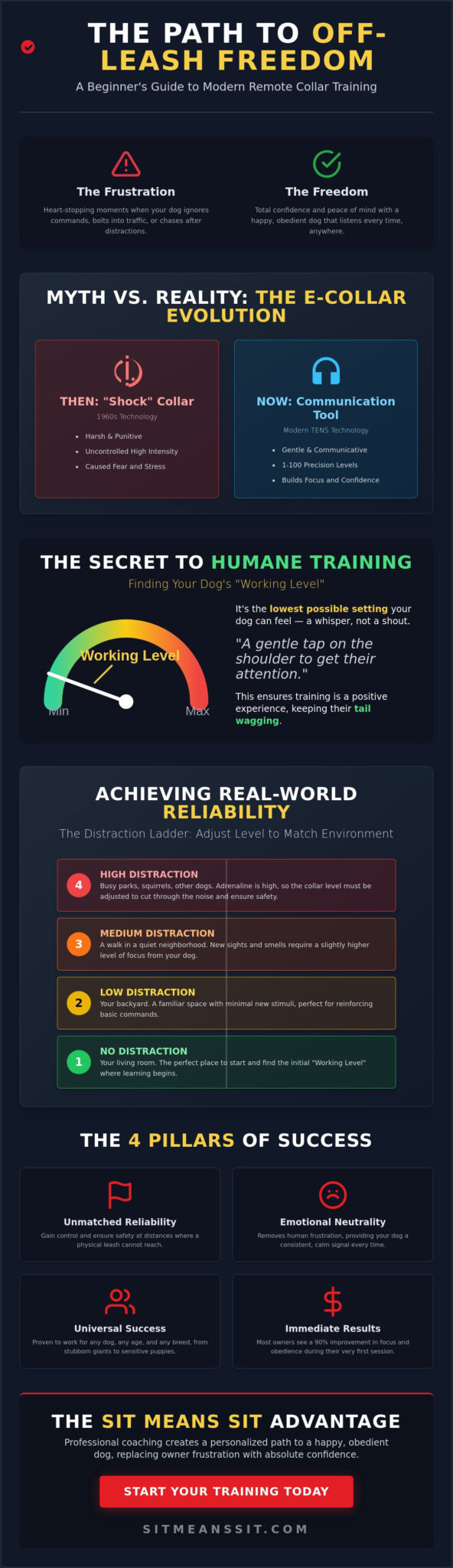
The industry has undergone a massive transformation since the high-intensity units of the 1960s. Modern collars offer a range of 1 to 100 levels of stimulation. This precision is vital. It allows you to find the exact “whisper” your dog responds to without causing stress. We focus on skin health by using high-quality contact points that ensure a reliable connection without irritation. It’s about a soft tap on the shoulder, not a shove.
Why Beginners Choose Remote Training
- Unmatched Reliability: You gain control at distances where a physical leash cannot reach.
- Emotional Neutrality: The collar removes human frustration from the equation. Your dog receives a consistent, calm signal every time.
- Universal Success: This method works for any dog, any age, and any breed, from stubborn giants to sensitive puppies.
- Immediate Results: Most owners see a 90 percent improvement in focus during their very first session.
You want a happy dog that can go anywhere with you. By establishing clear communication and “off-leash control,” you replace your daily stress with total confidence. It’s time to stop wishing for a well-behaved dog and start creating one.
Finding the “Working Level”: The Secret to Humane Training
Success in remote collar training for beginners hinges on one fundamental concept: the Working Level. This isn’t a tool for punishment or fear. Think of it as a wireless leash that delivers a gentle tap on the shoulder. It’s the lowest possible setting your dog can perceive. At Sit Means Sit, we focus on high-level communication that builds trust rather than breaking it down. We want your dog to feel empowered, not intimidated.
A 2014 study published by the NCBI analyzed humane training methods and highlighted that timing and consistency are the real drivers of behavioral success. When you find the right level, your dog feels a subtle sensation that says, “Hey, pay attention to me.” It’s a whisper, not a shout. Your goal is to keep your dog’s tail wagging and their mind engaged. If you’re consistent with your remote handling, your dog learns that the sensation is a predictable, reliable part of your conversation.
Environment dictates your settings. A level 5 might work perfectly in your quiet hallway, but that same setting will likely be ignored if a squirrel dashes across the park. Adrenaline acts as a natural filter for physical sensations. You must be prepared to adjust your remote to match the distraction level of the moment. This flexibility ensures you maintain off-leash control in every situation, from the living room to the hiking trail. You are the leader, and your consistency provides the structure your dog craves.
The Baseline Test: Step-by-Step
Start your training in a familiar, low-distraction environment like your living room. Ensure the collar is fitted snugly so the contact points touch the skin. Follow these steps to find your starting point:
- Begin at level zero and press the button briefly.
- Slowly move up one level at a time while watching your dog’s face and body.
- Look for a “recognition point,” such as a subtle ear twitch, a slight head tilt, or a sudden pause in sniffing.
- Stop the moment you see this change; this is your baseline for that specific environment.
Reading Your Dog’s Body Language
Distinguishing between “I feel that” and “That surprised me” is vital for a happy, confident dog. You want to see a calm realization, not a jump or a yelp. If your dog vocalizes or looks distressed, you’ve gone too high. We never use levels that cause fear because a scared dog cannot learn effectively. The Working Level is the lowest setting where your dog acknowledges the sensation without any signs of stress or discomfort. Mastering this baseline allows you to transform your relationship through clear, reliable boundaries.
First Steps: Your First 15 Minutes of Remote Collar Training
Your first session isn’t about complex maneuvers or long-distance recalls. It’s about building a bridge of communication. Grab your high-value treats, like small pieces of chicken or cheese. Ensure your dog hasn’t eaten a full meal recently; a hungry dog is a focused dog. Choose a quiet spot in your home or backyard with zero distractions. We’re creating a “Happy, Obedient Dog” from the very first second by linking the collar’s signal to something wonderful.
The goal of these first 15 minutes is simple. You want to teach your dog that the “tap” means “look at me.” It’s a physical “excuse me” that starts a conversation. While some research into positive reinforcement training highlights its benefits, the Sit Means Sit method combines those rewards with the precision of a remote signal to create a reliable communication loop. Keep your energy high and your praise even higher. If you’re having fun, your dog will too.
The “Tap and Treat” Method
This method is the cornerstone of remote collar training for beginners. It builds the foundation for every advanced skill your dog will eventually master. Follow these three steps with absolute consistency:
- Step 1: Tap the remote button at your dog’s established working level.
- Step 2: Immediately guide your dog toward you using a treat or a gentle lead on the leash.
- Step 3: Reward heavily the moment your dog turns their attention to you and makes eye contact.
Repetition builds muscle memory. This isn’t a one-off event; it’s a pattern you’re hardwiring into your dog’s brain. You’re teaching them that the sensation from the collar isn’t something to fear. It’s a prompt that leads to a jackpot reward. This clarity replaces confusion with confidence.
Introducing Simple Commands
Once your dog understands that the tap means “focus on me,” you can start overlaying known commands. Use basic cues like “Sit” or “Place” that your dog already knows. The timing is vital for maximum clarity. Tap the button first to get their attention, then immediately give the verbal command. The tap acts as a “heads up” before the instruction follows.
This sequence turns a suggestion into a definitive contract. You’re building the skills necessary for Dog Obedience Training: Achieving Total Off-Leash Control in 2026 right now in your own living room. Limit these sessions to short, intense bursts. Ten to fifteen minutes is plenty of time to make progress without causing mental fatigue. End the session while your dog is still excited and successful. You want them waiting by the door, eager for the next time the collar comes out.
Achieving Real-World Reliability and Off-Leash Control
Your backyard is a safe, controlled classroom. It’s the perfect place to start, but your dog doesn’t live in a vacuum. The real world is the final exam. Achieving true off-leash control means your dog listens whether you’re in the living room or at a crowded trail. This is where remote collar training for beginners transforms from a technical drill into a lifestyle of total freedom.
Transitioning from a long line to total off-leash freedom requires a systematic approach. You can’t expect a dog to ignore a deer if they haven’t learned to ignore a tennis ball first. We move through these stages with confidence, ensuring the dog understands that the rules don’t change just because the scenery does. Our goal is a dog that is happy, focused, and responsive regardless of what’s happening around them.
Mastering the Recall (Come When Called)
A reliable recall is the most important safety command you’ll ever teach. It’s a non-negotiable contract between you and your pet. When your dog spots a squirrel across a busy street, their instinct often drowns out your voice. The remote collar allows you to “cut through the noise,” providing a clear, physical cue that redirects their focus back to you instantly. For owners who want to see these results in record time, our Board and Train programs provide the immersive environment needed to master high-level recall in every situation.
The Distraction Ladder Strategy
Success in remote collar training for beginners relies on the Distraction Ladder. You start with low-stakes environments and climb toward high-distraction zones. This gradual progression prevents your dog from becoming overwhelmed or failing. It typically follows this pattern:
- Level 1: The quiet hallway or living room with zero distractions.
- Level 2: The fenced backyard with familiar smells and sounds.
- Level 3: The front yard where neighbors, bikes, or cars might pass by.
- Level 4: A local park or busy sidewalk with other dogs and wildlife.
You must adjust your collar levels as the environment becomes more exciting. A level that works in the kitchen likely won’t work at a crowded park. This consistency also solves “bolting” at the front door. By establishing firm boundaries at every gate and exit, you teach your dog that an open door is a boundary to be respected, not an invitation to run. This creates a safer home for everyone.
The most common concern we hear is whether a dog will only listen when the collar is on. We aren’t building a dependence; we’re building a language. Once the behavior is reinforced through thousands of successful repetitions, it becomes a permanent reflex. The collar eventually stays on as a safety net, but the obedience becomes a natural part of your dog’s personality.
Ready to see the Sit Means Sit difference for yourself? Find a location near you and book a free demo today.
The Sit Means Sit Advantage: Professional Coaching for Beginners
Many owners start remote collar training for beginners with high hopes but hit a wall when distractions increase. You might get great results in your living room, but the real world is full of squirrels, cars, and other dogs. This is where DIY training often plateaus. A professional trainer identifies exactly why your dog isn’t responding and adjusts the strategy in real time. We don’t believe in a one-size-fits-all approach. Your dog has a unique temperament, and our personalized plans reflect that. Whether you have a shy rescue or a high-drive athlete, we tailor the stimulation levels and timing to match their specific personality.
Success requires “Training the Human” just as much as the dog. You are the one who will live with your pet every day. We ensure you feel confident holding the remote and giving commands. Our programs are designed to fit your lifestyle and goals:
- Private Lessons: One-on-one attention to master the fundamentals without outside pressure.
- Group Classes: Real-world distraction training with a supportive community of peers.
- Day Training: Let our experts do the heavy lifting during the day so you can enjoy a better-behaved dog in the evening.
Why Expert Guidance Matters
A professional reads subtle body language that a beginner might miss. A slight flick of an ear or a stiffening of the tail tells a story about your dog’s focus. If you’re dealing with an aggressive or highly anxious dog, safety is the absolute priority. Our trainers have seen every behavior imaginable and remain unfazed. Don’t guess when it comes to your dog’s safety. Learn more about finding the right fit in our guide, Dog Trainer Near Me: How to Choose a Professional Who Actually Delivers Results.
Your Journey Starts Here
We invite you to see the Sit Means Sit difference for yourself. Our goal is to give you a dog that is a welcome guest anywhere, from a crowded patio to a mountain hiking trail. Imagine the joy of watching your dog run free, knowing they will return the second you call. This is the transformation we provide. Your path to off-leash freedom is just one click away. Schedule your free evaluation with Sit Means Sit today!
Unlock a Lifetime of Off-Leash Freedom
Stop worrying about your dog bolting toward a busy street or ignoring your calls at the park. Mastering remote collar training for beginners builds a bridge of clear communication between you and your pet. By identifying your dog’s specific working level and practicing consistent boundaries, you turn every walk into a stress-free adventure. It’s time to replace frustration with the confidence of total off-leash control.
Sit Means Sit uses industry-leading technology trusted by thousands of happy owners across our nationwide network of locations. Our expert trainers deliver proven results for any dog, any age, and any breed. We’ve seen every behavioral challenge imaginable and helped families achieve a more joyful life through structured discipline. You don’t have to do this alone; professional coaching makes the difference between a command being a suggestion or a definitive contract.
Experience the Freedom: Schedule Your Free Dog Training Evaluation Now!
Your dog is ready to learn and you’re ready to lead. Let’s start this journey toward a happier, more adventurous life today.
Frequently Asked Questions
Is remote collar training safe for puppies?
Yes, remote collar training is safe for puppies once they reach 16 weeks of age and understand basic commands. We start with low-level stimulation that feels like a tap on the shoulder to get their attention without causing fear. Starting early helps 90% of puppies develop clear communication habits before they reach the difficult adolescent stage. It’s about building a happy, confident dog through consistent boundaries from the start.
Will a remote collar burn my dog’s skin?
No, a quality remote collar cannot burn your dog’s skin because it doesn’t use heat. These devices utilize Medical Grade TENS technology, the same used in human physical therapy, to stimulate the muscle. Most skin irritations, often called “pressure sores,” occur if the collar is left on for more than 12 consecutive hours. We recommend rotating the collar every 4 hours to keep the skin healthy and ensure your dog stays comfortable.
How long does it take to see results with a remote collar?
You’ll see a noticeable change in your dog’s focus within the first 60 minutes of a professional session. While initial attention happens fast, achieving total off-leash reliability typically requires 3 to 4 weeks of consistent daily practice. Remote collar training for beginners is designed to bridge the gap between a distracted dog and a responsive companion. This timeline ensures the behavior becomes a permanent habit rather than a temporary fix.
Can I use a remote collar for an aggressive dog?
Yes, you can use a remote collar for an aggressive dog, but you must do it under professional supervision. Approximately 90% of aggressive behaviors stem from fear or lack of leadership, and the collar provides the clear communication needed to redirect that energy. We use the tool to interrupt the “red zone” focus and bring the dog back to a calm state. This creates a safer environment for both the dog and the community.
What is the difference between a shock collar and a remote training collar?
The difference lies in the technology and the intent of the communication. Old-fashioned shock collars often used high-voltage AC current to punish behavior, while modern remote collars use low-level DC pulses with 100 different levels of adjustment. This allows for fine-tuned communication that matches your dog’s specific sensitivity level. It’s the difference between shouting at a dog and giving them a gentle, digital tap to remind them of their job.
Do I have to use the collar forever, or will my dog eventually listen without it?
The collar is a bridge to total freedom, not a permanent crutch. Most owners find that after 12 to 18 months of consistent use, their dog responds to verbal commands 95% of the time without any stimulation. Think of it like a training wheel; once the balance and muscle memory are there, the tool becomes a safety net rather than a necessity. Our goal is always a dog that listens because they understand the contract of the command.
How do I know what size or brand of remote collar to buy?
Choose a collar based on your dog’s weight and the specific environment where you’ll be training. For most pets, a collar with a 1/2 mile range and at least 100 levels of stimulation provides the most reliability. Avoid “no-name” brands from big-box retailers, as 40% of those devices have inconsistent signal delivery. Stick with industry leaders like Sit Means Sit or SportDOG to ensure your dog’s safety and your own peace of mind.
Can I use a remote collar to stop my dog from barking at the window?
Yes, a remote collar is an excellent tool for stopping nuisance barking by redirecting your dog’s focus back to you. Effective remote collar training for beginners teaches the dog that the window is a place for calm, not chaos. By using a low-level tap the moment the dog fixes their eyes on a distraction, you interrupt the cycle before the barking starts. This creates a quieter home and a much more relaxed pet who doesn’t feel the need to patrol.
Comments are closed.