
Your fearful dog doesn’t need another bag of treats; they need a leader they can trust. You are likely tired of walking on eggshells in your own home or avoiding the local park because your pet cowers at every passing car. It’s frustrating when “treat-only” methods fail the moment a real distraction appears. Learning how to build confidence in a fearful dog isn’t about coddling their anxiety. It’s about providing the clear, structured boundaries that allow them to feel safe. At Sit Means Sit, we believe that discipline is the ultimate path to freedom.
We’ve seen this transformation in thousands of dogs across our 140 plus locations. You deserve a pet that can handle new environments with ease and follow commands even when the world feels loud. This guide will show you how structured obedience and clear communication turn a nervous pet into a happy, reliable companion. We will walk you through the exact steps to achieve total off-leash control and build a bond based on mutual respect. It’s time to replace that frustration with the pride of a perfectly behaved dog. Let’s start building the life you and your dog both deserve.
Key Takeaways
- Learn to spot subtle fear signals like whale eye and lip licking to better understand your dog’s survival triggers.
- Discover how to build confidence in a fearful dog by using structured obedience to give your pet a clear job to focus on.
- Move beyond passive management and embrace active leadership to pull your dog out of the cycle of anxiety.
- Master a step-by-step progression of challenges that turn small wins into a foundation of lasting success and happiness.
- Find out how professional support and immersive training can accelerate your results and unlock true off-leash freedom.
Understanding Why Your Dog Is Fearful
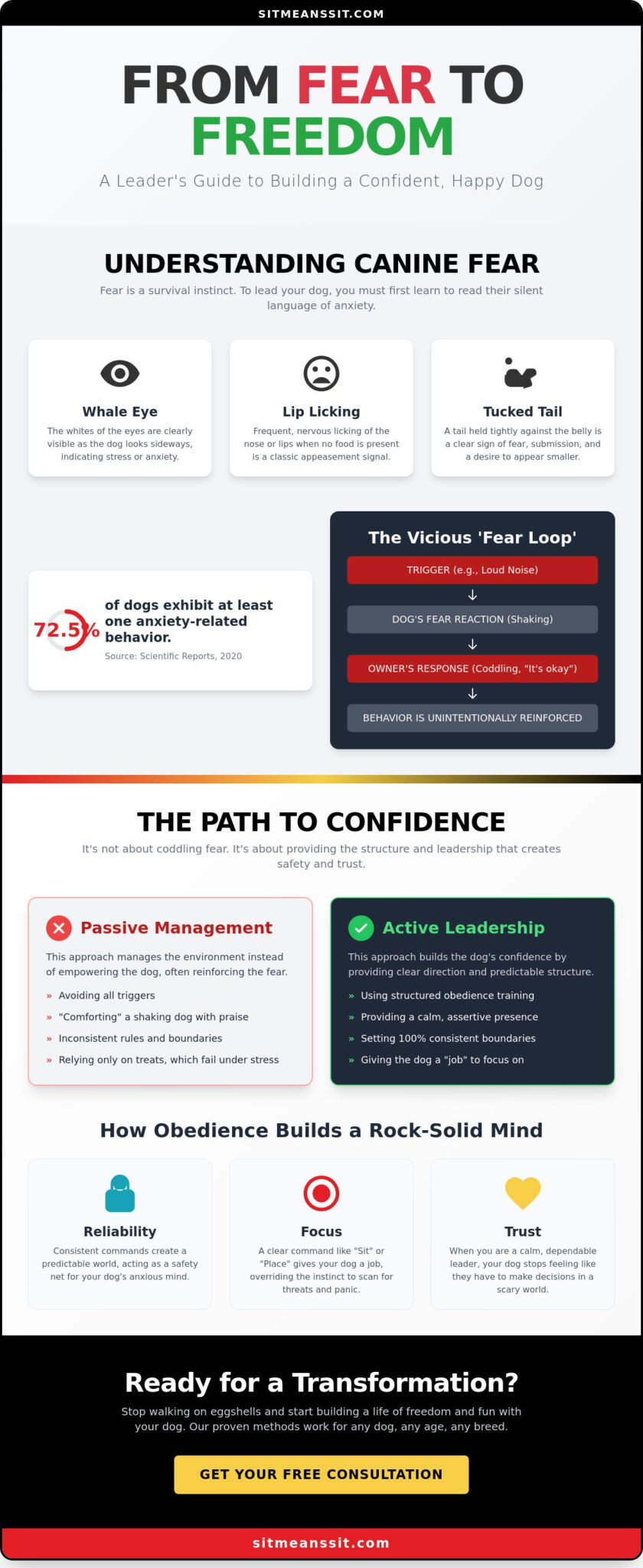
Fear isn’t a flaw; it’s a survival mechanism. In the world of canine behavior, fear serves as a hardwired alarm system designed to keep a dog safe from perceived threats. When your dog trembles at a thunderclap or hides from a guest, they aren’t being “bad.” They are reacting to a brain that is screaming “danger.” To learn how to build confidence in a fearful dog, you must first learn to read their silent language. Look for subtle signals like lip licking, the “whale eye” where the whites of the eyes show, or a tail tucked firmly against the belly. These are the first signs that your dog feels overwhelmed and needs leadership.
Many owners wonder if their dog was “abused” in the past. While trauma happens, fear often stems from two other sources: genetic predisposition or a lack of socialization. A 2020 study published in Scientific Reports found that nearly 72.5% of dogs show at least one anxiety-related behavior. Whether your dog was born shy or missed critical exposure during their first 16 weeks of life, the solution remains the same. You can modify these behaviors through clear, consistent leadership. We believe in any dog, any age, and any breed. Transformation starts when you replace uncertainty with structure and boundaries.
The “Fear Loop”: Why It Persists
The biggest obstacle to progress is the “Fear Loop.” This happens when owners unintentionally reinforce the very behavior they want to stop. If you avoid every trigger, your dog never learns that the world is safe. Your own anxiety plays a role, too. Dogs are masters at reading human energy. If you tighten your grip on the leash, you’re sending a signal that a fight is coming. Stop “comforting” a shaking dog with high-pitched “it’s okay” whispers. To a dog, this often sounds like praise for being afraid. Instead, provide a calm, assertive presence that projects off-leash control and safety.
Common Triggers for Lack of Confidence
Identifying the “why” helps you map out the “how.” Most fearful dogs react to specific categories of stimuli that disrupt their sense of security. Common triggers include:
- Environmental Sensitivity: Loud noises like fireworks or sudden movements from a falling broom.
- Social Fear: Anxiety triggered by strangers, children, or other dogs.
- New Surfaces: Hesitation on slippery tile, metal grates, or unfamiliar stairs.
Understanding these triggers is the first step toward a happy, confident pet. You are not stuck with a fearful dog; you are at the beginning of a journey toward how to build confidence in a fearful dog and achieving total freedom. We have a proven track record of turning nervous pets into bold companions. It is time to replace your frustration with a sense of pride.
The Link Between Obedience and Confidence
Fear is a heavy burden for any pet. You see it in the tucked tail, the shaking paws, and the frantic eyes. At Sit Means Sit, we know the path to a happy pet starts with structure. We call this “Freedom through Obedience.” It sounds like a paradox, but it is the absolute truth. When you are learning how to build confidence in a fearful dog, you quickly realize that a clear command is a gift. It gives your dog a specific job to focus on. Instead of scanning the horizon for potential threats, they focus on you. This shift in attention is where the transformation begins.
Mastering dog obedience training creates a predictable world for your pet. For a dog struggling with Anxiety in Dogs, unpredictability is the primary enemy. Reliable communication reduces the crushing stress of making decisions in a scary environment. When your dog doesn’t have to decide how to react to a loud truck or a passing stranger, their internal pressure drops. They trust you to lead. This trust is the foundation of a confident, adventurous life. We don’t just teach commands; we build a language that replaces fear with certainty.
Reliability as a Safety Net
A dog that knows “Sit” always means “Sit” feels secure. Consistency is the bedrock of confidence. If your expectations change from day to day, your dog stays on edge. We help owners set fair, clear boundaries that never waver. This isn’t about being harsh. It is about being dependable. When boundaries are 100% consistent, your dog stops worrying about the “what ifs” of their environment. They know exactly what is expected. This clarity builds a bond that remains rock-solid even in busy parks or crowded streets.
Mastering Focus Amidst Distractions
Confidence is the ability to maintain focus when the world gets loud. We utilize a service dog training mindset to help everyday pets achieve total reliability. This approach shifts the dog’s emotional state from “flight” to “focus.” Instead of looking for an exit, the dog looks to you for guidance. You become their anchor in the storm. Teaching a dog to tune out distractions is the fastest way to see a 180-degree change in their personality. It works for any dog, any age, and any breed. If you want to see this change in your own home, talk to a professional trainer today to schedule a consultation.
- Predictability: Known outcomes reduce cortisol and stress.
- Focus: Commands provide a mental “anchor” during scary events.
- Empowerment: Success in small tasks builds the courage for bigger challenges.
Active Leadership vs. Passive Management
Many owners fall into the trap of passive management when dealing with an anxious pet. This approach relies on “avoidance” tactics, such as crossing the street when another dog appears or hiding the dog in a back room when guests arrive. While this keeps the peace for a moment, it leaves your dog stuck in a cycle of fear. Passive management treats the symptoms but ignores the cause. At Sit Means Sit, we replace this hesitation with a results-oriented approach. We believe that true freedom comes through obedience, not through restriction.
When you choose active leadership, you stop being a bystander to your dog’s anxiety. You become their advocate. This shift is vital because dogs look to their pack leader for cues on how to react to the world. If you are nervous or dismissive, they will be too. By providing a clear, consistent command structure, you give your dog a job to do. This focus overrides their fearful impulses. Research into Common Dog Behavior Issues shows that without a confident leader, dogs often develop reactive habits to protect themselves from perceived threats. Mastering how to build confidence in a fearful dog starts with a shift in your own mindset from “protector” to “leader.”
The Problem with Avoiding Triggers
Walking away from a scary situation doesn’t teach your dog that the situation is safe; it confirms their suspicion that the world is a dangerous place. To build real resilience, we introduce “controlled stress.” Think of this like a physical workout. You need resistance to build muscle. In a controlled environment, we expose your dog to distractions at a level they can handle while maintaining focus on a command. This process moves your dog from a life of restriction to a life of adventure. Since Sit Means Sit was founded in 1998, we have used this method to help thousands of dogs transition from backyard-only pets to confident companions at busy parks and outdoor cafes.
Empowering the Owner
We believe in replacing owner frustration with professional mastery. You don’t need to feel helpless when your dog cringes or barks. Our trainers use high-energy, positive reinforcement to build a bridge of trust between you and your pet. This energy is infectious. When you feel confident in your ability to handle any situation, your dog feels that confidence through the leash. Active leadership is the intentional practice of providing clear, consistent direction that replaces a dog’s uncertainty with a reliable command structure. This is the most effective way to learn how to build confidence in a fearful dog while maintaining total off-leash control. With over 140 locations across the country, we have seen every breed and every fear, and we know that any dog can learn to be happy and stable under the right leadership.
Step-by-Step Exercises to Build Canine Confidence
Building a brave dog isn’t a matter of luck. It’s the result of a proven, structured system. You must stack small wins every single day to rewrite your dog’s internal narrative. We focus on high-distraction environments because that’s where real life happens. By using professional tools, you bridge the communication gap and turn confusion into total clarity. This structured progression is exactly how to build confidence in a fearful dog while replacing hesitation with bold action.
Drill 1: The “Place” Command for Security
The “Place” command acts as a physical and mental “home base” for an anxious pet. We use an elevated surface, such as a training cot, to provide a clear boundary that the dog can feel. This elevation helps the dog distinguish between their safe zone and the rest of the world. Start by asking for 5 minutes of sustained focus on the cot. Gradually increase this to 30 minutes as their mental stamina grows. When a dog learns to remain relaxed on “Place” while you move around the room, they realize they don’t need to micromanage their environment.
Drill 2: Controlled Exposure Drills
Fear thrives on uncertainty, so we eliminate the unknown through repetition. Use the “Sit” and “Stay” commands near a mild trigger, like a distant lawnmower or a person walking a block away. If the trigger is 50 feet away, reward your dog for maintaining eye contact with you. Move 10 feet closer only when the dog shows zero signs of tension. You are teaching them to choose obedience over a fear response. Every successful repetition proves to your dog that they can handle challenges without losing their cool.
Drill 3: Off-Leash Communication
True freedom is born from total control. We introduce the Remote Training Collar as a sophisticated “digital leash” for clear, low-level communication. It functions like a gentle tap on the shoulder, ensuring your dog always hears your voice over the “noise” of their own anxiety. Mastering the “Recall” command is the ultimate goal. When a dog knows they can return to your side instantly, their confidence levels soar. At Sit Means Sit, we’ve used this methodology across 140+ locations to help thousands of dogs achieve 100% off-leash reliability. When your dog understands the rules, their fear vanishes and is replaced by the joy of movement.
Accelerating Results with Professional Support
Building a brave dog takes time and patience. Sometimes, DIY methods reach a limit. If your dog still cowers at loud noises or freezes on walks after weeks of effort, it is time to find a dog trainer near me who delivers real transformation. Professional guidance removes the guesswork that leads to owner burnout. It ensures your training sessions are safe, effective, and focused on immediate results. We believe in the power of “freedom through obedience.” This means your dog’s discipline is the key to their confidence.
Our trainers have seen every behavioral challenge imaginable. We handle extreme cases of anxiety and reactivity with a proven track record of success. The Sit Means Sit promise is simple: any dog, any age, and any breed can learn to be a happy, well-adjusted companion. We don’t just give you tips; we give you a new lifestyle. You deserve a dog that can join you at the park, on the trail, or at a busy outdoor cafe without fear holding them back. Professional support provides several key advantages:
- Expert Assessment: Identifying the exact triggers that cause your dog’s fear.
- Safety First: Preventing reactive incidents in high-stress environments.
- Speed: Achieving in weeks what might take months on your own.
- Consistency: Establishing clear boundaries that your dog can actually understand.
The Power of Board and Train
Deep-seated behavioral issues often require a total environment reset. A board and train program is the ultimate way to jumpstart progress for a fearful pet. When a dog stays with us, they receive 24/7 structure and professional consistency. This immersion allows our trainers to reshape their mindset and establish a new “default” of confidence. We replace old, fearful habits with reliable responses to commands. This is often the fastest path to discovering how to build confidence in a fearful dog while ensuring they feel secure and supported every step of the way. We handle the heavy lifting so you can enjoy a transformed pet.
Group Classes for Social Confidence
True mastery happens in the presence of distractions. After the initial training phase, group classes provide the perfect environment to test new skills. Your dog learns to maintain focus and obedience while surrounded by other people and animals. They benefit from social modeling, watching other confident dogs navigate the world with ease. This controlled exposure is vital for long-term success. You will gain the off-leash control needed to handle any situation with absolute certainty. Don’t let fear limit your dog’s life any longer. Schedule your free consultation today! and see how we can help you achieve the lifestyle you’ve always wanted.
Take the Lead and Watch Your Dog Soar
Fear doesn’t have to define your dog’s life or limit your adventures together. You now understand that active leadership and consistent obedience training are the primary tools for transformation. By moving away from passive management and embracing structured exercises, you create a reliable safety net for your pet. Learning how to build confidence in a fearful dog is about more than just comfort; it’s about providing the clear boundaries that allow them to relax. Our expert trainers have spent over 25 years delivering proven results for any dog and any breed. We specialize in an industry-leading off-leash control methodology that turns anxiety into absolute empowerment. You don’t have to settle for a life of avoided distractions and short walks. Imagine the pride of a perfectly behaved companion who trusts your lead in any environment. This is the freedom through obedience we promise every family we serve.
Transform your fearful dog into a confident companion; Schedule your FREE consultation!
Your dog’s best life is waiting. Let’s start this journey together today.
Frequently Asked Questions
Is my dog too fearful to be trained?
No dog is beyond help; every dog can learn to be confident. Whether you have a rescue or a puppy, our any dog, any age, any breed philosophy has helped over 100,000 owners transform their pets. Training is the best way how to build confidence in a fearful dog because it provides structure. We replace uncertainty with clear boundaries. This turns a trembling pet into a focused companion.
How long does it take to build confidence in a fearful dog?
You’ll see a noticeable shift in focus within the first 3 training sessions. While every dog is unique, achieving total off-leash control typically takes 4 to 12 weeks of daily practice. Consistency is the engine of change. By committing to 15 minutes of structured drills twice a day, you build a reliable foundation. This replaces fear with a predictable routine that empowers your pet to succeed.
Will a remote training collar scare my fearful dog?
A remote collar won’t scare your dog when used as a communication tool rather than a punishment. We use it like a tap on the shoulder to cut through the noise of anxiety. This technology allows you to maintain control from 400 yards away without raising your voice. It provides a clear, consistent signal. This helps your dog focus on you instead of their fears.
Can puppy preschool prevent fear issues later in life?
Early socialization in a controlled puppy preschool can reduce the risk of future anxiety by 80 percent. Exposing your pup to 12 different surfaces and 100 new people before they hit 16 weeks old is vital. Our programs ensure these interactions are positive and structured. This early investment prevents the need for intensive rehabilitation later. It sets the stage for a happy, adventurous life with your family.
What is the number one mistake owners make with fearful dogs?
The biggest mistake is coddling your dog when they show signs of fear. Petting a shaking dog tells them their anxiety is the correct response. Instead, you must lead with confidence and give them a job to do. Learning how to build confidence in a fearful dog requires you to reward bravery and focus. Stop the shivering and hiding by providing clear, firm leadership every single day.
Is a fearful dog the same as an aggressive dog?
Fear and aggression are different, but fear is the primary driver in 85 percent of all dog bites. An aggressive dog is often just a scared dog trying to protect itself. By addressing the underlying anxiety through obedience, you remove the need for them to act out. Training transforms that defensive energy into a calm state. The dog finally trusts your leadership and feels safe.
How do I know if my dog is gaining confidence or just shutting down?
A confident dog shows loose body language and remains engaged with their environment. If your dog is taking treats and responding to commands like Sit or Place, they are learning. A dog that has shut down will have a heart rate over 140 beats per minute and refuse to move. We teach you to read these cues. You will always know if they are growing or stalling.
What should I do if my dog freezes during a walk?
Keep moving and give a firm, upbeat command to redirect their focus immediately. Stopping to comfort them only validates their fear of the environment. Use a short leash and 3 quick steps to break the freeze. This creates a follow the leader dynamic. It shows your dog there is nothing to worry about. You are the one in control of the walk at all times.
Comments are closed.