
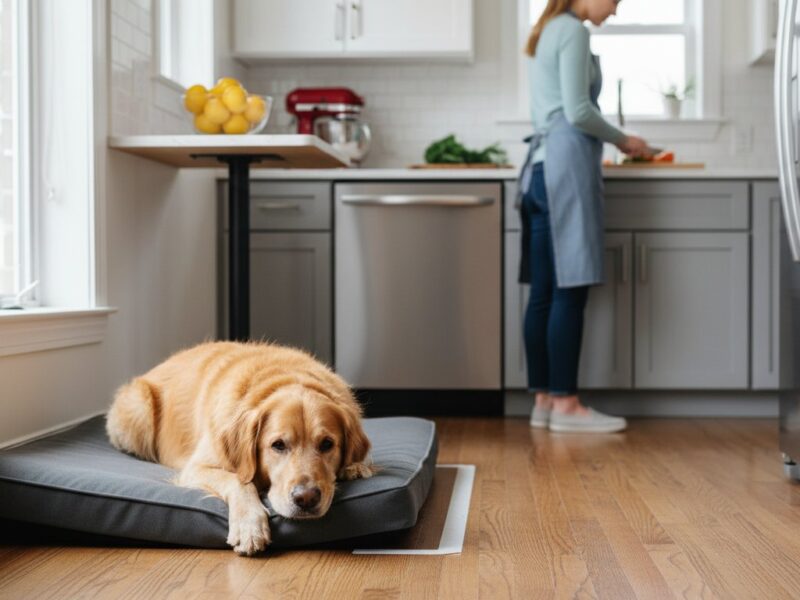
Your kitchen counter isn’t a buffet; it’s a boundary that requires a definitive agreement from your dog. You’re likely tired of the constant vigilance and the frustration of a stolen steak or a ruined holiday spread. If you’re searching for how to stop a dog from jumping on the counter, you’ve probably realized that simple “no” commands just aren’t enough. It’s exhausting to guard your meal prep like a hawk while worrying about your dog ingesting something dangerous.
This guide provides the professional techniques you need to reclaim your kitchen and establish lasting boundaries that your dog respects. You’ll learn how to move beyond temporary management and achieve a transformation where your dog stays on the floor by choice, even when you leave the room. We’ll preview the methods used in our Board and Train and Private Lessons, including how tools like a Remote Training Collar can create reliable, off-leash boundaries. It’s time to replace your frustration with absolute confidence and enjoy a more joyful, structured life with your pet.
Key Takeaways
- Identify why traditional vocal corrections fail and how counter surfing becomes a self-rewarding habit that overrides your commands.
- Master the “Place” command to establish a proactive kitchen boundary that keeps your dog on the floor by choice.
- Discover how to stop a dog from jumping on the counter using a Remote Training Collar for clear communication and off-leash reliability.
- Implement a strategic 4-step proofing plan using controlled temptations to ensure your dog respects the rules when you leave the room.
- Explore how professional solutions like Board and Train or Private Lessons can transform deep-seated habits into a lifetime of reliable obedience.
The Psychology of Counter Surfing: Why Your ‘No’ Is Being Ignored
Stop playing the guessing game in your kitchen. If you’ve been shouting yourself hoarse while your dog swipes your dinner, you’re fighting a losing battle. Your dog isn’t ignoring you because they’re stubborn or spiteful. They’re ignoring you because the reward on the counter is significantly more valuable than your verbal correction. Understanding how to stop a dog from jumping on the counter starts with recognizing that your dog is a master of cost-benefit analysis. Most generic advice tells you to just hide your food or clear the counters. That’s a temporary patch. It doesn’t address the internal drive that makes your dog a kitchen predator.
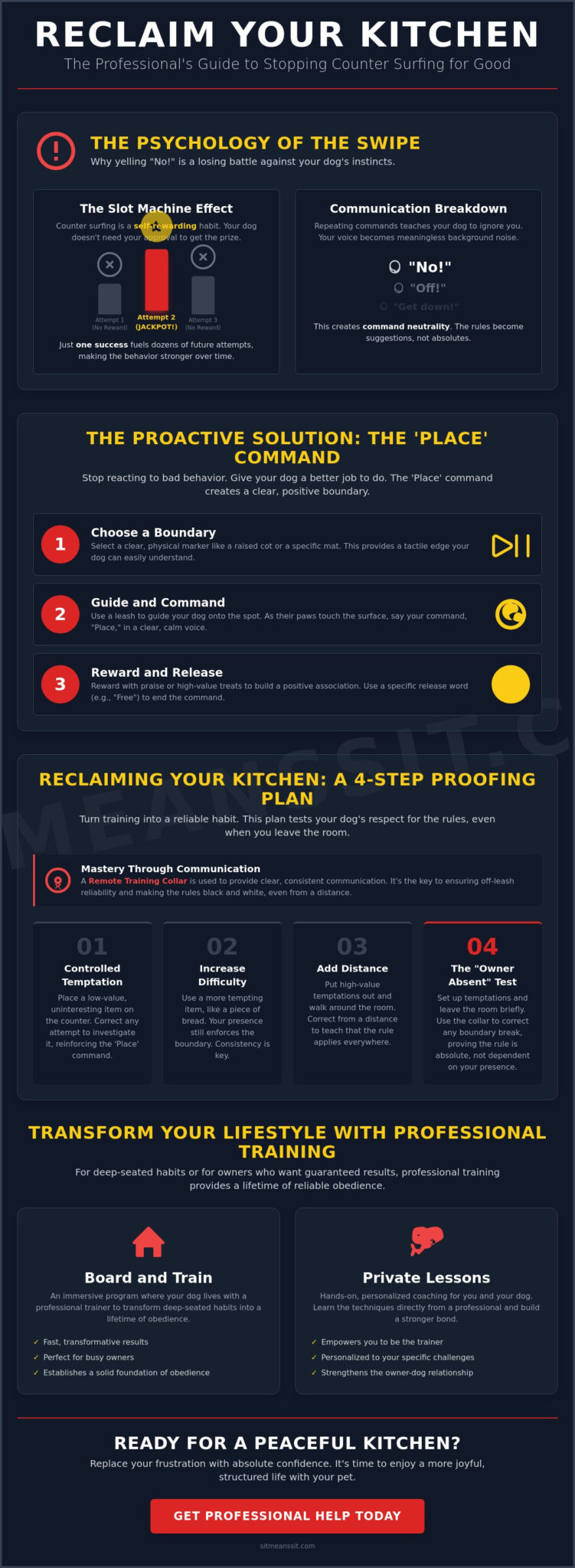
Every time your dog finds a single crumb, they hit the jackpot. In the framework of operant conditioning, this is known as a variable ratio reinforcement schedule. It’s the same logic that keeps people playing slot machines. The payoff doesn’t happen every time, but it happens often enough to keep the behavior alive. This creates the frustrating “Owner-Absent” problem. Your dog doesn’t learn that jumping is wrong; they learn that jumping is only “dangerous” when you’re standing right there. The moment you leave the room, the boundary vanishes because the environment is still offering a potential reward.
The Reward Loop: How Success Breeds Persistence
Scavenging is a primal canine instinct. It’s a high-drive behavior that has nothing to do with how much you fed them for breakfast. A dog with a full belly will still hunt the counter because the act of “finding” releases a powerful surge of dopamine. Self-rewarding behavior is any action where the dog receives a prize directly from the environment without needing your permission or interaction. Even one successful swiped sandwich can fuel their persistence for weeks. You aren’t just fighting a habit; you’re fighting biology. To win, you must replace that scavenging drive with a structured alternative that provides a different kind of satisfaction.
Communication Breakdown: Why Your Commands Aren’t Sticking
Stop nagging your dog. When you repeat “No, get down, off, stop it,” you’re creating command neutrality. Your dog learns to treat your voice like background noise or, worse, a part of the game. They wait to see how many times you’ll say it before you actually take action. This lack of clarity is why many owners struggle with how to stop a dog from jumping on the counter effectively. Effective training requires a binary system. The rules must be black and white. Your dog needs to understand that the counter is a definitive “No,” not a suggestion that depends on your mood or your presence in the room. We want to move away from reactive shouting and toward a proactive agreement where the floor is the only place to be.
Establishing the ‘Place’ Command: Creating a Kitchen Boundary
Stop reacting and start leading. Most owners wait for their dog to jump before they say a word. That’s a reactive correction, and it’s already too late. If you want to know how to stop a dog from jumping on the counter, you must give them a proactive job to do instead. The ‘Place’ command is that job. It isn’t just a suggestion to sit; it’s a definitive agreement that your dog stays on a specific boundary until released. This shifts the focus from the food on the counter to the success of staying on their bed.
Choose a physical marker like a raised cot, a specific mat, or a rug. A raised cot is often best because it provides a clear tactile edge. Your dog knows exactly where the boundary starts and ends. This physical anchor makes the rule easy to understand. When you are managing and training your dog, clarity is your best friend. A dog that understands their ‘Place’ is a dog that feels secure and successful. They no longer need to scavenge because they have a clear mission to accomplish.
Step-by-Step Guide to Teaching the Place Command
Start with a leash. Use it to guide your dog onto the designated spot. As their paws touch the surface, give the command ‘Place.’ Reward them immediately with high-value treats to build a powerful positive association. They need to believe that this spot is the most rewarding area in the house. Introduce a release command like ‘Free’ or ‘Okay.’ Your dog must remain on the boundary until you give that specific release word. Consistency is non-negotiable. If they step off early, calmly guide them back and reset. If you need hands-on help with these fundamentals, our Private Lessons offer the perfect environment for mastering these boundaries.
Building Duration and Distraction Resistance
Mastery requires practice under pressure. Start by asking for thirty seconds of ‘Place’ while you stand nearby. Gradually increase the time until you can wash a few dishes or chop vegetables while they stay anchored. Now, add the ultimate test: the distraction. Drop a piece of food on the floor. If they break, guide them back immediately. If they stay, reward them with something even better. You are building impulse control and proofing the behavior for real-world kitchen environments. The goal is a dog that chooses their bed over your counter every single time, even when the steak is sizzling and your back is turned.
Mastery Through Communication: The Role of the Remote Training Collar
You’ve established the ‘Place’ command, but what happens when you turn your back? True reliability requires a bridge of communication that works across the room. This is where the Remote Training Collar becomes your most valuable asset. It isn’t a tool for punishment; it’s a tool for absolute clarity. If you’re struggling with how to stop a dog from jumping on the counter, you need a way to redirect their attention the moment they think about breaking the rules. This tool provides a consistent, physical tap that says, “Hey, focus on me.” It replaces the confusion of shouting with a whisper-quiet directive that your dog understands instantly.
Reliability in the kitchen shouldn’t depend on a leash. The goal is total off-leash control. By using a remote collar, you establish a definitive agreement that the rules apply everywhere, all the time. It removes the “Owner-Absent” loophole discussed earlier. Your dog learns that the boundary is the environment itself, not just your physical reach. This creates a sense of empowerment for you and a sense of calm for your pet. They no longer have to guess what you want because the feedback is immediate and unmistakable.
Distance Correction: Stopping the Jump Before it Happens
Precision is everything. A shouted “No” from across the room is vague and often arrives too late. By the time you yell, the dog might already have the steak. The remote collar allows you to communicate the second your dog fixates on the counter. Use the “tap” as a physical reminder to snap back to your previous command. It’s a gentle but firm nudge that redirects their drive away from the food and back toward you. This proactive approach is the secret to how to stop a dog from jumping on the counter before their paws even leave the floor. You’re correcting the thought, not just the action.
Timing and Consistency: The Professional Edge
Great training lives and dies by timing. You must catch the “intent.” Watch your dog’s eyes. When they look at the counter with that specific, scavenging gaze, that’s your moment to intervene. Consistency builds trust. If you only correct the behavior half the time, your dog will keep gambling for the reward. Professional dog obedience training is essential for mastering this tool correctly. An expert ensures you’re using the right levels and the right timing to keep your dog confident and happy. Without professional guidance, you risk creating confusion. With it, you achieve a level of mastery that transforms your daily life and your bond with your dog.
Reclaiming Your Kitchen: A 4-Step Proofing Plan
It’s time to put your training to the test. You’ve established the ‘Place’ command and introduced the Remote Training Collar. Now, you must proof these behaviors in the environment where they matter most. This isn’t just about theory; it’s about real-world results. If you want to master how to stop a dog from jumping on the counter, you need a deliberate strategy that transforms impulse control into a definitive agreement. Training in a vacuum doesn’t work. You need to simulate the very distractions that usually cause your dog to fail.
Transition from leash-guided sessions to total off-leash freedom only when your dog is consistently choosing their bed over the bait. If a relapse happens, don’t get frustrated. Stay calm and assertive. Use your tools to redirect them back to their ‘Place’ without a fuss. Frustration is the enemy of progress. Reliability is born from steady practice and unwavering consistency. This is how to stop a dog from jumping on the counter for good.
The Set-Up: Creating Success Through Controlled Failure
Start by creating a scenario where you can control the outcome. This is ‘controlled failure.’ Place a low-value item, like a piece of dry kibble or an empty wrapper, on the edge of the counter. Wait for your dog to investigate. The second they show interest or sniff the air near the counter, redirect them to their ‘Place’ immediately. You are teaching them that the kitchen counter is off-limits regardless of what is on it. Gradually increase the value of the ‘bait’ as they master each level. Move from kibble to a slice of bread, and eventually to high-value treats. Each success builds the mental muscle they need to ignore even the most tempting distractions.
Environmental Management vs. Behavioral Change
During this initial proofing phase, keep your counters ‘cold.’ This means leaving them completely empty whenever you aren’t actively training. If your dog manages to jump and find a reward when you aren’t looking, the behavior is reinforced. Avoid accidental rewards at all costs. This is about establishing a lifestyle where the kitchen floor is the only place to be. If you have a young dog, starting early with puppy training classes can prevent these scavenging habits before they ever start. It’s much easier to establish a boundary from day one than it is to break a deep-seated habit later. If you are ready for a total transformation, our Board and Train program delivers the immersive results you need.
Transforming Your Lifestyle with Professional Training
Counter surfing is rarely an isolated incident. It’s often a symptom of a broader deficit in attention and impulse control. When you master how to stop a dog from jumping on the counter, you’re doing more than just saving your dinner. You’re establishing a new foundation for your entire relationship. A dog that respects the kitchen boundary is a dog that understands how to look to you for direction in every high-stimulation environment. This clarity is the first step toward a life of greater freedom and adventure for both of you.
For many owners, deep-seated habits require more than just weekend practice. If your dog has been scavenging for years, an immersive board and train program provides the professional reset they need. This immersive experience allows expert trainers to instill reliable boundaries in a controlled setting. Sit Means Sit Dog Training replaces your daily frustration with a sense of empowerment and pride. Once these manners are solidified at home, you can confidently apply them to the real world, whether you’re visiting a local park, hosting guests, or relaxing at a crowded outdoor cafe.
When to Call a Professional Dog Behavioral Trainer
Recognize the signs that you need expert intervention. If your dog’s counter surfing is accompanied by high-drive scavenging that ignores all redirection, it’s time to seek help. Professional guidance is especially vital for high-anxiety dogs that struggle with impulse control. Taking a dog behaviorist approach ensures you’re addressing the underlying emotional state of the animal, not just the physical jump. Expert trainers save you from the cycle of owner burnout. They provide the technical precision required to handle how to stop a dog from jumping on the counter without causing confusion or fear.
The Sit Means Sit Dog Training Way: Reliability Anywhere, Anytime
Our methodology is centered on the concept of “Attention.” We don’t just want a dog that follows orders; we want a dog that listens because they are eager to engage with you. This leads to what we call “Happy Obedience.” Your dog becomes confident because they understand exactly what is expected of them. Boundaries aren’t restrictions; they are the rules of the game that allow your dog to participate more fully in your life. Stop struggling with ruined meals and start enjoying the bond you’ve always wanted. Find a Sit Means Sit Dog Training trainer near you and start your transformation today.
Reclaim Your Kitchen and Your Peace of Mind
You’ve learned that management is just a temporary fix. True transformation happens when you replace your dog’s scavenging drive with clear boundaries and absolute focus. By mastering the ‘Place’ command and using the Remote Training Collar for precise communication, you establish a definitive agreement that your dog respects even when you leave the room. This journey isn’t just about kitchen manners; it’s about building a bond based on trust and reliable obedience. You now have the professional blueprint for how to stop a dog from jumping on the counter and reclaiming your home.
Sit Means Sit Dog Training brings over 25 years of professional training excellence to every client. Our nationwide network of expert trainers utilizes our signature Remote Collar methodology to ensure total reliability in high-stimulation environments. Stop guarding your dinner and start enjoying your pet. Ready for a dog that listens the first time? Schedule your free Sit Means Sit Dog Training consultation today! We’re excited to help you achieve the lifestyle change you and your dog deserve. Your kitchen is finally yours again.
Frequently Asked Questions
How long does it take to stop a dog from counter surfing?
You’ll see a shift in focus within the first few sessions, but total reliability usually takes three to four weeks of consistent practice. The timeline depends on how long the habit has existed and your commitment to the rules. Using professional tools like a Remote Training Collar accelerates this process by providing instant clarity. Stay the course; mastery is a marathon, not a sprint.
Can I use a spray bottle to stop my dog from jumping on the counter?
Ditch the spray bottle immediately. It’s a reactive distraction that fails to teach a lasting boundary. Your dog learns to fear the bottle or the person holding it, but they don’t learn that the counter is off-limits. True transformation requires a definitive agreement, not a temporary jump-scare. Focus on proactive commands like ‘Place’ to establish a kitchen floor that your dog respects by choice.
Is it too late to train an older dog to stay off the counters?
It is never too late to teach an old dog new boundaries. Senior dogs thrive on the structure and mental engagement that professional training provides. While a lifelong habit might take more repetitions to break, the methodology remains the same. Focus on clear communication and consistent feedback. You’ll be surprised how quickly an older dog embraces the pride of knowing exactly where they belong.
What should I do if my dog steals food when I’m not in the house?
This is the classic “owner-absent” loophole where the dog only follows rules when you’re watching. If you want to know how to stop a dog from jumping on the counter when you’re gone, you must shift the correction from you to the environment. Using a Remote Training Collar allows you to provide feedback from a distance. This creates off-leash reliability that sticks even when you step out of the room.
Why does my dog only jump on the counter when there is no food there?
Your dog is checking for a “jackpot.” Even if they find food only once every ten jumps, the behavior is reinforced by the possibility of a reward. This is why learning how to stop a dog from jumping on the counter requires keeping counters “cold” during training. If they never find a reward, the scavenging drive eventually fades. Consistency is the only way to break the slot-machine cycle.
Are certain breeds more prone to counter surfing than others?
High-drive and food-motivated breeds like Labradors, Golden Retrievers, and Beagles are often the most persistent scavengers. However, any dog with enough height or curiosity can become a counter surfer. The breed doesn’t change the solution; it only changes the level of persistence you might encounter. Every dog, regardless of their DNA, is capable of mastering reliable kitchen boundaries with the right instruction.
How do I stop my puppy from starting the habit of jumping on counters?
Prevention is the best medicine. Enroll in Puppy Preschool to establish boundaries before your puppy is even tall enough to see the counter. Teach the ‘Place’ command early to make the floor their favorite spot in the house. By rewarding them for staying down before the habit starts, you avoid the frustration of retraining a high-drive adult dog later. Start today to build a lifetime of success.
Can the ‘Place’ command work in an open-concept kitchen?
Absolutely. The ‘Place’ command is actually more effective in open-concept homes because it provides a physical anchor in a vast space. By using a raised cot or a specific rug, you create a visual and tactile island for your dog. They don’t need walls to understand a boundary; they just need a definitive spot that represents their “job” while you’re cooking.
Comments are closed.