

Nearly one in five couples admits to fighting over their pet, and most of those heated arguments stem from conflicting discipline and training styles. It’s incredibly frustrating when you invest time into teaching a command only to watch your partner inadvertently undo it. You want a dog that listens to both of you equally, but right now, you’re likely stuck in the “Too Many Bosses” paradox. Getting your spouse on board with dog training rules is not about being strict. It’s about providing the clear communication your dog needs to earn the off-leash freedom you both want.
We understand how exhausting it feels when your home becomes a battlefield of “yes” and “no.” You deserve a peaceful environment where your dog is a source of joy rather than a source of stress. This guide will show you how to build a unified front that replaces confusion with total reliability. We will cover the essential steps to syncing your house rules, refining your communication, and turning your training efforts into lasting results. Stop the arguments and start seeing progress. Let’s transform your household into a place of adventure and pride.
Key Takeaways
- Understand why consistency is a leadership necessity that eliminates your dog’s confusion and anxiety.
- Identify the specific mindset behind your partner’s actions to stop the cycle of undermined rules.
- Master the art of getting your spouse on board with dog training rules by showing them how structure leads to an adventurous life.
- Create a unified front by auditing your top non-negotiables and standardizing every command your dog hears.
- Learn when to leverage a professional Board and Train program to act as a neutral expert for your household’s success.
Why Consistency is a Leadership Issue (Not Just a Dog Issue)
Leadership in your home isn’t about power. It’s about clarity. When you and your spouse give different signals, your dog enters a state of perpetual gambling. This is called variable reinforcement. It’s the same psychology that keeps people playing slot machines. If your dog gets a “yes” once out of every ten times they jump, they won’t stop. They’ll just jump ten times harder. Getting your spouse on board with dog training rules is the only way to break this cycle. Without a unified front, you aren’t just failing to train; you’re actively training your dog to ignore you.
Mixed signals carry a heavy price tag. A dog that’s allowed to pull on the leash with one owner will never learn to walk politely with the other. This inconsistency leads to leash reactivity and dangerous bolting out of open doors. If the “stay” command is optional on Tuesdays but mandatory on Wednesdays, your dog will choose the most exciting option every time. This lack of reliability prevents you from taking your dog to cafes or family gatherings. Structure isn’t a cage. It’s the key that unlocks the world for your dog.
The Psychology of the ‘Confused Canine’
Dogs are masters of pattern recognition. They don’t understand the concept of “just this once.” When one person says “off” and the other offers a belly rub on the sofa, the dog doesn’t see a compromise. They see a puzzle they have to solve through trial and error. This constant guessing creates significant cortisol spikes. Your dog isn’t being stubborn; they’re anxious because the rules of their world change depending on who’s in the room. By utilizing effective training methods, you replace that stress with confidence. Clear communication is the highest form of kindness you can show your pet. It builds a foundation of trust that allows your dog to relax and thrive.
The Relationship Strain of Conflicting Rules
Inconsistency doesn’t just hurt the dog. It erodes the peace in your marriage. One partner inevitably becomes the “Bad Cop,” constantly correcting the dog and the spouse. This creates a cycle of resentment that makes training feel like a chore rather than a path to freedom. When you commit to getting your spouse on board with dog training rules, you shift from being adversaries to being a team. A well-trained dog that understands a solid “Place” command reduces household friction immediately. You stop arguing about muddy paws on the rug and start enjoying the adventurous life you imagined. Results require a shared vision. When you speak with one voice, your dog finally has the chance to listen.
Understanding Why Your Partner Undermines the Rules
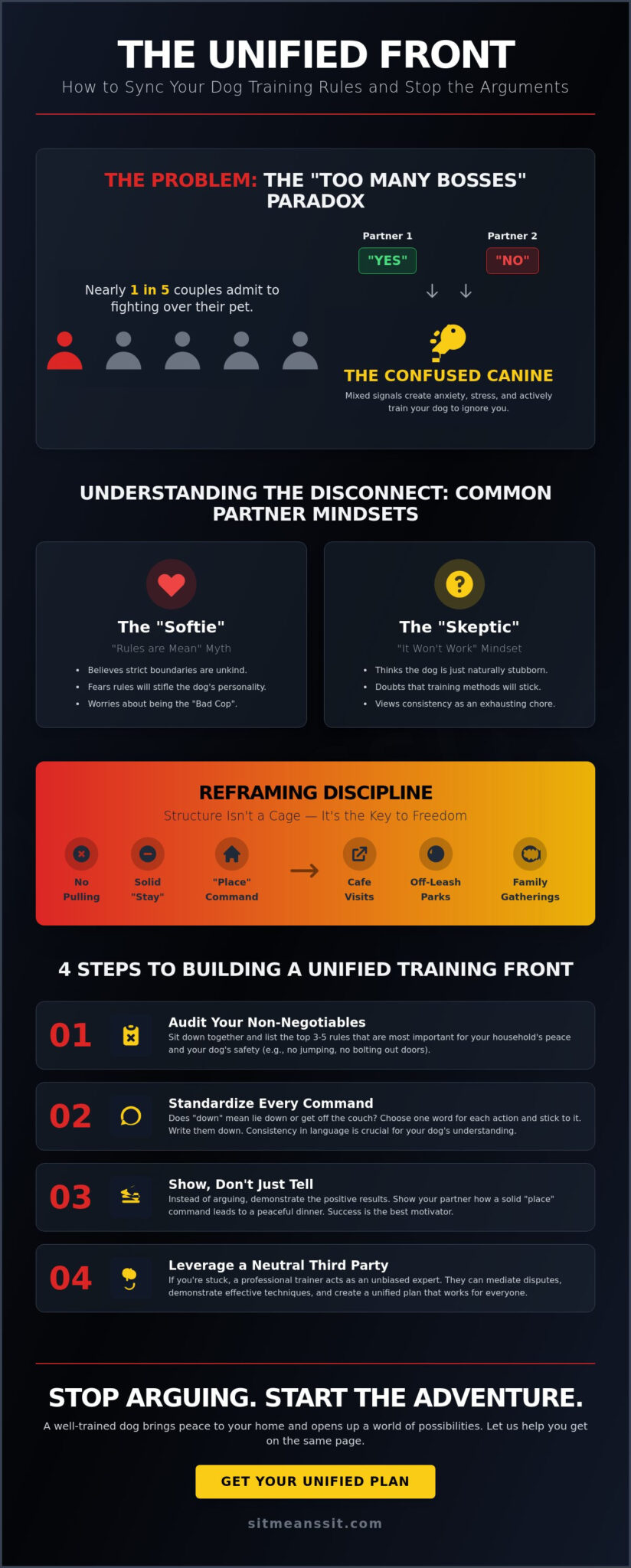
Conflict in training usually isn’t about the dog. It’s about a difference in perspective. One partner often plays the role of the “Softie,” believing that strict boundaries are mean or unnecessary. They worry that rules will stifle the dog’s personality or make them look like the “Bad Cop.” On the other side, you have the “Skeptic.” This partner might think the dog is simply stubborn by nature or that the training methods won’t stick long-term. This disconnect, often referred to as Family Sabotage, creates a cycle of confusion for the animal and resentment for the owners. Getting your spouse on board with dog training rules requires identifying these archetypes and addressing the underlying fears behind them.
The “Time Trap” and tool distrust are other major hurdles. Many spouses resist training because they feel too busy to maintain a strict regimen. They view consistency as an exhausting chore rather than a lifestyle shift. Others might feel uncomfortable using tools like a Remote Training Collar, fearing it replaces the bond with the animal. In reality, these tools provide the clarity your dog craves. Consistency actually saves time because a dog that listens the first time doesn’t need to be managed constantly. We aim to replace that frustration with pride by making the rules easy to follow. If you are struggling to find common ground, our Private Lessons provide a neutral environment to get everyone on the same page.
The ‘Rules are Mean’ Myth
Structure is not a restriction. It is a safety net. Comparing dog rules to child safety is the best way to reframe this mindset. You don’t let a child play in traffic. You shouldn’t let a dog ignore a recall command either. A dog without boundaries lives a small life. They stay home while the family goes on adventures. When you provide clear expectations, you are giving your dog the confidence to navigate the world safely. Discipline is the ultimate act of love.
Logistical Barriers to Consistency
Complicated plans fail. If your spouse has to remember a 20-step protocol for every walk, they will eventually give up. Consistency thrives on simplicity. Finding a simple way of getting your spouse on board with dog training rules is easier when you remove the guesswork. Start by picking three non-negotiable rules. Use short, punchy commands like “Sit,” “Place,” and “Heel.” Integrating these habits into your existing routine, like during feeding or TV time, removes the burden of “extra work.” When the process is easy, everyone stays committed.
Reframing Discipline: How Rules Create the Freedom Your Spouse Wants
Many owners view discipline as a set of restrictions. They think rules limit a dog’s happiness. This is the opposite of the truth. At Sit Means Sit, we believe that structure is the ultimate key to an adventurous life. When your dog has clear boundaries, they earn the right to participate in more of your world. Getting your spouse on board with dog training rules becomes much easier when you stop talking about “no” and start talking about “yes.” Instead of a dog that stays in the crate when guests arrive, you get a dog that can relax politely in the living room while you entertain. Discipline isn’t a cage; it’s a passport.
The ultimate goal for most families is total off-leash reliability. This level of mastery allows your dog to explore the world with confidence. Achieving this requires 100% consistency from every human in the house. If one person allows the dog to ignore a command, the reliability of that command disappears instantly in high-stimulation environments. By committing to a unified front, you are building the foundation for a life without leashes. Every consistent “sit” or “stay” is a deposit into a freedom fund that pays out in stress-free hikes and patio dinners. Boundaries allow for more “yes” moments because you can trust your dog to make the right choice every time.
Total Control Means More Adventures
Imagine a Saturday morning where you don’t have to leave your dog behind. You can go hiking, camping, or enjoy a local cafe without worrying about lunging or barking. This isn’t a fantasy. High-level dog obedience training opens up the world for your entire family. Show your spouse the roadmap to their “dream dog” scenario. When they see that consistent rules lead directly to more fun and fewer headaches, their motivation to stick to the plan will skyrocket. Mastery is the path to liberation.
The ‘Place’ Command as a Household Peacekeeper
The “Place” command is the most powerful tool in your training arsenal. It solves 80% of common household annoyances, from door-bolting to dinner-time begging. You aren’t just telling your dog to go to a bed. You are giving them a specific job to do that prevents them from practicing bad habits. Think of the “Place” command as the dog’s “reset button.” It provides a clear, safe boundary that helps an over-excited animal calm down. When both you and your spouse use this command consistently, your home transforms from a chaotic environment into a peaceful sanctuary.
4 Steps to Building a Unified Training Front
Transformation in your home happens when you stop debating and start executing. Building a unified front isn’t a suggestion; it’s a requirement for a well-behaved dog. Getting your spouse on board with dog training rules is easier when you treat the process like a team sport rather than a lecture. Follow these four definitive steps to align your household and see immediate results.
- Step 1: Audit the Rules. Sit down together and pick your “Top 3” non-negotiables. Don’t try to fix everything at once. Focus on the behaviors causing the most stress, like jumping on guests or bolting through the front door.
- Step 2: Standardize the Vocabulary. Pick one word for one action. If you say “Down” but your spouse says “Lay,” your dog will hesitate. Hesitation is the enemy of reliability.
- Step 3: The ‘No-Correction’ Zone. Never correct your spouse’s training technique in front of the dog. This undermines their authority and confuses the animal. Discuss adjustments in private to keep the human relationship safe and the dog’s hierarchy clear.
- Step 4: Celebrate Small Wins. Positive reinforcement isn’t just for the dog. When you see your partner maintain a boundary, acknowledge it. Pride is a powerful motivator for consistency.
If you find that the two of you are still struggling to find common ground, it’s time to take the next step. Our Group Classes offer a high-energy environment where both you and your spouse can learn to lead as a team.
Simplifying the Command Language
Confusion often starts with the words we use. For example, “Down” should always mean belly on the floor, while “Off” means removing paws from a person or counter. Pick your house words and stick to them. To prevent slips, post a “Command Cheat Sheet” in a visible area like the fridge or mudroom. This serves as a constant visual reminder for everyone in the family. Ensure your hand signals match your verbal cues perfectly. Dogs are highly visual animals; consistent physical signals provide a backup that increases total reliability in high-stimulation environments.
The 2-Minute Training Habit
You don’t need hours of free time to be consistent. Use the “commercial break” interval to practice a quick “Place” or “Stay.” Mealtime is another built-in opportunity for 100% consistency. Require a “Sit” before the bowl hits the floor every single time. This approach applies the foundational logic of puppy training classes to dogs of any age. By integrating these micro-sessions into your daily routine, getting your spouse on board with dog training rules becomes a natural part of your lifestyle rather than an extra chore. Steady practice leads to mastery.
When to Call in a Professional: The Power of a Neutral Third Party
Sometimes, despite your best efforts, the domestic deadlock remains. You’ve tried the cheat sheets and the two-minute drills, but the inconsistency persists. This is when calling in a professional becomes the smartest move for your marriage and your dog. A trainer acts as a neutral referee who removes the emotional baggage from the conversation. Instead of one spouse correcting the other, an expert provides a definitive standard of mastery. This shift removes blame from the equation and allows you both to focus on your dog’s untapped potential. Getting your spouse on board with dog training rules is much easier when the instructions come from an assertive authority figure who has seen it all.
Professional guidance replaces your frustration with a sense of empowerment. When a trainer demonstrates a technique, it isn’t a suggestion; it’s a proven methodology. This clarity helps the “Softie” partner see that structure isn’t mean and helps the “Skeptic” see that transformation is actually possible. You stop fighting about who is right and start working toward the well-behaved dog you both want. We provide the tools and the confidence to turn your home from a battlefield into a unified front.
Board and Train: The Ultimate Reset Button
This is the fastest way to break the cycle of confusion. Immersive programs remove the dog from the environment where old, inconsistent habits were formed. By choosing a Board and Train, you bypass weeks of domestic friction. Your dog returns with a rock-solid foundation of obedience that is significantly easier for a spouse to maintain. Professional immersion is faster than months of domestic arguing. It provides a clean slate for the animal and a clear roadmap for the owners. When the dog returns perfectly behaved, the motivation to keep those rules in place becomes undeniable.
Private Lessons for Hands-On Mastery
If you prefer to be part of the process every step of the way, working with a dog trainer near me is the answer. Private lessons offer a safe space for both partners to learn the “Why” behind the “How.” Understanding the mechanics of a command often changes the mindset of a partner who previously undermined the rules. We build confidence through immediate results in high-stimulation environments. This customized approach fits your specific family dynamic and ensures everyone is speaking the same language. Leadership is a skill you can master together. Take the first step toward a more adventurous and joyful life today.
Start Your Journey Toward a Unified Home
Consistency is the bridge between a chaotic household and a life of off-leash adventure. You now have the tools to audit your rules, simplify your command language, and build a partnership based on mastery. Getting your spouse on board with dog training rules is the most important investment you can make for your pet’s well-being and your own peace of mind. Stop the guessing games and start leading your pack with absolute confidence.
If you’re ready for a professional reset, we’re here to help. Since 1998, we’ve been the dominant experts in off-leash control, delivering proven results for all breeds and ages across our 150+ locations nationwide. We replace frustration with pride by providing the reliable structure your dog craves. You don’t have to navigate this alone; let us provide the expertise your family deserves.
Ready to get everyone on the same page? Schedule your FREE Sit Means Sit consultation today!
Your dream of a perfectly behaved dog is within reach. Take the lead today and start enjoying the adventurous, joyful life you and your dog were meant to share.
Frequently Asked Questions
What do I do if my spouse refuses to follow the dog training rules?
Stop the domestic arguments and bring in a professional trainer to act as a neutral referee. Often, a spouse who resists your instructions will respect the authority of an expert who demonstrates immediate, visible results. A professional removes the emotional friction from the conversation and sets a definitive standard for the entire household. This shift allows you both to focus on the dog’s progress rather than each other’s mistakes.
Is it okay if my dog only listens to one person in the house?
No, because this creates a significant safety risk and limits your dog’s freedom. A dog that only responds to one handler is only partially trained and cannot be trusted in high-stimulation environments when that person is absent. True reliability requires that every family member can give a command and expect an immediate response. This ensures the dog remains safe and well-behaved regardless of who is holding the leash.
How can I explain the importance of consistency to my partner without arguing?
Frame the conversation around the dog’s mental well-being rather than your partner’s actions. Explain that inconsistent rules cause the dog genuine anxiety because they never know which behavior will earn a reward or a correction. Focus on the fact that getting your spouse on board with dog training rules is the fastest way to earn the off-leash freedom you both want for your pet. Structure is the highest form of kindness.
Can a dog still be trained if only one person is doing the work?
A dog can learn specific commands from one person, but they will not generalize that obedience to the rest of the family. If you train the dog while your spouse ignores the rules, the dog simply learns who they can manipulate. You might see progress during your individual sessions, but the dog’s overall reliability in the home will remain low. Real transformation requires a unified front from everyone in the household.
What are the most important rules for a couple to agree on first?
Agree on safety-critical boundaries like door-bolting prevention, leash manners, and the “Place” command. These non-negotiables solve the most stressful household behaviors and provide immediate relief for both owners. Once you master these foundational rules, you can expand your training to more advanced skills. Starting with a small, shared list of priorities makes the process feel manageable rather than overwhelming for a busy couple.
How do I handle it when my spouse lets the dog on the couch but I don’t?
You must decide on a single, definitive rule for all furniture and stick to it without exception. Dogs are literal thinkers and do not understand the concept of “sometimes” or “only with Dad.” This specific inconsistency is a primary cause of confusion and boundary-pushing. Pick one side of the debate and ensure every human in the house enforces the same boundary every single time the dog approaches the furniture.
Will a Board and Train program help my spouse stay consistent?
Yes, because getting your spouse on board with dog training rules is much easier when the dog returns with a rock-solid foundation. Seeing a perfectly behaved dog first-hand provides the “buy-in” that a skeptical partner needs to stay committed. It removes the initial struggle of teaching new behaviors and shifts the spouse’s role to simple maintenance. Professional immersion provides the “reset button” many high-conflict households need to succeed.
What is the best way to introduce new training tools to a skeptical partner?
Demonstrate how the tool provides clarity and safety for the dog rather than just control for the human. Show them how a Remote Training Collar acts as an invisible safety line, allowing the dog to enjoy more off-leash time with total reliability. When a partner sees the dog respond happily and confidently to a tool, their skepticism usually vanishes. Let the results speak for themselves in a controlled, professional environment.
Comments are closed.