

What if the tool you’ve been avoiding is actually the key to the adventurous, off-leash life you’ve always wanted? You know the physical strain of a dog that pulls constantly or the sharp spike of fear when they lunge toward traffic. It’s frustrating to feel embarrassed in public while your pet ignores your voice. You deserve a dog that remains calm and focused even in the most high-distraction environments.
We agree that your current struggle is exhausting, but it doesn’t have to stay this way. This guide breaks down the e-collar vs prong collar for difficult dogs debate to help you gain total control over even the most challenging behaviors. You’ll learn how to replace your daily frustration with a sense of empowerment and pride. We’re going to compare the mechanics, the reliability, and the lifestyle transformations each tool offers so you can make a decisive choice for your pet’s future.
Key Takeaways
- Understand why standard collars trigger the opposition reflex and how this biological response actually encourages difficult dogs to pull harder against you.
- Discover the universal language of Pressure and Release to establish clear, stress-free communication with your pet in any environment.
- Compare the specific benefits of an e-collar vs prong collar for difficult dogs to determine which tool provides the best safety and off-leash reliability.
- Learn why professional guidance is essential to avoid common DIY mistakes that can lead to increased fear or aggression in sensitive pets.
- Master the Sit Means Sit methodology to transform reactive behaviors into total engagement and a stronger bond through focused, professional training.
The Struggle with Difficult Dogs: Why Standard Collars Often Fail
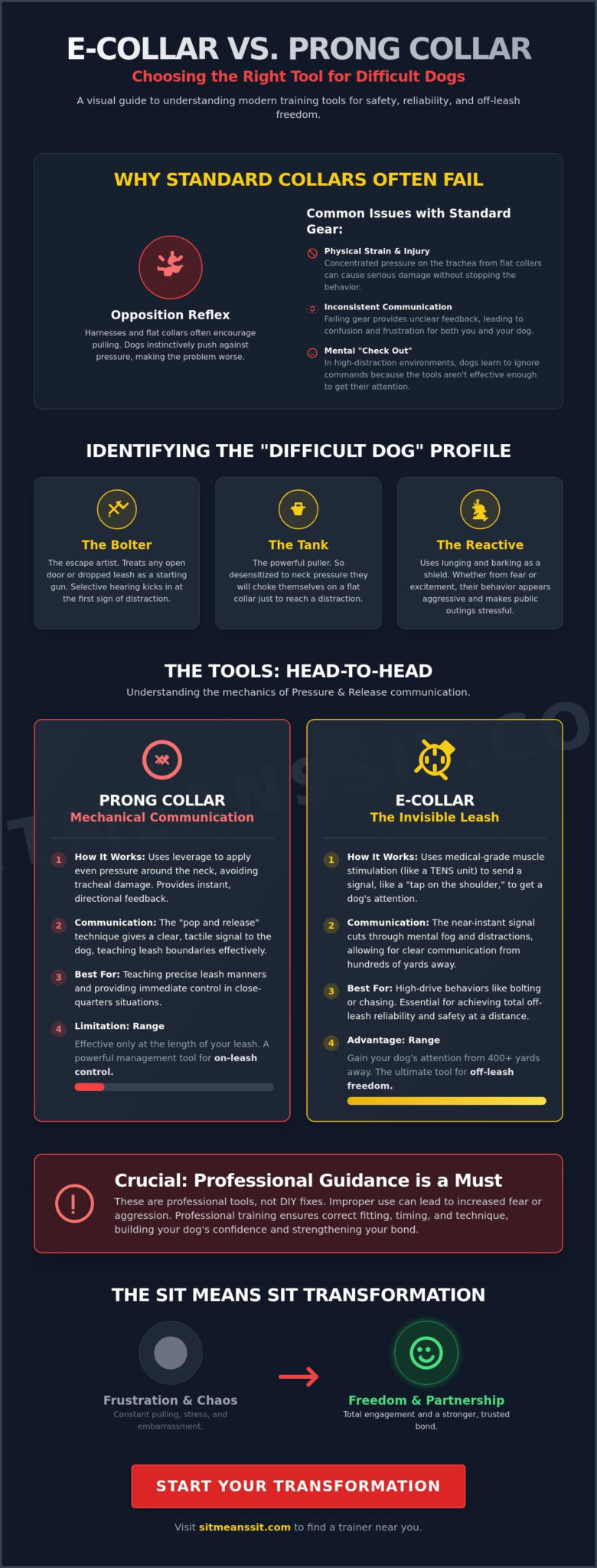
Stop settling for walks that leave you exhausted and embarrassed. Managing a difficult dog feels like a constant battle of wills. It’s the dog that ignores your voice the moment a squirrel appears or the one that drags you down the sidewalk like a sled. When we define difficult dogs, we aren’t just talking about a lack of manners. We’re talking about high-stakes behaviors like extreme reactivity, bolting into traffic, and a prey drive that overrides every command. In these high-pressure moments, the choice between an e-collar vs prong collar for difficult dogs becomes a matter of safety and sanity. Standard equipment simply isn’t designed to handle the intensity of a dog that has checked out mentally.
Identifying the ‘Difficult’ Dog Profile
Every challenging dog has a unique way of testing your boundaries. The ‘Bolter’ is the escape artist who treats every open door or dropped leash as a starting gun. They have selective hearing that kicks in the second they see a distraction. Then there’s the ‘Tank,’ the powerful puller who has developed a literal thick skin. These dogs are so desensitized to neck pressure that they’ll choke themselves on a flat collar just to reach a bird. Finally, the ‘Reactive’ dog uses lunging and barking as a shield. Whether it’s fear or over-excitement, their behavior looks aggressive. It makes every public outing a stressful ordeal for everyone involved.
The Limits of Flat Collars and Harnesses
Most owners start with a harness, thinking it’s the gentler choice. In reality, harnesses often trigger the opposition reflex. This is a natural physical response where a dog instinctively pushes back against pressure. If you pull back, they pull forward harder. For high-drive breeds, a harness is essentially an invitation to pull you across the neighborhood. Flat collars aren’t much better for powerful dogs. They put concentrated pressure on the trachea. This can lead to serious injury without actually stopping the behavior. Choke chains often provide inconsistent corrections that confuse the animal rather than teaching them.
Inconsistent communication is the real enemy. When your gear fails to provide clear feedback, your dog stays in a state of confusion. This frustration builds on both ends of the leash. The goal must shift from physical restraint to mental engagement. You need a tool that speaks the dog’s language. Understanding how e-collars work or how a prong collar distributes pressure is the first step toward reclaiming your freedom. We want to move away from holding on for dear life and toward a calm, focused partnership. Choosing the right tool for the job is how you finally stop managing the chaos and start enjoying your dog again.
Understanding the Tools: How Prong and E-Collars Actually Work
Effective training relies on a universal language: pressure and release. Think of these tools as volume knobs for your communication. They aren’t on/off switches for pain. Instead, they provide the clarity your dog needs to make the right choice in a high-distraction environment. When deciding between an e-collar vs prong collar for difficult dogs, you must understand the underlying mechanics of each. Mastery comes from knowing how to dial that communication up or down based on your dog’s focus and the surrounding environment.
The Prong Collar: Mechanical Communication
The prong collar is a mechanical tool. It uses leverage to provide instant, directional feedback. Unlike a flat collar that puts dangerous pressure on the throat, a properly fitted prong collar distributes pressure evenly around the entire neck. This design prevents tracheal damage while ensuring the dog feels the command clearly. The “pop and release” technique is the core of this tool’s effectiveness. It tells the dog exactly when they’ve reached the limit of the leash. It is a tactile tool that excels at teaching leash manners, but remember that its influence is limited by the physical length of your lead. You remain tethered to the dog, making it a management tool for close-range control.
The E-Collar: The Invisible Leash
The e-collar acts as a sophisticated invisible leash. Modern professional units use medical-grade muscle stimulation, similar to a TENS machine used in human physical therapy. This technology is a far cry from the outdated “shocks” of the past. It feels like a rhythmic tap on the shoulder, designed to cut through mental fog. You can gain your dog’s attention from 400 yards away or more, providing total off-leash reliability. Timing is everything in training. An electronic signal reaches your dog faster than a physical leash correction ever could. This speed is vital when managing high-drive behaviors like bolting or chasing prey.
While some research on training methods suggests that reward-based systems are the primary standard, professional trainers use these tools to layer clarity onto existing commands. They provide the definitive “stop” signal that treats alone sometimes cannot. These tools don’t replace your bond; they strengthen it by removing confusion. If you want to see how these tools look in professional hands, consider booking one of our private lessons for personalized guidance. We focus on transformation through precision, ensuring you and your pet speak the same language every single day.
E-Collar vs. Prong Collar: Which Is Right for Your Dog?
Choosing between an e-collar vs prong collar for difficult dogs isn’t about picking a side in a debate. It’s about matching the right tool to your dog’s unique personality and your lifestyle goals. Many owners think they have to choose one or the other for the life of the dog. We see these tools as a progression. You might start with physical leverage to gain control and graduate to electronic precision for total freedom. The goal is always a calm, focused pet that respects your boundaries because they understand them clearly.
When the Prong Collar Wins
If you’re currently struggling to keep your feet on the ground during walks, the prong collar is a game changer. It provides the immediate physical leverage required to manage heavy pullers in high-traffic urban environments. This tool is excellent for dogs that “shut down” or become confused by electronic stimulation initially. The tactile sensation is easy for them to process. It provides a clear physical anchor to your presence. It is a fantastic entry point for owners needing better physical control during dog obedience training. You gain the confidence to walk your dog without the fear of being pulled into the street.
When the E-Collar Is Superior
The e-collar is the “holy grail” for owners who dream of 100% off-leash recall. It solves the specific struggle of “leash reactivity” where a dog feels frustrated or trapped by a physical tether. Without that leash tension, many dogs actually become more relaxed and attentive. This tool allows you to refine commands without the constant “nagging” of a physical lead. You can communicate with total precision from across a football field or a hiking trail. It replaces physical restraint with mental engagement, which is the key to a truly reliable pet.
We understand the weight of this decision. Organizations have shared concerns, such as the AVSAB Position Statement on Punishment, which highlights why professional instruction is vital. At Sit Means Sit, we prioritize our Remote Training Collar because it offers the ultimate lifestyle change. While a prong collar manages behavior, the e-collar transforms it. We want to move you past the “management” phase and into a life of adventure. Discipline isn’t a restriction; it’s the key to a more joyful life for both you and your pet. Stop managing the chaos and start leading with absolute confidence.
Safety, Myths, and the Importance of Professional Guidance
“Is this hurting my dog?” This is the most common question we hear from stressed owners. It’s a natural concern for any loving pet parent. When comparing an e-collar vs prong collar for difficult dogs, safety must be your top priority. These tools are designed for communication, not punishment. A modern e-collar feels like a cell phone vibration or a TENS unit. It’s a rhythmic pulse that gains attention without causing distress. Similarly, a properly fitted prong collar uses flat tips to distribute pressure safely around the neck. It protects the sensitive trachea while providing clear, tactile feedback.
Finding the “working level” is a critical part of the Sit Means Sit process. We never start at a high setting and hope for the best. Instead, we begin at the lowest possible level and gradually increase it until the dog barely notices the signal. It might look like a slight ear twitch or a tilt of the head. This is the sweet spot where learning happens. It’s about whispering to your dog so they don’t have to listen to you scream. Precision matters when you’re dealing with high-stakes behaviors.
Debunking the ‘Pain’ Myth
Difficult dogs often live in a state of high anxiety because they don’t understand what’s expected of them. Providing clear, consistent boundaries through these tools actually makes them calmer. You’re removing the conflict from the leash and replacing it with a definitive agreement. The psychological benefit is massive. When a dog knows exactly how to succeed, their stress levels drop. They stop reacting to the world and start focusing on you. This transformation replaces their frustration with a sense of security and pride.
Why Professional Instruction Is Key
Improper tool use can backfire. Poor timing or accidental corrections can confuse a dog or even exacerbate fear. This is why working with a professional dog behaviorist is non-negotiable for challenging cases. We tailor every session to your pet’s specific temperament. There is no one-size-fits-all approach to mastery. For owners who need a total behavioral reset, our board and train programs offer an immersive experience that builds a rock-solid foundation in a controlled environment.
Don’t leave your dog’s safety to chance with unverified YouTube tutorials. Real results require expert hands and a proven methodology. Ready to see the results for yourself? Find a Sit Means Sit location near you and let us show you the path to a liberated, adventurous life with your pet.
Total Transformation: The Sit Means Sit Methodology
You’ve survived the lunging, the barking, and the constant stress of an unpredictable dog. It’s time to stop just “getting through” your walks. The debate over the e-collar vs prong collar for difficult dogs usually ends with a simple choice of equipment, but we offer a complete lifestyle change. Our methodology isn’t about suppression or fear. It’s about engagement. We replace your daily frustration with a sense of empowerment and pride. We don’t just stop bad behaviors; we build a dog that is excited to listen to you.
Our philosophy focuses on the emotional state of your pet. A dog that understands its boundaries is a dog that feels secure. We move beyond simple physical management and enter the world of mental connection. This shift transforms your pet from a liability into a companion you can take anywhere. We want you to feel the thrill of total control in high-stimulation environments. This is the liberation that comes through structure.
Our Remote Training Collar: A Different Breed of Tool
The Sit Means Sit Remote Training Collar is a precision communication device. Unlike generic tools found in big-box stores, our hardware allows for micro-adjustments tailored to your dog’s specific sensitivity. We focus on low-level communication that keeps your pet happy and working. Think of it as a gentle tap on the shoulder that cuts through the noise of a busy park. This clarity removes the conflict from your relationship and replaces it with a definitive agreement. Our Remote Training Collar serves as the definitive bridge to a joyful, off-leash life where boundaries create freedom.
Attention is the currency of effective training. If you don’t have your dog’s focus, you don’t have their heart. Our methodology works regardless of your dog’s breed, age, or behavioral history. We specialize in the difficult cases that others might turn away. Whether your pet has a high prey drive or intense reactivity, the “Attention” principle remains the same. We teach your dog how to tune out the world and tune into you. This universal applicability is why our programs deliver such reliable results.
From Frustration to Freedom
Visualize a walk where your dog focuses on you even when a cat streaks across your path. You feel a surge of confidence because you know your dog will return every single time you call. This isn’t a dream; it’s the standard for our clients. You deserve a bond that is built on trust and clear expectations rather than physical strength. Stop managing the problem and start living the adventurous life you’ve always wanted for you and your pet. Take the first step toward a total transformation and Contact a Sit Means Sit professional today to see our method in action.
Take the Lead Toward Your Dog’s Freedom
You now have the clarity to move past the frustration of reactive behavior and physical strain. We’ve explored how standard gear often triggers the opposition reflex and why understanding the e-collar vs prong collar for difficult dogs is the first step toward a total behavioral reset. Whether you need the mechanical leverage of a prong collar for urban walks or the long-range precision of a remote signal, the goal remains the same. You want a focused, happy dog that respects your boundaries. Discipline isn’t a cage; it’s the key to a more adventurous life together.
At Sit Means Sit, we bring over 25 years of specialized behavioral experience to every session. Our proprietary Remote Training Collar technology has created thousands of off-leash success stories nationwide. We replace your embarrassment with empowerment by building a bond based on clear, consistent communication. You don’t have to settle for chaos when total off-leash reliability is within reach.
Ready to transform your difficult dog? Find a Sit Means Sit trainer near you!
Your journey to a stress-free life with your pet starts today. Trust your instincts, choose professional mastery, and get ready to enjoy the joyful, liberated partnership you both deserve.
Frequently Asked Questions
Is an e-collar the same as a shock collar?
No, modern e-collars are not the “shock” devices of the past. Professional tools use TENS technology, which is the same medical-grade muscle stimulation used in human physical therapy. This creates a rhythmic pulse or “tap” that gains your dog’s attention without causing distress. It is a communication device designed to cut through mental fog, not a punishment tool meant to cause pain.
Can a prong collar damage my dog’s neck or throat?
A properly fitted prong collar is actually safer for strong pullers than a standard flat collar. It distributes pressure evenly around the entire circumference of the neck rather than concentrating force on the sensitive trachea. This prevents the choking and gagging often seen with flat collars or slip leads. You must ensure the prongs are blunt and the collar sits high on the neck for maximum safety and effectiveness.
Which is better for an aggressive dog: a prong or an e-collar?
The choice between an e-collar vs prong collar for difficult dogs with aggressive tendencies depends on the specific trigger and environment. A prong collar provides immediate physical feedback that can redirect a lunging dog at close range. An e-collar allows you to communicate with precision before the dog even reaches its threshold. We often use both tools in tandem to provide the most comprehensive behavioral reset for reactive pets.
How old does my dog have to be to start using a training collar?
Puppies should generally be at least four to six months old before you introduce specialized training collars. They need to have a basic understanding of commands and a solid foundation of engagement first. We recommend starting with our Puppy Preschool to build those early bonds. Once your dog is mature enough to handle formal structure, we can transition them to more advanced tools for total reliability.
Will my dog always have to wear the collar to listen?
The goal of our methodology is to build a dog that listens because they understand the expectation, not because they are wearing gear. The collar is a teaching tool used to establish muscle memory and clear communication. Once your pet is reliable in high-distraction environments, you’ll find you need the tool less and less. Eventually, the “invisible leash” becomes a permanent part of their behavior regardless of what they are wearing.
Can I use an e-collar and a prong collar together?
Yes, using these tools together is a common and effective strategy for total transformation. The prong collar manages the physical “pull” on the leash while the e-collar handles the mental engagement and off-leash recall. This combination provides a layered approach to e-collar vs prong collar for difficult dogs, giving you the best of both worlds. It ensures you have total control whether your dog is at your side or 100 yards away.
What happens if my dog ignores the e-collar stimulation?
If your dog ignores the signal, it usually means the stimulation level is too low for the current environment. High-distraction areas like a busy park require a higher “volume” than your quiet living room. You must find the working level that matches your dog’s current state of mind. Our trainers teach you how to adjust these levels in real-time so your dog never loses focus on your commands.
How do I know if I’m using the ‘right’ level on a difficult dog?
You’ve found the right level when your dog shows a subtle physical sign of acknowledgment. Look for an ear flick, a head tilt, or a sudden change in their eye contact toward you. This indicates they feel the “tap” but are not overwhelmed or distressed. Finding this sweet spot is the key to stress-free learning. It ensures your dog remains happy and motivated while respecting the boundaries you’ve set.
Comments are closed.