
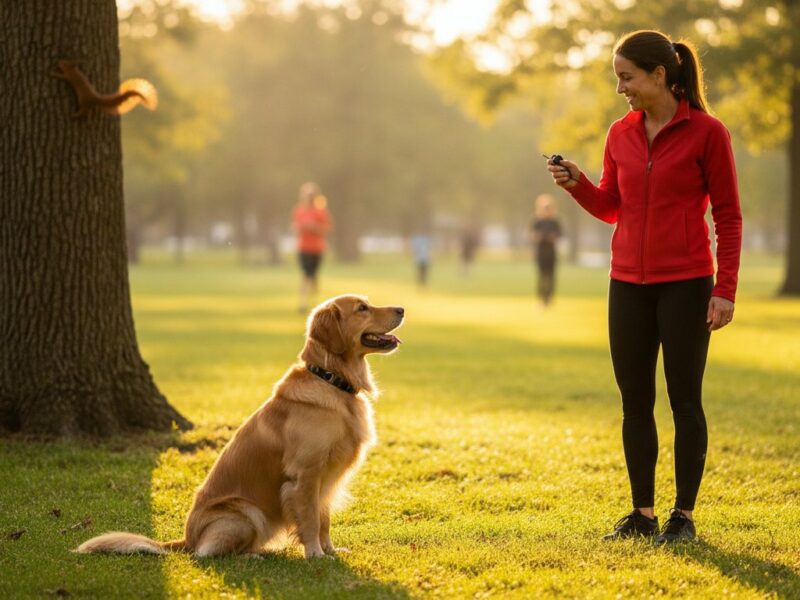
Stop competing with the environment and start winning. If your dog ignores you the moment a squirrel appears, it isn’t because they’re stubborn; it’s because you haven’t become the most valuable asset in their world yet. You aren’t alone in this struggle. In fact, 61% of dog owners seek professional help specifically to handle obedience issues like these. It’s exhausting to feel ignored, and it’s even worse to worry about your dog’s safety when they bolt toward a distraction. You want a partner, not a project.
Building engagement with a distracted dog is the secret to total liberation for both of you. We’re going to replace your frustration with absolute confidence. You’ll learn the professional techniques used to transform a scattered pet into a dedicated partner who chooses you over the environment every time. This isn’t about bribes or temporary fixes. It’s about structure, mastery, and a deep bond. We’ll explore how to achieve voluntary check-ins and stress-free walks, ensuring your dog stays focused on you no matter what the world throws your way. Get ready to claim the adventurous, joyful life you and your dog deserve.
Key Takeaways
- Master the “Value Gap” by learning how to make yourself more rewarding than any environmental distraction.
- Shift from bribing to rewarding by turning training into a high-stakes game your dog actually wants to win.
- Implement a proven five-step system for building engagement with a distracted dog, starting in neutral zones before conquering high-stimulation environments.
- Stop the “command nagging” cycle and prevent mental fatigue to keep your dog sharp and responsive every time you speak.
- Learn why professional intervention like a Board and Train program is the key to breaking through plateaus and achieving total reliability.
What Is Engagement and Why Does Your Dog Lose It?
Engagement isn’t a suggestion. It’s a definitive agreement between you and your dog. When we talk about building engagement with a distracted dog, we’re describing a state where your pet actively chooses to prioritize you over everything else. It isn’t about pulling on a leash or shouting a name. It’s about a dog that looks at the world and decides you are the most interesting thing in it. Real engagement is a voluntary connection, not a forced behavior. Building engagement with a distracted dog requires you to stop being a spectator and start being the center of their universe.
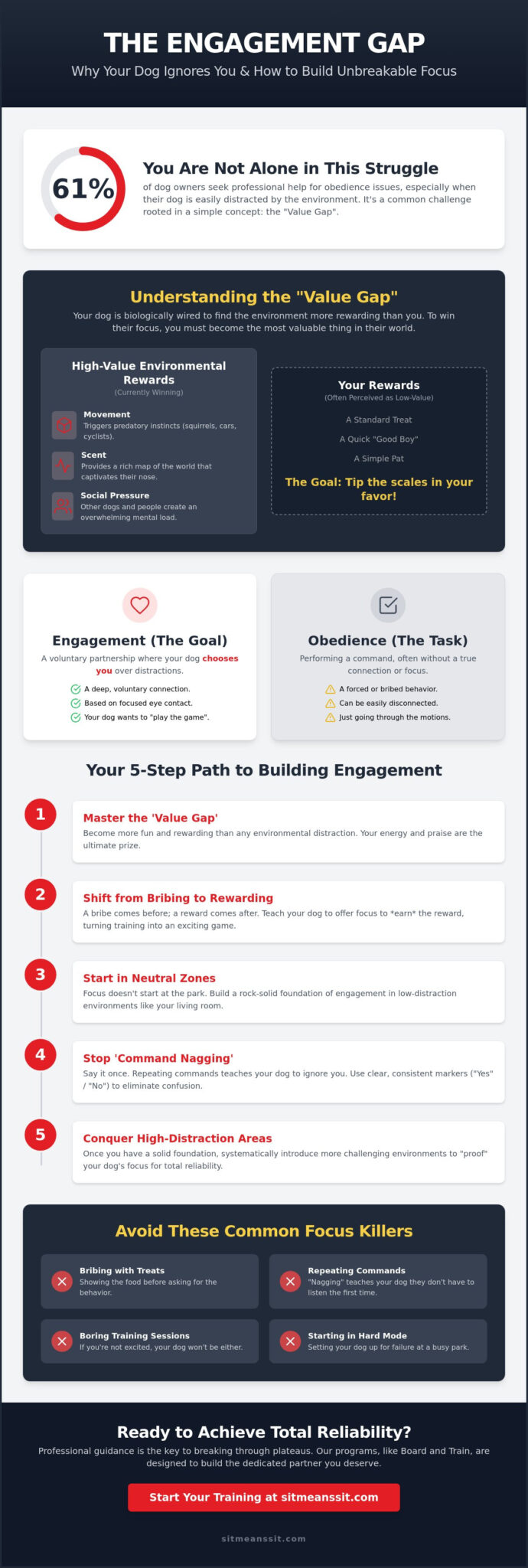
Most owners fail because they don’t understand the “Value Gap.” This is the biological reality that a squirrel, a bird, or a passing cyclist is inherently more rewarding than a standard treat. Your dog is a predator. Movement and scent trigger deep, instinctual drives that provide an immediate internal reward. To win their focus, you must prove that interacting with you provides a higher “paycheck” than the environment. If you don’t bridge this gap, you’ll always be second best to a blade of grass.
You’re fighting three main triggers every time you step outside: movement, scent, and social pressure. Movement captures their predatory sight. Scent provides a complex map of the neighborhood. Social pressure from other dogs or people creates a mental load that can feel overwhelming. If you don’t have a strategy to handle these factors, your voice becomes nothing more than white noise.
The Biology of Distraction
Distraction is driven by dopamine. This chemical is the fuel for your dog’s search for rewards. When they catch a scent or see a rabbit, their brain rewards them just for looking. If the stimulation gets too high, the “learning” part of the brain actually shuts down. This leads us to the concept of threshold. A threshold is the specific distance or intensity at which a dog becomes so emotionally overwhelmed that they can no longer process your instructions. If your dog is over threshold, they aren’t being stubborn. They’re biologically incapable of listening to you.
Engagement vs. Obedience
Don’t mistake a “sit” for a connection. Obedience is the ability to perform a task on cue. Engagement is the desire to stay in the game with you. You can have a dog that knows twenty tricks but refuses to look at you in a park. Because of the high level of canine intelligence found in modern pets, they can easily learn to go through the motions without actually connecting. Eye contact is the foundation of everything we do. It’s the signal that the communication channel is open and your dog is ready for the next move.
The Mechanics of Focus: Building Value in the Owner
Stop being a vending machine and start being a leader. If you have to show your dog a treat to get them to sit, you aren’t training; you’re negotiating. Building engagement with a distracted dog requires a fundamental shift from “bribing” to “rewarding.” A bribe is offered before the behavior to entice the dog. A reward is delivered after the dog makes the active choice to focus on you. When you wait for that choice, you build a dog that looks for opportunities to please you rather than a dog that only works when the price is right.
You need to turn training into “The Game.” This should be the most high-energy, exciting part of your dog’s entire day. If you’re bored, your dog is bored. Use clear markers like a sharp “Yes” to pinpoint the exact second they get it right. Use a calm “No” to communicate when they’ve missed the mark. This clarity removes frustration. Understanding how dogs learn through these social cues and clear boundaries is the first step toward a reliable partnership. When the rules are consistent, your dog feels safe and empowered to engage.
Focus doesn’t start at the park; it starts in your living room. If your dog can ignore you in the kitchen, they’ll definitely ignore you when a squirrel runs by. Establish structure in the home through clear boundaries and consistent expectations. This creates a baseline of respect that carries over into high-stimulation environments. If you want to see immediate progress, consider booking private lessons to refine your handling skills and sharpen your dog’s response time.
Breaking the Bribe Cycle
Hide the food. Keep your rewards in a pouch or your pocket where they’re out of sight. You want your dog to focus on your face, not your hand. Transition quickly to a variable reinforcement schedule. This means you don’t reward every single rep; you reward the best ones. This creates a “gambler’s effect” where the dog works harder because they never know when the big jackpot is coming. You can also use environmental rewards. If your dog gives you focus, reward them by releasing them to go sniff that interesting tree. You’re teaching them that engagement is the key that unlocks the world.
Communication Clarity with the Remote Training Collar
Sometimes, the mental fog of a high-distraction environment is too thick for a voice command to penetrate. A Remote Training Collar acts as a physical “tap on the shoulder” that cuts through the noise. It isn’t a punishment device. It’s a precise communication tool that uses low-level stimulation to get your dog’s attention back on you. It provides a consistent, neutral signal that doesn’t carry the emotion or frustration a human voice might. This technology allows you to maintain a connection even when your dog is off-leash, giving them the freedom they crave while ensuring they remain safely under your command.
5 Steps to Build Engagement in High-Distraction Areas
Transitioning from your quiet kitchen to a bustling city sidewalk is the ultimate test of your leadership. Most owners fail because they throw their dogs into the deep end without a life jacket. Building engagement with a distracted dog is a progressive process that requires a solid ladder of success. We follow the Sit Means Sit philosophy: Command, Action, Praise. This clear, three-part agreement ensures your dog always knows what is expected and exactly when they’ve succeeded. It replaces confusion with certainty.
You must start with the “Check-In” drill. This is the foundation of voluntary engagement. Every time your dog looks at you without being asked, reward them immediately. You’re teaching them that checking in with you is the most profitable decision they can make. Once they are consistently looking for you in quiet areas, you can begin to increase the environmental pressure. If you skip this step, you’ll be fighting an uphill battle against every squirrel and cyclist you encounter.
Step 1 & 2: Mastering the Living Room
Success starts in a vacuum. Begin your training in a neutral, zero-distraction environment like your living room or hallway. Build the “Focus” command here until it is lightning-fast. Once your dog is locked in, introduce artificial distractions. Have a family member walk by or roll a tennis ball across the floor. Your dog must learn to maintain eye contact despite these controlled interruptions. Remember; five minutes of focused work beats an hour of distracted walking. Quality always trumps quantity when you are building a dedicated partner.
Step 3, 4 & 5: Moving to the Real World
The “Driveway Test” is your bridge to the outdoors. Open the front door and practice your engagement drills right on the threshold. If your dog can’t focus on the driveway, they won’t focus at the park. If a command is “blown” because a distraction wins, don’t nag. Reset the dog, close the distance to the distraction, and try again at a level where they can succeed. For those looking to proof these skills around other animals, Puppy Training Classes provide the perfect controlled environment to practice focus under social pressure. Gradually move to busy streets and parks only when your dog proves they can choose you every single time.
Common Mistakes That Kill Your Dog’s Focus
Your dog isn’t the only one who needs to stay focused during training. Most owners unknowingly sabotage their own progress by falling into predictable traps. When you’re building engagement with a distracted dog, your consistency is the anchor. If you’re sloppy with your signals or timing, your dog will naturally look elsewhere for clarity. Stop guessing and start leading. Avoiding these common errors will immediately sharpen your dog’s response and save you months of frustration.
One of the biggest focus killers is training for too long. Dogs are not machines; they have a finite amount of mental energy. If you push a session to thirty minutes, your dog will likely check out long before you’re done. This teaches them that ignoring you is a valid way to end the session. Always end on a high note while they’re still winning. Five minutes of intense, high-energy engagement is worth more than an hour of distracted wandering. Keep it short, keep it punchy, and keep them wanting more.
The ‘Broken Record’ Syndrome
Stop repeating yourself. If you say “Sit, Sit, Sit,” you are literally training your dog to ignore you until the third time. This “nagging” effect is a direct result of not following through on the first command. We operate on the principle of “One Command, One Result.” If you give a command, you must ensure the action happens immediately. If your dog has already checked out mentally, don’t just keep shouting their name. Move closer, reduce the distraction, or use a gentle physical prompt to bring their focus back to the task at hand. You want a partner who listens the first time, every time.
Inconsistent Boundaries
Confusion is the enemy of engagement. If you allow your dog to pull on the leash during a “casual” walk but expect total focus during a “training” walk, you’re sending mixed signals. “Sometimes” rules create “all the time” confusion. Every interaction is a training opportunity. If the rules change based on who is holding the leash or what mood you’re in, your dog will stop trying to figure out the puzzle. This is why consistency between family members is non-negotiable. If you’re struggling to identify where the communication is breaking down, professional Private Lessons can help pinpoint owner-side errors that are holding your dog back.
Stop setting your dog up to fail by moving too fast. If they haven’t mastered focus in the driveway, don’t expect it at the farmer’s market. Master the basics before you increase the pressure. If you’re ready to stop the cycle of frustration and see real results, schedule a session with a pro trainer today and get your dog’s focus back on track.
Achieving Total Reliability: The Professional Advantage
You’ve done the work at home. You’ve practiced in the living room and mastered the driveway. But for many owners, progress eventually hits a wall. This plateau happens because the environment always has a vote. Building engagement with a distracted dog in a vacuum is one thing; doing it in the middle of a crowded festival or a busy park is another. Professional intervention breaks through these barriers by applying expert-level pressure in a controlled, safe way. We don’t just wait for distractions to happen. We create them, manage them, and teach your dog how to win despite them. This is how you move from “sometimes” obedience to total reliability.
Professional trainers have the tools and experience to simulate high-pressure environments that are difficult to find on your own. We use social pressure, controlled movement, and specific environmental triggers to proof your dog’s focus. This process ensures that your dog isn’t just listening to you because it’s quiet. They’re listening because they’ve learned that your command is the only thing that matters, regardless of what’s happening around them. We take the guesswork out of the equation and replace it with a proven system of success.
Immersive Learning for Faster Results
Speed matters when your safety and sanity are on the line. A Board and Train program offers an immersive environment where every single second is an opportunity for engagement. Instead of a few minutes of practice after a long day at work, your dog lives within a 24/7 structure designed to build focus. This constant reinforcement accelerates the learning process. Our experts build a bulletproof foundation, then we transition those skills directly to you. You aren’t just getting a trained dog. You’re gaining a new, clear way of communicating that works in the real world.
Your Path to Freedom and Adventure
Imagine a life without the constant tension of a tight leash. Picture yourself hiking a trail or visiting an outdoor cafe with a dog that checks in voluntarily and ignores every distraction. This isn’t a dream; it’s the result of discipline and clear boundaries. Total off-leash control gives you peace of mind and gives your dog the liberation they deserve. Structure isn’t a cage. It is the key to a more adventurous and joyful life for both of you. Don’t settle for a dog that only listens when it’s convenient. Contact Sit Means Sit today for a free consultation and see the difference in person.
Claim Your Life of Adventure Today
You now have the blueprint for a transformed relationship. Real focus isn’t a result of luck; it’s the product of consistent structure and clear communication. Building engagement with a distracted dog is the definitive path to a life without limits. You’ve learned that true connection comes from earning your dog’s voluntary attention rather than relying on temporary bribes. By closing the value gap and mastering the mechanics of focus, you’re setting the stage for total reliability in any environment.
We’re here to ensure your success. Sit Means Sit brings over 25 years of expertise in achieving total off-leash control for families just like yours. Our specialized Remote Training Collar methodology and results-oriented Board and Train programs provide the immersive experience needed for a permanent transformation. Stop settling for frustration and start enjoying the freedom of a perfectly behaved companion. Your journey toward mastery starts right now.
Schedule Your Free Consultation for Professional Dog Training Today!
Believe in the process. Your dog is capable of greatness, and you’re the leader who will get them there. Let’s get to work and create the adventurous, joyful life you both deserve.
Frequently Asked Questions
How long does it take to build engagement with a very distracted dog?
You can see a significant shift in focus within just a few days of starting a structured program. While every dog is different, building engagement with a distracted dog to the point of total off-leash reliability typically takes several weeks of consistent practice. The speed of your results depends entirely on your commitment to the rules and your ability to maintain clear boundaries during every interaction.
Can an older dog learn to be engaged, or is it only for puppies?
Dogs of any age can master total focus. While puppies are blank slates, older dogs are often more than capable of learning new ways to interact with their owners. You aren’t just teaching a command; you’re changing a lifestyle. We’ve successfully transformed senior dogs who had years of bad habits into dedicated partners who choose their owners over the environment every single time.
Is the Remote Training Collar safe for dogs that are anxious or easily distracted?
Yes, the Remote Training Collar is an incredibly safe and effective communication tool when used correctly. It provides a neutral, consistent signal that acts like a tap on the shoulder. For an anxious or distracted dog, this clear communication actually reduces stress. It cuts through the mental fog of overstimulation and gives the dog a definitive guide on how to win the game of training.
What should I do if my dog completely ignores me when they see another dog?
Increase your distance immediately. If your dog is ignoring you, they’ve crossed their threshold and are no longer in a learning state. Move back until you can regain their attention, then reward the choice to check in with you. Building engagement with a distracted dog in these high-pressure moments requires you to be proactive rather than reactive. Don’t wait for the blow-up; manage the environment first.
Why does my dog listen perfectly at home but not at the park?
Your dog hasn’t learned to generalize their training yet. The park has a much higher environmental value than your living room. To your dog, a “sit” at home is a completely different task than a “sit” while three other dogs are running nearby. You must proof your commands in varied environments with increasing levels of stimulation to achieve total reliability everywhere you go.
Do I need to carry treats with me forever to keep my dog’s attention?
No, you will not be a vending machine for life. We use treats as an initial reward to build value, but the goal is to transition to a variable reinforcement schedule. Eventually, the reward becomes the adventure itself, such as being released to sniff or play. Your dog learns to work for the relationship and the clarity of the task rather than just a piece of kibble.
How often should I practice engagement drills to see real results?
Short, high-energy sessions are the key to success. Practice for five to ten minutes, three times a day. Quality always beats quantity in dog training. If you train for too long, your dog will experience mental fatigue and start checking out. Keep your sessions punchy and always end on a high note while your dog is still winning and excited to continue the game.
What is the difference between a distracted dog and a dog with a high prey drive?
Distraction is a general interest in the environment, while prey drive is a specific, biological urge to chase and capture. A distracted dog might look at a leaf, but a dog with high prey drive is locked onto a squirrel with intense focus. Both issues are solved through the same engagement principles. You must become more valuable than the biological trigger by establishing clear communication and firm boundaries.
Comments are closed.