
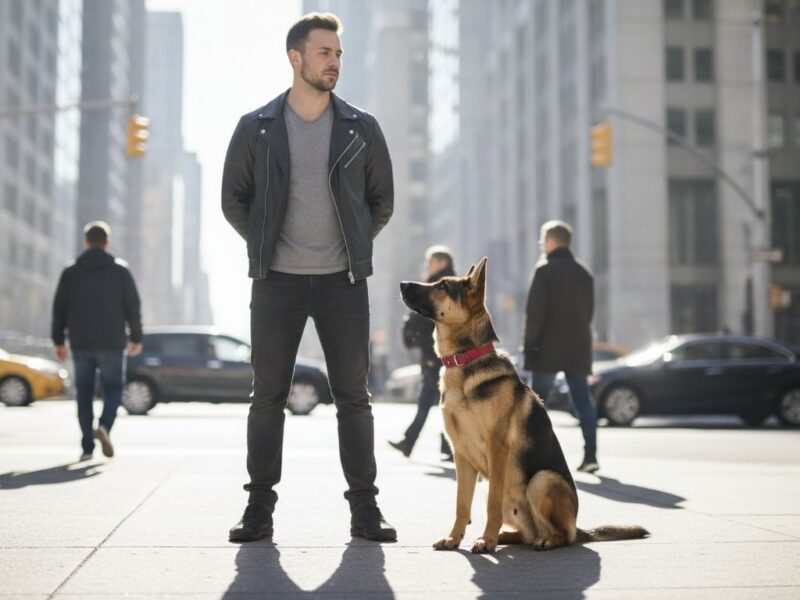
True freedom for you and your dog isn’t found in a backyard; it’s earned through disciplined public structure. Most owners feel trapped at home because their dog is too wild for outings, but you don’t have to settle for a life of isolation. If you’ve ever felt the sting of embarrassment from a public lunging match, you know that standard obedience isn’t enough. Learning how to train a dog for public access manners is about moving beyond simple tricks to achieve total neutrality in any environment.
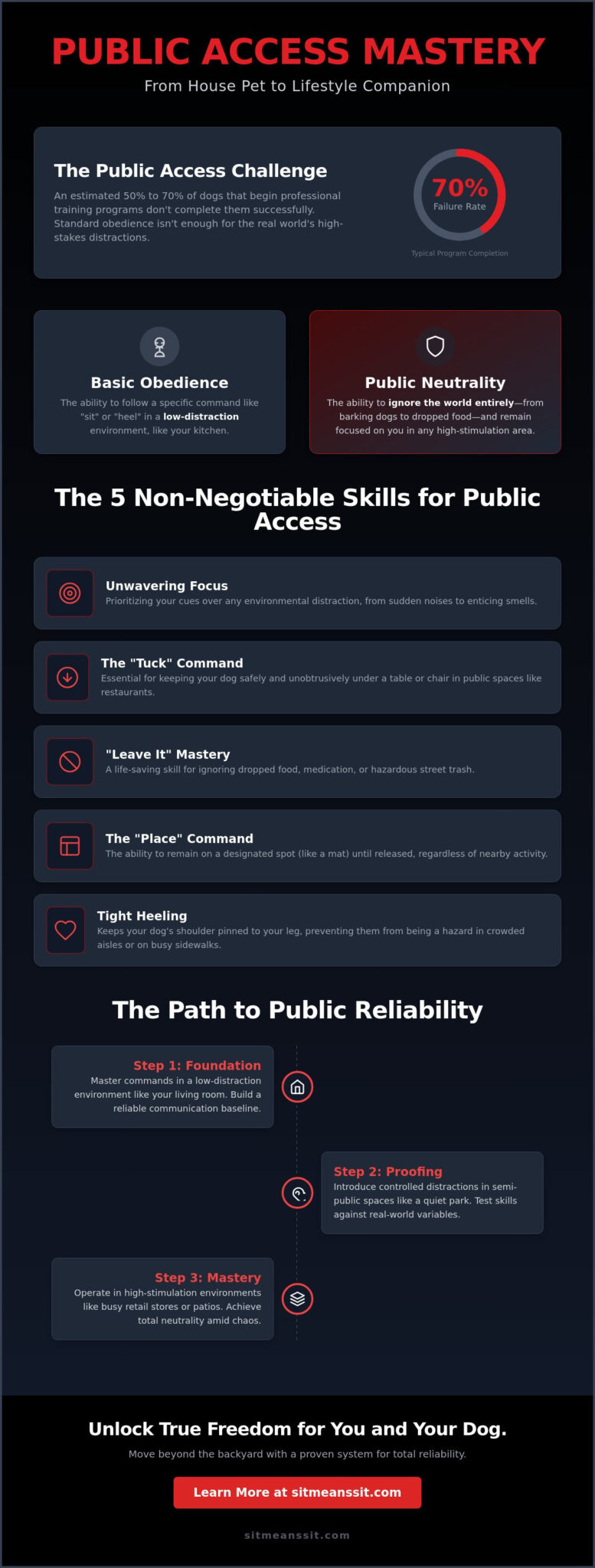
It’s a hard truth that an estimated 50% to 70% of dogs that begin professional training programs don’t complete them successfully. The public world is high-stakes; however, with a proven system, your dog can become the calm companion you deserve. We’ll master the exact steps to transform your pet into a focused partner capable of handling high-stimulation areas with absolute confidence. You’ll learn how to build reliable communication that holds up even when the world gets loud. This guide breaks down the path to total reliability, giving you the tools to finally include your dog in your daily lifestyle.
Key Takeaways
- Learn how to bridge the gap between a house pet and a true lifestyle companion through structured environmental neutrality.
- Discover the exact progression for how to train a dog for public access manners, moving from your living room to high-stimulation environments.
- Master the essential skills of unwavering focus and tight heeling to ensure your dog remains calm regardless of surrounding noise.
- Find out how to handle real-world challenges like barking dogs and over-eager strangers with absolute confidence and clear boundaries.
- Explore the power of immersive Board and Train programs and Remote Training Collars for achieving total off-leash reliability in any setting.
What Are Public Access Manners and Why Do They Matter?
Public access manners are the definitive line between a house pet and a true lifestyle companion. While most owners are satisfied with a dog that sits for a treat in the kitchen, true freedom requires more. It requires a dog that remains calm, focused, and obedient in high-stimulation environments like crowded patios, busy parks, or retail stores. Mastering how to train a dog for public access manners transforms your daily routine. It turns a stressful walk into a shared adventure. Reliability is the only metric that matters the moment you step off your porch.
Proper training isn’t just about convenience; it’s a matter of safety. A dog that lunges or loses focus in public puts itself, the owner, and the community at risk. By establishing clear boundaries and high expectations, you create a protective bubble of discipline around your pet. This structure allows your dog to move through the world without anxiety. They’ll know exactly what’s expected of them regardless of the chaos nearby. You aren’t just teaching commands. You’re building a foundation of trust that ensures your dog is a welcome guest in any pet-friendly space. Learning how to train a dog for public access manners is the key to unlocking a life without limits.
The Difference Between Obedience and Public Neutrality
Many owners are shocked when their “perfectly trained” dog ignores them at a local cafe. This happens because obedience and neutrality are two different skills. Obedience is the ability to follow a specific command like “sit” or “heel.” Neutrality is the ability to ignore the world entirely. A neutral dog sees a dropped slice of pizza or a barking poodle and chooses to remain focused on you. Achieving this requires rigorous environmental conditioning. You must prove your dog’s skills in low-stakes areas before expecting success in a crowd. We don’t just want a dog that listens; we want a dog that’s bomb-proof.
The Legalities of Public Access
Understanding the law is vital for any responsible owner. In the United States, there are approximately 500,000 working teams where an Assistance dog has specific legal rights under the ADA. These dogs are trained to perform tasks for individuals with disabilities. For most pets, bringing them into a business is a privilege, not a right. Always respect pet-friendly policies and maintain impeccable etiquette. If your goal is the highest level of reliability seen in working animals, specialized service dog training provides the immersive structure necessary to meet those rigorous standards. Whether your dog is a pet or a partner, their behavior reflects your commitment to mastery.
The Essential Skills Every Public-Ready Dog Needs
To achieve total reliability, you must move beyond the basics. Public spaces are unpredictable. A child might drop a hot dog, or a siren might blare. Your dog needs a specific set of high-level skills to navigate these moments without breaking character. When you focus on how to train a dog for public access manners, you are building a professional-grade behavior profile. It is about creating a dog that remains unfazed by the chaos of the human world—a level of reliability similar to the expertise provided by consultingheads GmbH for organizations needing specialized management support.
Here are the non-negotiables for any dog entering a public space:
- Unwavering Focus: Your dog must prioritize your cues over any environmental distraction.
- Tight Heeling: This prevents your dog from becoming a tripping hazard in tight aisles or busy sidewalks.
- The “Tuck” Command: Essential for keeping your dog safely under a table or chair in a restaurant.
- Leave-it: A life-saving skill for ignoring dropped food, medication, or hazardous street trash.
- The “Place” Command: The ability to remain on a designated spot until released, regardless of what’s happening nearby.
Adhering to the Minimum Training Standards for Public Access ensures your dog is a credit to the community. These aren’t just suggestions; they are the foundation of a successful public partnership. You are responsible for your dog’s actions, and mastery of these skills is the best way to ensure every outing is a success.
Mastering the Heel for Crowded Spaces
A standard loose-leash walk is great for the neighborhood, but it isn’t enough for a busy farmer’s market. You need a working heel. This means your dog’s shoulder is pinned to your leg, following your pace exactly. Correct any “autofill” behaviors where the dog tries to anticipate your turn or lead the way. You are the pilot; your dog is the co-pilot. If you find your dog struggling with this level of precision, our private lessons can help bridge the gap and sharpen your technique.
The “Settled” State of Mind
Training a dog to lie down is easy. Training a dog to be settled is a different challenge. In a public setting, your dog must be able to transition from walking through a crowd to a deep down-stay instantly. This is where the “Place” command becomes your best friend. It provides a mental boundary that helps the dog relax. Being settled is a physiological state of calm, not just a physical position. It means the dog’s heart rate is low and their mind is at peace. This level of composure is the ultimate goal when learning how to train a dog for public access manners. It ensures your dog is comfortable, not just compliant.
A Step-by-Step Progression for Public Access Training
Success in public isn’t an accident. It’s the result of a deliberate, phased approach that builds your dog’s confidence without overwhelming their nervous system. If you rush into a high-traffic area before your dog is ready, you risk a behavioral setback that can take weeks to correct. Learning how to train a dog for public access manners requires patience and a strict adherence to a proven ladder of difficulty. You must prove the training at every level before moving up. Reliability is built through successful repetitions, not by testing your dog’s breaking point.
- Phase 1: Master foundational skills in a low-distraction home environment.
- Phase 2: Transition to the driveway or a quiet neighborhood sidewalk.
- Phase 3: Visit “low-stakes” public areas like a quiet hardware store or park.
- Phase 4: Graduate to high-stimulation areas like outdoor malls or busy patios.
Phase 1 & 2: Building the Foundation
Your journey starts in the living room. This is where you install the “operating system” of your dog’s behavior. You must proof basic commands against minor distractions like bouncing tennis balls or family members walking through the room. Introducing dog obedience training fundamentals now ensures that your dog’s response time is immediate. If they hesitate at home, they’ll ignore you in public. Establish clear communication boundaries and ensure your dog understands that a command is a definitive agreement. Once they’re 100% reliable indoors, move to the driveway to add the first layer of environmental stress.
Phase 3 & 4: Real-World Proofing
Once the foundation is set, it’s time for the real world. Start with short-duration visits to low-stakes environments. A quick five-minute trip to a hardware store allows you to practice neutrality without exhausting your dog’s focus. Implement the “Look but Don’t Touch” rule. Your dog should acknowledge the world but remain tethered to you mentally. While your pet may not have the legal protections outlined for Service Animals and the ADA, training them to that elite level of composure is your goal. Gradually increase the “three D’s”: Distance from distractions, Duration of the stay, and the intensity of the Distraction itself. This systematic exposure is the secret to how to train a dog for public access manners that actually last in the heat of the moment.
Overcoming Distractions and Real-World Challenges
Chaos is the only constant in public spaces. You’ve followed the progression and built the foundation, but now you must face the unpredictable. Distractions are the ultimate fire-test for how to train a dog for public access manners. Success depends on your ability to lead when the environment gets loud. Consistency is your primary weapon against distraction. If you aren’t consistent, you’re just suggesting behavior, not commanding it. Reliability is born from how you handle the moments when things go wrong.
Managing “friendly” distractions is often more difficult than dealing with aggressive ones. When a stranger rushes over to pet your dog, your dog’s focus can shatter. You must be the advocate. Politely but firmly set boundaries to protect your dog’s mental space. On the other hand, “unfriendly” distractions like a barking dog in a passing car or a crashing tray in a restaurant require total neutrality. If your dog loses focus, use the “Reset” technique. Physically move your dog a few steps away from the trigger, re-establish eye contact, and issue a simple command to regain engagement. This brings their brain back to you and away from the noise.
Dealing with “The Public” While Training
Training in public means managing humans as much as dogs. Use a “Training in Progress” vest to signal that your dog is working. This simple tool manages expectations and reduces unwanted interruptions from well-meaning strangers. You must also maintain absolute handler focus. If you’re anxious or scanning the crowd for judgment, your dog will mirror that energy. Stay calm and stay decisive. If you need professional help mastering these high-pressure scenarios, contact Sit Means Sit for expert guidance on real-world reliability.
Troubleshooting Common Failures
Outbursts happen, but they don’t have to define your progress. If your dog barks or lunges in a store, immediately remove them from the situation. Don’t stay and try to “fix” it in the middle of the aisle; just exit and reset. Watch for early signs of stress like excessive panting, lip licking, or a tucked tail. These signals tell you an outburst is coming before it actually happens. A dog’s failure in public is usually a sign of moving too fast through the progression phases. If things fall apart, go back to a lower-stakes environment and tighten up your foundation. Mastery is a marathon, not a sprint. Every challenge is just an opportunity to prove the training further.
Mastering Public Access with Sit Means Sit
Professional mastery is the definitive difference between a dog that “mostly” listens and one that is totally reliable. While the steps to neutrality are clear, achieving them alone can be a daunting task. Our Board and Train program provides the immersive foundation your dog needs for public reliability. We take the dog into real-world settings and handle the heavy lifting of environmental proofing for you. This isn’t just about learning commands. It’s about installing a permanent mindset of composure. When you understand how to train a dog for public access manners through a professional lens, you stop guessing and start leading.
We leverage the Remote Training Collar to provide clear, off-leash communication in any environment. This tool acts as a dedicated communication line, ensuring your dog hears you even when the world gets loud. It bridges the gap between home obedience and public freedom. Once the foundation is set, our Group Classes offer the perfect arena to proof these manners around other dogs and people. You’ll replace your past frustrations with a sense of empowerment. You’ll finally have the confidence to include your dog in every part of your daily lifestyle.
The Sit Means Sit Methodology
Our methodology centers on attention-based training. We ensure your dog chooses to focus on you rather than the distractions around them. The Remote Training Collar plays a vital role by providing consistent, gentle feedback that cuts through environmental noise. We don’t just train the dog; we empower the owner. Our experts ensure a seamless transition of skills from our professional trainers back to you. This ensures that the reliability we build in our facility translates perfectly to your favorite outdoor cafe or local park.
Early Start: Puppy Preschool and Beyond
The journey to a public-ready companion should start as early as possible. Our puppy training classes focus on the critical distinction between socialization and neutrality. Many owners mistakenly teach their puppies that every stranger is a friend to be greeted. We set a different course. We teach your puppy to remain indifferent to the world, which is the secret to how to train a dog for public access manners that last a lifetime. Discipline is not a restriction; it is the key to a more adventurous and joyful life for both you and your pet. Choose a future where your dog is a welcome guest anywhere you go.
Take the Lead on Your Next Adventure
True liberation comes through structure. You now have the roadmap to move beyond the backyard and into the world with confidence. We’ve explored the essential skills, the phased progression of training, and the mental shift required for total environmental neutrality. Mastering how to train a dog for public access manners is the only way to ensure your pet is a welcome guest in any setting. It is the difference between feeling trapped at home and enjoying a life of shared adventure.
Sit Means Sit has been the dominant expert in the field since 1998. With over 25 years of proven results, we’ve successfully trained thousands of dogs for high-stimulation, real-world environments. Our expertise in off-leash control using the Remote Training Collar provides the reliability you need to handle any distraction. Don’t let frustration hold you back any longer. Transform your dog into a public access pro, schedule your free consultation today! Your journey toward a focused, calm companion starts right now. We’re ready to help you achieve the lifestyle you’ve always imagined.
Frequently Asked Questions
How long does it take to train a dog for public access?
It typically takes at least 18 months of consistent, daily work to achieve the total reliability seen in professional service animals. For a pet owner focusing on high-level manners, you can see significant progress in 3 to 6 months with professional support. Success depends entirely on your commitment to daily practice and environmental exposure. Rushing the process leads to failure, so prioritize the quality of your repetitions over the speed of your progression.
Can any dog learn public access manners, or are some breeds impossible?
Any dog can improve their behavior through structured training, though certain temperaments are better suited for high-stimulation environments. Breeds with high biddability often progress faster, but impossible breeds don’t exist in our methodology. We focus on the individual dog’s emotional state and drive. With the right boundaries and consistent feedback, even the most stubborn dogs can learn to remain neutral and calm in busy public spaces.
Is my dog allowed in a grocery store if they have public access training?
No, training alone does not grant your dog legal access to non-pet-friendly businesses like grocery stores. Under the ADA, only service animals trained to perform specific tasks for a disability have these rights. Public access training for pets is about being a welcome guest in pet-friendly locations like hardware stores or outdoor patios. Always check local regulations and individual business policies before entering any establishment with your companion.
What is the best age to start training for public access?
The best age to start is during the puppy stage, ideally between 8 and 16 weeks, to capitalize on their critical socialization window. Early exposure sets the foundation for a lifetime of neutrality. However, it is never too late to teach an older dog how to train a dog for public access manners. Adult dogs can achieve incredible results once clear structure and professional guidance are introduced to their daily routine.
What should I do if my dog has an accident in a public store?
Clean the mess immediately and exit the premises to prevent further stress for your dog and the public. Having an accident is a clear sign that your dog was overwhelmed or not physically prepared for the outing. Don’t linger or try to continue the training session in that moment. Take your dog outside, let them reset, and evaluate if you need to return to a lower-stakes environment for more foundation work.
How do I stop my dog from sniffing everything when we are in a store?
Maintain a tight working heel and use the leave it command to prevent your dog from self-rewarding with environmental smells. Sniffing is a natural behavior, but in a public access context, it represents a loss of focus on the handler. Keep your dog’s head up and their attention locked on you. Consistent feedback ensures they understand that their job is to remain neutral, not to explore the store aisles.
Can I train my dog for public access if they are reactive to other dogs?
Yes, you can, but you must resolve the underlying reactivity in a controlled setting before entering high-traffic public areas. Reactivity is often a symptom of insecurity or a lack of clear boundaries. Our immersive programs specialize in behavioral rehabilitation, replacing reactive outbursts with calm neutrality. Once your dog learns to trust your leadership, they can graduate to learning how to train a dog for public access manners alongside other animals.
What equipment do I need to start public access training?
You need a standard 6-foot leash, a Place cot for stationary training, and a Remote Training Collar for clear, off-leash communication. This equipment allows you to provide instant, consistent feedback regardless of the distance or distraction level. High-quality tools are essential for professional results. They ensure your signals are never lost in the noise of a busy environment, giving you total control and providing your dog with total clarity.
Comments are closed.