
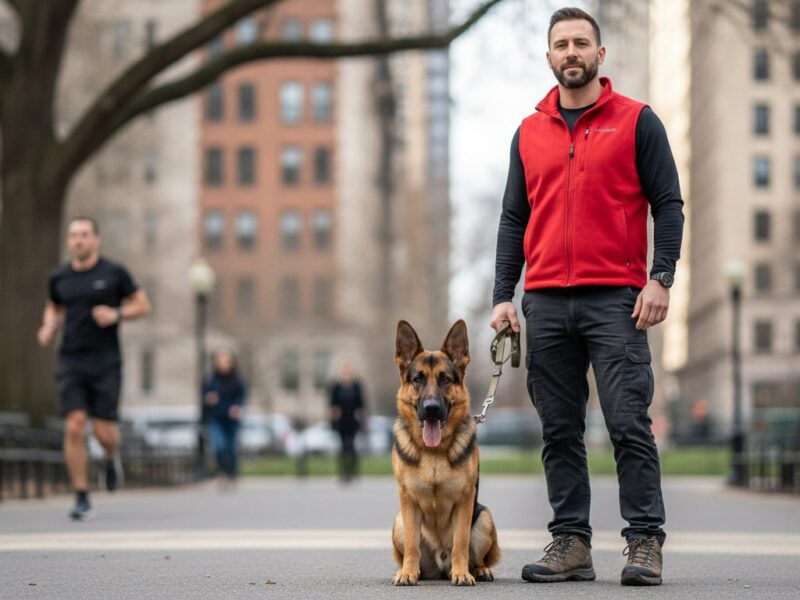
The Canine Good Citizen test is not just a list of commands; it is a definitive evaluation of the trust and communication between you and your dog under real-world pressure. Implementing the right canine good citizen test preparation tips is the difference between passing with ease and feeling overwhelmed by public distractions. You likely feel that sharp sting of embarrassment when your dog jumps on a neighbor or completely ignores you in a crowded park. It is exhausting to worry about how they will handle the supervised separation or if they will stay focused when the environment gets loud.
We understand that frustration, but we also know that discipline is the fastest path to a more adventurous and joyful life together. Since 1989, over one million dogs have earned this designation, and your dog is next. You are going to master the 10 essential CGC skills and transform your dog into a polite, reliable member of society. This guide provides a proven framework to help you secure that official AKC title in 2026. We will walk you through the standards for success, ensuring your dog remains calm, focused, and responsive no matter what distractions come your way.
Key Takeaways
- Discover why the Canine Good Citizen title is the essential foundation for therapy work and total public reliability.
- Master the three pillars of Socialization, Movement, and Temperament using our expert canine good citizen test preparation tips.
- Bridge the “Generalization Gap” by moving training into high-stimulation environments to ensure your dog remains focused under pressure.
- Conquer common hurdles like “friendly frustration” and supervised separation anxiety with proven impulse control strategies.
- Learn how professional training programs provide the ultimate shortcut to off-leash control and a bond built on clear communication.
The Gold Standard of Dog Ownership: Understanding the CGC Test
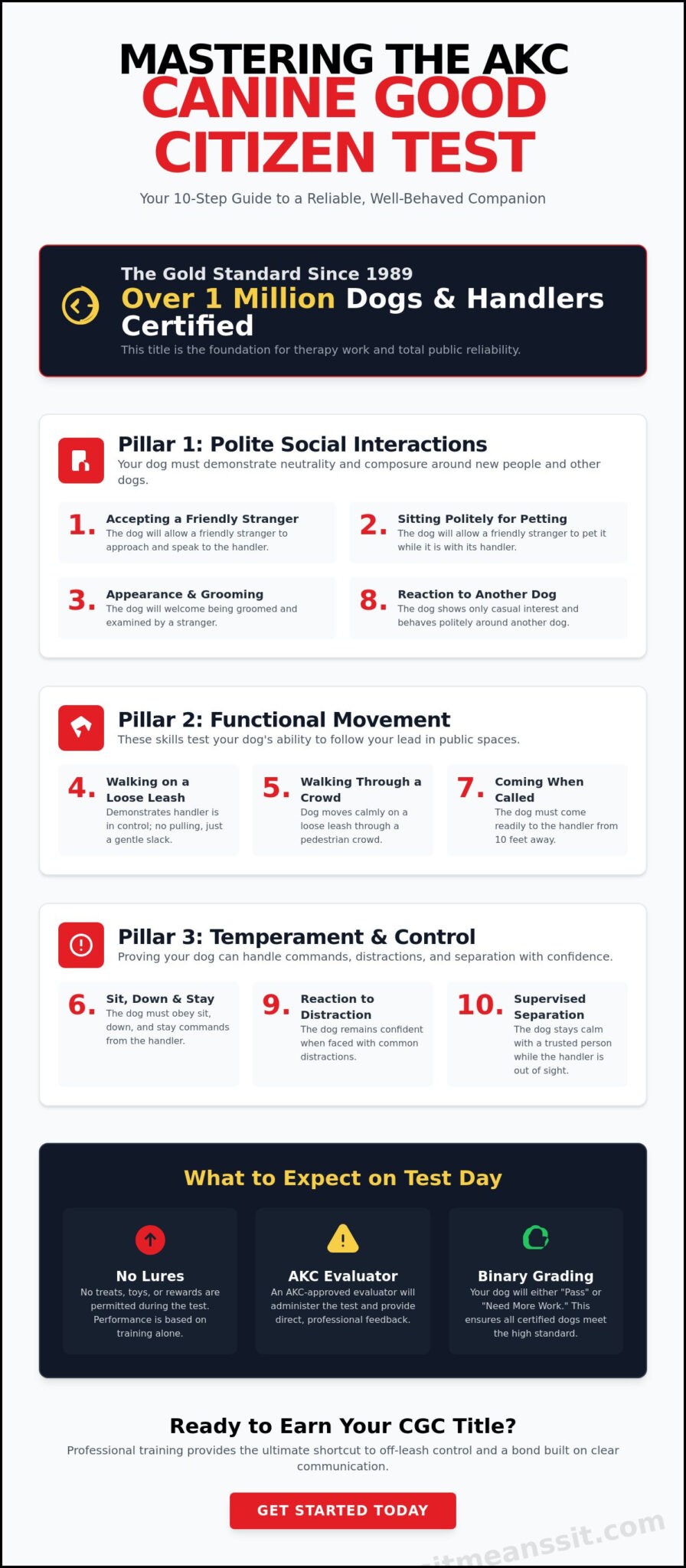
The Canine Good Citizen program is the ultimate benchmark for a well-integrated dog. Since its inception in 1989, it has served as the gold standard for responsible pet ownership. This isn’t a simple list of party tricks; it’s a rigorous assessment of your dog’s ability to remain calm and focused in a chaotic world. When you commit to this process, you are moving beyond basic compliance. You are choosing a lifestyle of total public reliability. Many owners start this journey feeling frustrated by a dog that pulls, jumps, or ignores commands. By the time they earn that certificate, that frustration is replaced by a deep sense of empowerment and pride.
Mastery of these skills is more than a trophy for your shelf. The CGC title is a prerequisite for most therapy dog organizations and a gateway to advanced sports like agility or tracking. It proves your dog possesses the temperament required for high-pressure environments. Effective canine good citizen test preparation tips focus on this specific shift in mindset. You aren’t just teaching a “sit” for a cookie; you are building a dog that chooses to sit because they trust your leadership. This reliability creates a life of liberation. When your dog is a certified “Good Citizen,” the world opens up to both of you.
Why Every Owner Should Aim for CGC Certification
Certification offers practical benefits that change your daily life. For renters, a CGC title is a powerful tool to prove to landlords that your dog is a quiet, well-behaved neighbor. It bridges the gap between basic manners and high-level dog obedience training. This process forces you to build a bond based on mutual respect rather than bribes. You will stop worrying about public outbursts and start enjoying the confidence that comes with clear, decisive communication.
What to Expect on Test Day
Test day is a serious, focused event. You will meet with an AKC CGC Approved Evaluator who will guide you through the ten specific items. There are no treats or toys allowed during the evaluation; your dog must perform based on your relationship and training alone. The grading is binary: you either “Pass” or the evaluator decides your dog “Needs More Work.” This direct feedback is invaluable. It ensures that every dog wearing the CGC title has truly mastered the requirements in a high-stimulation environment. Using consistent canine good citizen test preparation tips ensures you walk into that evaluation with absolute confidence.
The 10 Steps to Mastery: A Strategic Breakdown of Test Requirements
Mastering the CGC requires more than just luck; it demands a strategic training plan. We organize the ten requirements into three logical pillars to simplify your journey. This structure ensures you don’t just “get through” the test but achieve total public reliability. Remember, “Sit Means Sit” isn’t just a command. It is a definitive agreement between you and your dog that applies to every single interaction during the evaluation. To succeed, you need actionable canine good citizen test preparation tips that address the specific nuances of each task. Most owners fail because they train for the command, not the environment.
Pillar 1: Polite Social Interactions (Items 1, 2, 3, and 8)
Socialization is about neutrality, not constant interaction. Your dog must accept a friendly stranger and sit politely for petting without breaking focus or jumping. This is often where “friendly frustration” leads to failure. Mastering the approach of another dog (Item 8) requires your dog to remain calm and indifferent while you chat with another owner. Whether you are practicing at home or attending a Canine Good Citizen class, focus on rewarding your dog for choosing you over the distraction. Handling and grooming (Item 3) prepare your dog for the physical touch of a vet or groomer, ensuring they remain composed during an exam.
Pillar 2: Functional Movement (Items 4, 5, and 7)
Movement items test your leadership on the move. Walking on a loose leash and navigating a crowd are about a “follow me” mindset rather than a rigid heel. If your dog is pulling, they aren’t paying attention to your lead. You must demonstrate that your dog can weave through people and stay focused amidst moving distractions. The recall (Item 7) is perhaps the most vital skill. Coming when called with 100% reliability is a non-negotiable requirement for public safety and certification. If your dog’s recall is shaky, our private lessons can provide the one-on-one focus needed to bridge that gap.
Pillar 3: Emotional Control (Items 6, 9, and 10)
Emotional control is the ultimate test of your dog’s confidence. This pillar includes the sit, down, and stay commands, which must be rock-solid even when you walk away. Reaction to distraction (Item 9) ensures your dog remains unfazed by loud noises, like a dropped clipboard or a slamming door. The final hurdle is supervised separation. For three minutes, you’ll leave your dog with a stranger. They don’t have to be happy you’re gone, but they must remain calm without whining, pacing, or barking. These canine good citizen test preparation tips work best when you practice in diverse, high-stimulation environments to build true resilience.
Distraction Proofing: Why Backyard Success Is Not Enough
A common mistake owners make is assuming a dog that listens in the living room is ready for the CGC test. This is a dangerous trap. Dogs are context-specific learners, meaning they often fail to translate a “sit” command from the quiet kitchen to a bustling park. This phenomenon is known as the Generalization Gap. To achieve total reliability, your canine good citizen test preparation tips must move beyond the safety of your fence. If your dog only obeys when it is quiet and calm, they haven’t truly mastered the command; they’ve only mastered the location. True discipline is the key to a more adventurous life, and that discipline is forged in the middle of the noise.
We believe in training for the real world from day one. Our philosophy centers on replacing a dog’s “friendly frustration” or anxiety with absolute confidence in your leadership. Passing the CGC isn’t about hope; it’s about proofing. You must bridge the gap between knowing a command and doing it under pressure. This requires a systematic approach to environmental factors. By exposing your dog to controlled chaos, you ensure that test day feels like just another walk in the park. Professional group dog training classes are the ultimate tool for this stage, providing a safe but high-stimulation environment where your dog can practice neutrality around other animals.
The 3-Step Distraction Proofing Framework
- Step 1: Controlled Complexity. Start in a garage or driveway with the door open. Introduce low-level noise, like a radio or a bouncing ball, while maintaining a rock-solid stay.
- Step 2: Public Neutrality. Move to the parking lot of a home improvement store or a quiet corner of a local park. The goal here is focus amidst neutral bystanders who are not interacting with your dog.
- Step 3: High-Energy Chaos. Take your training to a busy farmers’ market or a pet store. Your dog must remain responsive while other dogs pass by and people move quickly in every direction.
Mastering the “Watch Me” Cue Under Pressure
In high-stimulation environments, communication must be instant and clear. We use the Remote Training Collar to maintain a “digital leash” that cuts through the mental fog of a distracted dog. This tool isn’t about restriction; it’s about maintaining a definitive agreement even when a squirrel runs by. As you progress, you must transition from constant food rewards to the higher-value rewards of your praise and the adventure itself. Distraction proofing is the bridge between “knowing” and “doing.” When your dog realizes that your directive is the most important thing in their world, they become a truly confident member of society. These canine good citizen test preparation tips will ensure your dog remains unfazed by any surprise the evaluator throws your way.
Overcoming Common Testing Hurdles and Owner Anxiety
Even with the best canine good citizen test preparation tips, test day can feel like a high-stakes environment. The most common reason for a “Needs More Work” result isn’t a lack of intelligence; it’s “friendly frustration.” This occurs when a dog is so over-excited to meet people or other dogs that they completely lose their impulse control. They aren’t being bad; they’re being undisciplined. This lack of structure leads to jumping, pulling, and a total loss of focus. You must replace that frantic energy with a calm, business-like attitude. Your dog needs to know that neutrality is the only way they get what they want. When you establish this definitive agreement, the stress of the testing environment begins to fade.
Your own body language plays a massive role in your dog’s performance. Dogs are experts at reading our emotional states. If your hands are shaking and your breath is shallow, your dog assumes there is a reason to be on high alert. Stand with confidence. Give clear, punchy directives. When you act like the leader, your dog feels safe enough to follow. This relationship is the core of our training philosophy. We don’t just train dogs; we empower owners to lead with absolute certainty. This shift in mindset transforms the test from a source of anxiety into a celebration of your hard work.
Solving the “Jumping” Problem for Good
Jumping is a boundary violation that often stems from a dog trying to manage their own excitement. We implement the “Four on the Floor” rule: no attention, petting, or rewards happen unless all four paws are firmly on the ground. This creates a non-negotiable standard for every greeting. You must also learn to advocate for your dog. If a stranger rushes in to pet them during practice, step forward and politely ask them to wait. Setting these early boundaries is much easier if you start with professional puppy training classes. Building impulse control early ensures that polite greetings become a default behavior rather than a constant struggle.
Curing Separation Anxiety for the 3-Minute Test
The supervised separation is the final hurdle for many. For three minutes, your dog must remain calm with a stranger while you are out of sight. This is a test of confidence, not just a “stay” command. We recommend practicing incremental departures as part of your canine good citizen test preparation tips. Start by stepping behind a door for five seconds and return before any whining begins. You want to build a long history of “I always come back.” If your dog struggles with severe anxiety, an immersive board and train program can provide the total behavioral reset they need. This intensive environment builds the emotional resilience required for public reliability. Remember, discipline isn’t a restriction; it’s the key to the adventurous, joyful life you both deserve. If you’re ready to stop the frustration, contact us today to start your journey.
Final Prep: How Professional Training Ensures CGC Success
Don’t leave your success to chance on test day. While basic classes might teach your dog to sit for a treat, professional training provides the shortcut to total reliability and off-leash control. We believe that a command is a definitive agreement, not a suggestion. Our canine good citizen test preparation tips focus on exceeding the AKC standards so that the actual evaluation feels like a breeze. You want to walk into that ring with absolute confidence, knowing your dog is a polite, focused member of society. Professional guidance replaces the “hope he listens” mindset with a “know he will” reality.
Many owners view the CGC as the finish line, but we see it as the foundation for a lifetime of adventure. Once you master these ten skills, the world opens up for you and your dog. You move from the frustration of public embarrassment to the pride of having a dog that can go anywhere. This transformation is what we deliver. We don’t just help you pass a test; we help you build a bond based on clear communication and mutual respect. This is the key to a more joyful, adventurous life for both the pet and the owner.
The Sit Means Sit Advantage
Our methodology is designed for real-world results. We use the Remote Training Collar to create a “digital leash” that ensures clear communication even when distractions are at their peak. This tool allows you to give precise directives that your dog understands instantly. Our Group Classes provide the perfect mock test environment. You will practice the ten CGC items surrounded by other dogs and moving distractions, mirroring the exact pressure of the evaluation. Our trainers act as the assertive authority figures you need, providing the professional feedback that ensures you are ready for the official evaluator.
Your CGC Readiness Checklist
Success requires preparation in both training and logistics. Before you head to your session, run through this final checklist to ensure a smooth experience. Evaluators look for a team that is prepared and composed.
- Equipment Check: You must use a flat collar or a well-fitting harness. Slip leads, prong collars, and head halters are strictly prohibited during the test.
- Find Your Evaluator: Locate an AKC CGC Approved Evaluator in your area and schedule your session in advance. Many of our locations host these tests regularly.
- The “Pro Tip”: Keep your energy high and encouraging. If you are tense, your dog will be too. Use a happy, confident voice to guide your dog through each item.
- The Pledge: Be ready to sign the Responsible Dog Owners Pledge, affirming your commitment to your dog’s health and safety.
Mastering these canine good citizen test preparation tips is your first step toward total public reliability. Replace your frustration with empowerment and earn that title with pride. If you are ready to transform your dog’s behavior and achieve total off-leash control, our team is here to lead the way. Let’s make 2026 the year you and your dog become the ultimate team.
Achieve Public Reliability and Earn Your CGC Title Today
Earning the Canine Good Citizen title is more than just passing a test; it’s the first step toward a life of total freedom and adventure with your dog. You’ve learned how to break down the ten requirements into pillars of success and why moving beyond backyard training is vital for real-world reliability. These canine good citizen test preparation tips are designed to replace your frustration with a sense of mastery and pride. Discipline isn’t a barrier to fun; it’s the exact tool that makes a more joyful life possible.
We bring over 25 years of results-oriented training to every dog and owner we work with. Our expertise in high-distraction environments and off-leash control ensures your dog remains responsive in any situation. We offer programs tailored for every dog, regardless of age or breed, ensuring no owner is left behind. Stop worrying about public outbursts and start imagining a future where your pet is a perfectly behaved companion in any setting.
Master the CGC and beyond—schedule your FREE consultation today!
Your journey to a perfectly behaved companion starts right now. We’re ready to help you turn that vision into a reality. Let’s get to work.
Frequently Asked Questions
Can my dog use a training collar during the actual CGC test?
No, the AKC prohibits training collars like slip leads, prongs, or electronic collars during the actual evaluation. You must use a well-fitting flat collar or a harness made of leather, fabric, or synthetic material. While we use the Remote Training Collar to achieve total reliability during your practice sessions, test day is about proving your dog obeys because of the bond and structure you’ve built together. Focus on clear communication to ensure your dog remains responsive on a standard collar.
What happens if my dog fails one of the 10 CGC test items?
If your dog fails an item, the evaluator will mark your performance as “Needs More Work” for that day. You won’t earn the title immediately, but you can retake the test at a later date once you’ve polished those specific skills. Use this feedback as a definitive roadmap for your canine good citizen test preparation tips. Most owners find that a few extra weeks of structured practice in busy environments is all it takes to turn a failure into a pass.
Is there an age limit for a dog to take the Canine Good Citizen test?
There is no age limit for dogs taking the CGC test. The program is open to all dogs, from puppies to seniors, provided they have received their necessary vaccinations. We recommend starting structured training as early as possible to build a foundation of focus and reliability. Whether your dog is six months or six years old, the goal remains the same: creating a confident, polite member of society through consistent leadership.
Can I give my dog treats during the CGC evaluation to keep them focused?
No, you cannot use treats or toys during the CGC test. The evaluator needs to see that your dog responds to your verbal cues and body language without external bribes. This is why our training methodology focuses on moving beyond food rewards as quickly as possible. You want a dog that obeys because of your clear communication and established boundaries, ensuring total reliability even when the cookies are out of reach.
How much does it typically cost to take the CGC test?
The cost to take the evaluation generally ranges from $20 to $50 depending on the location and the specific evaluator. Once you pass the test, there is an additional fee paid directly to the AKC to make the title official. As of June 2026, the fee is $32 to receive the CGC certificate and have the title added to your dog’s record, or $25 if you only want the certificate without the official title listing.
How long does it take to prepare a dog for the Canine Good Citizen title?
Preparation time varies based on your dog’s starting point, but most owners achieve readiness within six to ten weeks of consistent practice. Success depends on how often you proof your skills in high-distraction environments rather than just the backyard. Implementing structured canine good citizen test preparation tips daily will accelerate your progress. Our professional programs are designed to streamline this process, replacing your frustration with rapid, visible transformation.
Does a dog have to be AKC registered to earn a CGC title?
No, your dog does not need to be a purebred AKC-registered dog to earn the title. The CGC program is inclusive and open to all dogs, including mixed breeds. If you want the title to appear on official AKC records, you can use an AKC Canine Partners number or a Purebred Alternative Listing (PAL) number. This ensures every responsible owner has the opportunity to showcase their dog’s mastery and commitment to good behavior.
Can my dog take the CGC test if they are reactive to other dogs?
Your dog can take the test, but they must remain neutral and under control during the “Reaction to Another Dog” portion. Any display of aggression, lunging, or excessive barking will result in a “Needs More Work” grade. If your dog struggles with reactivity, focus on building impulse control through our specialized training programs. We turn reactive behavior into reliable focus, giving you the confidence to pass the evaluation on your first try.
Comments are closed.