

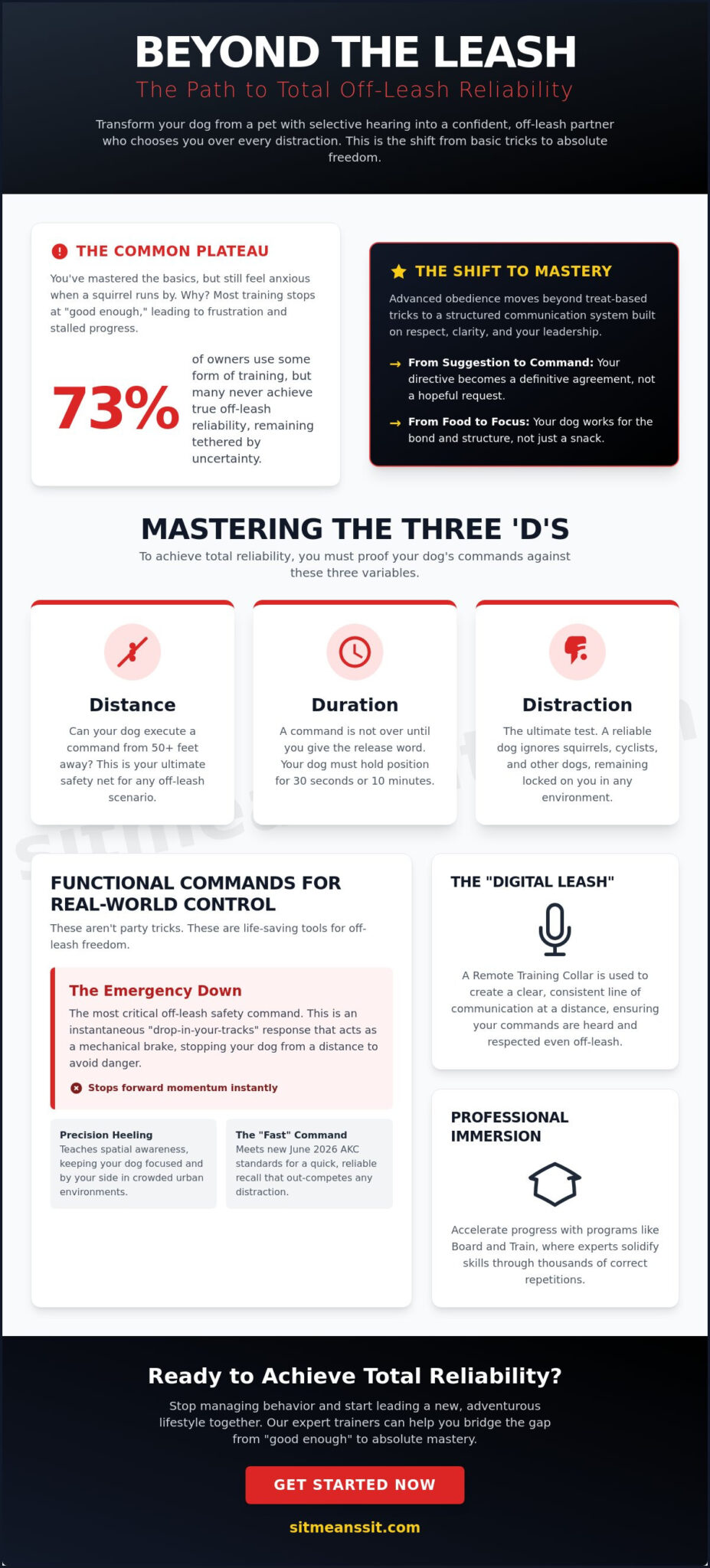
What if the leash was just a safety net rather than a tether you rely on for every walk? You’ve likely mastered the basics of sit and stay, but you’re still holding your breath every time a squirrel runs by or a car door slams. It’s frustrating when your dog’s selective hearing kicks in just when you need them to listen most. Finding the right advanced obedience commands to teach your dog is the only way to replace that anxiety with absolute confidence. You aren’t alone; while 73% of owners use some form of training, many hit a plateau where progress simply stalls.
We’re going to bridge that gap and show you how to achieve total reliability. This guide transforms your dog into a confident, off-leash partner who chooses you over every distraction. You’ll master high-level communication techniques, the new June 2026 AKC “Fast” command standards, and the specific drills that turn discipline into a lifestyle of freedom. Get ready to build a bond rooted in pride and mastery. It’s time to stop managing your dog’s behavior and start leading a new, adventurous lifestyle together.
Key Takeaways
- Define the shift from basic tricks to total reliability by moving beyond food rewards and into structured, high-level communication.
- Identify the critical advanced obedience commands to teach your dog, like the “Emergency Down,” that act as an immediate safety brake in high-risk situations.
- Master precision movement and spatial awareness to ensure your dog remains focused on you, even in the middle of a crowded urban environment.
- Learn the step-by-step process of transitioning to a “digital leash” using a Remote Training Collar for ultimate off-leash control and freedom.
- Explore how immersive professional programs like a Board and Train can accelerate your progress and solidify your dog’s skills through expert-led repetitions.
Beyond the Basics: What Defines Advanced Obedience in 2026?
Advanced obedience isn’t about teaching your dog a dozen cute parlor tricks. It’s about achieving Total Reliability. In the modern world, a “good” dog is one that listens in the living room; a master-level dog is one that listens instantly in the middle of a chaotic city park. This level of training represents a fundamental shift in how you interact with your pet. We are moving beyond the phase where your dog only works for a piece of cheese. We are building a communication system based on mutual respect and crystal-clear expectations. When you prioritize advanced obedience commands to teach your dog, you’re investing in their safety and your own peace of mind.
The transition from treat-dependent behavior to structured communication is vital. While treats are excellent for introducing new concepts, relying on them in high-stress situations is a recipe for failure. Real-world reliability requires a dog that works for the bond and the boundary, not just the snack. This discipline is the gateway to a more adventurous and joyful life. By establishing clear structure, you grant your dog the liberation they deserve. They get more off-leash time, more hikes, and more inclusion in your daily life because you know they will handle any environment with ease.
The Shift from Suggestion to Command
Stop treating your directives like requests. Selective hearing usually happens because an owner stops at the “good enough” stage of training. If your dog only listens when they feel like it, you don’t have a command; you have a suggestion. Advanced training reframes every directive as a definitive agreement. This requires you to project absolute authority. Your dog needs to know that when you speak, the world stops. This level of precision is a hallmark of competitive obedience trials, where handlers and dogs operate as a single, seamless unit. Your confidence as a leader is the most important tool in your kit. When you are certain, your dog is certain.
Mastering the Three Ds
You cannot claim mastery until you’ve proofed your dog against the Three Ds: Distance, Duration, and Distraction. These are the variables that separate the amateurs from the pros. Focus on these metrics to ensure your dog is truly reliable:
- Distance: Can your dog execute a “Down” or “Sit” from 50 feet away? Reliability at a distance ensures safety when you aren’t within arm’s reach. It’s the ultimate safety net for off-leash adventures.
- Duration: A command isn’t over until you say it is. Your dog must hold their position until they hear their formal release word. It doesn’t matter if it’s thirty seconds or ten minutes; the command stands until it’s broken by you.
- Distraction: This is the ultimate test of advanced obedience commands to teach your dog. A perfectly trained dog ignores squirrels, cyclists, and barking dogs. They remain locked on you regardless of the environment.
Mastering these variables turns a hesitant pet into a focused companion. You’re creating a “digital leash” that keeps them safe while allowing them the freedom to explore the world by your side.
The Big 3 Functional Commands for Real-World Control
Mastering the basics is just the beginning. To truly enjoy the freedom of an off-leash lifestyle, you must move beyond simple parlor tricks and focus on utility. The goal isn’t just to have a dog that listens; it’s to have a dog that responds with total reliability when the stakes are high. When you’re choosing the right advanced obedience commands to teach your dog, you have to prioritize the ones that provide immediate control in unpredictable environments. These skills transform your dog from a pet that follows rules into a partner that understands clear, high-level communication.
Achieving this level of mastery requires a deep understanding of advanced training techniques that account for canine psychology and environmental stress. We aren’t just looking for “good” behavior. We are looking for a definitive agreement between you and your dog. If you’re feeling stuck with standard classes, our private lessons can help you break through that plateau with personalized instruction.
Emergency Down: The Life-Saving Command
The Emergency Down is the most critical off-leash safety tool. Unlike a standard “down” you might use in your living room, this is a high-intensity “drop in your tracks” response. You want your dog to hit the ground instantly, regardless of how fast they are moving or how far away they are. This command acts as a mechanical brake. Imagine your dog spots a ball bouncing toward a busy road or catches the scent of a deer across a hiking trail. A vocal “Down!” should stop them mid-stride. To train this, start with short distances and zero distractions. Gradually increase the energy of the session until your dog can drop while at a full sprint. It’s about building a muscle memory so strong that it overrides their predatory drive or curiosity.
Reliable Recall Under Pressure
Coming when called is easy in a quiet backyard, but real life happens at the park, the beach, and the brewery. Advanced dog obedience training focuses on proofing the recall against high-value rewards. Your dog must decide that returning to you is more rewarding than chasing a squirrel or greeting another dog. Use long lines to maintain control while you increase environmental pressure. Always reward the return with high energy and praise. We want your dog to feel a sense of urgency every time they hear their recall word. Total reliability means they don’t weigh their options; they just move toward you immediately.
Advanced “Leave It” and the “Place” Command
An advanced “Leave It” isn’t just about ignoring a dropped treat. It’s about ignoring a piece of trash on the sidewalk or a reactive dog barking through a fence. Combine this with the “Place” command to create a calm boundary in any setting. Training your dog to stay on a specific mat or park bench until released builds incredible mental endurance. It allows you to enjoy public spaces without worrying about your dog wandering or bothering others. These advanced obedience commands to teach your dog are the keys to a more adventurous, stress-free life together.
Movement and Spatial Awareness: Precision Heeling
Walking your dog should be a joy, not a physical struggle. While most owners are happy with a loose leash, true mastery requires precision. Advanced movement is about more than just staying close; it is about total engagement and spatial awareness. When you focus on advanced obedience commands to teach your dog, you are building a hip-to-shoulder connection that works in any environment. This level of control allows you to navigate crowded city sidewalks or narrow hiking trails with absolute confidence. You stop reacting to the world and start moving through it as a synchronized team.
Achieving the Focused Heel
There is a massive difference between a casual walk and a focused heel. On a casual walk, your dog can sniff and explore within the boundary of the leash. In a focused heel, your dog’s world shrinks down to your left hip. This command requires your dog to ignore every distraction, from passing cyclists to barking neighbors, and maintain a specific position relative to your body. This isn’t just physical exercise; it’s an intense mental workout. For high-energy breeds, this level of concentration builds incredible mental stamina and prevents the boredom that often leads to destructive behaviors. Integrating consistent eye contact into the heel ensures your dog is constantly checking in with you, making you the most important thing in their environment.
Spatial Awareness and Reverse Movement
Most dogs have no idea they have a back half. Teaching your dog to “Back Up” on command is the secret to developing total body awareness. This is one of the most practical advanced obedience commands to teach your dog because it solves real-world problems. Imagine you are in a crowded elevator or a narrow doorway and need to clear a path. A sharp “Back!” command tells your dog to move out of the way without breaking focus. Practicing reverse movement also reinforces the heel position. If your dog overshoots the mark, a quick backup reset brings them right back to your hip. It teaches them that their position is relative to yours, regardless of which direction you are moving.
The Finish and Directional Cues
The “Finish” is the hallmark of a polished, well-trained companion. It is the command that tells your dog to return from a distance and swing directly into a perfect heel position. Combine this with directional cues like “Left,” “Right,” and “Behind” to master urban navigation. These cues allow you to guide your dog around obstacles without ever needing to tug on the leash. You become the navigator, and they become the expert pilot. If you find that your dog is struggling with these complex movements or you’ve hit a plateau, seeking assistance from a qualified professional can provide the breakthrough you need. Total reliability is a journey, and having an expert eye can help you refine the subtle mechanics that lead to true mastery.
Achieving Off-Leash Reliability with Clear Communication
Total off-leash reliability is the ultimate goal of any high-level training program. It represents the pinnacle of the bond between you and your dog. You’ve already identified the advanced obedience commands to teach your dog, but having a list of skills isn’t enough. You need a way to maintain that connection when the physical leash is gone. This is where the transition from a nylon tether to a digital leash becomes essential. It’s about replacing physical restraint with mental engagement and absolute clarity.
Providing clear feedback at a distance is what separates a “good” dog from a perfectly behaved companion. When your dog knows that the boundary exists even without a leash, they gain the freedom to explore safely. You stop worrying about “what if” and start enjoying the adventure. This is the liberation that comes through structure. You aren’t just training a dog; you’re unlocking a new way of life where the world becomes your training ground. If you are ready to experience this level of control, contact us for a free evaluation to see how our methodology works.
The Remote Training Collar Advantage
Many owners hesitate when they hear about a Remote Training Collar. Let’s clear up the confusion. This tool isn’t for punishment; it’s for precise, long-distance communication. Think of it as a tap on the shoulder that your dog can feel from 100 yards away. It provides the same clarity as a leash pop but without the physical restriction. This allows you to give immediate feedback the moment a command is ignored. Professional instruction is non-negotiable here. You must learn how to integrate this tool correctly to ensure your dog understands the signal as a helpful guide rather than a surprise. It’s the most effective way to proof advanced obedience commands to teach your dog in high-stakes environments.
Distraction Proofing in the Wild
Reliability is forged in the real world. You can’t expect a perfect response in a crowded park if you’ve only practiced in your hallway. We use a gradual exposure method. Start with “pollen”—low-level distractions like a distant bird or a quiet street. Only when your dog is 100% successful do you move into the “storms” of high-traffic areas, off-leash beaches, or busy festivals. This step-by-step proofing ensures your dog never feels overwhelmed. At this level, we maintain the Sit Means Sit standard: a command is a definitive agreement. It isn’t a request they can ignore when a squirrel appears.
The transition to a digital leash happens in phases. First, you pair the collar signal with known commands on a long line. Once the dog understands that the “tap” means “listen to me,” you can begin dropping the leash. This phase requires consistency. You must provide the same feedback every single time. If you allow a command to be ignored once, you’ve broken the contract. Advanced obedience requires a handler who is as disciplined as the dog. By providing consistent feedback, you build a level of trust that allows your dog to roam with confidence, knowing exactly what is expected of them.
Professional Immersion: Elevating Your Dog to Mastery
Mastery is the difference between a dog that knows what to do and a dog that does it by instinct. While self-training is a great start, reaching total reliability often requires a professional touch. Advanced obedience is more than just a checklist of skills. It is a complete transformation of your dog’s mental state. When you decide on the specific advanced obedience commands to teach your dog, you aren’t just choosing tricks. You are choosing a lifestyle of freedom. Professional immersion programs remove the guesswork and replace it with proven results. You move from the frustration of “will they listen?” to the pride of “I know they will.”
The Power of Professional Board and Train
A board and train environment is the fastest path to this level of mastery. In this setting, your dog lives in a world of 24/7 structure. Every interaction is a training opportunity. Professional trainers have the experience to see subtle behavioral cues that the average owner might miss. They can perform hundreds of “reps” in high-distraction environments, proofing commands against squirrels, cars, and other dogs with expert timing. This immersive approach solidifies the concepts much faster than a weekly class ever could. We ensure the skills transfer seamlessly to you so that the reliability stays long after the program ends. It’s about building a rock-solid foundation that holds up in the real world.
Private Lessons for Personalized Mastery
Once the foundation is set, private lessons allow for personalized fine-tuning. This is where we customize the training to your specific lifestyle. Do you want to take your dog to a bustling outdoor cafe? We focus on a rock-solid “place” command. Are you an avid hiker? We prioritize directional cues and long-distance recall. These sessions are about elevating your handling skills to match your dog’s new advanced level. Group classes often fail because they can’t address these individual hurdles. Private instruction gives you the one-on-one attention needed to achieve the exact life you imagined when you first brought your dog home. These personalized sessions ensure that the advanced obedience commands to teach your dog are relevant to your daily adventures. You gain the confidence to lead, and your dog gains the clarity to follow. It is a partnership built on mutual respect and clear boundaries.
Claim Your Off-Leash Freedom Today
You’ve seen that the path to a perfectly behaved companion isn’t found in a list of complex tricks; it’s forged through structure and crystal-clear communication. By focusing on the right advanced obedience commands to teach your dog, you replace the daily anxiety of “what if” with the absolute confidence of total reliability. You now understand how the Three Ds and precision heeling create a foundation for a life without limits. Mastering these skills allows you to trust your dog in any environment, from a quiet mountain trail to a bustling city street.
Sit Means Sit is here to turn that vision into your daily reality. With over 150 locations nationwide, our results-oriented Board and Train programs and industry-leading Remote Training Collar technology provide the tools you need for a complete transformation. Stop settling for a dog that only listens when they feel like it. It’s time to experience the liberation that comes with professional training. Ready for total off-leash control? Find a Sit Means Sit location near you! Your dog is ready for more adventure, and you deserve the pride of a perfectly trained partner.
Frequently Asked Questions
How long does it take to teach advanced obedience commands?
Immersive programs like a two-week Board and Train can provide a massive head start on advanced skills. For most owners, achieving total reliability takes about four to six weeks of steady practice. It’s about the quality of the repetitions rather than just the time spent. Consistent daily work ensures that these behaviors become second nature for your dog in any environment.
Can older dogs learn advanced obedience, or is it only for puppies?
Dogs are lifelong learners regardless of their age. While puppies are blank slates, older dogs often bring a level of maturity that helps them focus during complex tasks. We’ve seen senior dogs master new communication systems and achieve off-leash freedom just as effectively as younger pets. It’s never too late to replace frustration with a sense of empowerment and pride.
Do I need a special collar to achieve off-leash reliability?
A Remote Training Collar is the most effective way to maintain a digital leash at a distance. While you can teach the concepts on a long line, the collar provides the clear feedback needed for total off-leash reliability. It allows you to tap your dog on the shoulder from 100 yards away. This tool ensures that your commands remain a definitive agreement even without a physical tether.
What is the difference between a trick and an advanced obedience command?
A trick is a performance for entertainment, while an obedience command is a functional safety tool. Tricks like “roll over” are fun, but advanced obedience commands to teach your dog are designed for real-world control. The Emergency Down or a Focused Heel can save your dog’s life in a dangerous situation. We prioritize commands that build a deeper bond and offer greater freedom.
How do I keep my dog from getting bored during advanced training?
Change the environment frequently to keep the mental challenge high. Move your training sessions from the backyard to a busy park or a local hardware store. Varying the distance and distractions ensures your dog stays engaged and focused on you. Advanced training is a high-energy mental workout that prevents boredom and destructive behaviors by giving your dog a clear, rewarding job to do.
Is advanced training necessary if my dog already sits and stays?
Standard sitting and staying are great foundations, but they often fail under pressure. Advanced training is essential if you want to enjoy an adventurous lifestyle together. It bridges the gap between a “good” dog at home and a perfectly behaved companion in public. If you want the freedom to hike off-leash or visit a crowded patio, you need the reliability only advanced work provides.
What should I do if my dog ignores a command they already know?
You must provide immediate feedback and ensure the command is completed. Ignoring a known directive breaks the contract between you and your dog. Use your communication tool to regain their focus and reset the position immediately. Consistency is the only way to maintain mastery. If you let a command slide once, your dog learns that your words are suggestions rather than definitive agreements.
How often should I practice advanced commands to maintain reliability?
Aim for ten to fifteen minutes of focused practice every day. You don’t need hours of work; you need high-quality reps in different environments. Frequent, short sessions keep the advanced obedience commands to teach your dog fresh in their mind. This steady practice maintains the digital leash and ensures your dog remains reliable regardless of how much time has passed since their initial training program.
Comments are closed.