

What if the secret to a perfectly behaved off-leash dog isn’t the collar itself, but the strategic moment you decide to stop using it? You’ve spent weeks building a foundation of discipline, yet that nagging fear remains. You worry that the second the equipment comes off, the selective hearing will return. It’s common to feel like your dog’s reliability is tied to a device rather than a deep-rooted habit. If you’re struggling with collar-wise behavior, you aren’t alone; many owners feel stuck in a cycle of dependency.
We’re here to replace that anxiety with absolute confidence. This guide reveals the exact professional protocol for how to fade the e-collar after training so you can enjoy total off-leash reliability without losing control. You’ll learn how to shift your dog’s expectation from a physical prompt to a psychological habit of listening. We will cover the specific timeline for the transition, the importance of the “dummy collar” phase, and how to test your dog’s mastery in high-stimulation environments. It’s time to turn your hard work into a lifestyle of liberation and adventure.
Key Takeaways
- Redefine fading as a path to generalization, ensuring your dog understands commands apply in every context, not just during “work” mode.
- Eliminate the trap of collar-wise behavior by adjusting how and when your dog wears their remote training collar to break the association between the tool and the rules.
- Implement the exact professional protocol for how to fade the e-collar after training to move seamlessly from continuous reinforcement to total independence.
- Learn how to proof obedience in high-stimulation environments using long-line backups so you never lose control when the stakes are highest.
- Transition your training into a lifestyle where your dog remains under command, granting you both the confidence to explore the world with absolute freedom.
The Goal of E-Collar Fading: Achieving Total Reliability
Fading the collar is the systematic reduction of electronic prompts while maintaining 100% command compliance. It is a deliberate training phase, not an overnight event. Many owners make the mistake of simply taking the gear off once the dog starts listening. This leads to a breakdown in communication. Instead, you must focus on generalization. This is the process where your dog understands that your commands apply in every context, regardless of what they are wearing or where they are standing. You want your dog to realize that “Sit” means “Sit” whether you are in the quiet of your living room or the chaos of a busy park.
Don’t confuse “taking the collar off” with the actual process of fading. Fading is a transition where the tool moves from being a primary communication device to a silent safety net. At Sit Means Sit, our philosophy is rooted in the belief that structure creates freedom. Discipline is not a restriction. It is the key to a joyful, adventurous life for both you and your pet. A dog that is truly reliable off-leash is a dog that can enjoy the world to the fullest without the constant tether of a physical leash.
Reliability vs. Dependency
Dependency is a common trap for owners who stop active training too early. It happens when you only use the collar for corrections or to stop unwanted behaviors. If your dog only listens when they feel a pulse, they have become dependent on the tool. This creates “selective hearing” the moment the collar is removed. You want to build reliability instead. Reliability occurs when the dog anticipates the command and chooses to obey because the behavior has become a habit. Reliability is the dog’s internal commitment to the command.
When Are You Ready to Start Fading?
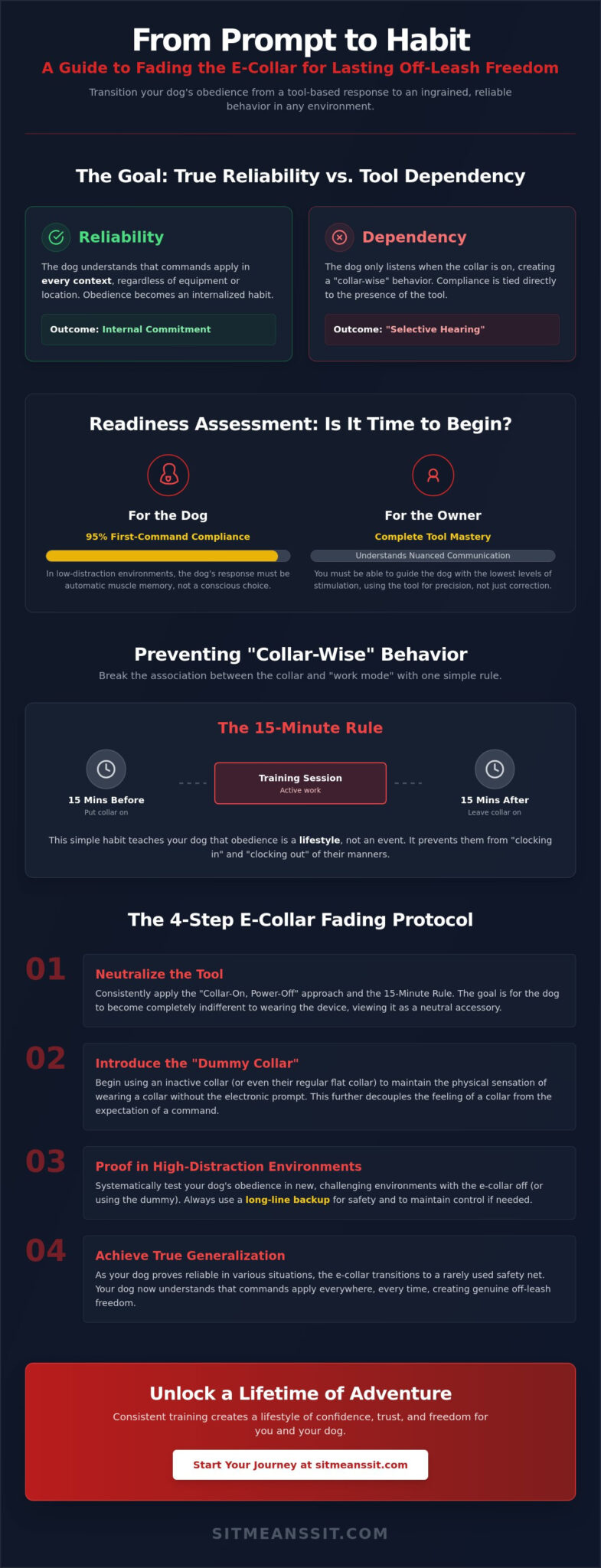
Timing is everything when learning how to fade the e-collar after training. You shouldn’t rush this process. Before you begin, your dog must demonstrate 95% first-command compliance in low-distraction environments. This means they respond immediately the first time you speak, almost every single time. The behavior needs to be muscle memory. If the dog has to “think” about whether to listen, they aren’t ready yet. The response should be automatic and fluid.
Owner mastery is just as vital as the dog’s performance. You must be completely comfortable with the remote training collar. You need to understand what an e-collar is and how it functions as a nuanced communication tool rather than a simple remote control. When you can use the lowest levels of stimulation to guide your dog with precision, you have the mastery required to begin the fading protocol. Mastery ensures that the transition is seamless and that your dog’s confidence remains high throughout the process.
Why Dogs Become ‘Collar-Wise’ and How to Prevent It
Your dog is a genius at pattern recognition. They aren’t trying to be stubborn; they’re simply reacting to the environment you’ve created. If the collar only appears when it’s time for drills, your dog learns that obedience is a temporary state. This is the root of contextual association. They link the physical weight of the equipment to the requirement of following commands. To achieve total freedom, you must break this link. You want a dog that listens because they understand the rules, not because they feel a device on their neck.
The most effective way to prevent this is by making the collar a neutral part of your dog’s daily wardrobe. We recommend the “Collar-On, Power-Off” approach. Let your dog wear the device even when you have no intention of using it. When the presence of the collar doesn’t always lead to a correction, the dog stops looking for the “off” switch in your training. This is a vital step in learning how to fade the e-collar after training because it shifts the focus from the tool to the relationship. It transforms the collar from a “work uniform” into a simple piece of jewelry that carries no special meaning.
The 15-Minute Rule
Never put the collar on and immediately start a training session. Follow the 15-minute rule to maintain absolute consistency. Gear up your dog 15 minutes before you plan to work. Once the session is over, leave the collar on for another 15 minutes while they relax or play. This prevents the dog from “clocking in” and “clocking out” of their manners. It teaches them that being a good dog is a lifestyle choice, not just a response to a training session. This simple habit ensures that your authority remains constant regardless of the equipment.
Using Inactive Collars as Dummies
As you progress, the physical sensation of the collar must remain consistent even as the electronic prompts decrease. This is where dummy collars become essential. A dummy collar provides the same weight and fit as the active tool but lacks the internal electronics. By alternating between the active remote training collar and a dummy version, you ensure your dog cannot distinguish between the two. They learn to stay under command because they never know if the tool is active or not. This creates a seamless bridge toward total off-leash reliability. If you want to see this transformation in action, our Board and Train programs specialize in building this level of professional, lifelong reliability.
A Step-by-Step Protocol for Fading the Remote Training Collar
Mastering how to fade the e-collar after training requires a shift from prompt-based communication to habit-based reliability. You aren’t just removing a tool. You are solidifying a lifestyle of obedience. This transition moves your dog from continuous reinforcement, where they expect a pulse with every command, to variable reinforcement. This is the testing phase. Your objective is to keep the remote in your hand but keep your finger off the button unless it is absolutely necessary. Never “test” your dog by putting them in a situation you know they will fail. Always set them up for success to build their confidence and yours.
Phase 1: Variable Reinforcement
Start by stopping the tap for every single command. When you give a directive, wait for the response. If your dog obeys immediately, reward them with praise or a treat. If they ignore the first command, give it a second time and pair it with a tap. This shift forces your dog to pay closer attention to your verbal cue rather than waiting for the sensation. Variable reinforcement is the strongest way to solidify a habit. It creates a dog that stays alert and ready to respond because the reward of compliance is always on the table.
Phase 2: The “Ghost” Remote
Dogs are masters of visual cues. If they see the remote in your hand, they know the rules are in effect. To break this association, move the remote to your pocket or keep it out of sight behind your back. You are transitioning from visual prompts to pure auditory commands. This phase builds your dog’s confidence that they can succeed without the visible safety net. It proves to the dog that your authority comes from your voice and leadership, not from the device you are holding. Stay consistent and keep your commands clear and decisive.
Phase 3: The Dummy Collar Transition
The final bridge to total freedom is the use of an inactive unit or a “dead” collar for two to four weeks. During this period, you must maintain the same high standards of dog obedience training that you established with the active tool. If your dog begins to test the boundaries, do not ignore the lapse. Immediately return to using the active collar for several days to reinforce the standard. Once the reliability returns, switch back to the dummy collar. This back-and-forth ensures that the dog never learns to distinguish between the active tool and the placeholder. Your goal is a dog that remains under command regardless of what is around their neck.
Proofing Obedience Without the Tool in High-Distraction Environments
True reliability means your dog listens when it matters most. Fading the collar is rarely a straight line. You might have perfect recall in your living room but find your dog struggles when a squirrel darts across the street. High-stimulation environments often require the tool for a longer duration to ensure safety. During this stage, use a long line as a secondary backup. This physical tether provides a safety net while you continue the process of how to fade the e-collar after training in the real world. At Sit Means Sit, we focus on results that happen in your daily life, not just inside a controlled training facility. We follow the Three-Environment Rule: master the backyard first, move to the quiet neighborhood sidewalk, and finally conquer the local dog park.
This systematic approach prevents your dog from feeling overwhelmed. If you move too fast, you risk breaking the trust and structure you have worked so hard to build. By proofing in stages, you ensure the dog’s internal commitment remains high. You want your dog to feel empowered to make the right choice even when the world is loud and distracting. This transition is about moving from external control to internal discipline.
The Distraction Ladder
Systematically increase the level of difficulty to build lasting muscle memory. Start with low-level distractions like a rolling ball or a family member walking by. Progress to higher stakes like other dogs, bicycles, or wildlife. If your dog fails a command in a new environment, don’t get frustrated. Simply return to the active collar for that session. This reinforces the standard that a command is a contract, not a suggestion. You are building a rock-solid foundation where the dog understands that a directive is a definitive agreement regardless of the environment. This level of proofing is what separates a pet that knows tricks from a dog that is truly under command.
Maintenance Sessions
Never retire the collar permanently. Even the most elite dogs benefit from a occasional tune-up. Use the collar once a month or when visiting high-risk areas like crowded hiking trails, camping trips, or public events. These maintenance sessions keep your dog’s skills sharp and prevent the slow creep of selective hearing. For many owners, intermittent professional Board and Train refreshers are the best way to maintain peak performance and address any new behavioral challenges. Consistency is the only path to lifelong freedom and adventure. If you want to ensure your dog stays reliable for years to come, contact us to learn about our private lessons and group classes.
Transitioning to Lifelong Off-Leash Freedom with Sit Means Sit
The remote training collar was always intended to be a bridge, not a permanent crutch. It served as the foundation for a clear, concise language between you and your dog. Now that you’ve built that foundation, you’re ready to cross into a life of total freedom. Imagine a morning hike where your dog roams through the brush, exploring with joy, yet stays perfectly under command. They stop on a dime when you speak. They return the moment they’re called. This isn’t a dream; it’s the result of a structured transition from equipment-based obedience to a psychological habit of reliability. You’ve replaced your initial frustration with a sense of empowerment that changes everything about how you live with your pet.
At Sit Means Sit, we believe that discipline is the ultimate key to a more adventurous and joyful life. Structure doesn’t limit your dog; it grants them the safety to experience the world without the constant tether of a leash. When your dog understands that a directive is a definitive agreement rather than a suggestion, the bond between you reaches a level of mastery that few owners ever experience. You’ve done the hard work of building the habit. Now, it’s time to enjoy the liberation that comes with a perfectly behaved companion.
The Sit Means Sit Advantage
Our specialized instruction ensures you never become dependent on the tool. We teach you the nuances of communication so the equipment eventually becomes a silent safety net rather than a requirement. One of the greatest benefits of our program is the access to group classes. These sessions provide ongoing proofing and socialization in a controlled yet high-stimulation environment. It’s the perfect way to maintain your dog’s skills and ensure they remain reliable regardless of what other dogs or people are doing around them. We are committed to your dog’s well-being and your long-term peace of mind.
Ready for Total Control?
You don’t have to navigate this transition alone. Whether you’re working with a high-drive hunting breed or a stubborn family pet, our programs offer universal applicability. We’ve encountered every possible challenge and remain unfazed because our methodology is rooted in proven results. We can show you exactly how to fade the e-collar after training while maintaining the high standards you’ve established. It’s time to stop worrying about selective hearing and start enjoying the confidence of a professionally trained dog. Replace the anxiety of off-leash walks with the pride of total control. Book a consultation today to master your off-leash communication and start your new lifestyle.
Experience the freedom of a perfectly behaved dog—contact Sit Means Sit today!
Embrace a Future of Total Off-Leash Freedom
You’ve built the foundation. Now it’s time to live the lifestyle. By mastering the 15-minute rule and utilizing dummy collars, you’ve already broken the cycle of equipment dependency. Moving through the phases of variable reinforcement ensures your dog listens to your voice, not just a pulse. Learning how to fade the e-collar after training is the final step toward a life of adventure without the tether of a leash. You’ve transformed from a frustrated owner into a confident leader.
Sit Means Sit brings over 25 years of professional training experience to every session. Our national network of expert trainers provides specialized remote training collar instruction that focuses on your dog’s well-being and your peace of mind. We don’t just train dogs; we transform lives. You deserve the confidence that comes with a perfectly behaved companion in any environment. Stop settling for selective hearing. Take the lead and turn your hard work into lifelong reliability.
Master off-leash control with Sit Means Sit; Book Your Free Consultation!
Your journey to total off-leash mastery starts today. We can’t wait to see what you and your dog will achieve together. Let’s get started.
Frequently Asked Questions
How long does it take to completely fade the e-collar?
Expect the fading process to take approximately two to four months after your dog has mastered basic obedience. This timeline varies based on your dog’s individual temperament and your consistency with daily practice. You must achieve 95% first-command compliance in high-distraction areas before moving to the final stage of the protocol. Rushing this transition often leads to avoidable relapses, so focus on the quality of every interaction.
Is it okay to use the e-collar only for specific situations like hiking?
Yes, using the tool as a safety net for high-risk activities is a responsible choice for any owner. While your dog may be perfectly reliable in a quiet neighborhood, a hiking trail presents unpredictable distractions like wildlife or steep terrain. Keeping the remote training collar on during these adventures ensures your dog stays under command even when their natural instincts are at their peak. It provides total peace of mind.
What should I do if my dog stops listening as soon as I take the collar off?
Immediately return to the “Collar-On, Power-Off” strategy to break the contextual association your dog has formed. This reaction proves your dog has become collar-wise and believes the rules only apply when they feel the equipment. By having them wear the tool during relaxed times at home without using it, you teach them that the standards of obedience are a constant part of their lifestyle regardless of gear.
Will my dog ever be able to go 100% without any collar?
Most dogs can achieve total off-leash reliability, but they should always wear a standard flat collar with identification for safety. The objective of learning how to fade the e-collar after training is to remove the electronic prompt while maintaining the habit of obedience. While the electronic tool may eventually be retired to the drawer, the internal commitment to your commands must remain a permanent part of your dog’s behavior.
Can I use a dummy collar indefinitely?
You can use a dummy collar for as long as necessary, but it is intended as a transitional tool rather than a permanent solution. Its purpose is to ensure your dog cannot distinguish between active and inactive equipment during the proofing phase. If you find yourself relying on a placeholder for years, it is a sign that you should book a professional refresher to strengthen your dog’s internal discipline and response.
Does fading the collar mean I stop using treats or praise?
No, you should never stop using praise and positive reinforcement to reward your dog’s good choices. While you are reducing the electronic prompts, you are actually strengthening the psychological bond between you and your pet. High-energy praise and rewards ensure that the transition away from the tool feels like a positive evolution. This keeps your dog motivated and excited to stay under command in any environment.
How do I know if my dog is “collar-wise” or just needs more training?
A collar-wise dog obeys perfectly when wearing the tool but ignores you the moment it comes off. If your dog struggles to follow commands even while wearing an active collar, they simply need more foundation work to master the basics. Understanding this distinction is vital when learning how to fade the e-collar after training. If the behavior is equipment-dependent, you must focus on neutralizing the physical sensation of the tool.
What is the best way to handle a “relapse” in obedience during the fading phase?
Immediately go back one step in the protocol and reintroduce the active remote training collar for at least three to five days. Relapses are a natural part of the learning curve, especially when you introduce a new or high-stimulation environment. Don’t get frustrated by a temporary setback. Use the tool to reinforce the standard, and once your dog is 100% reliable again, you can resume the fading process with confidence.
Comments are closed.