

Board and train isn’t a magic wand; it’s a structural reset that only fails if you let it. You want a dog that listens the first time, whether you’re at a crowded park or just opening the front door. It’s frustrating to invest your money and emotional energy into a program only to worry that old habits like bolting or aggression will creep back in the moment you’re back in charge. You’ve likely felt that knot of anxiety about being away, wondering if the long-term results of board and train are actually worth the distance. We’re here to replace that worry with absolute confidence.
Lasting transformation is entirely possible when professional mastery meets owner commitment. You’ll discover how these programs create permanent behavioral shifts and exactly what you must do to ensure your dog’s new skills stick for life. We’ll break down the mechanics of behavioral retention and show you how to step into your role as a confident leader. Prepare to see how structure creates the freedom you’ve always wanted for your dog. It’s time to turn your frustration into a sense of pride and adventure.
Key Takeaways
- Define success by your dog’s reliable obedience in high-distraction, real-world environments rather than just their performance in a controlled facility.
- Discover how professional immersion and expert timing create the foundational habits necessary to secure the long-term results of board and train.
- Master the “Go-Home” transition to ensure you learn your dog’s new language and maintain their progress once they return to your daily routine.
- Learn to use the Remote Training Collar as a clear, low-level communication tool that provides a reliable safety net for total off-leash freedom.
- Select a program that prioritizes lifetime support and group classes to guarantee your dog remains a predictable and well-behaved companion for life.
What Are the Long-Term Results of Board and Train?
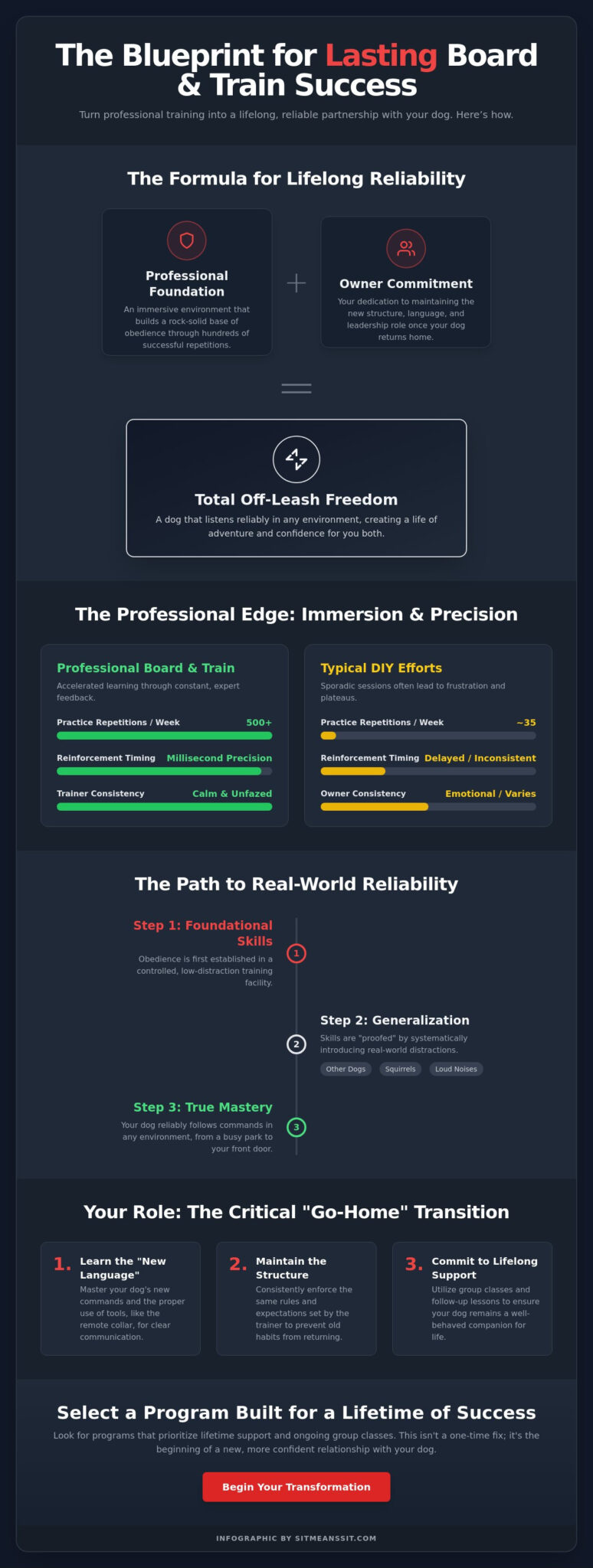
True success isn’t just a dog that sits for a treat in your kitchen. Real long-term results of board and train mean having a dog that remains reliable in high-distraction, real-world environments. Imagine your dog holding a “place” command while a delivery driver knocks or coming back instantly when you call them at a busy park. That’s the standard we aim for. However, we must address the “magic pill” myth immediately. A board and train program is a massive head start, not a finished product that requires zero future effort. It builds a rock-solid foundation through behavioral conditioning, which is far more effective than sporadic home sessions.
Professional immersion works because it accelerates learning. Instead of five minutes of practice after a long workday, your dog receives hundreds of repetitions in a single week. This immersion creates a clear language between the trainer and the animal. But remember, the final outcome is a 50/50 split. We build the foundation; you maintain the lifestyle. Without your commitment to the new structure, even the best training can fade. Different dog training methods offer various paths, but immersion is the fastest way to achieve deep-seated behavioral changes.
The Difference Between Short-Term Obedience and Long-Term Reliability
Your dog might be a star at the training facility but act like they’ve never heard a command once they hit the local park. This happens because dogs are situational learners. They need to learn “generalization,” which is the ability to apply a command regardless of the environment. Reliability comes from proofing behaviors against squirrels, other dogs, and loud noises. If you don’t vary the environment, you don’t have long-term reliability; you only have a facility-trained pet. Generalization takes time and consistent exposure to different triggers.
Why 2026 Is the Year of the Balanced Training Approach
In 2026, the industry is seeing a massive shift toward professionalization. Owners are looking for mastery, driving the market toward a projected $43.8 billion valuation this year. This growth is fueled by a desire for balanced training that prioritizes clear communication and fair boundaries. People want a lifestyle-integrated approach where their dog can actually participate in their daily adventures. This means moving away from constant treat-shoveling or harsh corrections. Instead, we use tools and techniques that foster a deep bond through mutual respect and clear expectations. Discipline isn’t a restriction. It’s the key to a joyful, off-leash life.
Why a Professional Foundation Outperforms DIY Efforts
YouTube tutorials make it look easy. But watching a video isn’t the same as having a professional trainer’s intuition. The long-term results of board and train depend on a foundation that DIY efforts simply cannot replicate. Professionals operate with a level of precision that captures the exact moment your dog makes a good choice. We’re talking about milliseconds. If your timing is off by even a second, you’re accidentally rewarding the wrong behavior. This precision is what builds a clear, frustration-free connection that sticks for years.
Immersion is the second heavy hitter. Think about the math. A typical owner might manage five minutes of training after a long day. In a professional program, your dog gets 500+ successful repetitions in a single week. This high volume of “wins” creates a default setting for your dog. They stop guessing and start knowing. This constant feedback loop is why professional work is so much more durable. We also follow established humane training guidelines to ensure this progress is built on trust and clarity.
Professional Timing and Consistency
Expert trainers use specific reinforcement schedules to turn a new command into a permanent habit. When you train at home, it’s easy to “poison” a command by using it inconsistently. For example, if you call your dog and then immediately do something they dislike, you’ve just taught them that “come” is a trap. Professionals avoid these pitfalls. We remain unfazed by behavioral outbursts. Whether your dog is bolting or showing signs of aggression, a trainer’s calm, consistent feedback provides the stability a stressed animal needs. This professional authority replaces a dog’s anxiety with a sense of security and pride.
Overcoming the Learning Plateau
Most owners quit when things get tough. It’s natural to feel defeated when your dog hits a plateau or starts testing boundaries. A board and train program is designed to push through these sticking points with relentless consistency. We don’t just train in a quiet room. We proof commands in diverse, high-stimulation settings once the foundation is set. This ensures the behavior holds up when a squirrel runs by or another dog barks. We build the mastery so you can enjoy the transformation.
If you’re tired of the “two steps forward, one step back” cycle, it’s time to consider a professional reset. We neutralize distractions in a controlled environment before moving to the real world. This ensures every repetition is a success. This expert problem-solving is especially critical for complex issues like extreme anxiety or reactivity. Don’t settle for temporary fixes when you can have a well-behaved companion for life.
The Owner Factor: Bridging the Gap from Kennel to Couch
The trainer builds the foundation. You build the lifestyle. While professional immersion provides the initial breakthrough, the long-term results of board and train are ultimately decided in your living room. This is why the “Go-Home” session is the most important hour of the entire program. It isn’t just a pickup; it’s a transfer of authority. You aren’t just getting your dog back. You’re learning to speak a new, clearer language that your dog already understands. If you don’t step into your role as a leader from the moment you take the leash, your dog will naturally test the old boundaries of their old environment.
Regression happens when owners treat the return home as a return to the “old ways.” To prevent this, you must view yourself as a partner in the process. We use private lessons to refine this bond and ensure you’re comfortable with every command. These sessions bridge the gap between the facility and your couch, giving you the confidence to handle real-world distractions with ease. You’ve invested in a transformation. Now, it’s time to own it.
The Critical Transition Period
The first 72 hours back home are a test of leadership. Your dog is looking to see if the new rules apply in their old territory. Start by restricting their freedom. Don’t let them bolt through the front door or jump on the furniture if those were old problem behaviors. Establish immediate structure by practicing “place” commands while you cook dinner or “heel” during a short walk around the block. The biggest mistake owners make is giving too much freedom too soon. This leads to a training “fade” where the dog realizes they can get away with old habits. Stay firm, stay consistent, and keep the boundaries clear.
Integrating Training into Your Daily Routine
You don’t need to carve out an hour for “training sessions” if you adopt a training lifestyle. Every interaction is an opportunity for reinforcement. Use mealtime to practice a solid “sit” and “wait” before they eat. Use your daily walks to proof their “heel” command against neighborhood distractions. This constant, low-pressure practice ensures the long-term results of board and train stay sharp. For the best outcome, attend group classes regularly. These classes provide the social proofing your dog needs to remain a predictable, well-behaved companion in any environment. When training becomes a habit, reliability becomes a reality.
Maintaining Reliability with the Remote Training Collar
Reliability isn’t just about what happens when your dog is right next to you. It’s about what happens when they’re 50 yards away and a squirrel darts across their path. This is where the Remote Training Collar becomes your most valuable asset. Contrary to outdated myths, this tool isn’t about punishment; it’s about clear, low-level communication. Think of it as a tap on the shoulder that works at a distance. This tool is the secret to securing the long-term results of board and train by providing a consistent way to reach your dog regardless of the environment.
Consistency is the enemy of bad habits. When you use the collar to reinforce commands, your dog learns that “come” or “sit” is a definitive agreement, not a suggestion. Over time, this steady practice creates a dog that listens so well they eventually need the tool less. You’re building a muscle memory for obedience. The goal is a dog that chooses to listen because the communication has always been fair, clear, and reliable. This creates a foundation of trust that lasts for the rest of your dog’s life.
Clear Communication Over Physical Strength
Many owners struggle with dogs that are physically stronger than they are. If you’re being dragged down the street, you aren’t in control. The Remote Training Collar is the great equalizer. It allows you to lead with your mind rather than your muscles. It works by redirecting your dog’s attention back to you the moment they become fixated on a distraction. The Remote Training Collar serves as a digital bridge for off-leash communication between you and your dog. By using low-level signals that the dog barely feels, you provide a gentle reminder to stay focused on the task at hand. This professional approach replaces frustration with a sense of mastery and empowerment.
Achieving Total Off-Leash Control
Imagine the psychological freedom your dog feels when they can explore a hiking trail without a restrictive leash. This liberation is only possible through structure. The collar provides a safety net that prevents “command deafness” when the world gets loud or exciting. Whether you’re on a busy street or in the middle of the woods, you have a direct line of communication. It ensures that your dog remains “on command” even when they’re enjoying their freedom. This is a supportive tool that fosters a deeper bond, allowing for a more adventurous and joyful life together. You can finally stop worrying about bolting and start enjoying the journey.
Ready to experience this level of freedom with your own pet? Learn more about our specialized programs at sitmeanssit.com and take the first step toward total off-leash control.
Selecting a Board and Train Program Built for Life
Your choice of trainer is the single biggest predictor of success. Not all programs are created equal. Some facilities focus on temporary compliance in a quiet room; others build a foundation that survives the real world. The long-term results of board and train are only as strong as the program’s support system. You aren’t just buying a trained dog. You’re investing in a lifelong partnership. Look for programs that include lifetime support or group classes. These resources ensure that as your dog grows and your environment changes, your control remains absolute.
Demand to see real-world proof. Facility videos are easy to fake. A dog sitting in a sterile kennel doesn’t prove they’ll listen when a cat runs by. Look for trainers who show you dogs working in high-distraction zones like busy downtowns or local parks. A service dog training level of precision should be the standard for any pet program. If a trainer can’t achieve that level of reliability, they shouldn’t be handling your dog’s behavioral transformation. Excellence is the only acceptable baseline.
Red Flags and Green Lights in a Trainer
Watch out for trainers who promise a “finished” dog with zero owner involvement. This is a massive red flag. If they tell you that you don’t have to change your habits, they are setting you up for failure. A green light is a trainer who insists on multiple follow-up sessions and gives you homework. They should be evaluating your ability to lead, not just the dog’s ability to follow. There is also immense value in a national franchise system. With a 22% growth in franchise dog training since 2020, these systems offer proven, standardized results that independent shops often can’t match. Consistency in the method leads to consistency in the animal.
The Sit Means Sit Dog Training Difference
We don’t just train dogs; we empower owners. The Sit Means Sit Dog Training methodology is designed to replace your frustration with a sense of mastery. Our programs focus on the adventure and joy that come from a well-behaved dog. We believe discipline is the path to liberation. It allows you to take your dog anywhere with total confidence. You’ve felt the anxiety of a dog that won’t listen. Now, imagine the pride of a dog that responds instantly every single time. It’s time to stop settling for “good enough” and start your journey toward total reliability. Replace your frustration with pride and start your journey today. Visit sitmeanssit.com to find a location near you and secure the future you and your dog deserve.
Your Journey to Total Off-Leash Freedom Starts Now
Transformation is a decision. You’ve seen how a professional foundation outpaces DIY efforts and why the transition home is your time to lead. Securing the long-term results of board and train requires a commitment to the lifestyle we’ve built together. By using clear communication and reliable tools, you’re not just managing a pet; you’re cultivating a bond based on mutual respect and adventure. The days of worrying about bolting or aggression are over when you embrace the structure your dog needs to thrive.
Sit Means Sit Dog Training brings over 25 years of professional training experience to every client. Our national network of expert trainers focuses on real-world, off-leash reliability that works when it matters most. We believe every dog deserves the freedom that comes from discipline. You’ve waited long enough for a predictable, well-behaved companion. It’s time to take the final step and reclaim your peace of mind.
Transform your dog’s behavior and your lifestyle—find a Sit Means Sit Dog Training trainer near you today! We can’t wait to help you discover the joy of a truly liberated life with your dog.
Frequently Asked Questions
Will my dog forget me if I send them away for board and train?
Absolutely not. Dogs have incredible long-term associative memory and your bond is far deeper than a few weeks of separation. If anything, the time away creates a healthy reset. When they return, they’ll be excited to see you and far more willing to listen to your new, clear direction. You remain their primary source of love and security; we just add the structure they need to succeed.
How long do the results of a 2-week board and train program typically last?
The results can last a lifetime if you maintain the lifestyle we establish. A 2-week program builds a rock-solid foundation, but the long-term results of board and train depend on your consistency once they return. Without your leadership, any training can eventually fade. However, when you follow our maintenance plan, those new habits become permanent traits that define your dog for the rest of their life.
What happens if my dog goes back to their old habits after coming home?
Contact us immediately to troubleshoot the breakdown in communication. Regression usually happens when boundaries in the home environment become blurry or inconsistent. We provide follow-up support to identify exactly where the “fade” is happening. We’ll get you back on track quickly before a minor slip becomes a major problem, ensuring your confidence remains high and your dog remains obedient.
Is board and train effective for older dogs with deep-seated behavioral issues?
Yes, you can absolutely teach an older dog new boundaries and better behaviors. While 52% of urban pet owners prioritize training in the first year of adoption, older dogs often benefit the most from a professional reset. Deep-seated issues like aggression or bolting require the mastery and patience of an expert. We have encountered every possible challenge and remain unfazed by an older dog’s history.
Can I still use positive reinforcement alongside a board and train program?
Yes, balanced training relies heavily on rewarding good choices. We use praise, play, and treats to capture desired behaviors while using the Remote Training Collar for clear, low-level communication. This combination ensures your dog is motivated to succeed and understands exactly what is expected of them. It builds a relationship based on trust, clarity, and mutual respect rather than just compliance.
How much time will I need to spend training my dog once they return from the program?
You don’t need hours of dedicated drills; you need a training lifestyle. Instead of long sessions, integrate commands into your existing daily routine. Spend five minutes proofing a “place” command while you cook dinner or practicing a “heel” during your morning walk. This steady practice ensures your dog’s skills stay sharp without adding a burden to your busy schedule.
Is the Remote Training Collar safe for all breeds and sizes?
It is completely safe for every dog when used as a communication tool. The collar uses low-level electronic stimulation similar to a TENS unit used in human physical therapy. It’s designed to get your dog’s attention, not to cause pain or fear. We carefully adjust the levels to suit the specific sensitivity of your individual pet, ensuring they receive a gentle tap they can understand.
What is the “Go-Home” session, and why is it mandatory?
This session is the official transfer of authority from the trainer to the owner. It is mandatory because you must learn how to speak your dog’s new language and handle them with confidence. Without this education, your dog will quickly realize the old rules still apply to you. We ensure you leave the facility feeling empowered and ready to lead your well-behaved companion.
Comments are closed.