

What if the difference between a stressful walk and a proud public outing wasn’t your dog’s personality, but a specific standard of communication? Many owners think their dog is ready for the world until they hit a crowded cafe or a busy park. Mastering public access dog training is the bridge between a good pet and a reliable partner that remains calm in any environment. It is the definitive shift from simply managing your dog’s behavior to actually communicating with them.
You know that sinking feeling when your dog lunges at a passerby or ignores your commands in a high-distraction zone. It is frustrating to feel like you are constantly on edge, wondering if your dog will listen when it matters most. You deserve to feel empowered and proud every time you leave the house. We understand that struggle, and we are here to replace that anxiety with absolute confidence through proven structure.
This guide reveals the exact training phases and standards required for total reliability in 2026. You will learn how to transition from simple pet-friendly spaces to full public access mastery. We will show you how to build a foundation that ensures your dog stays focused on you, regardless of the chaos around them. Get ready to transform your bond and start living a life of adventure without limits.
Key Takeaways
- Master the distinction between basic manners and true public access dog training to ensure your dog remains neutral and focused in any environment.
- Identify the “automatic fail” behaviors of the Public Access Test so you can train with precision and avoid common pitfalls.
- Apply the “3 D’s” of training; Distance, Duration, and Distraction to turn every directive into a definitive agreement.
- Follow a structured roadmap that transitions your dog from low-distraction foundations to total reliability in busy, non-pet-friendly zones.
- Leverage immersive programs like Board and Train and the Remote Training Collar to accelerate your results and achieve total off-leash control.
What is Public Access Dog Training? Beyond Basic Manners
Public access dog training isn’t just about teaching your dog to sit; it’s about teaching them to listen when the whole world is screaming for their attention. Most dogs can perform a perfect “stay” in the quiet comfort of a kitchen. That same dog might crumble the moment they step into a crowded hardware store or a busy sidewalk cafe. True public access means your dog remains neutral and obedient in environments where dogs aren’t usually the focus. This level of mastery transforms you from a frustrated owner who is constantly managing a leash into a proud partner enjoying a seamless outing.
Think of this as the ultimate lifestyle upgrade. You’re no longer limited to the backyard or the local dog park. Instead, you gain the freedom to navigate life with your companion by your side, confident they’ll handle every new sight and sound with poise. This training replaces the anxiety of “what if” with the certainty of “I know.” It’s about building a bond so strong that your dog chooses you over every distraction the environment throws their way. Discipline creates the path to a more adventurous and joyful life for you both.
Service Dog Standards vs. Elite Pet Obedience
While the Americans with Disabilities Act (ADA) provides specific legal protections for service dogs in “no-pet” zones, every dog owner benefits from these elite behavioral standards. Training your pet to service-dog levels of behavior opens up a world of possibilities. There is a massive difference between a “pet-friendly” patio and a high-stakes public environment. In a crowded store, “good enough” behavior is a liability. You need a dog that treats every directive as a definitive agreement, not a suggestion. This discipline isn’t about restriction; it’s about the liberation to take your dog anywhere with absolute certainty.
The Goal of Public Access: Neutrality
The ultimate objective of public access dog training is neutrality. A neutral dog is a safe, reliable dog. They possess the rare ability to ignore passing strangers, dropped food, and other barking dogs without losing their connection to you. Focus is the most valuable currency you have in high-distraction zones. When your dog is locked onto you, the environment becomes background noise. Neutrality is a dog’s refusal to be moved by environmental stimuli. Achieving this state requires steady practice and clear, consistent communication. It’s the difference between a dog that is simply present and a dog that is truly prepared for the world.
The Public Access Test (PAT): Understanding the Gold Standard
The Public Access Test (PAT) is the definitive benchmark for reliability. It is the moment where your training meets the real world. While basic obedience focuses on simple commands, the PAT evaluates the total picture of your dog’s behavior in high-stakes environments. This isn’t just a dog test; it is a team evaluation. Your ability to lead is just as critical as your dog’s ability to follow. Successful public access dog training culminates in this gold standard of performance, proving your dog can handle the pressure of the public eye.
Certain behaviors are non-negotiable. Aggression, persistent barking, or indoor eliminations result in an automatic fail. These are the red flags of a dog that isn’t ready for the pressure of public spaces. Beyond avoiding these pitfalls, the ‘Heel’ and ‘Under’ commands are your best friends. A tight heel ensures you can navigate narrow aisles with ease. The ‘Under’ command keeps your dog tucked safely away in busy areas. This ensures they don’t become a trip hazard for others while maintaining their own sense of security.
Common Public Access Tasks
Mastering the basics is only half the battle. You must prove your dog can handle specific, real-world scenarios with grace. This includes controlled entry and exit from vehicles and buildings. Your dog shouldn’t bolt the moment a door opens. Restaurant etiquette is another essential pillar. Your dog should remain tucked under a table, ignoring the chaos of foot traffic and the enticing smell of food. Even “drive-by” distractions, like a toddler running past or a dropped piece of pizza, must be met with total indifference. These tasks demonstrate that your dog is a neutral participant in the environment.
Why Most Dogs Fail Their First Public Evaluation
Most failures stem from a lack of engagement. If your dog is scanning the room instead of checking in with you, their focus is misplaced. Over-stimulation occurs when the environment becomes louder than your voice. This is why the core of effective public access dog training is building a rock-solid foundation before ever stepping into a store. If you find yourself hitting a wall, an immersive Board and Train program can provide the professional structure required to pass with flying colors.
Washing out is a term used when a dog simply isn’t suited for the stress of public access. However, many owners confuse a lack of foundation with a lack of ability. Before you decide your dog isn’t cut out for it, evaluate your structure. Are your directives suggestions or definitive agreements? Total reliability requires a shift in mindset. You are building a lifestyle, not just checking off a list of tasks. With the right approach, you can replace your frustration with the pride of having a perfectly behaved companion.
The Science of Attention: Mastering High-Distraction Environments
Success in the real world depends on one thing: attention. At Sit Means Sit Dog Training, we operate under a simple but powerful philosophy. Every directive is a definitive agreement, not a suggestion. When you give a command, your dog must understand that it isn’t optional. In the context of public access dog training, this level of clarity is life-changing. It replaces the frantic repetition of commands with a calm, certain response. You aren’t just managing a pet; you’re leading a partner who knows exactly what is expected of them.
Mastering this focus requires an understanding of the 3 D’s: Distance, Duration, and Distraction. You can’t expect a dog to hold a stay in a busy mall if they haven’t mastered it in a quiet park. We build reliability by systematically increasing the difficulty of these three factors. By the time you reach the public square, your dog has already practiced the discipline needed to ignore the chaos. This structured approach ensures that your dog’s focus remains on you, even when the environment is competing for their eyes and ears.
Dogs often ignore commands in public because the environment is more interesting than the owner. To win this competition, you must become the most relevant thing in their world. Achieving total off-leash control in 2026 requires conditioning your dog to prioritize your voice over every squirrel, car, or stranger. This isn’t about being louder; it’s about being more consistent. When your dog knows that listening leads to a better experience, their focus becomes automatic.
Building Focus in a Noisy World
Start small to win big. Don’t jump from the living room directly to a festival. Transition to the driveway, then the sidewalk, then a quiet park. We use the ‘Look at Me’ principle to condition the dog to check in automatically. Every time your dog chooses to look at you in a new environment, they are building a habit of engagement. You can even use the environment as a reward. After a successful command, “releasing” your dog to go sniff a tree or explore a safe area reinforces that listening pays off.
Managing Thresholds
Every dog has a breaking point. A dog’s threshold is the limit where their training breaks down under pressure. If your dog hits sensory overload, they aren’t being “bad”; they are overwhelmed. When this happens, use a tactical reset. Move your dog back to a distance where they can successfully listen again. This preserves their confidence and keeps the training positive. By respecting these limits and gradually pushing them, you ensure that public access dog training remains a source of pride rather than a source of stress.
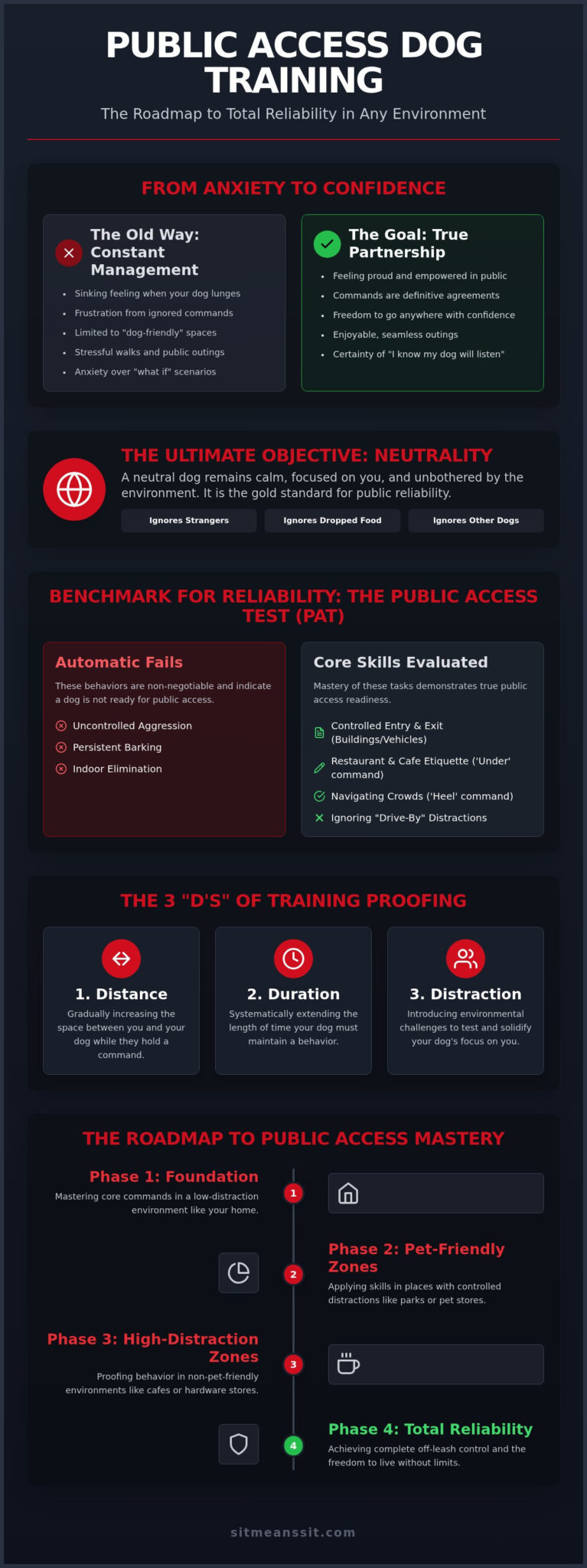
The Roadmap to Public Access: Phases of Training
Achieving total reliability doesn’t happen by accident. It requires a clear, step-by-step path. You can’t skip the basics and expect success in a crowded lobby. This roadmap provides the structure you need to move from “maybe he’ll listen” to “I know he will.” Discipline isn’t a cage; it’s the key to a more adventurous life. Follow these phases to build a foundation that lasts.
- Step 1: Foundation. Establish the rules in a quiet space where your dog can win. Solidify basic commands like sit, stay, and come without distractions.
- Step 2: Generalization. Move to the driveway and local parks. Prove that the rules apply everywhere, not just in your living room.
- Step 3: Proofing. Add the chaos. Use shopping carts, loud engines, and sudden movements to test their focus.
- Step 4: Immersive Practice. Focus on long-duration stays in high-traffic zones. This is where public access dog training becomes second nature.
- Step 5: Maintenance. Standards slip without practice. Keep the routine alive with consistent daily sessions to keep your dog’s skills sharp.
The Puppy Preschool Advantage
Start as early as possible. Early socialization is the secret weapon for future public access dog training success. It allows us to prevent fear-based reactions before they ever become ingrained habits. By exposing your puppy to new surfaces and sounds in a controlled way, you build a confident foundation. Don’t wait for problems to start. Check out our Puppy Training Classes to get started on the right paw and set your dog up for a lifetime of public reliability.
Proofing with Purpose
You must simulate “the worst” to prepare for the best. Real-world environments are unpredictable. Practice on slippery tile floors, ride in elevators, and walk through automatic doors. These environments feel different to a dog and require specific conditioning. If you’re struggling to bridge the gap between home and the public, our Day Training programs offer the professional support needed to proof these behaviors in real-time. We help you identify weak points and turn them into strengths.
Take the first step toward a more joyful and liberated life with your pet. Find a Sit Means Sit Dog Training location near you and let’s turn your dog into a perfectly behaved companion today.
Accelerating Results: How Sit Means Sit Dog Training Achieves Public Reliability
Establishing total reliability through public access dog training shouldn’t feel like a lifelong struggle. While some peer-led programs suggest a timeline of several years, our methodology at Sit Means Sit Dog Training accelerates that transformation. We focus on immersion to build deep-seated habits quickly. Our Board and Train program provides the intensive conditioning required for your dog to remain neutral and responsive in any environment. We do the heavy lifting of proofing behaviors against high-level distractions so you can step into the world with a partner who is already prepared.
Professional trainers at Sit Means Sit Dog Training handle the initial conditioning to ensure your dog understands that every command is a definitive agreement. Once the foundation is rock-solid, we transition that leadership back to you. This hand-off is the most critical part of the process. You learn to maintain the standards we’ve set, ensuring that your dog’s reliability remains high for the rest of their life. Stop settling for “good enough” and start demanding excellence. The foundation for public access dog training requires a professional touch to ensure safety and success.
The Remote Training Collar for Public Access
Communication is the heartbeat of safety in public spaces. In a high-noise zone like a busy airport or a crowded festival, your voice can get lost in the chaos. The Remote Training Collar acts as a clear, consistent safety net. It replaces shouting with a gentle “tap” on the shoulder, gaining your dog’s immediate focus without stress. This tool allows for precise off-leash communication, ensuring your dog listens even when the world is at its loudest.
Mastering the “Place” command is another game-changer for public outings. Whether you’re at a sidewalk cafe or a busy lobby, your dog needs to know where they belong. We use the collar to reinforce this boundary, making it clear that staying in “Place” is their primary job until released. This level of structure creates a calm animal that feels secure because they know exactly what to do. It turns a potentially stressful situation into a routine exercise in focus.
Your Partner in Public Mastery
You shouldn’t have to limit your life because of your dog’s behavior. We are the experts for owners who refuse to settle for average manners. Sit Means Sit Dog Training is here to replace your frustration with a sense of empowerment and pride. Imagine the feeling of walking through a busy store with a dog that ignores every distraction and stays locked on your lead. It isn’t just a dream; it’s the inevitable result of our proven methodology.
Take the leap toward a more adventurous and joyful life today. A perfectly behaved companion is the key to liberation for both you and your pet. Contact Sit Means Sit Dog Training for a Free Evaluation and let’s begin the journey toward total public reliability together. Your dog is capable of greatness, and we have the tools to help them achieve it.
Take Command of Your Future Together
You’ve seen that the journey to total reliability is about more than just simple commands. It’s about mastering neutrality and building a bond rooted in clear, definitive agreements. By following a structured roadmap and understanding the science of attention, you can navigate any environment with poise. Public access dog training is the ultimate key to a life without limits. It turns every outing into a source of pride rather than a source of stress. Discipline is the foundation of your new, adventurous lifestyle.
Our professional trainers have encountered every behavioral challenge and remain unfazed. We deliver industry-leading results in off-leash control by empowering owners with the Remote Training Collar and our proven methodology. Don’t let frustration hold you back from the adventures you and your dog deserve. It’s time to replace anxiety with the absolute confidence of a perfectly behaved companion. Structure is the path to liberation for both you and your pet.
Achieve total public reliability with our Board and Train program and start your transformation today. The world is waiting for you both. We are ready to help you lead the way with confidence and joy.
Frequently Asked Questions
Is public access training only for service dogs?
No, public access dog training is for any owner who wants their pet to be a reliable companion in the real world. While service dogs require these standards by law, pet owners benefit from the same level of focus and neutrality. Achieving this mastery allows you to take your dog to cafes and shops with total confidence. It turns a stressful walk into a proud, seamless outing.
How long does it take to train a dog for public access?
The timeline varies based on the dog’s foundation and your chosen training method. Some peer-led programs suggest one to three years, but professional immersion can accelerate those results significantly. Our Board and Train programs focus on intensive conditioning to build habits fast. While every dog is different, consistent daily practice ensures these high standards become permanent. Your dedication to the process is the ultimate deciding factor.
Can any breed of dog be trained for public access?
Yes, any breed can succeed with the right structure and clear communication. We believe that every dog is capable of greatness regardless of their size or lineage. Success depends more on the individual dog’s temperament and your commitment to the training roadmap. Professional evaluation helps identify specific challenges early. With a results-oriented approach, we transform any dog into a calm, confident partner ready for any environment.
What is the difference between an emotional support animal and a dog with public access?
Emotional support animals (ESAs) are primarily recognized for housing rights and do not have the same public access rights as service dogs. A service dog is specifically trained to perform tasks that mitigate a disability. Public access dog training ensures these dogs remain neutral and obedient in “no-pet” zones. Most ESAs are not required to meet these elite behavioral standards, which is a critical distinction for handlers.
What happens if my dog barks once in a public place?
A single bark isn’t always a disaster, but it is a clear signal that your dog has hit a sensory threshold. You must act immediately to regain focus and reset their emotional state. In a formal Public Access Test, persistent barking is an automatic fail. Use a tactical reset by moving your dog back to a successful distance. This proactive leadership prevents a small distraction from turning into embarrassment.
Do I need a vest or a certificate for my dog to have public access?
No, the law does not require a specific vest or a formal certificate for a service dog to have public access. Many handlers use vests for clarity, but your dog’s behavior is the true indicator of their training. Businesses can only ask if the dog is a service animal and what task it performs. Focus on the results of your training rather than a piece of paper.
What are the legal requirements for public access in the United States?
The Americans with Disabilities Act (ADA) governs the legal requirements for service dogs in the United States. To qualify for public access, a dog must be trained to perform a specific task for an individual with a disability. They must also remain under the handler’s control at all times. If a dog is disruptive or not housebroken, a business can legally ask for the animal’s removal.
Can I train my own dog for public access, or do I need a professional?
You can train your own dog, but professional help is the fastest path to mastering public access dog training. Public environments are high-stakes, and mistakes can lead to stress or safety issues. Professional trainers provide the “proofing” needed to ensure your dog listens in every situation. Our experts use tools like the Remote Training Collar to establish clear feedback. This support replaces frustration with absolute empowerment.
Comments are closed.