
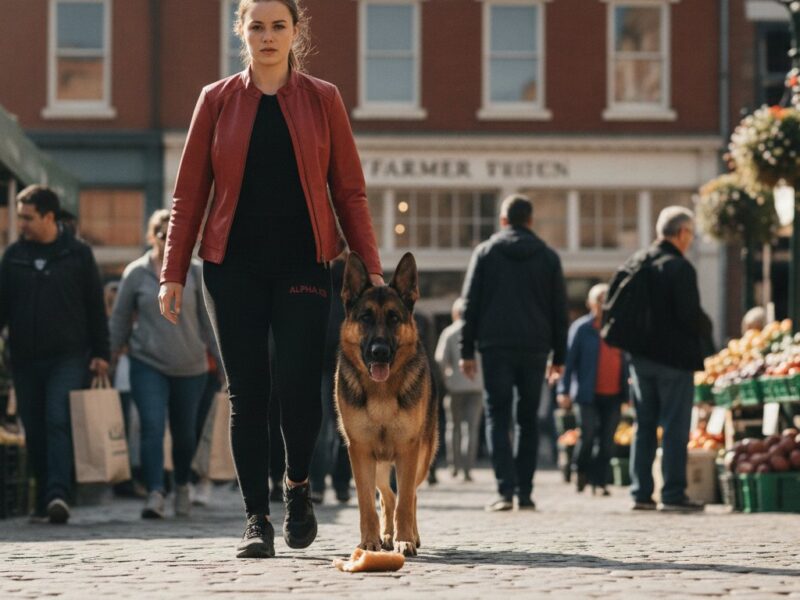
Imagine walking into a bustling farmer’s market where your dog remains perfectly heel-locked, ignoring the chaos of dropped food and lunging pets. For most owners, this feels like an impossible dream, but it’s actually the direct result of clear boundaries and structured conditioning. If you’ve ever felt the sting of embarrassment when your dog barks at a stranger, you know that traditional dog training for public places often fails when the stakes are high. You deserve to take your dog anywhere without the constant weight of anxiety or unpredictability.
We’re here to transform that frustration into a sense of pride. You’ll learn how to build a bond so strong that your dog views your commands as a definitive agreement rather than a suggestion. This article provides a roadmap to achieving total reliability in 2026, covering essential public access standards and the technical mastery needed to proof your dog against any distraction. We’ll explore how to navigate high-stimulation environments with professional-level obedience, giving you the liberation to live a more adventurous and joyful life together.
Key Takeaways
- Move beyond basic manners to achieve professional-grade neutrality. Learn how to condition your dog to stay focused in even the most chaotic environments.
- Understand the “Distraction Ceiling” and why traditional obedience often crumbles outside the home. We’ll show you how to bridge the gap between your living room and the real world.
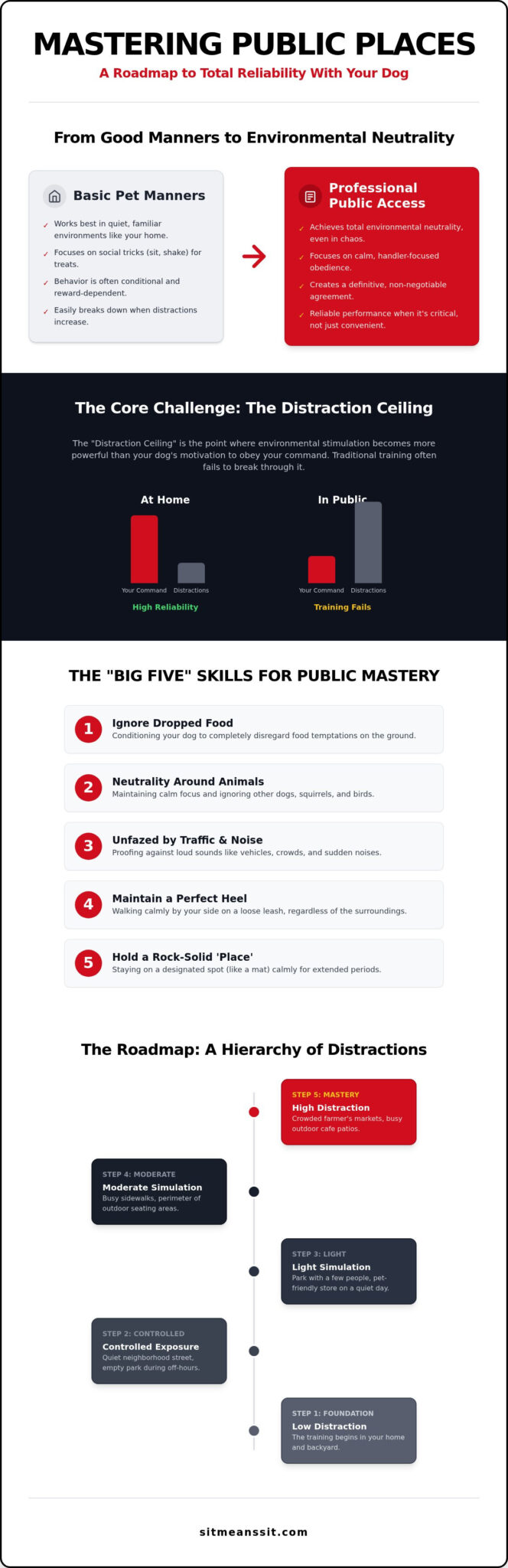
- Master the “Big Five” essential skills for dog training for public places to ensure your dog ignores food, animals, and traffic with total confidence.
- Follow a structured roadmap using the “Hierarchy of Distractions.” This proven method allows you to proof behaviors systematically without overwhelming your companion.
- Explore how immersive programs like Board and Train build a definitive agreement of obedience. Turn every outing into a stress-free experience through professional-grade structure.
Defining Public Access: More Than Just “Good Manners”
Most owners believe a dog that sits for a treat in the kitchen is “trained.” They’re often surprised when that same dog ignores every command the moment they step onto a busy sidewalk. True dog training for public places isn’t about teaching tricks; it’s about achieving total environmental neutrality. We define public access as the absolute conditioning of a dog to remain neutral, calm, and obedient in high-stimulation environments. It is the bridge between a pet that behaves when it’s convenient and a companion that performs when it’s critical.
Basic pet manners usually focus on social interactions like shaking paws or not jumping on guests. Professional-grade public access standards are different. They require a dog to exist in a space as if the distractions around them don’t exist at all. When you commit to dog training for public places, you’re choosing a lifestyle of adventure. This training is the ultimate goal for anyone who wants to take their dog to outdoor cafes, hardware stores, or crowded festivals without the constant weight of anxiety. It replaces your frustration with a sense of absolute empowerment.
This level of training is what allows you to confidently visit professional establishments; for example, when visiting the experts at Astrid Gold for goud verkopen Antwerpen, your dog’s discipline ensures a seamless and stress-free experience.
Service Dogs vs. Publicly Accessible Pets
There’s a significant legal distinction between a pet and an Assistance dog. Under the ADA, service animals have specific rights to enter businesses where pets are typically barred. However, every pet owner should aim for service-level behavior. Why? Because a dog that acts with professional-grade composure is always a welcome guest. When your dog remains tucked under a table or heels tightly through a crowd, you ensure the safety and comfort of everyone around you. You have a responsibility to be a disciplined handler, ensuring your dog never becomes a nuisance in non-traditional public spaces.
The Mindset of a Publicly Trained Dog
Transformation starts with a mental shift from an excited or anxious state to a neutral, working mindset. Most pets are constantly scanning their environment for the next “event,” whether that’s a dropped fry or a passing cyclist. A publicly trained dog looks to you for direction instead. Their confidence grows because they understand the boundaries of the situation. Environmental neutrality is a dog’s ability to remain unfazed by environmental triggers. This mindset is the key to liberation. It allows your dog to ignore the roar of traffic or the barking of a distant pet because they know their job is to stay focused on you. Discipline isn’t a restriction; it’s the secret to a joyful, adventurous life together.
Why Traditional Obedience Fails in High-Stimulation Environments
“My dog listens perfectly at home, but he completely ignores me at the park.” This is the number one objection we hear from frustrated owners. It’s a common struggle that stems from a fundamental misunderstanding of how dogs process information. When you move from your quiet living room to a bustling city street, the environment changes, and so does your dog’s ability to hear you. This is the core challenge of dog training for public places. Traditional methods often crumble because they don’t account for the “Distraction Ceiling.”
The Distraction Ceiling is the point where environmental stimulation outweighs your dog’s motivation to obey. In your kitchen, you are the most interesting thing in the room. At a busy outdoor mall, you’re competing with a thousand different smells, sounds, and movements. Your voice becomes background noise. To achieve total reliability, you need a communication style that cuts through this environmental clutter. We utilize a specialized Remote Training Collar to act as a “digital leash.” This tool provides a clear, tactile signal that ensures your dog stays tapped into your guidance, regardless of how loud the world gets.
The Science of Distraction and Attention
Every dog has a threshold for stimulation. Once they cross that line, their brain shifts into a reactive state where learning stops. Bribery with treats often fails here. A piece of chicken simply cannot compete with a fleeing squirrel or a passing bicycle in a high-stakes environment. You must build a foundation of “Attention First.” This means your dog learns to check in with you before you even give a command. By managing their threshold and providing clear feedback, you replace their anxiety with focused confidence. If you’re ready to see this transformation in action, our team can help you achieve total off-leash control in any setting.
Closing the Command Loop
At Sit Means Sit Dog Training, we operate on a simple but powerful philosophy: a command is a definitive agreement, not a suggestion. Traditional training often leaves a “no-choice” gap where the dog decides whether or not to listen based on the current distraction level. We eliminate that gap. By closing the command loop, you ensure 100% reliability every time you speak. This is the standard required for those following the ADA Requirements for Service Animals, and it’s the standard we set for every pet in our care. Establishing this level of foundational control is the first step in comprehensive dog obedience training. When your dog understands that “Sit” means “Sit” everywhere, you gain the freedom to explore the world together without limits.
The “Big Five” Skills for Professional Public Access
Achieving total reliability requires a specific toolkit. You can’t rely on luck when you’re in a crowded mall or a quiet library. Professional dog training for public places focuses on five non-negotiable skills that transform a pet into a focused partner. These behaviors aren’t just suggestions; they are the foundation of your dog’s safety and your peace of mind. Without mastery of these core movements, your dog remains a guest rather than a reliable companion.
First is the Reliable Recall. Your dog must return to you instantly, every single time. It doesn’t matter if there’s a squirrel darting across the street or a car door slamming nearby. Recall is your emergency brake. In high-stimulation environments, a split-second delay can lead to disaster. We train for immediate response because total control is the only acceptable outcome.
Next is the Leave It command. Public spaces are filled with dropped fries, discarded trash, and enticing smells. A dog ready for public access ignores these triggers without hesitation. This skill prevents dangerous ingestions and keeps your dog’s focus exactly where it belongs. By mastering this, you eliminate the constant battle over “street treats” and maintain a clean, professional presence.
Non-Negotiable Behaviors for Crowded Spaces
Loose leash walking is the hallmark of a disciplined companion. Your dog should move with zero tension, maintaining a tight heel even through narrow doors or busy passages. This level of dog training for public places ensures you can move through a crowd without being pulled or tripped. We also prioritize the “Under” or “Tuck” command. The “Under” command is a vital safety skill for navigating crowded urban environments, allowing your dog to safely settle beneath a restaurant table or a bus seat where they are out of the way of foot traffic.
Maintaining Focus During Long “Down-Stays”
Finally, we master the long “Down-Stay” using the “Place” command. This serves as a mental anchor. It tells your dog to switch off their curiosity and simply exist in the space. We build this duration systematically, moving from a five-minute settle to a full hour of quiet relaxation in a busy cafe. Understanding the difference between Service Animals and Emotional Support Animals is key here, as professional-grade training sets the standard for public acceptance. If you want to see how these skills integrate into a life of total independence, check out our specialized Service Dog Training programs. Discipline creates the freedom to go anywhere together.
The Roadmap to Reliability: Proofing Your Dog for the Real World
Reliability isn’t a switch you flip; it’s a ladder you climb. Many owners make the mistake of jumping from the living room straight to a busy festival, only to be met with frustration when their dog ignores them. This failure happens because the dog hasn’t been proofed through a proper “Hierarchy of Distractions.” Effective dog training for public places requires a systematic approach that builds confidence and reinforces commands at every level of stimulation. You must ensure that your dog’s obedience is a definitive agreement, not a choice made based on how interesting the environment feels.
To achieve total reliability, follow this structured progression:
- Step 1: The Foundation. Master all core commands in a low-distraction environment like your backyard. Your dog should be 100% focused here before moving forward.
- Step 2: Controlled Chaos. Introduce household distractions. Use squeaky toys, bouncing balls, or household noises like vacuums to test their focus while you remain in a familiar space.
- Step 3: Semi-Public Spaces. Move to quiet parks or empty parking lots. These areas offer new smells and distant sights without the overwhelming pressure of a crowd.
- Step 4: The Real World. Graduate to high-traffic zones. This includes pet-friendly hardware stores and busy downtown streets where the stimulation is constant and unpredictable.
Using Group Classes as a Training Lab
Practicing around other trained dogs is the ultimate public access simulator. Our Group Classes provide a safe, controlled environment to fail and correct under professional supervision. It is one thing to sit in a quiet park, but it is another to maintain a heel while ten other dogs are working nearby. A trainer’s expert eye helps you identify subtle signs of stress or distraction before they escalate. This environmental conditioning is what separates a pet from a truly reliable companion. If you are ready to test your dog’s limits in a professional setting, join one of our Group Classes today and see the transformation for yourself.
Tactical Use of the Remote Training Collar
Clear communication is the secret to off-leash reliability. We use the Remote Training Collar as a gentle tap on the shoulder to regain your dog’s focus instantly. It cuts through the environmental “noise” that often causes traditional training to fail. This tool allows you to maintain a calm emotional state for both you and your dog. You no longer have to worry about your dog bolting in public because you have a reliable way to communicate across any distance. This “digital leash” provides the structure needed for a more adventurous and joyful life, ensuring your dog stays neutral and focused regardless of the distractions around them.
Mastering Public Access with Sit Means Sit Programs
Reliability in the real world doesn’t happen by accident. It is the result of a deliberate, high-energy training methodology designed to overcome the unpredictability of modern life. Sit Means Sit programs are specifically engineered to bridge the gap between “home manners” and total public focus. We don’t just teach your dog to listen; we build a mindset where your commands are a definitive agreement. This is the standard of dog training for public places that we deliver every day. We replace your frustration with a sense of absolute empowerment.
Private Lessons offer a surgical, one-on-one approach to your specific goals. Perhaps your dog is perfect until they see a stroller, or maybe they struggle with the echo of a busy parking garage. We target these individual public access hurdles with precision coaching. You get the expert guidance needed to refine your handling skills while we proof your dog’s focus in real-time. This personalized attention ensures that no environmental trigger remains a barrier to your lifestyle. We empower you to lead with confidence in any situation.
Why Board and Train is the Gold Standard
For owners who want the fastest results, our Board and Train program is the ultimate deep dive. Our professional trainers perform the heavy lifting of environmental conditioning for you. We take your dog into diverse, high-stimulation environments every day. This ensures they achieve thousands of successful repetitions under expert supervision before they ever return home. This immersive path builds a level of fluency and “Total Control” that is nearly impossible to replicate in a standard classroom setting.
Ready for Total Control?
Stop settling for “good enough” behavior when you’re out in public. You shouldn’t have to cross the street to avoid another dog or leave a cafe because your pet won’t settle. It’s time to demand more from your dog training for public places and start enjoying the freedom you deserve. We invite you to see the Sit Means Sit difference firsthand with a free evaluation. We will assess your dog’s public access potential and show you exactly how we achieve professional-grade reliability. Transform your dog’s public behavior with Sit Means Sit!
Take Control of Your Public Adventures
Total reliability isn’t a happy accident. It’s the result of clear communication and a mindset of environmental neutrality. You’ve learned that professional-grade dog training for public places requires mastering the “Big Five” skills and systematically climbing the hierarchy of distractions. By replacing unpredictability with structure, you unlock a life of true freedom where your dog remains a focused partner in any environment. You no longer have to settle for “good enough” behavior or avoid the places you love.
We’ve spent over 25 years transforming difficult dogs into reliable companions through our specialized methodology. Our nationwide network of professional behavioral experts is ready to help you achieve expert off-leash control. Stop managing your dog’s reactions and start leading with confidence. It’s time to experience the liberation that comes with total obedience. Schedule your free dog training evaluation today! We can’t wait to help you and your dog start your next great adventure together with absolute pride.
Frequently Asked Questions
What is a Public Access Test (PAT) for dogs?
A Public Access Test is a rigorous evaluation designed to ensure a dog can behave reliably and unobtrusively in diverse public settings. While there is no federally mandated test under the ADA in 2026, organizations use these standards to benchmark a dog’s ability to ignore food, remain calm in crowds, and stay neutral around other animals. It proves that a dog is a safe, focused partner rather than a distracted pet.
Can any dog be trained for public access?
Most dogs can achieve a high level of environmental neutrality through structured conditioning and clear boundaries. While individual temperament and history play a role, our methodology focuses on building confidence in every animal. Even if a dog isn’t pursuing service work, dog training for public places empowers any owner to enjoy a more adventurous life with a companion they can actually trust.
How long does it take to train a dog for public access?
Achieving total reliability typically requires several months of consistent, daily practice to proof behaviors against high-level distractions. Immersive programs like Board and Train can significantly accelerate this timeline by establishing thousands of successful repetitions under professional supervision. The goal is to move beyond basic commands until obedience becomes a definitive agreement in any environment.
Is public access training only for service dogs?
No, this level of training is for any owner who wants the liberation of taking their dog anywhere without the weight of anxiety. While service dogs require these skills for legal access, pet owners benefit immensely from having a dog that settles quietly in a cafe or heels through a festival. It replaces the frustration of a reactive pet with the pride of a perfectly behaved companion.
What are the most common mistakes owners make in public?
The most frequent mistake is skipping steps in the hierarchy of distractions and expecting a dog to perform in a high-stress zone without a solid foundation. Many owners also try to use treats as a bribe when a dog is already over-stimulated, which rarely works in high-stakes environments. Success requires a “digital leash” and clear communication that cuts through environmental noise before the dog loses focus.
Do I need a special vest for my dog during public access training?
You don’t need a vest, as current ADA regulations in 2026 do not require any specific gear or identification for service dogs or those in training. Some handlers choose to use a vest to signal to the public that the dog is working and should not be disturbed. However, the true mark of a publicly trained dog is their behavior and focus, not the equipment they wear.
How do I handle people who want to pet my dog during training?
Advocate for your dog by politely and firmly telling strangers that your dog is currently working or in training. You have the responsibility to maintain your dog’s neutral mindset and prevent them from being rewarded for breaking focus. Keeping your dog in a disciplined heel or a “Place” command often provides a visual cue that signals to others that your dog isn’t available for social interaction.
What should I do if my dog has an accident or barks in a store?
Immediately remove your dog from the building to handle the situation and reset their emotional state. An accident or a bark is a clear signal that the environment was too stimulating for your dog’s current level of training. Don’t be discouraged; instead, use it as data to realize you need to step back in your roadmap and reinforce foundational neutrality in a lower-distraction area.
Comments are closed.