

What if your puppy’s relentless energy wasn’t an obstacle to overcome, but a superpower waiting to be directed? Most owners approach puppy behavior training as a battle of wills, yet the most successful partnerships are built on a definitive agreement of mutual respect. You’re likely tired of the sleepless nights, the shredded furniture, and the embarrassment of being ignored at the local park. It’s a common struggle, but it doesn’t have to be your reality.
We promise to replace your frustration with a sense of total empowerment. This guide provides a professional behavioral framework designed to transform chaotic puppy energy into lifelong off-leash reliability. You’ll learn how to master the art of puppy communication and stop unwanted behaviors the moment they start. We’ll preview the essential role of early socialization in our Puppy Preschool and explain how tools like the Remote Training Collar provide the clarity your dog craves. Get ready to build a bond that turns every walk into an adventure and every command into a promise of freedom.
Key Takeaways
- Master the art of puppy behavior training by focusing on clear communication and redirecting natural instincts into positive habits.
- Learn why attention is the foundation of every command and how to maintain focus even in high-distraction environments.
- Identify the critical differences between DIY home training and the accelerated results found in a professional Puppy Preschool.
- Implement immediate, practical solutions for common frustrations like “puppy shark” nipping and potty training accidents.
- Build a foundation of reliability that turns your chaotic puppy into a confident, off-leash companion ready for any adventure.
Understanding Puppy Behavior: Why Your Puppy Does What They Do
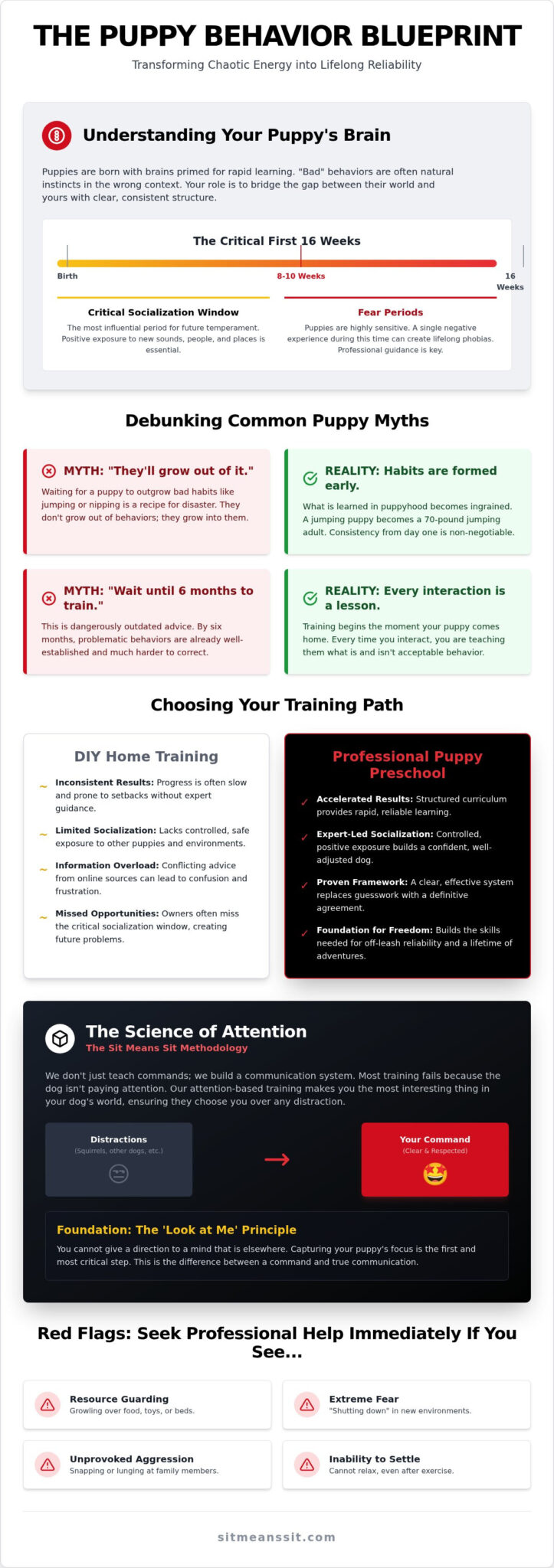
Puppies are born in an altricial state. This means they enter the world completely dependent on their mother for survival, yet their brains are essentially blank slates primed for rapid programming. From the moment they open their eyes and ears, they are absorbing data about their environment at a staggering rate. Effective puppy behavior training starts by acknowledging this high-speed learning phase. You aren’t just teaching a few tricks; you’re teaching your puppy how to exist in a human world that is entirely foreign to their wild instincts.
Most “bad” behaviors are actually natural behaviors performed in the wrong context. Nipping isn’t a sign of a mean dog; it’s a puppy’s primary way of exploring textures and testing boundaries. Jumping isn’t an act of defiance; it’s an instinctive greeting. While some resources only explain why these things happen, we focus on how to channel that energy into a definitive agreement. You must bridge the gap between their instincts and your household expectations through consistent, clear structure. Discipline isn’t about restriction. It’s the key to a joyful life where your dog understands exactly what is expected of them.
The first 16 weeks of a dog’s life represent the critical socialization window. This is the most influential period for their future temperament. If you wait until they are older to introduce them to new sounds, people, and environments, you’re already playing catch-up. This is why we emphasize the importance of our Puppy Preschool. It provides the controlled, positive exposure necessary to prevent future behavioral disasters before they take root.
Watch for red flags that indicate you need professional intervention immediately:
- Resource guarding, such as growling over food, beds, or toys.
- Extreme fear or “shutting down” when encountering new people or environments.
- Snapping or unprovoked lunging toward family members or other pets.
- An inability to settle or relax even after physical exercise and mental stimulation.
The Biology of the ‘Puppy Brain’
A puppy’s attention span is measured in seconds, not minutes. This biological reality requires high-frequency, short-duration training sessions that keep them engaged without causing mental fatigue. You must also be aware of fear periods, which typically occur between 8 and 10 weeks and again during adolescence. A single negative experience during these windows can create lifelong phobias. Understanding various dog training methods helps you navigate these sensitive stages without damaging your puppy’s confidence. What feels like a behavioral disaster to you is often just a young brain struggling to process a complex world.
Debunking Puppy Behavior Myths
Stop waiting for your puppy to grow out of bad habits. They don’t grow out of behaviors; they grow into them. If your puppy learns that jumping gets them attention now, they’ll be a 70-pound adult jumping on your guests later. Another dangerous myth is that you shouldn’t start training until a dog is six months old. By six months, many problematic habits are already ingrained. Every single interaction you have with your puppy is a training session, whether you intend it to be or not. Start early, stay consistent, and demand reliability from day one.
The Science of Attention: Sit Means Sit Methodology
Effective puppy behavior training isn’t a collection of parlor tricks. It’s a sophisticated communication system. At Sit Means Sit, our philosophy centers on Attention-Based Training. We don’t just want your dog to know what ‘sit’ means; we want them to care that you said it. Most owners fail because they issue commands to a dog that isn’t even looking at them. If your puppy is staring at a squirrel, your voice is just background noise. We change that dynamic instantly by making you the most interesting thing in your dog’s world.
There is a massive difference between a command and true communication. A command is often a one-way street where the owner simply hopes for compliance. Communication is a two-way definitive agreement. When you speak, your puppy recognizes it as a directive that requires immediate focus. This focus allows for total reliability in high-distraction areas like busy parks or outdoor cafes. We move beyond the bribery of food lures. While treats have their place, they often fail when the environment becomes more exciting than the snack. Our framework ensures your puppy chooses you over the distraction every single time.
Why Attention is the Foundation of All Obedience
Everything starts with the ‘Look at Me’ principle. You cannot give a direction to a mind that is elsewhere. Capturing focus is the first step in any successful interaction. You must learn to compete with environmental distractions like barking dogs, passing cars, or enticing scents. Our Puppy Training Classes are designed to build this focus in real-world scenarios. We don’t train in a vacuum. We train where life happens. This ensures your puppy’s reliability isn’t limited to your living room. It’s about creating a dog that listens because they are tuned into your frequency.
Clear Communication with the Remote Training Collar
The secret to our results is the proprietary use of the Remote Training Collar. Think of this tool as a physical tap on the shoulder. It’s a gentle, non-vocal way to say, ‘Hey, pay attention to me.’ It cuts through the mental fog of a distracted puppy without the need for shouting or physical force. Professional instruction is vital here to ensure the tool is used correctly. We teach you how to use this technology to provide consistent, clear feedback. This level of clarity is the fastest path to achieving your Dog Obedience Training goals. When communication is this clear, your puppy gains the confidence to navigate the world off-leash. If you want to see this level of focus in action, contact a local trainer to experience the Sit Means Sit difference firsthand.
Puppy Preschool vs. DIY: Choosing the Right Training Path
You’ve likely seen the viral videos online. They make it look easy. Just hold a treat, wait for the sit, and your puppy is suddenly a model citizen. Real-life puppy behavior training doesn’t happen on a curated video set. It happens in the real world. DIY training often works in your quiet kitchen but falls apart the second you step outside. The problem with at-home training is the lack of controlled distraction. You simply can’t replicate the energy and variety of a professional environment by yourself. Stop guessing and start leading with a proven system.
DIY training often leads to “fair weather” obedience. Your dog listens when it’s quiet, but ignores you when it matters most. Professional Puppy Preschool bridges this gap. It places your puppy in a high-stimulation environment under the watchful eye of an expert. You’ll learn to identify the subtle body language cues that precede a behavioral blowout. This professional oversight ensures that your puppy behavior training stays on track. You get immediate feedback on your own handling errors. This prevents you from accidentally reinforcing the very behaviors you want to stop, like jumping or excessive barking.
The Benefits of Puppy Preschool
When to Consider a Board and Train Program
Sometimes, basic classes aren’t enough to handle a high-energy or difficult puppy. If your puppy shows early signs of resource guarding, extreme fear, or relentless reactivity, you need a more intensive approach. Our Board and Train program is the immersive solution for owners who want faster, more definitive results. We do the heavy lifting in a professional setting. This creates a rock-solid foundation of skills that you can easily maintain at home. It’s a total transformation in a fraction of the time. You skip the months of struggle and go straight to the lifestyle of freedom you deserve.
Actionable Guidance: Solving the Top 3 Puppy Problems
Stop managing your puppy’s chaos and start engaging their mind. Most owners rely on crates and gates to survive the early months. While management has its place, successful puppy behavior training relies on active engagement. You want a dog that chooses to listen, not just a dog that is physically restrained. Transitioning from a state of constant reaction to one of proactive leadership is the only way to achieve long-term reliability. We focus on building drive and focus so your puppy looks to you for direction in every situation.
The “Puppy Shark” phase is the first major hurdle. Common advice tells you to yelp when your puppy nips to show them it hurts. For a high-drive puppy, that high-pitched sound is just a squeaky toy invitation to bite harder. Instead of making noise, provide a definitive alternative. Use a toy to redirect that predatory drive. If the nipping continues, the interaction ends immediately. This creates a clear boundary: biting humans stops the fun, while biting toys continues the engagement. Consistency here is non-negotiable.
Potty training fails when routines are loose. Establish a fail-proof schedule that matches your puppy’s biological needs. Take them out after every nap, every meal, and every vigorous play session. On the leash, prevent pulling before it becomes a lifelong habit. Keep the leash loose and reward the moment your puppy looks back at you. Finally, master the “Place” command. This isn’t a “stay”; it’s a boundary. Teaching your puppy to relax on a specific mat or bed on cue is the ultimate tool for a peaceful household. If you are struggling with these basics, schedule a consultation with a Sit Means Sit expert to get your training back on track.
Mastering the Art of Redirection
Successful redirection requires you to be faster than your puppy’s impulses. Always have a high-value toy ready to swap for your hand or the furniture. You aren’t just moving their mouth; you are redirecting their focus. Use energy-burning games like tug or fetch to drain their physical battery. This reduces destructive chewing because a tired puppy is a well-behaved puppy. Set your environment up for success by removing temptations until the “definitive agreement” of what is and isn’t a toy is fully understood.
Building Real-World Reliability
Reliability dies in the living room if you never practice elsewhere. Move your training sessions into different rooms, the backyard, and eventually the front sidewalk. Apply the Three D’s of training: Distance, Duration, and Distraction. Gradually increase how far you are from your puppy, how long they must hold a command, and the level of noise around them. This process transitions them from a scattered “Puppy” mindset into a “Reliable Companion” mindset. You are building the confidence to take your dog anywhere, knowing they will remain focused on you regardless of the environment.
The Path to Freedom: Long-Term Behavioral Success
Training doesn’t have an expiration date. It is a lifelong commitment to the bond you share with your dog. While the initial phase of puppy behavior training focuses on stopping accidents and nipping, the long-term goal is total liberation. You want a dog that can navigate a crowded outdoor market or a steep hiking trail with the same level of focus they show in your living room. This transition from “puppy manners” to “advanced reliability” is where many owners stall. They stop training once the dog is “good enough,” but “good enough” doesn’t give you the freedom of off-leash control. Demand more from your partnership.
True success means integrating your dog into every aspect of your life. Imagine a future where you don’t have to leave your best friend at home when you head to a cafe or go on a weekend trip. This level of reliability is achieved through consistent practice and environmental proofing. As your puppy matures into an adult, you may encounter new challenges or complex transitions. Knowing when to consult a Dog Behaviorist versus a standard trainer can make all the difference in maintaining your dog’s mental well-being during these shifts. We provide the roadmap to ensure that every stage of your dog’s life is marked by clarity and confidence.
Living the Sit Means Sit Lifestyle
There is a profound joy in owning a dog that listens the first time, every time. It eliminates the stress of public embarrassment and the fear of dangerous situations. Structure doesn’t just benefit you; it increases your pet’s happiness by providing a world they understand. When expectations are clear, anxiety disappears. You also join a community of like-minded, responsible owners who value the same level of mastery. This is more than just a class. It is a commitment to a higher standard of companionship and a more adventurous life together.
Your Next Steps to a Better Behaved Puppy
Every puppy is unique. Your journey starts with a professional evaluation to assess your puppy’s current temperament and your family’s specific goals. Whether you need the immersive experience of a Board and Train program or the collaborative environment of Group Classes, we have a path for you. Don’t settle for a life of frustration and restricted freedom. Take the first step toward a transformative partnership today. Transform your puppy’s behavior with a Sit Means Sit evaluation!
Claim Your Future of Off-Leash Freedom
Your puppy has the potential to be the perfect companion. You now understand how biological insights and the science of attention bridge the gap between chaos and control. Effective puppy behavior training isn’t about mere management; it’s about building a definitive agreement that lasts a lifetime. Since 1998, Sit Means Sit has delivered decades of professional expertise to families just like yours. We replace the stress of nipping and potty accidents with a proven path to mastery.
Our specialized Puppy Preschool and results-oriented off-leash communication methodology provide the clarity your dog needs to thrive. Stop settling for a dog that only listens when there aren’t any distractions. You deserve the confidence to take your pet anywhere, from busy cafes to mountain trails. It’s time to transform your frustration into pride through a framework that prioritizes both structure and the bond you share.
Schedule Your Professional Puppy Evaluation Today!
The life of adventure and joy you’ve imagined with your dog is within reach. Take the lead and start your transformation today. We’re ready to help you every step of the way.
Frequently Asked Questions
When should I start puppy behavior training?
Effective puppy behavior training begins the day you bring your new companion home. The most critical learning window occurs between 8 and 16 weeks of age. Waiting until they are six months old means you’ll spend more time fixing established bad habits than building a foundation of success. Establish clear boundaries and start basic obedience immediately to ensure your puppy grows into a reliable adult.
How do I stop my puppy from biting and nipping at my hands?
Redirect their mouth to a high-value toy the second they try to nip your skin. If your puppy continues to target your hands, end the interaction instantly by walking away. This creates a clear boundary: biting stops the fun, while playing with toys continues the engagement. Avoid high-pitched yelping, as this often excites high-drive puppies and encourages them to bite even harder.
Is my puppy too young for a Remote Training Collar?
We typically introduce the Remote Training Collar after a puppy has built a solid foundation through our Puppy Preschool program. This tool isn’t for correction; it’s for clear, long-distance communication. Once your puppy understands basic directions, the collar becomes the “physical tap” that ensures they pay attention to you regardless of environmental distractions. It is the fastest path to total off-leash reliability.
How long does it take to potty train a puppy completely?
Most puppies can be fully potty trained within four to six months if you maintain a strict, fail-proof schedule. Your success depends on your ability to prevent accidents before they happen. Take your puppy outside after every meal, nap, and play session. Consistency is the only way to turn a house-training routine into a permanent, reliable habit that keeps your home clean and stress-free.
What is the difference between puppy socialization and just meeting other dogs?
Socialization is about neutral exposure to the entire world, while meeting dogs is just a small part of that process. True socialization includes experiencing different surfaces, loud noises, and new environments without fear or over-excitement. The goal is a dog that remains calm and focused on you in any situation. Simply letting your puppy play with every dog they see often leads to over-arousal and future reactivity.
Can a Board and Train program really work for a young puppy?
An immersive Board and Train program is highly effective for establishing a rock-solid foundation in a fraction of the time. It allows our professional trainers to handle the repetitive, high-frequency sessions that a young puppy’s short attention span requires. You skip the months of frustration and receive a puppy that is already programmed for success, making it easy for you to maintain their progress at home.
What should I do if my puppy is showing signs of aggression?
Schedule a professional evaluation immediately if you notice growling, resource guarding, or unprovoked snapping. These behaviors rarely disappear on their own and often escalate as the dog matures. Early intervention allows us to address the root cause of the behavior before it becomes a dangerous, ingrained habit. Don’t wait for a “phase” to pass; take decisive action to protect your puppy’s future and your family’s safety.
How do I teach my puppy to focus on me when there are distractions?
Mastering puppy behavior training in high-distraction environments requires a foundation of attention-based engagement. Start in a quiet room and reward the moment your puppy makes eye contact. Gradually move to more challenging environments, like your backyard or a local park, as their focus improves. By using our specific methodology, you’ll teach your puppy that looking at you is always more rewarding than chasing a squirrel or barking at a neighbor.
Comments are closed.