
Your dog isn’t ignoring other dogs because they’re stubborn; they’re ignoring you because you haven’t become more interesting than the environment. It is a bold truth, but it’s the key to your liberation. We’ve all felt that spike of adrenaline when another dog appears on the horizon. You brace for the lunging, the physical strain on your arm, and the judgmental stares from neighbors. It’s exhausting, and it turns what should be a joyful outing into a source of deep anxiety. Mastering the professional process of training a dog to ignore other dogs on walks is the definitive path to reclaiming your peace of mind.
You deserve to walk with pride, not panic. With Millennial owners now spending an average of $1,200 annually on their pets’ well-being, the standard for canine behavior has never been higher. Discipline isn’t a restriction. It is the bridge to a more adventurous life where your dog chooses you over every distraction in the park. We are moving past the frustration of reactive behavior and stepping into a world of absolute confidence and reliable communication.
This guide delivers the exact engagement techniques used to transform chaotic reactivity into a calm, focused partnership. We will explore how to build real-world focus and master environmental control through proven professional methods. Get ready to turn every walk into a stress-free victory.
Key Takeaways
- Identify the root cause of reactivity, whether it is fear or frustration, to stop the cycle of leash tension and emotional escalation.
- Establish “Sit Means Sit” as a lifestyle and master the “Focus” command to ensure your dog prioritizes you in any environment.
- Implement the professional “U-Turn” maneuver and mobile “Place” commands to navigate busy parks with absolute confidence.
- Stop the “Treat Trap” by learning the definitive difference between bribing your dog and rewarding a successful command.
- Explore how professional Board and Train programs and Group Classes deliver the reliability required for training a dog to ignore other dogs on walks in high-stimulation settings.
Understanding Why Your Dog Reacts to Other Dogs
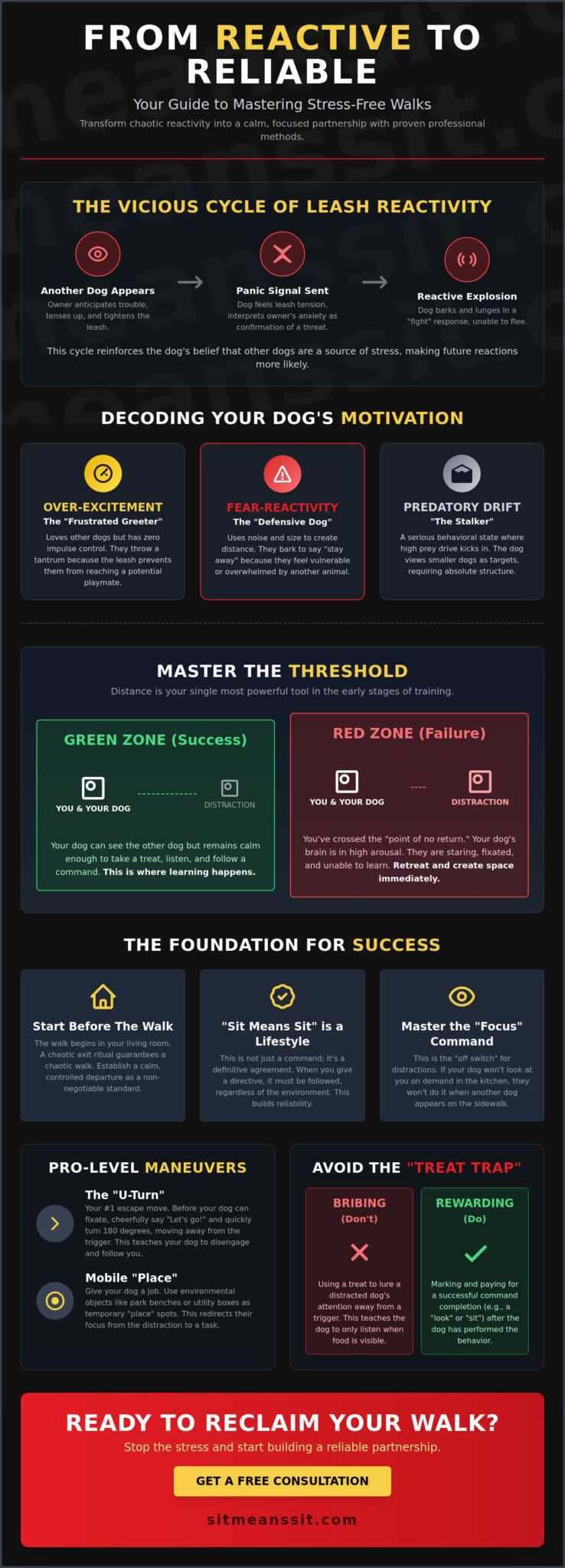
Reactivity is not a mystery. It is a predictable sequence of events fueled by emotion and environment. Your dog is not being “bad” or “spiteful” when they erupt at the sight of a neighbor’s Labrador. They are communicating. For many owners, the struggle starts with a “hard stare.” This intense, unblinking focus is the first red flag of a looming walk disaster. Once your dog locks eyes and freezes, they have already stopped listening to you. If you don’t break that focus immediately, the barking and lunging are inevitable consequences of that mental “lock-on.”
Leash tension often acts as the primary catalyst for an explosion. When you see another dog and instinctively shorten your grip, you send a physical signal of panic directly down the line. Your dog feels your heart rate spike and interprets the tight leash as a warning that a threat is imminent. This physical restriction triggers a “fight or flight” response because the dog knows they cannot move away. Understanding Dog Aggression and Leash Reactivity helps owners realize that these outbursts are frequently defensive. Your anxiety travels down the leash, confirming to your dog that the environment is unsafe.
The Spectrum of Dog Reactivity
Not all reactivity comes from the same place. Success in training a dog to ignore other dogs on walks requires you to identify your dog’s specific motivation. Consider these three common profiles:
- Over-excitement: These “frustrated greeters” love other dogs but have zero impulse control. They throw a tantrum because the leash prevents them from reaching a potential playmate.
- Fear-reactivity: This dog uses noise and size to create distance. They bark to say “stay away” because they feel vulnerable or overwhelmed by the presence of another animal.
- Predatory drift: This occurs when high prey drive kicks in. The dog views smaller dogs as targets rather than social peers. This is a serious behavioral state that requires absolute structure and professional mastery.
The Threshold Concept
Every dog has a “bubble.” This is the specific distance at which they can see another dog but still remain calm enough to take a treat or follow a command. This is your “green zone.” The secret to training a dog to ignore other dogs on walks is staying within this zone as long as possible. Once you cross the “point of no return,” your dog’s brain enters a state of high arousal where learning is impossible. Distance is your greatest tool in the early stages. If your dog is staring and refusing to look at you, you are too close. Turn around, create space, and regain the connection before you try again.
The Foundation: Building Engagement Before the Walk Starts
The walk does not start on the sidewalk. It starts in your living room. If your dog is frantic before the leash is even clipped, you’ve already lost the battle for their attention. Most owners make the mistake of allowing a chaotic “pre-walk” ritual. Bolting out the door in a state of high arousal sets a baseline of excitement that makes reactivity inevitable. You must establish a calm, controlled exit as a non-negotiable standard. Success in training a dog to ignore other dogs on walks depends entirely on the engagement you build in a zero-distraction environment first.
At the core of this foundation is the principle that “Sit Means Sit.” This is not just a command; it is a lifestyle. It represents a definitive agreement between you and your dog. When you give a directive, it must be followed regardless of the environment. Mastering the “Look” or “Focus” command indoors allows you to capture your dog’s eyes on demand. This mental connection is the “off switch” for environmental distractions. If your dog won’t look at you in the kitchen, they certainly won’t look at you when a squirrel or another dog appears on the horizon.
To achieve this level of reliability, many owners find that private lessons help bridge the gap between basic obedience and real-world mastery. Following a structured plan like Cornell’s Guide to Managing Reactive Dogs reinforces the necessity of starting in controlled settings. You are building a history of successful choices before the stakes get high.
Engagement Drills for Home
Turn your home into a training lab. Start with the “Check-In” game. Reward your dog every single time they choose to look at you without being prompted. This teaches them that you are the most rewarding thing in the room. Practice short-leash healing in the hallway to establish physical boundaries. Once they are perfect in silence, manufacture distractions. Drop toys, have family members walk by, or open the front door. Your dog must remain focused on you despite the noise. This is how you build the mental muscle required for training a dog to ignore other dogs on walks.
The Role of Clear Communication Tools
Communication must be crystal clear. Traditional collars often send “blurry” signals, especially when a dog is highly aroused. We use the Remote Training Collar to provide a consistent, low-level “tap” for attention. Think of it like a tap on the shoulder. It cuts through the environmental “noise” without causing stress. This electronic communication allows you to whisper to your dog from a distance. Transitioning from physical leash pressure to this precise “tap” creates a more sophisticated bond. It replaces the physical struggle with a reliable, digital connection that works every time.
Practical Techniques for Managing Distractions in Real-Time
Moving from the hallway to the sidewalk is the ultimate test of your leadership. You’ve mastered the “Focus” command at home. Now, you must apply it when the stakes are real. One of the most effective tools in your arsenal is the “U-Turn” maneuver. This isn’t a retreat; it’s a tactical redirection. When you spot a distraction that is too close for your dog’s current threshold, execute a swift, confident turn. This breaks the visual lock and reminds your dog that you are the one leading the adventure. Don’t wait for the bark. Turn the moment you see the stare.
Maintaining a rhythmic, brisk pace is equally vital. A dog in motion is a dog in a working mindset. If you slow down or stop when you see another dog, you’re inviting your pet to fixate. Keep your feet moving. Use the “Watch Me” drill as a distraction passes at a safe distance. This is a practical application of the “Look at That” Training Method, where the dog learns to acknowledge a stimulus and then immediately look back to you for direction. This creates a cycle of engagement rather than escalation. It turns a potential disaster into a successful training rep.
Active Management on the Sidewalk
Control the space. Your body should always be the shield between your dog and the distraction. If a dog is approaching on the left, move your dog to your right side. This positioning lowers the emotional pressure on your pet and signals that you have the situation under control. For dogs that struggle to stay present, try the “Magnet Walk.” Keep a steady stream of communication or rewards moving to keep their nose glued to your hip while passing. If you notice a fixated stare, use a quick “tap” on the Remote Training Collar. It’s a digital reminder to snap back to reality and rejoin the team. This is the secret to training a dog to ignore other dogs on walks without the physical struggle.
Transitioning to High-Traffic Areas
Once you’ve conquered the quiet side streets, it’s time to level up. Use pet-friendly store parking lots as your “training labs.” These areas offer a predictable flow of dogs at varying distances. It’s the perfect environment for training a dog to ignore other dogs on walks because you can control your proximity. Gradually shrink the distance as your dog proves their reliability. Start at the edge of the lot and move closer as they maintain focus. If you’re working toward off-leash communication, these sessions are where you refine your “tap” levels for high-stimulation environments. You want a response that is immediate and calm, ensuring your dog remains a reliable partner even in the busiest city parks.
Overcoming the “Treat Trap” and Training Plateaus
Dependence on treats is a common pitfall that leaves many owners stranded when they need control the most. You’ve likely experienced the frustration of your dog ignoring a piece of high-value chicken because a neighbor’s husky just appeared. This happens because a dog “over threshold” has physically switched from their digestive system to their nervous system. They aren’t being stubborn. They’ve simply lost their food drive in favor of high arousal. If your strategy for training a dog to ignore other dogs on walks relies solely on a cookie, you’re trying to bribe your way out of a behavioral crisis. It won’t work when the stakes are high.
Mastery requires you to distinguish between a bribe and a reward. A bribe is showing the treat to convince the dog to look at you. A reward is a paycheck delivered after the command is successfully followed. If your dog only listens when they see the food, you haven’t established a command; you’ve negotiated a deal. We move beyond this “cookie-cutter” approach by building a mindset where the dog works for your approval and the structure of the walk itself. While 78% of dog owners preferred positive reinforcement in a 2023 survey, the most successful owners know that food is just one tool in a much larger kit.
The “he does it at home but not here” frustration is the most common sign of a training plateau. It means your dog hasn’t generalized the behavior to high-stimulation environments. They understand the rules in the quiet of your kitchen, but those rules feel optional on the sidewalk. This is where professional intervention makes the difference. If you’re stuck in this cycle and ready for real-world reliability, our Private Lessons provide the targeted coaching needed to break through these plateaus once and for all.
Why Motivation Matters More Than Treats
Structure creates a dog with a work ethic. When you establish clear boundaries, your dog starts looking to you for a job rather than looking for a snack. Praise and play are high-value functional rewards that don’t disappear when the dog gets excited. The Remote Training Collar acts as your essential safety net during these moments. When a dog is too amped to care about food, the low-level “tap” provides the necessary physical redirection to bring their brain back to the task at hand. It ensures the communication remains open even when the treats are ignored.
Troubleshooting Common Walk Issues
Walking in the real world is unpredictable. You will eventually face an off-leash dog charging toward you. In these moments, your dog must trust your leadership implicitly. Stand your ground, use a firm “Place” or “Sit” command, and focus on maintaining your own calm. Consistency across all family members is also non-negotiable. If one person allows pulling while another demands focus, the dog remains in a state of confusion. One walk, one set of rules. This unified front is the only way to handle “rebound” reactivity after a bad encounter and keep your progress on track.
Professional Training: Achieving Real-World Reliability
Mastering the sidewalk is the final frontier of dog ownership. You have the tools. You understand the “threshold.” Now, you need the consistency that only professional structure can provide. Training a dog to ignore other dogs on walks is not a weekend project; it’s a transformation of your relationship. With the global dog training market reaching $43.8 billion in 2026, more owners are recognizing that professional guidance is a vital investment in their dog’s safety and their own sanity. While DIY methods offer a start, professional programs provide the high-repetition, high-distraction environments required for absolute reliability. You aren’t just teaching a command. You’re installing a new way of living.
Immersive programs deliver the fastest path to success. By placing your dog in a professional environment, you bypass the “he does it at home but not here” plateau mentioned earlier. This total reset allows our experts to build a rock-solid foundation of engagement before handing the leash back to you. For owners facing severe reactivity or physical strain, this level of immersion is the definitive solution to years of frustration. It replaces panic with a sense of empowerment. Discipline isn’t a restriction; it’s the key to the adventurous life you’ve always imagined for your pet.
Group Classes and Private Lessons offer the perfect follow-up for long-term mastery. Group settings provide a controlled “training lab” where every other dog is also under professional control. This allows you to practice the “Watch Me” drill and “U-Turns” in a safe, judgment-free zone. Private sessions bring that expertise directly to your front door. We help you navigate your specific neighborhood triggers, from the barking dog behind the fence to the busy park down the street. You stop surviving the walk and start enjoying the journey.
The Sit Means Sit Advantage
Our approach is built on absolute confidence. We don’t just hope your dog listens; we ensure they do. Our methodology focuses on gaining real-world focus through clear, digital communication. This creates a bond where your dog chooses you over any external stimulus. We help you reclaim your freedom so you can walk anywhere, at any time, with total pride. For those ready for a complete behavioral overhaul, our Board and Train program offers the ultimate guide to total immersion and lasting results.
Getting Started with a Professional Evaluation
Every dog is an individual. A “frustrated greeter” needs a different roadmap than a fear-reactive dog. That’s why we start with a professional behavioral assessment. We analyze your dog’s specific reactivity level and identify the environmental triggers that cause them to lose focus. From there, we customize a plan that fits your lifestyle and your goals. Whether you want reliable off-leash communication or just a peaceful stroll around the block, we have the expertise to make it happen. Don’t wait for the next walk disaster. Schedule your free evaluation today! and take the first step toward a more adventurous life.
Reclaim Your Adventures and Take the Lead
You have the roadmap to transform your daily routine from a stressful struggle into a source of pride. Mastering the art of training a dog to ignore other dogs on walks requires more than just patience; it demands a definitive commitment to structure and clear communication. By establishing engagement before you even open the front door and utilizing professional tools like the Remote Training Collar, you’re creating a bond that’s stronger than any environmental distraction.
Stop settling for “surviving” your outings. With over 25 years of professional training experience and a national network of expert trainers, we specialize in delivering the real-world reliability you need. Our industry-leading methodology replaces chaos with confidence, ensuring your dog remains focused on you in even the most high-stimulation parks.
The path to liberation starts with a single decision. Ready for a stress-free walk? Schedule your free Sit Means Sit evaluation today!
Your future of calm, controlled adventures is waiting. Let’s get to work and unlock the joyful life you and your dog deserve.
Frequently Asked Questions
How long does it take to train a dog to ignore other dogs?
Progress starts immediately, but total reliability typically takes 3 to 4 weeks of consistent daily work. Your dog’s history and your commitment to the routine dictate the final timeline. Immersive programs like Board and Train often deliver faster results because they provide professional repetition in high-distraction environments. Consistency is the key to transforming a chaotic stroll into a calm, focused adventure.
Is my dog too old to learn how to walk calmly past others?
Dogs of any age can learn to walk calmly and ignore distractions. Senior dogs often benefit greatly from the mental stimulation and clear structure of a new training program. While it may take a few more repetitions to break old habits, the result is the same: a more confident pet and a proud owner. It’s never too late to reclaim your walk and empower your senior companion.
Will a remote training collar hurt my dog during walk training?
A high-quality Remote Training Collar is a communication tool that provides a gentle “tap” for attention, not a painful shock. It functions like a tap on the shoulder, helping your dog snap out of a fixated state and rejoin the team. When used with professional guidance, it becomes a reliable safety net that ensures your dog listens even in high-stimulation environments without causing stress or fear.
What should I do if another dog lunges at mine first?
Remain calm and immediately use your body to block your dog’s view of the intruder. Command a firm “Sit” or “Place” to keep your dog in a working mindset while you manage the external pressure. Successful training a dog to ignore other dogs on walks ensures that when chaos erupts, your pet looks to you for direction instead of reacting to the threat with their own lunging.
Can I train my dog to ignore others without using treats?
You can absolutely achieve real-world focus without using treats as a constant bribe. While food is a useful tool in the early stages, true reliability is built on a foundation of praise, play, and clear boundaries. We teach your dog to value your approval and the structure of the walk itself. This creates a lasting work ethic that doesn’t disappear when you run out of cookies.
What is the best leash for a dog that reacts to other dogs?
A 4 to 6-foot leather or nylon flat leash is the professional standard for control and clear communication. Retractable leashes are a walk disaster because they reward pulling and send blurry signals to your dog. For the best results, combine a sturdy flat leash with a Remote Training Collar to maintain a sophisticated, digital connection that ensures your dog stays by your side during every encounter.
Why does my dog only act up when he is on the leash?
This behavior is known as leash reactivity and stems from the dog feeling physically restricted and unable to move away from a perceived threat. When a dog cannot use their “flight” response, they resort to “fight” signals like barking to create distance. Our method for training a dog to ignore other dogs on walks replaces this defensive panic with absolute trust in your leadership and clear environmental boundaries.
Should I let my dog meet other dogs while on a walk?
We advise against on-leash greetings because they are often the root of social tension and reactivity. Walks should be about engagement between you and your dog, not socializing with every stranger on the sidewalk. By maintaining a “no-meeting” policy, you remove the pressure and uncertainty that leads to lunging and barking. This ensures every outing remains a stress-free victory for both you and your pet.
Comments are closed.