
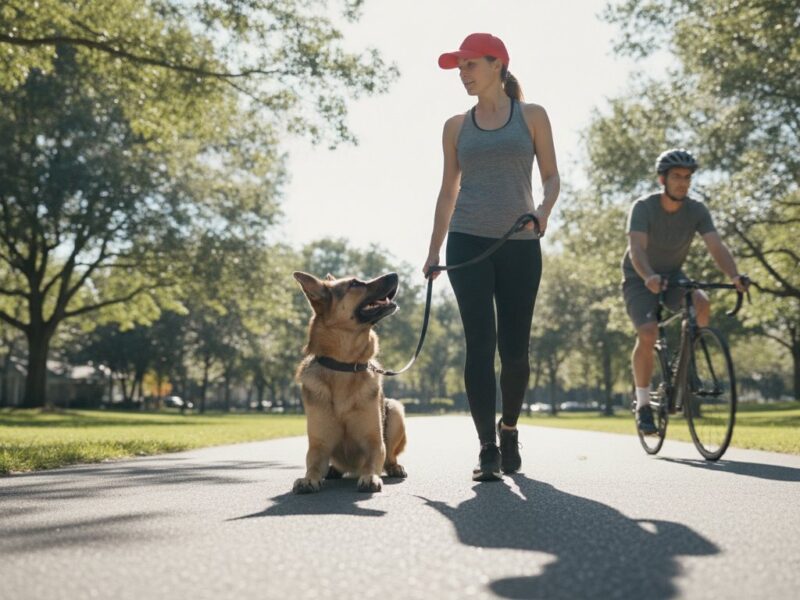
You hear the rhythmic clack of a skateboard behind you and your heart immediately sinks. Within seconds, your peaceful morning walk dissolves into a chaotic struggle as your dog lunges, barks, and strains against the leash. It is exhausting, embarrassing, and physically draining. We know the frustration of scanning every horizon for a cyclist, but training your dog to be neutral to bikes and skateboards is the definitive solution to reclaiming your peace of mind.
We believe that discipline is the gateway to a more adventurous life; it is the structure that allows both you and your pet to enjoy the world without fear. You deserve a partner who remains focused on you, regardless of how fast the wheels are turning nearby. In this guide, we reveal the professional methodology used to transform reactive lunging into calm neutrality. We will walk you through the essential steps to build reliable focus and environmental mastery, ensuring your next neighborhood stroll is defined by pride rather than stress. Let’s replace that anxiety with absolute confidence in your dog’s behavior.
Key Takeaways
- Identify the biological “chase drive” and learn why true neutrality means your dog can acknowledge a stimulus without an emotional reaction.
- Start training your dog to be neutral to bikes and skateboards by building a foundation of obedience that replaces temporary management hacks with real results.
- Utilize remote training technology to provide a gentle “tap on the shoulder,” ensuring clear communication even in high-distraction environments.
- Implement a 4-stage desensitization drill to safely bridge the gap between your dog and the high-speed wheels that currently trigger them.
- Discover how professional immersion through a Board and Train program can accelerate your progress and restore your confidence on every walk.
The Predator-Prey Connection: Why Wheels Trigger Your Dog’s Brain
Neutrality is the gold standard for a well-behaved companion. It is defined as your dog’s ability to acknowledge a stimulus without an emotional or physical reaction. When you achieve this state, the world becomes your playground. You no longer have to worry about a passing cyclist or a teenager on a board ruining your afternoon. You gain the freedom to go anywhere, knowing your dog is focused on you rather than the distractions around them.
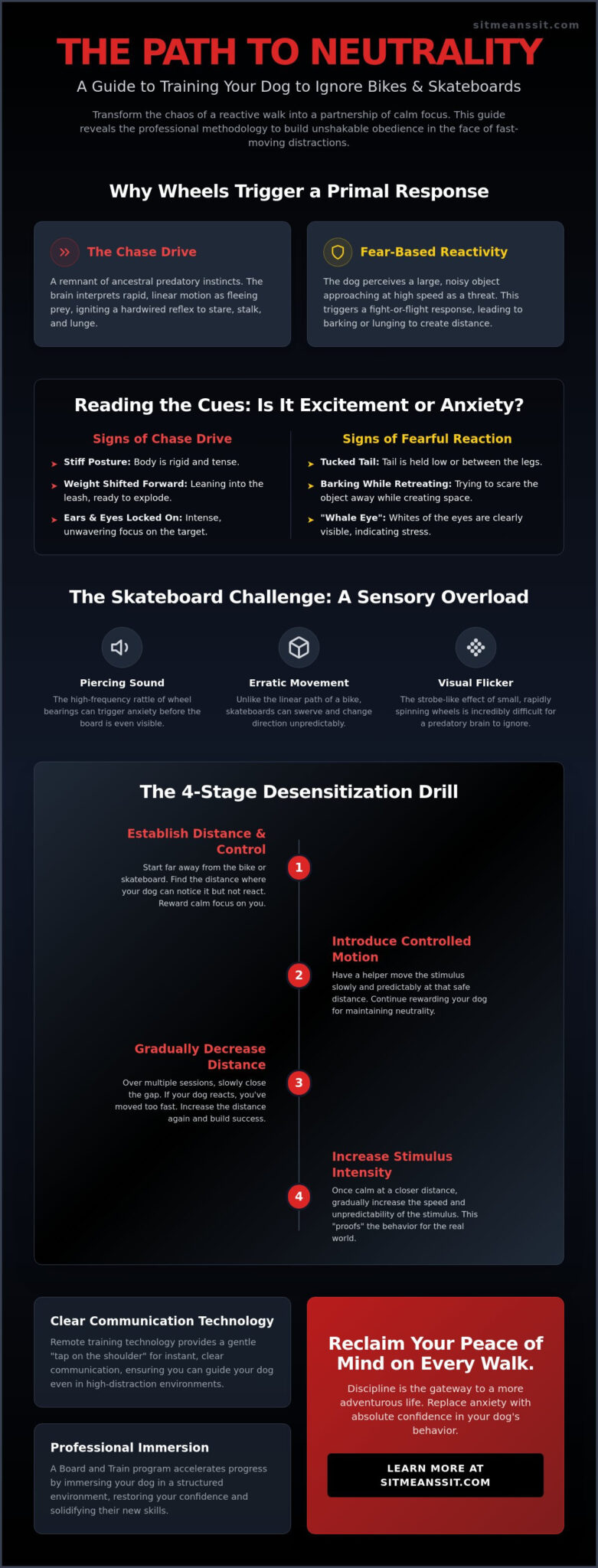
Fast-moving objects are a direct line to your dog’s primitive brain. When a bicycle flashes by, it often ignites a biological response known as the chase drive. This is a remnant of ancestral predatory instincts where rapid, linear motion signaled a successful hunt. Training your dog to be neutral to bikes and skateboards means overriding this hardwired reflex with clear, structured commands. It’s about replacing an impulsive instinct with intentional, calm behavior.
Not every dog reacts for the same reasons. Some enter the predatory sequence of staring, stalking, and lunging because they want to capture the “prey.” Others experience a fight or flight surge because they perceive a large, noisy object approaching at high speed as a threat. You must distinguish between a dog that is over-excited by the prospect of a chase and a dog that is genuinely terrified of the stimulus. Identifying this emotional state is the first step toward a definitive resolution.
Distinguishing Between Chasing Drive and Fear-Based Reactivity
Read the visual cues to understand your dog’s internal state. A dog driven by the chase will show a stiff posture, weight shifted forward, and ears locked onto the target. They are ready to explode into motion. Conversely, a fearful dog may tuck their tail, bark while backing away, or exhibit “whale eye” where the whites of their eyes are visible. Your training approach must shift based on these signals. Fear requires a focus on safety and confidence, while chase drive demands mastery over impulse control. Reactivity is a breakdown in communication between dog and owner.
The ‘Sound and Speed’ Factor: Why Skateboards Are Extra Challenging
Skateboards present a unique hurdle because they attack multiple senses at once. The high-frequency rattle of wheel bearings can trigger anxiety in sensitive dogs before the board is even visible. While bicycles follow a mostly linear path, skateboards are erratic and loud. The “visual flicker” of small, rapidly spinning wheels creates a strobe-like effect that is incredibly difficult for a dog’s predatory brain to ignore. This sensory overload is why many owners struggle to maintain control without a professional methodology. Commit to a structured plan that addresses these specific triggers to ensure your dog remains a neutral partner in any environment.
The Neutrality Blueprint: Building Unshakable Focus Through Structure
Management is a temporary band-aid. Crossing the street or hiding behind parked cars might get you through the moment, but it doesn’t solve the underlying issue. True neutrality is built on a solid foundation of dog obedience training that works under pressure. We want to move you away from the “hope he doesn’t see it” mentality. Instead, we install a “watch me” mindset where your dog looks to you for direction the moment a distraction appears.
Training your dog to be neutral to bikes and skateboards requires consistent rules in every area of their life. If your dog doesn’t respect boundaries at the dinner table, they won’t respect them when a skateboarder rattles past. Structure creates clarity. Clarity creates confidence. When your dog knows exactly what is expected, their anxiety melts away and is replaced by a sense of purpose. This discipline isn’t a restriction; it is the key to a joyful, adventurous life together.
Establishing Engagement Before Leaving the Driveway
The walk starts inside your home, not on the sidewalk. Use the “threshold” rule; your dog must sit and wait for a clear release command before crossing the front door. If they are already lunging at the end of the leash in the driveway, they are already over threshold. You’ve lost the battle before it began. Practice check-in drills where making eye contact is the most rewarding behavior your dog can perform. This foundational work is the bedrock of desensitization and counter-conditioning, teaching your dog that focus on you is always the best choice regardless of the environment.
The Role of Place Commands in High-Stimulus Environments
The “Place” command is one of the most powerful tools in your arsenal. It provides a physical boundary that anchors your dog, giving them a specific job to do while distractions move around them. This builds massive impulse control. Start proofing this in a controlled environment like your backyard. Have a family member ride a bicycle in a wide circle around the dog while they maintain their “Place.” Gradually decrease the distance as your dog shows they can remain calm and stationary. If you want to see this level of control in person, our private lessons provide the hands-on coaching you need to master these high-level mechanics.
Leveraging Remote Training Technology for Instant Communication
Frantic leash tugging is the most common mistake owners make. When you feel the tension of a lunging dog, your natural instinct is to pull back. This triggers the opposition reflex, a physical drive that causes the dog to lean even harder into the pressure. It creates a cycle of escalation that leaves both you and your pet exhausted. A tight leash is a telegraph for dog reactivity. It signals to your dog that you’re on edge, confirming their suspicion that the approaching wheels are something to fear or attack.
We replace this physical struggle with clear, digital communication. The Remote Training Collar acts as a subtle tap on the shoulder, allowing you to reach your dog even when their focus is elsewhere. Training your dog to be neutral to bikes and skateboards is about maintaining a conversation, not winning a fight. This technology provides a consistent signal that your dog understands instantly, regardless of the distance or the speed of the distraction. It removes the emotion from the correction, replacing frustration with a professional standard of reliability.
Why Traditional Leash Pressure Often Fails with Fast Distractions
Physical corrections often arrive too late. By the time you’ve pulled the leash, your dog has already reached a peak emotional state. This delayed feedback is confusing and often heightens the dog’s anxiety. Because the pressure is constant rather than precise, the dog simply learns to tune it out or fight against it. You need a tool that offers the speed and clarity required to match the fast-moving environment of a modern neighborhood.
Using the Remote Training Collar to Break the ‘Hyper-Focus’ Loop
Success is found in the seconds before the explosion. You must interrupt the “stare” before it transforms into a “lunge.” Once your dog locks their eyes on a target, their adrenaline begins to climb. By identifying the specific types of aggression or prey drive at play, we can use low-level stimulation to “break the lock” on their focus. We aren’t looking to overwhelm the dog; we’re simply reminding them to check back in with their handler.
Once you have their attention, immediately redirect them to a command they already know, such as “Heel” or “Sit.” This redirection provides the dog with a clear path to success and a way to earn praise. Ensure your dog has a 100 percent success rate with these commands in low-distraction areas before you introduce the challenge of high-speed wheels. When you master the art of training your dog to be neutral to bikes and skateboards using these tools, you unlock a level of freedom most owners only dream of. You’re building a bridge of communication that leads to total environmental confidence.
Practical Desensitization: A 4-Stage Drill for Bikes and Skateboards
Desensitization is the process of gradually exposing your dog to a trigger at an intensity they can handle. Success depends on finding the threshold distance. This is the specific point where your dog can see the bike or skateboard but still chooses to listen to your commands. If you get too close too soon, you risk “flooding.” Flooding happens when a dog is overwhelmed by fear or excitement, causing their brain to shut down. This doesn’t teach neutrality; it only reinforces the panic. Training your dog to be neutral to bikes and skateboards requires patience and a commitment to short, successful sessions over long, stressful ones.
Recruit a “decoy” helper for these drills. Having a friend on a bike or skateboard allows you to control every variable, from speed to distance. You can’t control the random teenager at the park, but you can control your training environment. Aim for three to five high-quality repetitions per session. Stop while your dog is winning to keep their confidence high. If you find the process overwhelming, our group classes provide the perfect controlled environment to practice these drills with professional guidance.
Stage 1: Establishing the Safety Threshold Distance
Start at a distance where your dog can maintain a rock-solid “Sit” while the bike passes. This might be fifty feet or even a hundred feet away. Your goal is to reward the dog for acknowledging the movement and then immediately choosing to focus back on you. Once your dog is consistently calm, decrease the distance by five feet at a time. Move slowly. If the dog reacts, you’ve moved too close. Simply reset, back up, and find the last successful distance.
Stage 2: Introducing Parallel Movement Drills
Walking in the same direction as the trigger is significantly less threatening than a head-on approach. In this stage, have your decoy ride slowly alongside you at a safe distance. Focus entirely on the “Heel” command. Your dog should be more interested in maintaining their position by your leg than in the wheels spinning nearby. Parallel movement helps the dog realize that the bike is just another part of the environment, not a target to be chased.
Stage 3: Managing Direct Approaches and High-Speed Passes
The final challenge involves head-on approaches and high-speed passes. This is where training your dog to be neutral to bikes and skateboards truly pays off. Have your decoy approach from the front while you reinforce the “Leave It” command. Use your Remote Training Collar to interrupt any lingering stares before they escalate. As your dog masters this, have the decoy increase their speed or create more noise. When your dog can watch a skateboarder fly past at full speed without breaking their “Heel,” you have achieved true environmental mastery.
Professional Immersion: Why Board and Train is the Shortcut to Neutrality
Complex behavioral issues like skateboard reactivity don’t disappear with a thirty-minute walk once a day. They require a total immersion in structure that most busy families simply cannot provide at home. A board and train program acts as a complete behavioral “reset” for your dog. It removes them from the environment where they’ve developed bad habits and places them in a world of 24/7 consistency. This immersive approach is the fastest way to replace chaos with calm, focused obedience.
Training your dog to be neutral to bikes and skateboards requires hundreds of successful repetitions. In a professional facility, your dog experiences these controlled encounters under the guidance of experts who have seen every possible reaction. We handle the high-intensity initial stages so you don’t have to. This professional start ensures that your dog’s first experiences with neutrality are successful, building a foundation of reliability that carries over to every walk you take in the future.
The Benefits of 24/7 Professional Behavioral Conditioning
The “human error” factor is the biggest hurdle in early-stage training. If your timing is off by even a second, you might accidentally reward the very lunging behavior you’re trying to stop. Professional trainers eliminate this risk. We provide the precise, instant feedback your dog needs to understand the new rules of engagement. While an average owner might encounter one or two bikes on a walk, our trainers can facilitate dozens of controlled passes in a single session. This volume of practice is what creates a truly neutral dog. We transform training your dog to be neutral to bikes and skateboards from a stressful chore into a reliable, everyday reality.
Transitioning Neutrality from the Facility to Your Neighborhood
The transformation is only complete when the training transfers back to you. We prioritize owner “go-home” lessons to ensure you master the same communication tools our professionals use. You’ll learn how to maintain the boundaries we’ve established and how to handle the unpredictable nature of your own neighborhood. We don’t just train your dog; we empower you to lead with absolute confidence. Stop scanning the horizon for wheels and start enjoying the freedom of a perfectly behaved companion. Ready for a transformation? Schedule your free consultation with Sit Means Sit today!
Reclaim Your Freedom on Every Walk
You have the power to replace the chaos of reactive lunging with the calm of professional neutrality. Success is built on the foundation of clear communication and unshakable structure. By addressing the biological chase drive and implementing a phased desensitization plan, you turn high-speed distractions into non-events. We have seen thousands of dogs achieve total off-leash control through our industry-leading Remote Training methodology. It is about more than just obedience; it is about the liberation that comes from knowing your dog will listen regardless of the environment.
Training your dog to be neutral to bikes and skateboards doesn’t have to be a solo struggle. Our specialized programs are designed specifically for high-distraction environments, ensuring you and your pet can enjoy a more adventurous and joyful life together. Stop avoiding the sidewalk and start leading with absolute confidence. Transform your walks with a free Sit Means Sit evaluation today and experience the difference that professional expertise makes. You’ve done the research; now take the final step toward mastery. We are ready to help you unlock your dog’s full potential.
Frequently Asked Questions
How long does it take to train a dog to be neutral to bikes?
Most owners see a significant transformation within two to four weeks of consistent, structured practice. The timeline depends on your dog’s history and your commitment to daily drills. If you choose an immersive Board and Train program, our professional trainers can often achieve these results in a matter of days by providing hundreds of successful repetitions in a controlled environment.
Is it possible to train an older dog to stop chasing skateboards?
You can absolutely teach an older dog new boundaries regardless of their age. While long-standing habits require more patience, dogs are capable of learning at any life stage. We use clear communication tools to override years of reactive behavior, replacing old instincts with a new foundation of calm obedience. It’s never too late to reclaim your peace of mind on walks.
Does the Remote Training Collar hurt the dog?
The Remote Training Collar does not hurt your dog. It utilizes Transcutaneous Electrical Nerve Stimulation (TENS) technology, which feels like a localized muscle pulse or a gentle tap on the shoulder. This industry-standard tool is designed for precise, low-level communication rather than punishment. It allows us to reach the dog’s focus without causing fear or physical distress.
What should I do if a skateboarder surprises us around a corner?
Execute an immediate “Sit” or “Place” command to anchor your dog’s focus. Use your remote tool to interrupt the initial stare before the lunging begins. If your dog is already over threshold, maintain a calm demeanor and create distance as quickly as possible. Avoid pulling the leash, as this signals your own anxiety and confirms the dog’s reactive state.
Why is my dog only reactive to skateboards but not cars?
Skateboards produce a unique high-frequency rattle and erratic movement that specifically triggers the predatory chase drive. Cars generally move at a consistent pace and sound frequency that dogs find easier to ignore. The “visual flicker” of small, fast-spinning wheels combined with the loud bearing noise creates a sensory overload that requires specialized training to overcome.
Can puppy preschool prevent reactivity to bikes and skateboards?
Early exposure is the most effective way to prevent future behavioral struggles. Our Puppy Preschool programs focus on neutral socialization, teaching young dogs to exist calmly around various environmental stimuli before they develop a chase reflex. Building this foundation early ensures your dog grows up viewing high-speed wheels as a normal, non-threatening part of the world.
What is the difference between a dog trainer and a dog behaviorist for this issue?
A trainer focuses on teaching specific commands and practical environmental mastery to solve the immediate problem. While a dog behaviorist may analyze the psychological “why” behind a reaction, our trainers provide the “how” to fix it. We specialize in results-oriented methods that transform your dog’s behavior in real-world, high-distraction scenarios.
Should I use treats or the collar to fix this problem?
We believe in a balanced approach that utilizes both for maximum reliability. Treats are excellent for rewarding the choice to remain calm, but they often fail when a dog’s adrenaline is high. Training your dog to be neutral to bikes and skateboards requires a collar to provide a clear interruption when the dog is hyper-focused on a trigger. This combination ensures total control in every situation.
Comments are closed.