
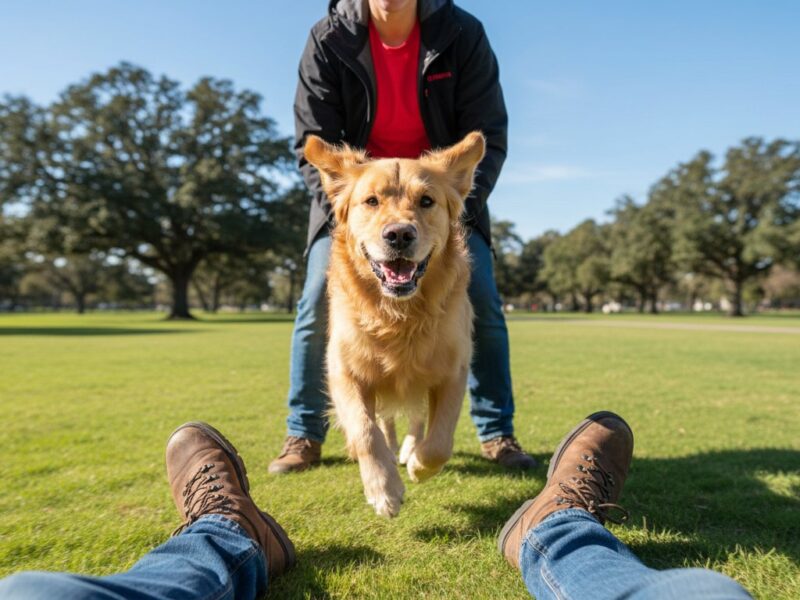
A reliable recall is not a suggestion; it is a life-saving agreement between you and your dog that guarantees their safety in a chaotic world. When you master how to teach a reliable recall command, you aren’t just training a behavior. You are unlocking a lifestyle of total off-leash freedom. You’ve likely felt that surge of panic when your dog ignores your voice to chase a distraction toward a busy street. It’s exhausting to feel powerless while your dog treats your commands like optional background noise. We understand that frustration, and we’re here to end it.
Stop settling for inconsistent results and start demanding reliability. This guide will show you how to transform your distracted runner into a focused companion who chooses you every single time. We’ll cover the essential steps to build a bulletproof foundation, the role of professional tools like remote training collars, and how to navigate local leash laws safely. Get ready to replace your embarrassment with pride and build a bond rooted in clear communication. Your journey to a perfectly behaved dog starts right now.
Key Takeaways
- Stop the cycle of “poisoned cues” by redefining your recall command as a definitive agreement rather than a suggestion.
- Master the “Look at Me” reflex to establish a clear communication bridge before adding high-stakes distractions.
- Discover how to teach a reliable recall command using a phased approach that builds confidence from your living room to the park.
- Leverage specialized tools like the Remote Training Collar to bridge the gap between a standard leash and total off-leash freedom.
- Identify when to accelerate your results through immersive Board and Train programs for dogs with high prey drive or stubborn habits.
The Reality of the Recall: Why Your Dog Ignores You (and How to Fix It)
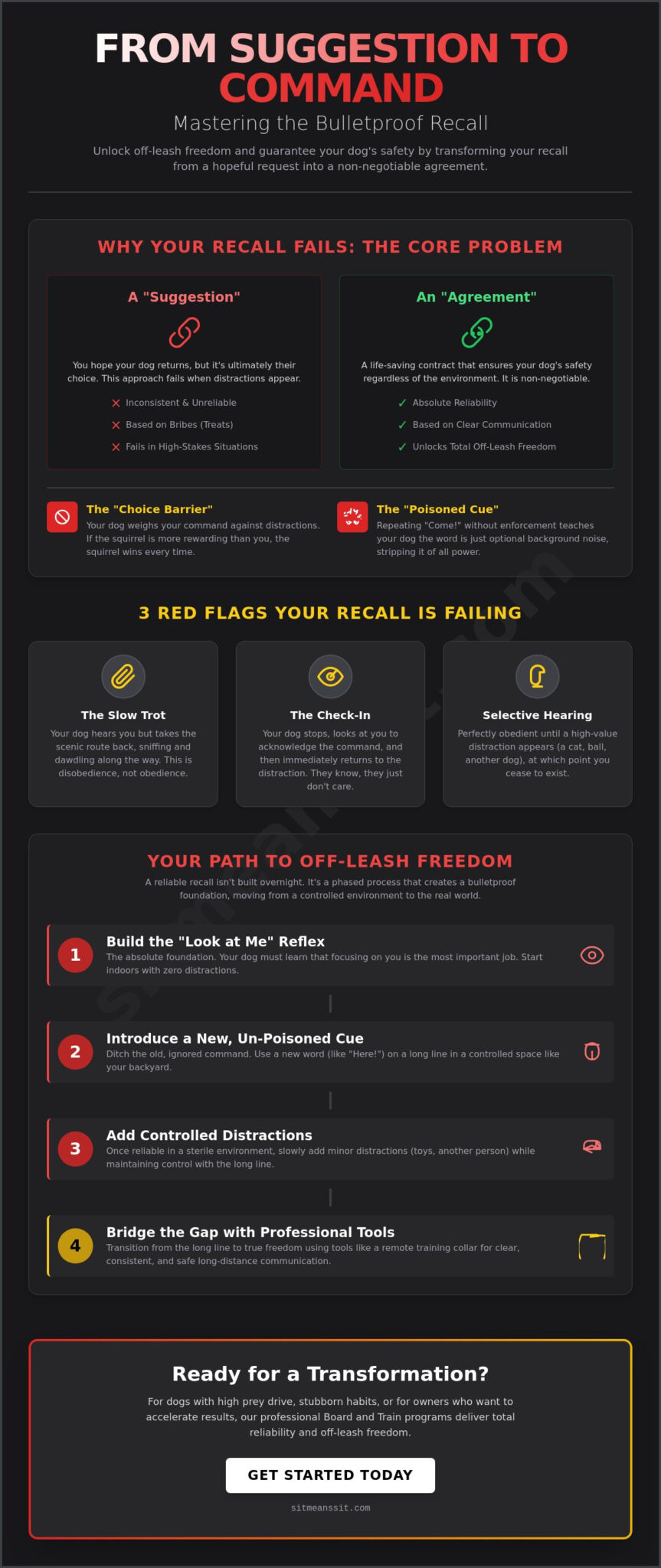
Most owners view the recall as a polite request. They hope their dog will return when called, but hope is not a strategy. A reliable recall is a non-negotiable agreement between you and your dog. It is a life-saving contract that ensures their safety regardless of the environment. If your dog only listens when there are no distractions, you don’t have a command; you have a suggestion. Mastering how to teach a reliable recall command starts with moving away from optional obedience and toward absolute reliability.
The biggest hurdle in this process is the “Choice Barrier.” Dogs are natural economists. They constantly weigh the value of your praise or treat against the thrill of chasing a squirrel or greeting another dog. If the environment offers a higher reward than you do, the dog chooses the environment every time. To fix this, you must shift the narrative. You aren’t just another option in the park; you are the definitive source of direction. Understanding foundational dog training principles helps you realize that a command must be a boundary, not a bribe.
You might also be dealing with a “Poisoned Cue.” This happens when the word “Come” has been repeated so many times without a response that it becomes background noise. If you’ve ever called your dog five times while they continued to sniff a bush, you’ve accidentally taught them that “Come” is optional. The word has lost its power. To achieve total off-leash freedom, we must strip away these failed habits and build a new, unbreakable communication bridge.
The Problem with “Suggestion-Based” Training
Relying solely on treats creates a “fair-weather” recall. It works in your kitchen, but it fails at the beach. Inconsistency teaches your dog that they can choose when to listen based on the current “payout.” This approach lacks the structure needed for real-world safety. We prioritize “Attention First, Command Second.” If you don’t have your dog’s focus before you speak, you’re just talking to yourself. Discipline isn’t a restriction; it’s the key to a more adventurous life.
Signs Your Recall Command is Failing
Is your training actually sticking? Watch for these red flags that indicate your dog is still making choices instead of following directions:
- The “Slow Trot”: Your dog hears you but takes the scenic route back, stopping to sniff three times along the way.
- The “Check-In”: Your dog stops, looks at you to acknowledge the command, and then immediately goes back to what they were doing.
- The “Selective Hearing”: Your dog is perfectly behaved until a high-value distraction appears, such as a cat or a tennis ball, at which point you cease to exist.
Don’t let these behaviors become the norm. Learning how to teach a reliable recall command requires a shift from frustration to empowerment. It’s time to stop asking for permission and start leading with confidence.
The Foundation of Mastery: Building Attention Before the Command
You cannot give a command to a dog that isn’t listening. If your dog is locked onto a squirrel or mesmerized by a passing cyclist, your voice is just background noise. True mastery begins with the “Look at Me” reflex. This isn’t a casual glance; it’s an immediate, reflexive pivot of focus toward the owner. Establishing this communication bridge is the first real step in how to teach a reliable recall command. Without focus, your recall will always remain a gamble.
Structure creates clarity. High-level dog obedience training is designed to install a focused mindset that persists even when the world gets loud. You want your dog to view you as the most relevant thing in their environment. In the early stages, environmental management is your best friend. Don’t set your dog up for failure by practicing in a crowded park before they’ve mastered focus in your hallway. Control the environment so you can control the outcome.
Capturing Focus in High-Distraction Environments
Use “Focus Games” to prove you’re more interesting than a pile of leaves or a stray ball. Start by saying your dog’s name and rewarding the exact second their eyes meet yours. We call this rewarding the “Turn.” It’s the moment your dog consciously chooses to disengage from a distraction and engage with you. Attention Mastery is the non-negotiable foundation that makes total off-leash freedom possible. If you find your dog’s focus is constantly drifting, our private lessons can provide the one-on-one coaching needed to sharpen their response.
Setting the Stage for Success
Never poison your recall by calling your dog for something they dislike. If you call them to go inside, take a bath, or get their nails trimmed, you’re teaching them that coming to you ends their fun. Instead, create a “Recall Jackpot.” Make the return the most rewarding part of their day with high-value praise and engagement. For younger dogs, starting early in puppy training classes builds these habits before bad behaviors can take root. Success is built on thousands of small, positive repetitions. Every time your dog chooses you over the world, you’re one step closer to a bulletproof recall. Practice with purpose and lead with absolute confidence.
Tools for Total Control: Transitioning to Off-Leash Freedom
A standard six-foot leash is a safety requirement, but it’s also a limitation. It keeps your dog close, but it doesn’t teach them to choose you when the tether disappears. To master how to teach a reliable recall command, you must transition from physical restraint to a mental connection that works at any distance. This is where specialized tools become the bridge to total off-leash freedom. We don’t just want a dog that stays close; we want a dog that stays connected. Structure is the foundation of this liberty.
Tools create an “invisible leash.” They allow you to maintain clear, consistent communication even when environmental distractions are high. However, a tool is never a substitute for a solid foundation. It’s an amplifier for the work you’ve already put in. By using the right equipment correctly, you replace your own anxiety with absolute confidence. You’re no longer hoping they listen; you’re ensuring they do.
The Role of the Long Line in Early Training
Before going completely off-leash, use a 15 to 30-foot long line. This tool provides the safety of a leash while allowing your dog the freedom to explore and make choices. It’s the perfect environment to practice the focus reflexes established in earlier sessions. When you call your dog, use the line to provide gentle guidance rather than a harsh yank. You’re showing them the way back, not dragging them. This phase is about transitioning from physical guidance to consistent mental focus.
Leveraging the Remote Training Collar for Off-Leash Safety
The Remote Training Collar is the ultimate communication tool for the modern owner. Think of it as a long-distance “tap” on the shoulder. It provides a clear, consistent signal that cuts through the noise of a busy park or a sudden squirrel sighting. This technology eliminates the dangerous “I’m too far away to listen” mindset that many dogs develop when they realize they’re out of reach. It ensures your command is a definitive agreement, not a suggestion.
When you understand how to teach a reliable recall command using this tool, you aren’t using punishment. You’re providing a consistent language that your dog understands instantly. Because this tool is so powerful, professional instruction is vital. Our experts ensure you use the collar to build a deeper bond and clear boundaries. When the methodology is right, the collar becomes a symbol of freedom. It’s the key that unlocks a life of hiking and off-leash adventures with total peace of mind.
The Step-by-Step Protocol for a Bulletproof Recall Command
A dog that comes to you in the kitchen is a great start, but it isn’t a fully trained companion. Most owners fail because they never bridge the gap between “yard recall” and real-world reliability. They assume that because the dog listens in a quiet environment, they’ll respond when a squirrel darts across a busy trail. This assumption is dangerous. Mastering how to teach a reliable recall command requires a disciplined, four-phase protocol that systematically increases environmental pressure while ensuring your dog never feels empowered to ignore you.
Phase 1 & 2: Building the Reflex
Phase 1 begins in a zero-distraction environment, like your living room. You are building a reflex, not a choice. Pair your verbal cue with an immediate, high-value reward every single time. Use your body language to your advantage. Kneeling down or moving backward rapidly creates a “magnetic” effect that draws your dog in. Don’t just stand there like a statue; be the most exciting thing in the room. Once your dog is sprinting to you 100% of the time indoors, transition to Phase 2 in a controlled outdoor space like a quiet backyard. Consistency in the first 30 days dictates lifetime reliability. If you want to fast-track this process with professional guidance, our group classes provide the perfect setting to practice these foundations around other focused teams.
Phase 3 & 4: Distraction Proofing and Maintenance
Phase 3 is where you proof the command against high-stimulation “Real World” distractions. You must use intentional “Set-Ups” to test the recall. Have a friend walk by with another dog or toss a tennis ball nearby as you give the command. If your dog fails to respond, don’t repeat the cue. Simply reset the dog, move closer to reduce the difficulty, and try again until they succeed. This teaches the dog that the command is a definitive agreement, not a suggestion based on their current interest level.
Phase 4 is the maintenance stage. Move to a “Random Reward” schedule so your dog stays motivated by the possibility of a jackpot. The most critical technique here is “Recall to Play.” Call your dog, give them a quick reward, and then immediately release them to “Go Play.” This prevents them from associating the recall with the end of their freedom. By following this structure, you transform a simple trick into a life-saving agreement. You are selling a lifestyle of adventure, and that starts with a dog you can trust anywhere.
Professional Solutions: When to Seek Expert Help for Total Reliability
Training a dog with a high prey drive or a stubborn streak can feel like an uphill battle. You might understand the theory of how to teach a reliable recall command, but executing it when your dog is focused on a bolting deer is another story. When your dog’s natural instincts consistently override your instructions, it’s time to bring in the experts. Professional trainers have the tools and the controlled environments to proof commands against distractions that are impossible to replicate at home. We don’t just teach your dog. We rebuild their decision-making process from the ground up.
At Sit Means Sit Dog Training, we specialize in replacing your frustration with a sense of absolute empowerment. We recognize that every dog is an individual with unique environmental triggers. Our role is to act as your partner in achieving a life of adventure and safety. If you’ve hit a plateau or feel powerless in high-stimulation areas, seeking professional intervention is the most responsible choice you can make for your pet’s well-being.
The Advantage of Immersive Training
An immersive board and train program is the fastest path to total reliability. In this setting, your dog receives 24/7 consistency from a team of assertive authorities. This professional environment is designed to reset deeply ingrained bad habits and replace them with a focused, responsive mindset. You aren’t just getting a trained dog back; you’re receiving a comprehensive “Owner Manual” for your specific companion. We ensure the transition from our facility to your home is seamless, giving you the skills to lead with confidence.
Transforming Frustration into Empowerment
Imagine the liberation of a life without a leash. When you master how to teach a reliable recall command through our professional programs, the world opens up. You can enjoy hiking, camping, and beach trips with the absolute peace of mind that your dog will stop on a dime. This isn’t just about obedience. It’s about safety and the deep bond that comes from mutual trust. Stop living in fear of traffic or public embarrassment. Reclaim your freedom and ensure your dog’s safety today. Your journey to a bulletproof recall and total off-leash freedom is just one decision away.
Reclaim Your Freedom and Adventure
You now hold the definitive roadmap for how to teach a reliable recall command. You’ve seen that off-leash freedom is built on the pillars of attention mastery, the right communication tools, and a structured protocol. It’s about moving from a place of uncertainty to a place of absolute confidence. Your dog deserves the freedom to explore, and you deserve the peace of mind that comes with total control. Discipline is the gateway to a more adventurous life.
Don’t let past struggles or a high prey drive define your future. Sit Means Sit Dog Training brings over 25 years of professional experience and a specialized Remote Training Collar methodology to your doorstep. With our national network of expert trainers, we turn the dream of a bulletproof recall into a daily reality. We replace your powerlessness with a sense of empowerment and pride. Structure isn’t a restriction; it’s the key to a more joyful life for you and your pet.
Contact Sit Means Sit Dog Training today to schedule your free evaluation and start your journey to off-leash freedom! Let’s transform your relationship and unlock a world of new possibilities together. Your journey to total reliability starts right now.
Frequently Asked Questions
Can I teach an older dog a reliable recall command?
Yes, age is never a barrier to learning new habits. Older dogs often have better focus than puppies once you establish clear boundaries and consistent structure. The process remains the same: build a solid foundation in low-distraction areas and gradually increase environmental pressure. Mastering how to teach a reliable recall command is possible at any stage of a dog’s life with steady practice and the right tools.
Why does my dog run away from me when I call them?
Your dog likely views your approach as a game of “keep away” or associates being caught with the end of their fun. If you only call them to go inside or leave the park, they learn that coming to you is a negative consequence. You must flip the script immediately. Make yourself the source of the most exciting rewards and use “Recall to Play” to prove that coming to you doesn’t mean the party is over.
How long does it take to train a dog to come when called every time?
Achieving total reliability typically takes several weeks of consistent, daily practice. While a dog can learn the basic concept in a few days, proofing that command against high-level distractions like squirrels or other dogs requires hundreds of successful repetitions. Consistency in the first 30 days is critical for dictating lifetime reliability. Professional programs like a Board and Train can significantly accelerate this timeline by providing 24/7 consistency.
What is the best “high-value” reward for recall training?
The best reward is whatever your dog finds most motivating in that specific moment. For many, this is a premium food item like plain chicken or freeze-dried liver. For others, it’s a high-energy game of tug or a favorite tennis ball. The key is to create a “Recall Jackpot.” Save these elite rewards exclusively for the recall command to ensure it remains the most exciting request you ever make during your sessions.
Is it safe to use a Remote Training Collar for recall?
Yes, when used as a professional communication tool rather than a punishment. The Remote Training Collar acts as an “invisible leash” that provides a clear, consistent signal at any distance. It ensures your dog understands that the command is a definitive agreement. When integrated correctly by experts, it builds confidence and provides the safety net needed for true off-leash freedom in high-stimulation environments without the need for physical restraint.
My dog listens in the house but not outside; what do I do?
Your dog hasn’t generalized the command to new environments yet. Dogs are situational learners, so a command learned in the kitchen doesn’t automatically translate to the park. You must bridge this gap by slowly increasing distractions. Start in your backyard, then move to a quiet sidewalk before attempting a busy trail. This structured progression is the secret to how to teach a reliable recall command that works in the real world.
What should I do if my dog ignores the recall command in public?
Don’t keep repeating the command, as this only teaches your dog that your voice is optional background noise. If they are on a long line, use it to provide gentle physical guidance back to you. If they are off-leash and failing, you must simplify the task by moving closer or reducing the environmental pressure. A failure is a sign that you’ve pushed too fast. Reset the dog, succeed at a shorter distance, and end on a win.
How do I avoid “poisoning” my recall cue?
Stop using the command if you aren’t in a position to enforce it. If you call your dog while they are mid-chase and you have no way to guide them back, you’re accidentally teaching them that the word has no meaning. Also, never use the recall for things the dog dislikes, such as baths or medication. Keep the cue associated with positive outcomes and clear boundaries to maintain its power and reliability over time.
Comments are closed.