
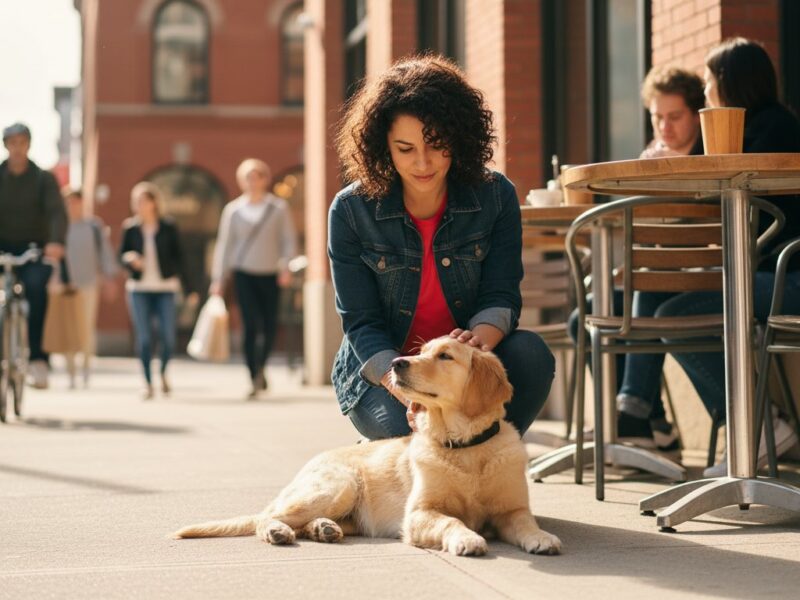
Socialization isn’t about your puppy meeting every dog in the park; it’s about teaching them to be completely bored by the world around them. You want a dog that can walk through a crowded festival or sit at a cafe without lunging or trembling. It’s a common struggle to balance the need for early exposure with the safety of a vaccination schedule. You feel the pressure of that 16 week clock ticking, and it’s easy to feel overwhelmed. Our 2026 puppy socialization checklist replaces that anxiety with a clear, professional roadmap for success.
We’ll show you how to master your puppy’s critical development window using proven exposure strategies that prioritize neutrality. You’ll learn to navigate the vaccination gap safely while building a dog that is calm in high-stimulation environments. This guide breaks down exactly what your puppy needs to see, hear, and feel to become a confident partner. From handling fear periods to mastering body handling, you’re about to transform your puppy’s potential into a lifetime of adventure and reliability. Let’s replace the frustration of uncertainty with the pride of a well-adjusted companion.
Key Takeaways
- Seize the critical 16-week developmental window to hardwire confidence and prevent long-term behavioral struggles.
- Follow our detailed puppy socialization checklist to provide structured exposure to diverse people, sounds, and environments.
- Prioritize neutrality over interaction to ensure your dog remains calm and focused even in high-distraction settings.
- Bridge the vaccination gap safely by using controlled “paws-off” exposure techniques that protect your puppy’s health.
- Elevate your dog’s development by moving from simple exposure to structured training in a professional Puppy Preschool environment.
The Critical Socialization Window: Why the First 16 Weeks Matter
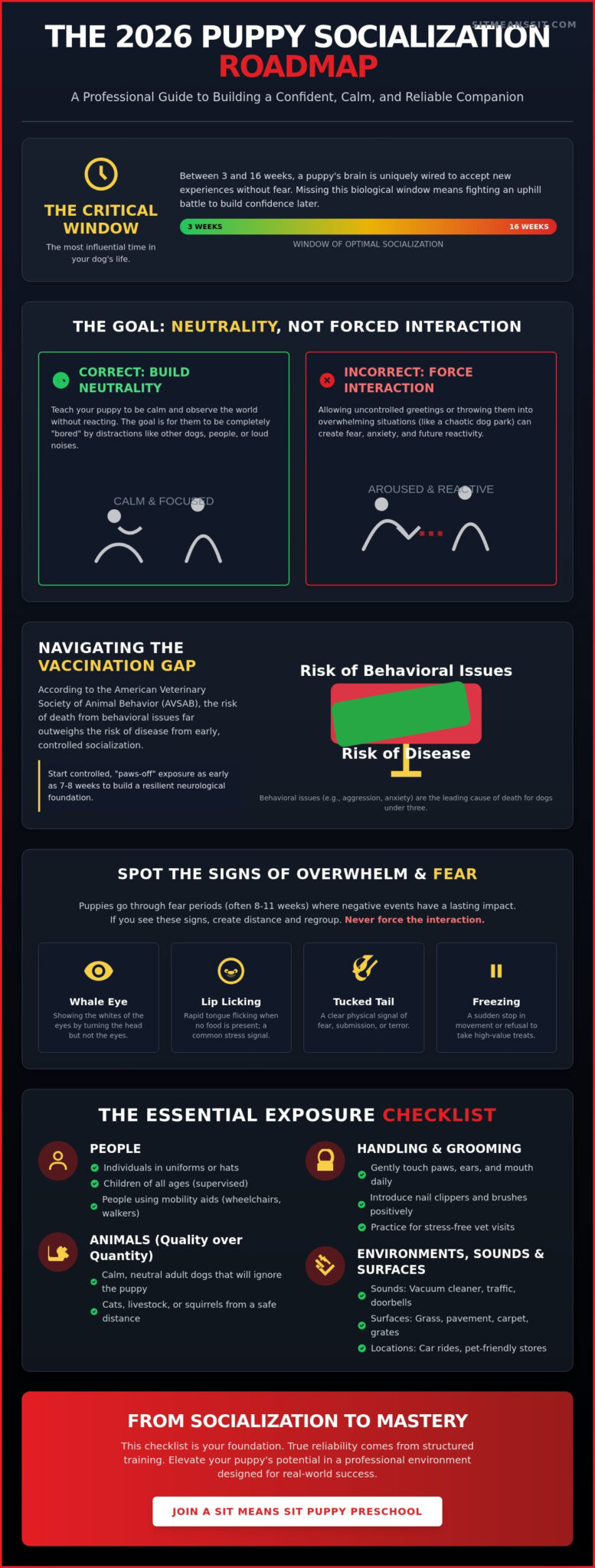
You have a narrow window of opportunity to shape who your dog becomes. Between 3 and 16 weeks of age, a puppy’s brain is hardwired to accept new experiences without the immediate reflex of fear. This is the critical period of socialization, and it’s the most influential time in your dog’s life. If you miss this window, you’re not just losing time; you’re fighting against biology to build confidence later. We don’t want you to just survive this phase. We want you to dominate it.
There’s a massive difference between socialization and mere exposure. Taking a puppy to a loud construction site and letting them tremble is exposure, and it’s often damaging. True socialization is the process of creating positive associations with the world. It requires a structured puppy socialization checklist to ensure every new sight, sound, and surface is paired with a win for the dog. At Sit Means Sit Dog Training, we know that liberation comes through structure. By providing your puppy with a clear, disciplined framework now, you’re giving them the freedom to navigate a high-stimulation world with total ease in the future.
The AVSAB Position on Early Socialization
Many owners feel stuck between training their puppy and waiting for a full round of vaccinations. The American Veterinary Society of Animal Behavior (AVSAB) is clear on this: the risk of behavioral issues is far greater than the risk of disease in controlled environments. Behavioral problems like aggression and extreme anxiety are the leading causes of death for dogs under three years old. You can’t afford to wait until 16 weeks to start. Empower yourself to begin controlled exposure and training as early as 7 or 8 weeks. This early start builds the neurological foundation for a resilient, reliable adult dog.
Identifying Fear Periods
Puppies aren’t always fearless explorers. They go through specific developmental stages where they become hyper-sensitive to their environment. These fear periods often hit between 8 and 11 weeks of age. During these times, a seemingly minor negative event can leave a lasting scar on their psyche. You must be an expert at reading your puppy’s communication. Look for these specific signs of overwhelm:
- Whale eye: When the puppy turns their head but keeps their eyes fixed on an object, showing the whites of their eyes.
- Lip licking: Rapid flicking of the tongue when there is no food present.
- Tucked tail: A clear physical signal of submission or terror.
- Freezing: A sudden lack of movement or refusal to take high-value treats.
If you see these signs, don’t force the interaction. Forcing a puppy to “face their fears” usually backfires and creates a reactive adult. Instead, create distance from the trigger immediately. Regroup, reward the puppy for staying calm at a distance, and try again later with less intensity. Your goal is constant, steady progress, not a single overwhelming event. This proactive approach ensures your dog remains a capable partner for all your future adventures.
The Essential Puppy Socialization Checklist: Exposure Categories
Exposure without a plan is just a walk. You need a mission. Successful socialization requires a deliberate approach to every new encounter. Our puppy socialization checklist categorizes the world into manageable targets to ensure no developmental stone is left unturned. Start with people. It’s not enough for your puppy to meet your neighbors. They need to see people in high-visibility uniforms, individuals wearing bulky hats, and children of all ages. Introduce them to people using mobility aids like wheelchairs or walkers. This prevents your dog from being startled by “unusual” silhouettes or movement patterns later in life.
The animal category is about quality, not quantity. Don’t let your puppy get overwhelmed by a hyperactive dog at a park. Instead, seek out calm adult dogs that will ignore your puppy’s antics. This teaches your dog that other animals aren’t always a reason for high arousal. Introduce the concept of livestock or cats from a safe distance to build a foundation of neutrality. Handling is equally vital for a stress-free life. Touch their paws, look in their ears, and gently open their mouth every single day. You’re training them to be a dream patient for future vet visits. If you want professional guidance on these interactions, our Puppy Preschool provides the perfect controlled environment to practice these skills.
Sights and Sounds: Building Environmental Confidence
Building environmental confidence requires a soundtrack. Start with low-volume recordings of thunder, sirens, and doorbells. Pair these sounds with high-value rewards to create a positive association. Move on to visual triggers. Open an umbrella nearby. Let a bicycle or skateboard pass at a distance. We recommend following the “Rule of 7”: your goal is to have your puppy meet seven new people and experience seven new surfaces every week. For a comprehensive list of specific triggers to track, you can utilize this Puppy Socialization Checklist from the San Diego Humane Society.
Tactile Exposure: Surfaces and Textures
Surface shyness is a common struggle for adult dogs who only know carpet and grass. Break that habit now. Walk your puppy on gravel, metal grates, and wet pavement. Use “wobbly” surfaces like unstable cushions or low balance beams to build their confidence. This isn’t just about the feel of the ground. It’s about proprioception. Learning how to balance on uneven or moving surfaces builds core strength and mental resilience. A dog that is confident underfoot is a dog that can go anywhere. Steady practice now ensures a lifetime of access to the world around you.
Mastering the Art of Neutrality: Interaction vs. Observation
Most owners get socialization wrong. They treat it like a social club where their puppy must greet every person and dog they see. This is a mistake. If your puppy socialization checklist only focuses on greetings, you’re accidentally training a “frustrated greeter.” A frustrated greeter is a dog that lunges and barks on the leash, not out of aggression, but because they’ve been conditioned to believe they have a right to meet everyone. True mastery is neutrality. Neutrality is the ability for your dog to see a distraction and remain completely calm, looking to you for their next cue.
We use the 50/50 Rule to build this reliability. For every one time your puppy interacts with a new person or dog, they should spend at least one other time simply observing from a distance. This balance ensures they don’t become over-stimulated by the environment. According to the American Veterinary Society of Animal Behavior’s guidelines, early exposure is the standard of care for preventing lifelong behavioral issues. However, that exposure must be structured. At Sit Means Sit Dog Training, we want your puppy to realize that while the world is interesting, you are the most exciting thing in it. Discipline isn’t a restriction; it’s the key to taking your dog anywhere with total confidence.
The ‘Watch the World’ Exercise
Find a park bench in a moderately busy area and just sit. Don’t ask for a sit or a down yet. Simply reward your puppy with a high-value treat every time they look at a distraction and then look back at you. This builds a positive association with the environment without the need for physical interaction. You must find the “threshold” distance. If your puppy is barking or refusing treats, you’re too close. Move back until they can focus on you again. This steady practice turns a chaotic environment into a neutral background for your dog.
Preventing Leash Reactivity Early
Stop the “on-leash greeting” habit immediately. When your puppy is on a leash, it should mean “we are working,” not “we are playing.” On-leash greetings are often tense and can lead to reactive behavior as the dog matures. By maintaining clear boundaries now, you prevent the frustration that leads to pulling and barking later. If you want to achieve total control even when the leash comes off, our dog obedience training programs provide the structure you need for a lifetime of adventure. Success starts with the decisions you make today.
Safe Socialization: Navigating the Vaccination Gap
“My vet said don’t take the puppy out yet.” This is the most common objection owners face. While medical safety is vital, isolating your puppy until they are 16 weeks old is a recipe for behavioral disaster. You don’t have to choose between physical health and mental stability. You just need a smarter strategy. We call this “paws-off” socialization. It allows you to follow your puppy socialization checklist without ever letting your puppy’s feet touch a contaminated public surface.
Carry your puppy through a busy outdoor mall. Use a pet stroller to navigate a local park. These methods provide all the visual and auditory stimulation your dog needs while keeping them perfectly safe from ground-based pathogens. Avoid high-traffic areas like public dog parks, big-box pet stores, or highway rest stops where the viral load is high. Instead, stick to “safe” zones. A friend’s fenced yard with a known, fully vaccinated adult dog is an excellent classroom. You are in control of the environment. You decide the level of risk. Mastery requires this kind of calculated, proactive leadership.
The Car Ride Strategy
Your vehicle is a mobile, climate-controlled observation deck. Park at the back of a grocery store lot or near a construction site and let your puppy watch the world through the window. This is the perfect way to build neutrality without any physical pressure. They learn to process the sounds of air brakes, the sight of shopping carts, and the movement of crowds from a place of total security. It also desensitizes them to the motion and vibration of the car itself. Safe exposure is the precise balance between protecting a puppy’s health and ensuring their future behavioral mastery.
Puppy Preschool: The Controlled Environment
If you want the benefits of interaction without the risks of the public square, professional puppy training classes are the definitive solution. We maintain sanitized facilities specifically designed for young learners. Every attendee must provide proof of age-appropriate vaccinations. This creates a “bubble” of safety where your puppy can learn to read dog body language under the watchful eye of an expert trainer. We monitor play styles to prevent bullying and ensure every interaction is a confidence-builder. Don’t leave your dog’s development to chance. Secure your spot in our Puppy Preschool today to begin their transformation into a reliable, adventurous companion.
From Socialization to Mastery: The Sit Means Sit Dog Training Advantage
Socialization provides the foundation of confidence, but obedience provides the structure for a lifetime of freedom. Completing your puppy socialization checklist is a vital milestone. However, exposure alone doesn’t guarantee a dog that listens when a squirrel runs by or a cyclist zooms past. At Sit Means Sit Dog Training, we bridge the gap between a puppy that is “comfortable” and a dog that is “reliable.” We use a proven methodology to ensure that your pet remains focused on you, no matter how distracting the environment becomes.
Our approach utilizes specialized tools like the Remote Training Collar to transition your puppy toward total off-leash reliability. This isn’t about restriction; it’s about giving your dog the liberty to enjoy life to the fullest. Whether you’re relaxing at a busy outdoor cafe or exploring a mountain trail, you need the peace of mind that comes from absolute control. Our Puppy Preschool is designed to turn these early lessons into permanent, high-level skills that last a lifetime.
Why Professional Guidance Trumps DIY
Expert trainers identify subtle physiological shifts that most owners miss. We catch a tensed shoulder or a fixated stare before it escalates into a behavioral problem. By correcting early habits like jumping or nipping under professional supervision, you prevent these issues from becoming ingrained. This creates a relationship built on clear communication rather than constant correction. Professional structure ensures that your hard work with the puppy socialization checklist translates into a perfectly behaved adult dog.
Take the Next Step Toward a Better Life
Don’t wait for your puppy to develop “selective hearing” or leash frustration. Take a proactive step toward a more adventurous future by seeing our results in person. We offer immersive Board and Train programs for owners who want to accelerate their dog’s transformation. Our team is ready to show you how discipline leads to a more joyful, stress-free bond with your pet. Schedule your free puppy training evaluation today!
Unlock a Lifetime of Adventure and Reliability
You now have the tools to master your dog’s most critical developmental stage. By following a structured puppy socialization checklist, you’ve moved beyond random exposure toward intentional, confidence-building experiences. As you document these milestones, you can preserve the memories of your puppy’s growth in a high-quality custom photobook from Photobook Press. Remember that neutrality is your ultimate goal. A dog that can ignore the world is a dog that can truly participate in it. You’ve learned how to navigate the vaccination gap safely and why early structure prevents the frustration of reactivity later in life. Now it’s time to turn that foundation into mastery.
Success doesn’t stop at 16 weeks; it’s the beginning of a total transformation. We’ve been delivering industry-leading results since 1998, helping owners achieve total off-leash control through our proprietary remote training technology. Our specialized Puppy Preschool programs provide the professional guidance needed to catch subtle cues and reinforce good habits before they break. Don’t settle for a dog that is just “okay” in public. Start your puppy on the path to total reliability with a FREE training evaluation! We’re ready to help you build the bond you’ve always wanted. Your journey toward a perfectly behaved companion starts right now.
Frequently Asked Questions
Can I socialize my puppy before they are fully vaccinated?
Yes, you can and should begin socialization immediately. The American Veterinary Society of Animal Behavior confirms that the behavioral risks of isolation far outweigh the medical risks of controlled exposure. Use “paws-off” strategies like carrying your pet or using a stroller in public areas. This allows you to check items off your puppy socialization checklist while keeping them safe from ground-based pathogens. Start today to ensure your dog becomes a confident, reliable adult.
What should I do if my puppy is scared during a socialization outing?
Create distance from the trigger immediately to lower your puppy’s stress levels. Forcing a frightened dog to stay near a scary object leads to “flooding,” which ruins their confidence. Move back until your puppy can comfortably focus on you and accept a high-value reward. Once they are calm, you can reward that neutrality. This teaches them that they are safe under your leadership, replacing fear with trust and steady progress.
How many new things should my puppy meet every day?
Aim for one to three short, positive experiences every day. Consistency is the key to mastery. You don’t need to spend hours outside; a five-minute session watching a garbage truck or walking on a new texture is enough. Use your puppy socialization checklist to ensure you’re covering different categories like sounds, people, and environments. Focus on quality interactions where your puppy remains calm and successful rather than rushing through a long list.
Is it okay to take my puppy to a dog park for socialization?
Avoid dog parks entirely with a young puppy. These environments are unpredictable and often serve as breeding grounds for disease and bad manners. You cannot control the health or temperament of other dogs there. One bad experience can cause a lifetime of fear or reactivity. Instead, opt for a professional Puppy Preschool or a private yard with a known, vaccinated adult dog. This ensures every interaction is safe, structured, and positive.
What is the difference between socialization and training?
Socialization builds the emotional foundation, while training provides the functional structure. Socialization teaches your puppy that the world is a safe and neutral place. Training teaches them how to respond to your commands within that world. You need both for a truly adventurous life. Without socialization, a trained dog may be too fearful to perform. Without training, a social dog may be too chaotic to manage. Discipline creates the freedom you both deserve.
How do I know if my puppy is being ‘over-socialized’?
Look for signs of hyper-arousal or a total lack of focus on you. If your puppy lunges, barks, or whines because they can’t reach a person or dog, they are becoming a frustrated greeter. This happens when you allow too much interaction and not enough observation. Rebalance your puppy socialization checklist by spending more time on neutrality exercises. Your puppy must learn that being calm is the only way to earn a reward or a greeting.
Can an older dog still be socialized if I missed the puppy window?
You can still improve an older dog’s confidence, but the process is slower. While the critical puppy window has closed, dogs are capable of learning throughout their lives. This process is called remedial socialization or counter-conditioning. It requires a disciplined approach and professional guidance to ensure you don’t accidentally reinforce the fear. Mastery is still possible with steady practice and a commitment to providing your dog with a structured, supportive environment.
Why is my puppy suddenly afraid of things they used to like?
Your puppy is likely experiencing a developmental fear period. These typically occur around 8 to 11 weeks and again during adolescence between 6 and 14 months. Things that were once neutral might suddenly seem terrifying. Don’t panic and don’t force them to interact with the scary object. Remain a calm, assertive leader. Keep your training sessions short and successful. This phase will pass as long as you maintain your structure and positive reinforcement.
Comments are closed.