
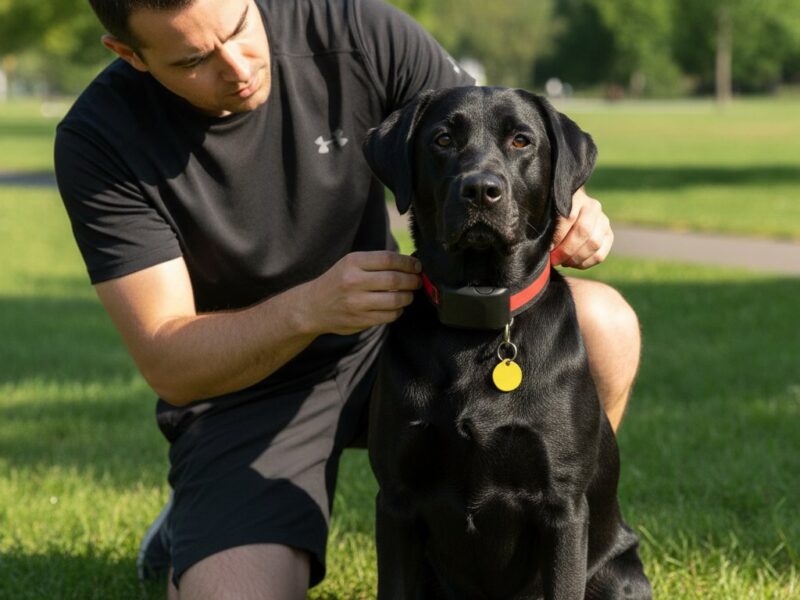
You are at the local trail, and for the first time in weeks, your dog ignores a solid recall command. You tap the transmitter, but there is zero response. That sudden spike of adrenaline isn’t just frustration. It’s the fear of losing the off-leash freedom you have both earned. When you start troubleshooting common e-collar problems, you quickly realize that a breakdown in gear is a breakdown in safety.
We understand that feeling of uncertainty. It is exhausting to wonder if the battery is dead, the contact points are loose, or if you are simply using the wrong levels for the environment. You want a partner who listens, not a technical headache. You deserve a training system that works as hard as you do, and we are here to ensure you get it.
This guide will help you master the technical fixes and behavioral shifts required to turn your remote training collar back into a precision communication tool. We will walk through verifying hardware integrity, perfecting the physical fit, and adjusting your timing for high-stimulation environments. You will gain the skills to ensure every command is met with a fast, reliable response. It is time to get your training back on track and reclaim your peace of mind.
Key Takeaways
- Verify power synchronization and battery health to ensure your hardware is always mission-ready.
- Master the “High and Snug” placement and the “Two-Finger Rule” to guarantee consistent skin contact and reliable communication.
- Reclaim your range by troubleshooting common e-collar problems caused by physical terrain and electronic signal interference.
- Identify the difference between a mechanical glitch and “learned irrelevance” to find your dog’s true working stimulation level.
- Integrate your remote training collar into a structured lifestyle to achieve total off-leash freedom and behavioral mastery.
Technical Diagnostics: Is Your Remote Training Collar Powering Up?
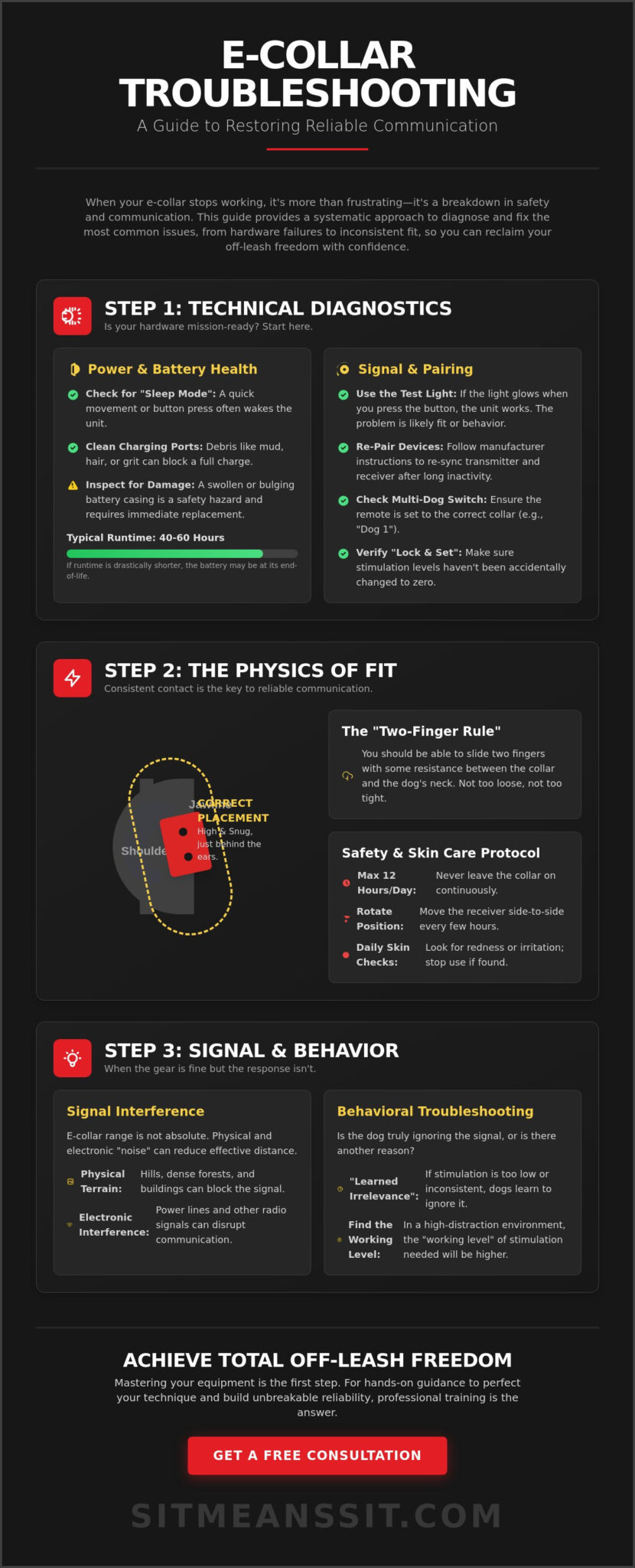
Reliability is the backbone of every successful training session. When your dog stops responding, your first move should be a hard look at the hardware. You cannot build a bridge of communication on a dead battery or a dropped signal. Troubleshooting common e-collar problems starts with a systematic power check. Many owners mistake a unit in “sleep mode” for a total hardware failure. Modern receivers often power down after inactivity to preserve life; a quick movement or a button press usually wakes them up. If the lights stay dark, it is time to dig deeper into the power synchronization between your handheld transmitter and the receiver collar.
Before you assume the stimulation is broken, perform a “test light” diagnostic. Most professional kits include a small plastic tool with a bulb. Hold this against the contact points and press the stimulation button. If the bulb glows, your equipment is delivering a signal. This simple test confirms that your electronic training collar is functioning correctly, shifting the focus from a mechanical failure to a fit or behavioral issue. If the light remains dark, check the charging ports for debris. Mud, hair, and grit can easily block the connection, preventing a full charge even if the unit was plugged in all night.
The Battery Health Checklist
Modern Lithium-Polymer (Li-Po) units have replaced the older NiMH batteries that suffered from “memory effect.” You don’t need to drain these completely before charging. However, they aren’t invincible. Inspect the receiver casing for any signs of swelling or bulging. A swollen battery is a safety hazard and needs immediate replacement. Professional-grade units typically provide between 40 and 60 hours of active runtime. If your collar dies after just a few hours, the internal cell has likely reached the end of its lifespan. Also, look for green or white crust around the contact points inside the casing; this indicates corrosion from moisture and will eventually kill the circuit.
Verifying Signal and Pairing
Sometimes the hardware is healthy, but the “digital handshake” has failed. Pairing desynchronization often happens after long periods of inactivity or extreme temperature shifts. To fix this, follow your manufacturer’s re-pairing sequence. This usually involves holding the power button on the receiver until a light flashes, then immediately pressing a button on the remote to sync the frequencies. Always check your multi-dog toggle switch. It is a common mistake to accidentally flip the transmitter to “Dog 2” when you only have one collar paired. Finally, utilize the “lock and set” feature on your remote. This ensures your stimulation levels haven’t accidentally shifted to zero during a hike, which is a frequent culprit when troubleshooting common e-collar problems.
The Physics of Fit: Solving Connectivity and Contact Issues
Precision is the heartbeat of effective training. You can have the most advanced hardware on the market, but if the physical connection to the dog is inconsistent, your communication will fail. When you are troubleshooting common e-collar problems, the most frequent culprit isn’t a technical glitch; it’s the fit. A loose collar leads to intermittent stimulation, which confuses your dog and erodes the trust you’ve built. To ensure a clear line of communication between the transmitter and the dog’s nervous system, you must master the high and snug placement.
The receiver should sit high on the neck, just below the jawline and behind the ears. This area has less muscle and fat, providing a direct path to the skin. Use the “Two-Finger Rule” to verify tension. You should be able to slide two fingers between the contact points and the dog’s neck with some resistance. If it’s too loose, the collar will rotate. If it’s too tight, you risk respiratory restriction. Consistency here is non-negotiable. If you find yourself struggling to maintain this balance, a private lesson can provide the hands-on guidance needed to perfect your technique.
Safety is just as important as signal. Never leave the collar on for more than 12 hours a day. Implement a strict rotation schedule, moving the receiver to the opposite side of the neck every few hours. This prevents pressure sores and skin irritation. Check the skin daily for redness or “hot spots.” If you notice any irritation, stop use immediately and let the skin heal. This disciplined approach ensures your dog remains comfortable and eager to work.
Overcoming Thick Undercoats
Standard contact points often fail on breeds with dense undercoats, like Huskies, Shepherds, or Malamutes. The fur acts as an insulator, blocking the signal before it reaches the skin. Don’t just tighten the strap to compensate. Instead, switch to specialized winged or extra-long contact points designed to bypass the fur. In some cases, a very slight trim of the hair at the contact site can drastically improve conductivity. This allows for a lower, more humane stimulation level because the signal isn’t fighting through a wall of hair.
Placement and Movement
Avoid placing the receiver directly over the dog’s windpipe. Position it slightly off-center to ensure comfort during heavy panting or movement. If your dog is highly active, a standard buckle collar might slip. Consider using a bungee collar. These flexible straps maintain constant, gentle tension as the dog moves, preventing the “sliding collar” that causes “dead” signals. Troubleshooting common e-collar problems often comes down to these small, physical adjustments that stabilize the connection.
Signal Interference and Range Limitations
Maximizing Your Transmitter Reach
The “Line of Sight” rule is your best friend for reliable communication. If you cannot see your dog, the signal has to work much harder to punch through obstacles. Hold your transmitter high and vertical for the best results. Never hide it behind your back or inside a heavy jacket pocket. If you find yourself in an emergency where you need every inch of range, try the “Chin Trick.” Hold the antenna firmly against the underside of your chin. Your body acts as a large antenna, extending the signal’s reach significantly through the surrounding air. It sounds strange, but it works when seconds count.
Identify “dead zones” in your local training environment before they cause a problem. Deep ravines, thick vegetation, and heavy concrete structures are notorious for blocking radio waves. Even the weather plays a role in signal propagation. High humidity or heavy rain can dampen the signal, while extreme cold can impact battery output, indirectly shortening your effective range. Stay proactive by testing your reach in different conditions to ensure you always have the upper hand.
Waterproofing and Maintenance
Mastery requires gear that survives the elements. Know the difference between “water-resistant” and “fully submersible” hardware. Water-resistant units handle a light rain, but fully submersible gear is essential for dogs that love dock diving or lake swims. After any exposure to salt water, you must rinse the unit with fresh water immediately. Salt is incredibly corrosive. It will eat through seals and contact points if left to dry, leading to total hardware failure. Troubleshooting common e-collar problems often starts with simple post-swim hygiene.
Inspect your gaskets and charging port covers every week. A tiny tear in a rubber seal can lead to internal fogging or circuit death. Clean the contact points with mild soap to remove mineral buildup from pond water or sweat. This ensures the stimulation remains consistent and reliable, no matter where your adventures lead. Taking care of your gear isn’t a chore; it’s an investment in your dog’s safety and your own peace of mind.
Behavioral Troubleshooting: When the Dog “Ignores” the Signal
You’ve checked the batteries. You’ve tightened the strap. Yet, your dog still stares at the squirrel like you don’t exist. Troubleshooting common e-collar problems often reveals that the issue isn’t in the wires; it’s in the understanding. Many dogs develop “learned irrelevance” when the stimulation is used without clear structure. They view the signal as background noise rather than a command. To fix this, you must return to your Dog Obedience Training foundations. Reliability is built on the dog knowing exactly how to turn the pressure off through compliance. If they don’t know the “out” for the pressure, they will simply tune it out.
Another common hurdle is “collar conditioning” gaps. This is where a dog is a perfect angel while wearing the gear but ignores commands the second the collar comes off. This happens when the owner relies solely on the tool rather than using it to reinforce a known behavior. You want a dog that listens because they understand the rules of the game, not because they feel a strap on their neck. If you’re struggling to bridge the gap between technical setup and behavioral response, scheduling private lessons can provide the expert eyes needed to fix your timing and communication.
Finding the Correct Working Level
Finding your dog’s “working level” is a delicate process. Use the “Ear Twitch” test. Start at zero in a low-distraction environment and slowly increase the level until you see a subtle physical response. This might be a flick of the ear, a slight head tilt, or a change in expression. This is your baseline. However, adrenaline is a powerful filter. A level that works in your living room will be invisible when a cat runs across the street. You must be prepared to adjust the dial to match the environment. Never “nag” your dog with a level they can’t feel; it only teaches them that the signal is meaningless.
Refining Handler Timing
Timing is the difference between a clear directive and a confusing punishment. You have a critical 1.5-second window to communicate effectively. If your correction comes three seconds after the dog ignores a command, they won’t associate the signal with their choice. Think of the collar as an “Invisible Leash” or a tap on the shoulder. It is a prompt to pay attention. As your dog gains mastery, you should transition from continuous stimulation to momentary “pings.” This shift rewards their fast response and moves them toward total off-leash freedom. Precise timing builds confidence in the dog, replacing anxiety with the pride of a job well done.
Beyond Troubleshooting: Achieving Total Reliability
Fixing a hardware glitch or adjusting a strap is only the first step. True mastery means moving beyond troubleshooting common e-collar problems and entering a lifestyle of absolute structure. You want a dog that responds with enthusiasm, whether you are in your backyard or a crowded city park. This level of reliability isn’t a happy accident. It is the result of consistent practice and a deep bond of trust. When you integrate your training tool into every aspect of your daily routine, you stop managing your dog and start living with them. You transform the remote collar from a simple safety net into a bridge for total off-leash freedom.
The transition from “fixing the tool” to “proofing the command” is where many owners get stuck. Proofing is the process of testing your dog’s obedience in increasingly difficult, high-distraction environments. If your dog only listens when it is quiet, they aren’t truly trained; they are just compliant. For those who want to accelerate this journey, Sit Means Sit Board and Train programs offer an immersive experience. We handle the heavy lifting of foundational communication, allowing you to step into a relationship that is already defined by respect and clarity. It is the fastest way to jumpstart your progress and eliminate the frustration of inconsistent results.
The Value of Professional Coaching
Expertise matters. Searching for a dog trainer near me is often the most efficient way to solve lingering technical confusion. Every dog has a unique temperament, and a professional can tailor a plan that works for your specific pet. They see the subtle body language cues you might miss. They help you build a bond that transcends the hardware. When you work with a coach, you aren’t just troubleshooting common e-collar problems anymore. You are learning the art of leadership. This partnership replaces your uncertainty with a sense of pride and empowerment.
Next Steps for Mastery
Don’t stop at basic obedience. Join group classes to reinforce your dog’s skills in social settings. These environments provide controlled distractions that prepare you for real-world adventures. Imagine hiking off-leash or visiting an outdoor cafe with total confidence in your dog’s recall. That is the life we want for you. It is time to stop settling for “good enough” and start aiming for excellence. Schedule a free consultation today to see the Sit Means Sit difference. Let’s unlock a more adventurous, joyful life for you and your dog. The path to mastery starts here.
Reclaim Your Freedom and Off-Leash Confidence
Reliable communication is the foundation of every great adventure with your dog. You have learned that mastering the technical setup and perfecting the physical fit are non-negotiable for success. By troubleshooting common e-collar problems with precision, you replace frustration with absolute certainty. You now understand that an “ignored” signal is often just a call for better timing or a clearer environment. Don’t let technical hurdles stand in the way of the joyful, structured life you both deserve. Mastery is within your reach.
Success requires more than just the right gear; it requires a proven methodology. With over 25 years of industry-leading experience and a nationwide network of professional trainers, Sit Means Sit delivers results that last. We provide customized programs for every breed and behavior, ensuring your path to transformation is seamless. It’s time to stop guessing and start leading. Ready for total off-leash control? Schedule your FREE consultation with Sit Means Sit today! We are ready to help you unlock the ultimate goal of a perfectly behaved companion in any environment. Your journey to total reliability starts now.
Frequently Asked Questions
Why does my dog only listen when the e-collar is on?
Your dog has likely learned to associate the physical presence of the gear with the requirement to listen. This is a common hurdle called “collar conditioning” failure. To fix this, have your dog wear the collar during all active hours, even when you don’t intend to use it. This prevents gear-wise behavior and ensures they focus on your command rather than the strap. Mastery comes when the rules remain consistent regardless of what the dog is wearing.
Can an e-collar stop working if my dog has thick fur?
Yes, dense undercoats frequently block the contact points from reaching the skin. Fur acts as a signal insulator, preventing the digital handshake from occurring. Troubleshooting common e-collar problems often involves switching to winged or extra-long contact points designed to bypass thick hair. Never just tighten the collar to compensate; instead, ensure the probes are actually touching the skin for a reliable and humane connection.
How do I know if my e-collar battery needs to be replaced?
Look for rapid power drops or flashing indicator lights on your unit. Most professional systems use LED light codes to signal battery health. A green light usually means a full charge, while a red or rapid-flashing light indicates you are near empty. If your receiver dies in under 12 hours of active use, the internal cell has likely reached its lifespan limit. Replace the battery immediately to maintain the reliability of your communication.
Is it possible for the e-collar signal to be blocked by trees or buildings?
Physical obstacles like dense vegetation, concrete walls, and rolling hills significantly reduce your effective range. While your remote might claim a half-mile reach, real-world conditions often cut that distance in half. Always maintain a clear line of sight whenever possible. If you lose signal in a “dead zone,” try holding the transmitter higher or using the antenna-to-chin trick to punch through the interference and regain control of your session.
What should I do if my dog yelps or seems scared of the collar?
Lower the stimulation level immediately and return to foundational drills in a low-distraction environment. A yelp usually means the level is set too high for the dog’s current adrenaline state or they don’t understand the command. You want the collar to feel like a gentle tap on the shoulder, not a frightening event. Rebuild their confidence by rewarding fast compliance. Discipline should always lead to a more joyful and adventurous life.
How often should I clean the contact points on the receiver?
Clean the contact points at least once a week to remove skin oils, mud, and debris. This residue creates a barrier that weakens the signal and can lead to skin irritation. Wipe the probes down with mild soap and water after every swim or heavy training day. Regular maintenance is a core part of troubleshooting common e-collar problems and ensures your communication stays sharp and consistent every time you head out.
Can I use one remote to control two different collars?
Most modern transmitters support multi-dog pairing through a dedicated toggle switch or button. You can pair each receiver to a specific channel, allowing you to manage multiple pets simultaneously with a single remote. This creates a seamless transition when training in a multi-dog household. Always verify which channel is active before sending a command to ensure you are communicating with the correct dog and maintaining clear boundaries.
What is the difference between “nick” and “constant” stimulation?
Nick is a momentary pulse lasting a fraction of a second, while constant stimulation lasts as long as you hold the button. Use “nick” for quick reminders or to reinforce known commands with a sharp “ping.” Constant is designed for teaching new behaviors or guiding a dog through high-distraction environments. Mastery involves knowing which mode matches your dog’s temperament and the specific challenge you are facing during your training session.
Comments are closed.