

Your dog doesn’t have a “chewing problem”; they have a communication gap that is currently costing you a fortune in ruined furniture. It’s a hard truth. Destructive behavior is one of the leading reasons dogs end up in shelters. You deserve a peaceful home where your belongings are safe and your pet respects your boundaries. This guide will teach you how to stop destructive chewing in dogs by replacing chaos with professional structure and clear commands.
You’ve likely tried every “indestructible” toy on the market only to find your baseboards are still the preferred snack. We understand the stress and tension this creates in your household. We’ll show you how to implement a lifestyle of discipline that actually grants your dog more freedom, not less. You’re about to learn the exact framework used by professionals to build reliability, foster a stronger bond, and finally achieve a home environment where you can truly relax. This isn’t just about saving your shoes; it’s about reclaiming your home and your relationship with your pet. Prepare to transform your frustration into absolute confidence.
Key Takeaways
- Identify the root cause of destruction to move beyond symptoms and address the underlying boredom or anxiety driving the behavior.
- Stop relying on “dog-proofing” traps and learn how to stop destructive chewing in dogs by establishing clear, firm environmental boundaries.
- Master declarative commands and precise timing to transform your dog’s behavior from impulsive destruction to intentional obedience.
- Leverage mental mastery and socialization to create a calm, satisfied pet that no longer feels the need to destroy your home.
- Recognize when to choose professional Board and Train programs to break deep-seated habits and achieve total control in an immersive setting.
Why Dogs Chew: Identifying the Root Cause of Destructive Behavior
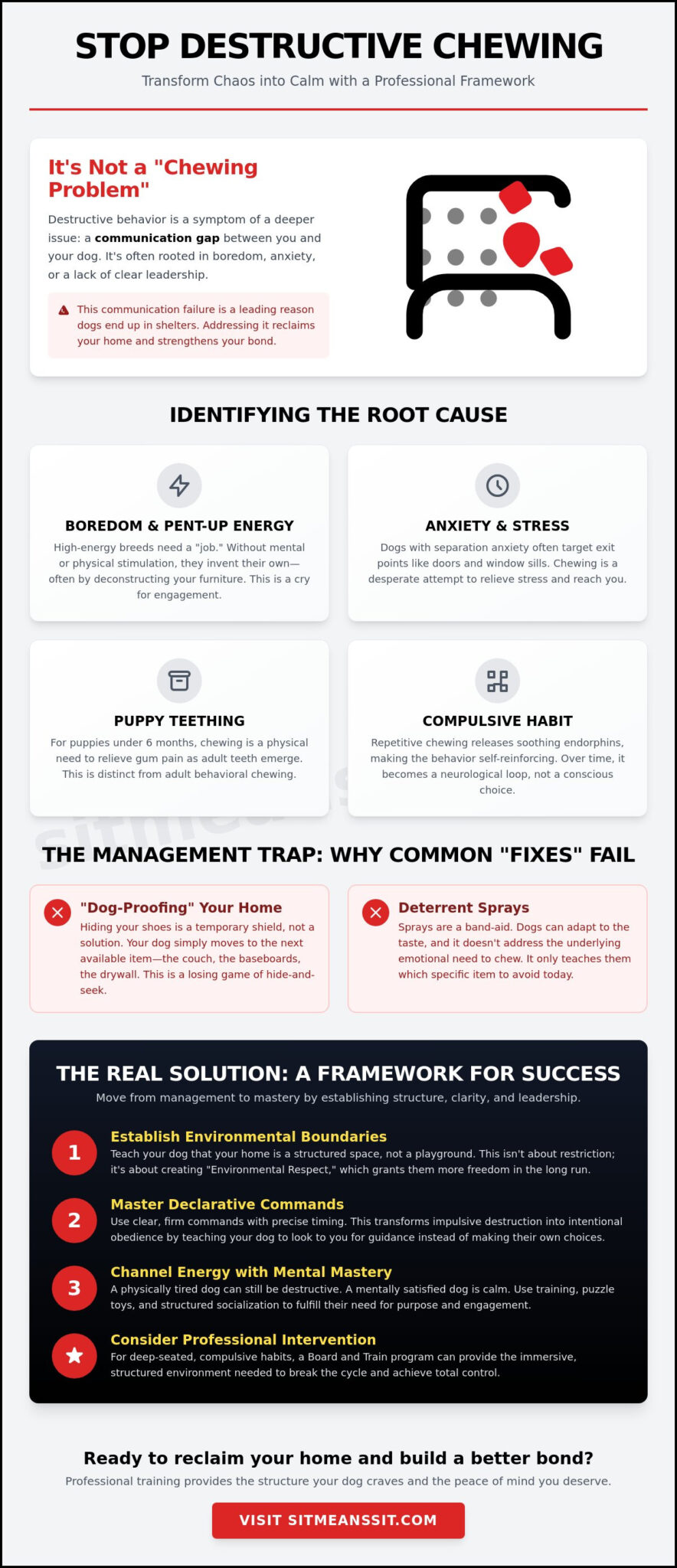
Your dog isn’t trying to be “bad” when they destroy your favorite pair of sneakers. Destructive chewing is a symptom of a deeper issue, usually rooted in boredom, anxiety, or a lack of leadership within the home. It’s easy to get frustrated when you see the debris, but you have to look past the damage to find the “why.” Destructive chewing is a failure of environmental communication between owner and dog. When you understand this, you can begin the real work of learning how to stop destructive chewing in dogs.
Teething is a physical necessity for puppies under six months old. Their gums hurt, and they need pressure to help those adult teeth break through. Adult destruction is entirely different. It’s behavioral. If your three-year-old Lab is eating the drywall, it isn’t about teeth; it’s about a lack of mental structure. This is often where the “Attention Gap” happens. Dogs are social animals that crave engagement. If they don’t get positive interaction through training or play, they’ll often settle for negative attention. Getting yelled at for chewing the rug is still a form of engagement to a dog that feels ignored.
The Psychology of the Chew: Boredom vs. Anxiety
High-energy breeds process pent-up energy through their jaws. If they haven’t had a mental “job” to do, they’ll create one by redesigning your living room. Anxiety looks different. Dogs suffering from separation anxiety often target “exit points.” They’ll chew door frames, window sills, or the carpet near the front door in a desperate attempt to reach you. Simply buying more toys won’t fix this issue. A dog looking for mental interaction won’t be satisfied by a rubber bone sitting on the floor. Proper understanding dog behavior shows that these animals need a sense of purpose and clear boundaries to feel secure in their environment.
When Chewing Becomes a Compulsive Habit
Chewing isn’t just a physical act; it’s a chemical one. Repetitive gnawing releases endorphins that soothe the dog’s nervous system. This makes the behavior self-reinforcing. The more they chew, the better they feel, which makes the habit harder to break over time. Watch for signs like “fabric sucking” or obsessive licking of blankets. This often stems from early weaning or high stress levels. When the behavior moves from “naughty” to “compulsive,” the dog is no longer making a conscious choice. They are stuck in a neurological loop. You must step in with professional structure to interrupt that cycle and provide a better outlet for their energy. Mastering how to stop destructive chewing in dogs requires you to be the leader they need to break these cycles.
The Management Trap: Why Hiding Your Shoes Isn’t a Real Solution
Stop living in fear of your own living room. Most advice tells you to “dog-proof” your home by hiding every object of value. This is a trap. Management is a temporary shield, not a permanent solution. If you hide the shoes, your dog eats the couch. If you hide the couch, they move to the drywall. You need a total shift in mindset. True mastery involves teaching your pet “Environmental Respect.” This means your dog views your home as a structured space where boundaries are absolute and non-negotiable. When you stop playing hide and seek with your belongings, you start building a real relationship based on clear expectations. This is the first step in learning how to stop destructive chewing in dogs for good.
The first step is understanding the causes of destructive chewing, which allows you to address the psychological root instead of just the symptoms. Many owners spend years in a cycle of frustration because they focus on the object being chewed rather than the dog’s state of mind. We replace that frustration with empowerment. By establishing professional structure, you give your dog the clarity they crave. This isn’t about restriction; it’s about liberation. A dog that understands boundaries can eventually enjoy more freedom throughout the entire house.
Why Deterrent Sprays Often Fail
Sprays are a band-aid. Many owners reach for bitter apple or cherry deterrents, but these often fail for several reasons. The “adaptation effect” is a common hurdle. Some dogs grow to tolerate or even enjoy the taste over time. More importantly, a spray doesn’t address the dog’s emotional need to chew. It just makes one specific item temporarily gross. This creates “training-free” zones where your dog learns they can’t chew the sprayed chair leg, but the unsprayed coffee table is fair game. You aren’t teaching impulse control; you’re just playing a game of chemical tag. To truly see how to stop destructive chewing in dogs, you must move beyond these superficial fixes.
The Limitations of Confinement
A crate is a fantastic tool for safety, but it is not a substitute for behavioral development. If your dog only behaves because they are locked in a box, you haven’t solved the problem. You’ve just delayed it. In fact, over-confinement often increases the very anxiety that drives destruction in the first place. Your goal should be a dog that can be trusted with the full run of the house. Transitioning from crate-dependence to house-wide reliability requires steady practice and professional structure. If you are struggling to bridge that gap, our Private Lessons provide the one-on-one guidance needed to reclaim your home and restore peace to your household.
Establishing Clear Boundaries Through Reliable Communication
Stop reacting and start directing. Most owners get stuck in a “Stop That” loop which only creates confusion for the animal. When you constantly yell “no,” you aren’t giving your dog a solution; you’re just adding noise to their environment. Real mastery comes from shifting the focus to “Do This.” By providing a clear, declarative command, you replace the dog’s destructive impulse with a structured task. While many resources offer practical solutions for destructive chewing, we focus on the underlying communication gap. When you tell a dog exactly what is expected, their anxiety drops and their reliability skyrockets. This is the core of how to stop destructive chewing in dogs.
Timing is the most critical element of effective communication. If you correct your dog even a few seconds after they’ve stopped chewing, they won’t associate the correction with the act. You must be precise. Professional structure requires you to catch the decision, not just the action. When you see your dog eyeing the table leg, that is the moment to intervene. This proactive approach prevents the habit from forming in the first place. Reclaiming your space using the Sit Means Sit methodology follows a decisive four step process:
- Interrupt the Thought: Use a clear cue to break the dog’s focus on the target object.
- Command a Specific Action: Direct the dog to a known command like “Sit” or “Place.”
- Reward the Compliance: Immediately acknowledge the correct choice to reinforce the boundary.
- Enforce Environmental Respect: Maintain the boundary consistently until the dog defaults to the correct behavior.
Mastering the “Place” Command
The “Place” command is your secret weapon against household destruction. It isn’t just a trick; it’s a mental state. When your dog is on their “Place,” they’re learning to settle and find calm in a designated area. A dog that is focused on staying in one spot cannot be wandering off to find something to destroy. This level of dog obedience training creates a framework for perfect house manners. It transforms your living room from a chew-toy minefield into a place of rest and mutual respect.
The Role of the Remote Training Collar
We use the Remote Training Collar as a sophisticated communication bridge. It’s time to demystify this tool. It’s about “attention,” not “punishment.” Think of it as a digital tap on the shoulder that cuts through the “mental fog” of a destructive episode. When a dog is hyper-focused on chewing, they often tune out verbal commands. The collar provides a gentle, consistent signal that redirects their focus back to you. This technology allows you to achieve total reliability and see how to stop destructive chewing in dogs even when you aren’t in the same room. It grants your dog the freedom they deserve by ensuring they always listen to your lead.
Channeling Energy: Socialization and Mental Mastery
Physical exercise is a great start, but it is rarely the silver bullet for a dog that loves to destroy your home. A dog can run five miles and still have the mental bandwidth to eat your baseboards the second you turn your head. You must target the brain. Mental fatigue is significantly more effective than physical exhaustion when you want to achieve a calm, respectful pet. This shift in focus is a critical component of how to stop destructive chewing in dogs. When you challenge your dog’s mind, you satisfy the internal drive that otherwise manifests as impulsive destruction.
Socialization also plays a massive role in stabilizing your dog’s emotional state. Many dogs chew because they are chronically anxious or unsure of their environment. By building their confidence through exposure and leadership, you remove the stress that triggers the need to gnaw. Proactively preventing these habits in young dogs is the smartest move you can make. Enrolling in puppy training classes sets a foundation of focus and engagement that lasts a lifetime. It teaches them from day one that engagement comes from you, not the objects on the floor.
Structured Socialization in Group Classes
Dog parks are often breeding grounds for chaos and over-stimulation. They don’t teach focus; they teach your dog to ignore you in favor of high-intensity play. Our Group Classes provide the opposite experience. They offer a controlled environment where your dog learns to maintain their composure amidst high-level distractions. This structured setting reinforces boundaries while in the presence of other dogs and people. It forces the dog to look to you for direction rather than reacting to the world around them. This level of control is essential for any owner learning how to stop destructive chewing in dogs.
Mental Exercises to Replace Destructive Habits
Replace the destructive dopamine hit with the reward of mastery. Use the “Three-Command Rule” every single day to keep your dog’s mind sharp. Spend fifteen minutes working on three distinct commands in different rooms of the house. This forces the dog to generalize their training and stay focused on the task at hand. Learning new tricks or perfecting old ones provides the mental engagement they are currently seeking from your couch cushions. Incorporate training into every interaction, from mealtime to walks. This results-oriented lifestyle keeps your dog in a “working” mindset. If you are ready to see a total transformation in your dog’s behavior, contact us for a free evaluation and take the first step toward total control.
Professional Intervention: When to Choose Board and Train for Chewing Issues
Sometimes, despite your best efforts, the damage continues. You reach a breaking point where the financial loss and household stress become unbearable. This is when professional intervention becomes necessary. Learning how to stop destructive chewing in dogs often requires a complete reset of the animal’s environment and routine. If your dog has spent months or years reinforcing a habit, a few minutes of training after work might not cut it. You need a partner who can provide the consistency and expertise required for a total behavioral transformation. Sit Means Sit is that partner. We take the burden off your shoulders and replace your frustration with a dog that respects every boundary you set.
Professional conditioning is about volume and precision. In a home setting, life often gets in the way of steady practice. A professional environment removes those obstacles. It allows for hundreds of successful repetitions in a single day. This immersion ensures that the new, positive behaviors become the dog’s default response. You aren’t just managing the problem; you are rewriting the dog’s internal code. This is the fastest path to a peaceful home. We don’t just teach your dog; we empower you to lead them with absolute confidence.
The Immersive Advantage of Board and Train
A 24/7 structure is significantly faster at resetting a dog’s destructive baseline than intermittent home training. Our Board and Train programs provide a “factory reset” for the dog’s focus. We remove them from the environment where they’ve learned to be destructive and place them in a world of clear, constant communication. Once the new habits are locked in, we focus on the transition. We ensure you have the tools and the confidence to maintain these results at home. You won’t just get a better dog; you’ll get a new lifestyle characterized by freedom and reliability.
Finding the Right Expert for Your Situation
Don’t mistake a pet sitter for a professional trainer. When your home is at stake, you need a results-based expert who understands the mechanics of behavior. Choosing between a dog behaviorist and a professional trainer depends on your specific needs. While a behaviorist may focus on the psychological “why,” a professional trainer focuses on the actionable “how.” We provide the commands and structure that lead to immediate, visible change. Reclaiming your home starts with a single decision. Book a consultation today to see how we can stop destructive chewing in dogs and restore the bond between you and your pet. It’s time to stop the destruction and start the adventure.
Reclaim Your Home and Your Peace of Mind
Stop living in a state of constant repair and start enjoying the home you’ve worked so hard to build. You now understand that chewing isn’t a random act of spite; it’s a call for leadership and mental structure. By identifying the root cause and moving beyond the management trap, you’ve taken the first steps toward a more harmonious life with your pet. Mastering how to stop destructive chewing in dogs requires more than just hiding your shoes. It demands clear communication, reliable boundaries, and the right tools for the job.
We are here to ensure your success. With over 150 locations nationwide and our industry-leading Remote Training Collar technology, we provide the results-oriented “Sit Means Sit” agreement that transforms lives. Don’t wait for the next piece of furniture to be destroyed. Reclaim your home and your peace of mind; find a Sit Means Sit trainer near you today! You have the power to replace your frustration with absolute confidence and pride. Your dog is ready for a life of adventure and joy; all they need is your direction. Let’s start this transformation together.
Frequently Asked Questions
How do I stop my dog from chewing on the furniture when I’m not home?
You stop this behavior by establishing a reliable “Place” command and using crate training until your dog earns their freedom through consistent obedience. If you haven’t trained your dog to respect boundaries while you are present, they won’t respect them when you’re gone. Focus on building environmental respect through professional structure. This ensures your dog views the furniture as a boundary rather than a snack.
Is my dog chewing because they are bored or because they have separation anxiety?
Check the location of the damage; separation anxiety usually targets exit points like doors and windows, while boredom results in random destruction of household items. Bored dogs look for entertainment, whereas anxious dogs look for a way to reach you. Identifying this distinction is the first step in learning how to stop destructive chewing in dogs. Both issues require a shift toward mental mastery and clear leadership.
At what age do puppies usually stop destructive teething?
Puppies typically finish the physical teething phase by six or seven months of age once their adult teeth have fully emerged. However, don’t confuse the end of teething with the end of chewing. If you haven’t implemented a structured training program by this age, the physical need to chew often transforms into a behavioral habit. Start your Puppy Preschool early to prevent these issues from becoming permanent.
Will getting another dog stop my current dog from chewing out of boredom?
No, adding another dog usually doubles your trouble rather than solving the original problem. A second dog doesn’t provide the structured leadership or mental engagement your current pet is missing. Instead, they often learn bad habits from each other. Focus on mastering your relationship with your current dog first. Reliability comes from your guidance, not from a playmate. Master the dog you have before adding more.
Can a remote training collar help stop my dog’s destructive chewing?
Yes, a Remote Training Collar is an incredible tool for providing clear communication and gaining your dog’s attention during a destructive episode. It allows you to interrupt the chewing thought process from a distance without using harsh punishment. By using low-level stimulation, you can redirect your dog back to their “Place” or an appropriate toy. This technology builds the focus needed for total reliability in any environment.
Is it too late to train an older dog to stop chewing destructively?
It is never too late to transform an older dog’s behavior through professional structure and steady practice. While older dogs may have more reinforced habits, they are still fully capable of learning new boundaries. You just need to be more consistent with your commands and expectations. Our results-oriented approach replaces their old, destructive patterns with a new sense of purpose and calm. Age is never a barrier to mastery.
What are the best alternatives to give a dog that loves to chew?
Provide durable, high-quality rubber toys or hard nylon bones that can withstand intense jaw pressure. Avoid soft plushies or items that resemble household objects like old shoes or socks. This prevents confusion and reinforces what is yours versus what is theirs. Pair these alternatives with a command to ensure your dog understands exactly which items are approved for engagement. Clear choices lead to a peaceful home.
How much exercise does a dog need to stop being destructive?
Most dogs need a combination of thirty minutes of physical activity and at least fifteen minutes of focused mental training daily. Physical exercise alone won’t stop the destruction because it doesn’t tire the brain. Incorporating obedience drills into your daily routine is the most effective way to see how to stop destructive chewing in dogs. A mentally fatigued dog is a well-behaved dog that respects your home.
Comments are closed.