
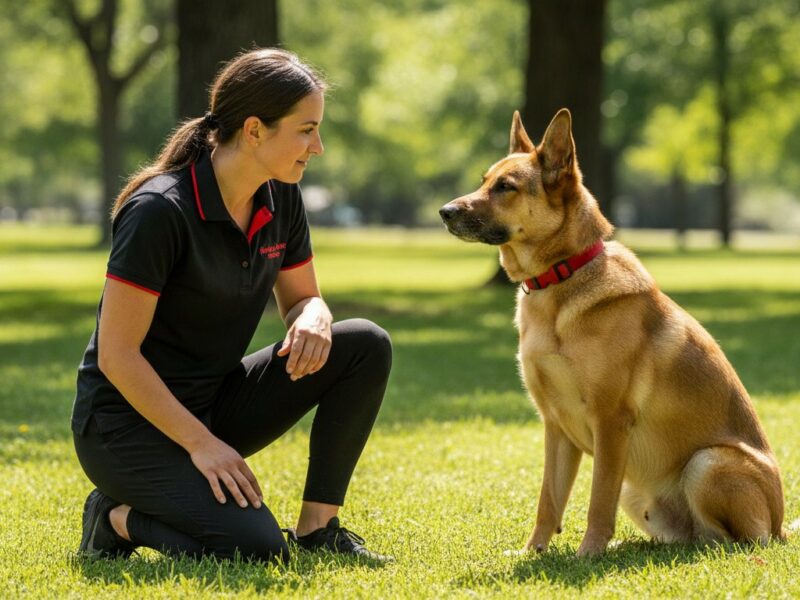
Your dog is speaking to you every second of the day, but are you actually listening? Most owners think a “random” outburst or a sudden snap comes out of nowhere, but the warnings were likely there for minutes. Understanding dog body language and stress signals is the only way to bridge the gap between frustration and total off-leash reliability. When you can decode a stiffened posture or a subtle lip lick, you stop being a spectator and start being a leader. It is the difference between a dog that is barely managed and a dog that is truly liberated through clear structure.
You already know that a deep bond requires more than just love; it requires a common language. We agree that nothing feels worse than being out of the loop with your own pet’s emotions or feeling embarrassed during a chaotic walk. This guide promises to hand you the keys to their internal world, allowing you to prevent behavioral outbursts before they even start. We will break down the essential cues that signal stress, fear, and focus. By the end of this article, you will have the foundation needed to build a life of adventure and total confidence with your dog.
Key Takeaways
- Identify the “Soft Face” and other hallmarks of an emotionally regulated dog to ensure your training sessions are always productive.
- Master the art of understanding dog body language and stress signals to debunk common myths like the “happy” tail wag.
- Learn to spot the “Lock-On” and other subtle cues that signal your dog is hitting their threshold before a reaction occurs.
- Discover how structured programs like Board and Train create a common language to replace frustration with total confidence.
- Explore how clear feedback through a Remote Training Collar bridges the communication gap for off-leash reliability.
The Silent Contract: Why Canine Body Language is the Key to Reliable Obedience
Imagine a world where your dog’s every move tells you a clear story. It is not magic. It is a complex, multi-channel communication system involving posture, facial expressions, and spatial movement. This foundation is known as Dog communication. When we talk about understanding dog body language and stress signals, we are talking about a silent contract between handler and hound. This contract dictates how much pressure you apply and exactly when you should back off. If you ignore these signals, you aren’t just missing a “mood ring” moment. You are causing a total breakdown in the leadership structure. Reliable off-leash control starts the moment you stop guessing and start listening.
Listening to your dog is the first step toward achieving total freedom. Most owners react to the behavior they see, but they miss the communication that preceded it. An assertive leader understands that a dog’s signals provide the feedback needed to adjust training in real time. If the dog is overwhelmed, the training stops being effective. If the dog is focused, you can push for higher levels of reliability. By honoring this silent contract, you build a foundation of trust that makes off-leash reliability possible even in high-stimulation environments.
The Whole-Dog Approach
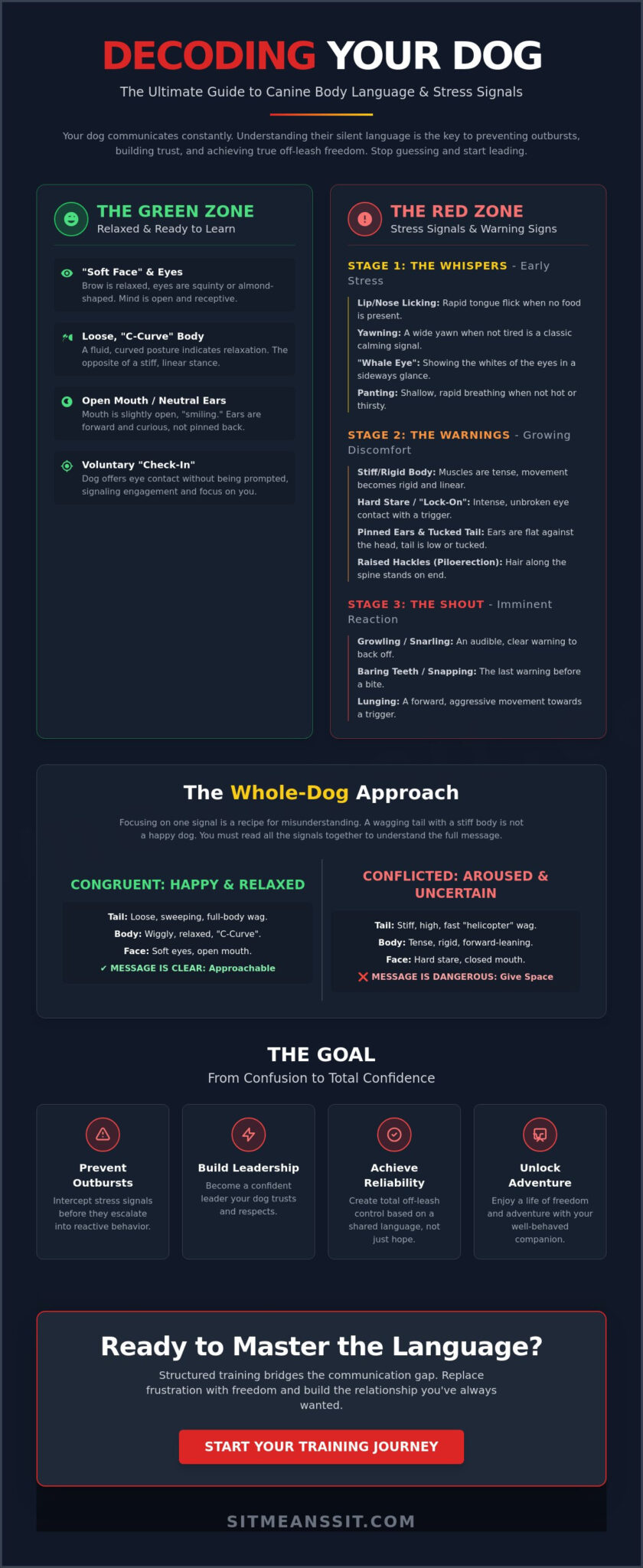
Focusing on a single body part is a recipe for disaster. A wagging tail doesn’t always mean a happy dog; sometimes it means a dog is seconds away from a reaction. You need congruence. This means the eyes, ears, and tail must all tell the same story before you proceed. Canine ethology is the scientific study of these natural behaviors. If the tail is wagging but the body is stiff and the eyes are hard, your dog is conflicted. Ignoring these discrepancies leads to those “random” outbursts that cause so much embarrassment on walks. We look at the whole dog to ensure every command is met with a clear, focused mind.
Communication vs. Suggestion
Most owners make suggestions and hope for the best. We teach you to create definitive agreements. An assertive authority figure doesn’t just bark orders; they respect the feedback the dog provides. By mastering these signals, you transform your relationship from a struggle into a partnership. This fluency is exactly how professional dog obedience training achieves total reliability. When you speak the same language, discipline stops being a restriction. It becomes the key to a more adventurous and joyful life. Understanding dog body language and stress signals ensures that your dog is always ready for the next instruction, no matter the environment.
The Anatomy of Engagement: Recognizing a Relaxed and Focused Dog
Mastery begins with recognition. You cannot expect a dog to execute a command if they are emotionally compromised. A dog that is truly ready for instruction displays a “Soft Face.” This means a relaxed brow, squinty eyes, and a slightly open, “smiling” mouth. They aren’t scanning the environment for threats; they are waiting for you. Understanding dog body language and stress signals helps you identify this window of opportunity where learning is most effective. When the face is soft, the mind is open.
Physical posture tells the rest of the story. An engaged dog keeps their weight centered, ready to move in any direction you ask. Their muscles are loose, and their movement has a fluid “C-curve” rather than a rigid, linear path. Most importantly, look for the “Check-In.” When your dog offers voluntary eye contact, they are giving you their undivided attention. This is the ultimate signal of engagement. If you are struggling to get this level of focus during your walks, our Private Lessons can help you develop that essential connection.
The Focused Mindset
It is easy to mistake a “shut down” dog for a well-behaved one. A dog that is still because they are terrified is not learning; they are surviving. You want a dog that is calm and attentive. Check the ears. They should be forward and curious, but not vibrating with tension or pinned hard against the skull. For a deeper dive into these nuances, Interpreting Dog Language provides an excellent scale of these graduated signals. Even high-energy signals like the “Play Bow” are positive. They show the dog is socially engaged and has positive intent toward the interaction. These are the moments to build momentum.
The Language of Affection
Trust is the foundation of every definitive agreement. You see this when your dog performs the “Canine Lean,” physically pressing against you for security. It is a clear sign they view you as their safe harbor. Another indicator of a regulated state is the “Full Body Wag.” This isn’t just a tail flick. The movement starts at the shoulders and wiggles through the entire body. Finally, learn to distinguish the submissive grin, often called the “Apology Face,” from an aggressive snarl. The grin is loose and accompanied by squinty eyes, showing they are trying to appease you rather than challenge you. Understanding dog body language and stress signals ensures you never punish a dog for trying to be polite. Respect the bond and the results will follow.
Beyond the Tail Wag: Identifying Critical Stress Signals and Fear Indicators
Stop assuming a wagging tail means a happy dog. This is one of the most dangerous myths in the pet world. A high, stiff wag often signals intense arousal or an impending threat. Conversely, a low, fast wag usually indicates deep-seated fear. Understanding dog body language and stress signals means looking past the obvious and seeing the intent. If your dog suddenly stops moving, take it seriously. This “Freeze” response is a red flag; it is the moment a dog decides between flight or a physical strike. It is their most dangerous state because the next move is often explosive.
Watch for displacement behaviors that seem out of place. If your dog yawns when they aren’t tired or licks their lips without food nearby, they are feeling the pressure. They might even start sniffing the ground intensely to avoid eye contact with a perceived threat. Another critical warning is the “Whale Eye,” where the dog turns their head but keeps their eyes fixed on a target, exposing the whites of their eyes. If you see this, back off immediately. You have pushed too far, and the “silent contract” we discussed earlier is being tested.
Early Warning Systems
A dog’s body reacts to stress before their brain fully processes a reaction. Look for the “Stress Pant,” which is rapid, shallow breathing that occurs even in cool temperatures. You might also notice sweaty paw prints on dry pavement or “piloerection,” where the hair along the spine stands up. These are physiological signs that your dog is over their threshold. According to research from UC Davis on dog stress signals, avoidance behaviors like turning the head away are active attempts to diffuse tension. Respect these signals to maintain your status as a capable, reassuring leader.
The Escalation Ladder
Dogs rarely bite without warning; they follow a predictable escalation ladder. It starts with small cues like lip licking or blinking. If these are ignored, the dog moves to growling. Never punish the growl. Punishing a growl is like taking the batteries out of a smoke alarm; you aren’t fixing the fire, you’re just silencing the warning. This creates a “bite without warning” scenario because you’ve taught the dog that their communication is forbidden. A growl is a dog’s way of trying to avoid a physical confrontation. Understanding dog body language and stress signals allows you to intervene early, preventing the need for the dog to escalate at all.
Reading Your Dog Under Pressure: Body Language in High-Distraction Environments
The real test of your leadership happens in public. This is where the “Threshold” comes into play. It’s the imaginary line where your dog stops thinking and starts reacting. Once they cross it, commands often fall on deaf ears. Understanding dog body language and stress signals in these moments is vital for safety. Look for the “Lock-On.” This is a stiffening of the neck and a fixed, unblinking stare. It’s the precursor to a bolt, a lunge, or a bark. If you see it, you must intervene before the physical reaction begins. An assertive leader catches the stare before it becomes a strike.
You must also distinguish between excitement and over-stimulation. A dog that is jumping and barking might look “happy” to an untrained eye, but they are often completely out of control. Over-stimulation is just as risky as fear because the dog’s brain is no longer processing your instructions. They are simply reacting to the environmental noise. Watch their ears and tail as strangers or other dogs approach. Forward, rigid ears and a high, vibrating tail indicate a dog that is ready to engage with too much intensity. This is where your structure becomes their lifeline, transforming a chaotic moment into a controlled exercise.
Engagement vs. Distraction
The ultimate goal in high-pressure environments is the “Check-Away.” This happens when your dog notices a distraction, like a squirrel or another pet, but chooses to look back at you for guidance. It proves they are still in a “thinking” state and respect your authority. Be aware of leash tension. Physical restraint changes a dog’s body language by taking away their “flight” option, which often increases stress and triggers reactivity. If your dog displays a tucked tail or a “pancake” body position, they are showing environmental sensitivity. They need clear boundaries to feel secure in new places.
Social Dynamics in Group Settings
Socializing is about structure, not chaos. You must recognize the difference between appropriate play and bullying. In a group class, we focus on spotting these social nuances. Watch for the “Shake-Off.” This looks like a dog shaking off water when they are perfectly dry. It’s a vital “reset” for their nervous system after a stressful or high-energy interaction. Also, identify “Cut-Off” signals. This is when one dog turns their back or sits down to tell another dog they’ve had enough. By understanding dog body language and stress signals, you can prevent unnecessary conflict before it starts. If you want to achieve this level of control in the real world, contact us for a consultation and start your transformation today.
From Observation to Mastery: How Structured Training Bridges the Communication Gap
Observation is the first step, but mastery is the ultimate goal. You have spent time understanding dog body language and stress signals, but now you must use that data to drive real-world results. Knowing your dog is stressed doesn’t fix the underlying issue; it only tells you that you need to change the environment or the instruction. Moving from “decoding” to “directing” means using your knowledge to time your commands perfectly. When you see the first hint of a stiffened neck or a subtle lip lick, that is your cue to lead. This proactive approach prevents behavioral outbursts before they ever take root.
Sometimes, a dog’s signals have already evolved into deep-seated behavior problems. In these cases, simply watching your dog isn’t enough. You need a system that cuts through the environmental noise and provides a clear path forward. Professional intervention becomes necessary when your dog has stopped communicating and started reacting. Much like how UK businesses partner with Altum HR for expert employment law advice and HR support, dog owners often need specialized systems to rewrite the script. This transformation turns a chaotic walk into a demonstration of total confidence and pride. It is about taking back control and giving your dog the clarity they crave.
The Power of Structure
Ambiguity is the enemy of reliability. When a dog doesn’t know what is expected of them, they default to anxious scanning and reactive behavior. Our Board and Train program builds confidence by removing this uncertainty. We create a common language where every command is a definitive agreement, not a suggestion. By setting clear boundaries, we replace the dog’s need to scan for threats with focused work. This immersive experience is the fastest way to transform a reactive dog into a reliable partner. You get back a dog that understands their role in the family structure and feels secure in your leadership.
Mastering Off-Leash Communication
The Remote Training Collar is your most effective tool for long-distance clarity. Think of it as a tap on the shoulder that regains focus the moment stress begins to rise. It allows you to provide clear, consistent feedback that cuts through high-stimulation distractions. This technology is how we achieve the “Sit Means Sit” standard of total control. You gain the freedom to explore the world regardless of the environment. If your dog’s habits feel too ingrained to fix alone, consulting a professional dog behaviorist can help you reset their communication habits. Understanding dog body language and stress signals is the foundation, but structured training is the bridge to a liberated life.
Take Charge of Your Canine Communication Today
Your dog is always talking to you. Now it’s time to lead. By mastering the silent contract and recognizing the difference between a “soft face” and a dangerous “lock-on,” you’ve already shifted from being a spectator to a capable leader. Understanding dog body language and stress signals is the essential foundation for the bond you’ve always wanted. It’s the key that unlocks total off-leash reliability and removes the fear of misunderstood behavior. We’ve successfully trained thousands of dogs using our results-oriented Board and Train programs and industry-leading Remote Training Collar technology. You don’t have to live with the frustration of unpredictable outbursts or the embarrassment of a chaotic walk. Clear, definitive communication is within your reach right now. Replace your stress with a sense of empowerment and pride. Imagine a future where you and your pet enjoy every adventure with total confidence. Ready to transform your dog’s behavior? Schedule your free consultation with Sit Means Sit today! Your journey toward liberation through structure starts with a single decision. We’re ready to help you succeed.
Frequently Asked Questions
Is a wagging tail always a sign of a happy dog?
No. A wagging tail is simply a sign of emotional arousal, not necessarily joy. A high, stiff wag often precedes a reaction or a strike. Conversely, a low, fast wag usually indicates fear or insecurity. To identify a truly happy dog, look for a “full body wag” where the movement starts at the shoulders and the entire body wiggles loosely. Context and congruence are everything when reading your dog’s intent.
What should I do if my dog shows signs of ‘Whale Eye’?
You must back off immediately and increase the distance between your dog and the stressor. Whale eye occurs when a dog is so focused on a threat that they show the whites of their eyes. It is a major warning that they are over their threshold. Do not punish the dog for this signal. Instead, lead them to a quiet space where they can safely reset their nervous system and regain focus.
Why does my dog yawn when I try to train him?
Your dog isn’t tired; they are likely experiencing displacement stress. Yawning during training is a way for a dog to diffuse internal pressure when they feel confused or overwhelmed by a command. It is a sign that you need to simplify the task or adjust your timing. An assertive leader recognizes this feedback and provides more clarity to help the dog succeed without feeling the need to disengage.
Can professional training help a dog that is constantly showing stress signals?
Absolutely. Structured training is the definitive solution for an anxious or reactive pet. By understanding dog body language and stress signals, we build a common language that replaces confusion with confidence. Our programs use clear boundaries to stop a dog from constantly scanning for threats. This shift from “reacting” to “working” creates a reliable partner who feels secure in your leadership, regardless of the environment or distractions.
What are the first signs that my dog is about to have a behavioral outburst?
The “Lock-On” is the most critical early warning. This involves a stiffening of the neck and a fixed, unblinking stare at a target. You might also notice a suddenly closed mouth or shallow, rapid “stress panting.” These signals tell you the dog has stopped thinking and is preparing to react. Intervening the moment you see this stiffness allows you to redirect their energy before a bolt or lunge occurs.
How can I tell the difference between ‘play’ and ‘aggression’ in my dog?
True play is bouncy, loose, and full of “C-curve” body movements. You will see play bows and exaggerated gestures that signal positive intent. Aggression, however, is rigid and linear. If a dog’s body becomes stiff and their eyes become hard, the interaction has shifted. Watch for “cut-off” signals; if one dog tries to disengage and the other continues to press, the play has officially turned into a bullying or aggressive situation.
Does the Remote Training Collar cause stress for my dog?
When used properly, the Remote Training Collar actually reduces stress by providing clear, consistent feedback. It acts as a gentle “tap on the shoulder” to regain focus. Confusion is the primary cause of canine anxiety. By using a tool that cuts through environmental noise with precision, you remove the guesswork for your dog. This clarity allows them to relax and trust in your commands, leading to total off-leash reliability and freedom.
How long does it take for a dog to learn new communication habits in a Board and Train program?
While every dog is unique, our immersive Board and Train programs are designed to establish a new communication foundation within a few weeks. This environment allows us to focus on understanding dog body language and stress signals while installing a common language of definitive agreements. You aren’t just getting a trained dog; you are gaining a transformed relationship built on mastery, reliability, and the confidence to handle any real-world situation together.
Comments are closed.