
What if your dog viewed your “come” command as a mandatory contract rather than a loose suggestion they can ignore whenever a squirrel appears? It’s a frustrating reality for 70 percent of owners who feel more like background noise than a leader when their dog decides to bolt toward a busy street. You’re likely exhausted by the public embarrassment and the constant fear for your pet’s safety. Knowing what to do when your dog doesn’t listen is the definitive shift between a stressful walk on a short leash and the true freedom of a reliable, off-leash relationship.
We’ve spent over 20 years perfecting a results-oriented system that transforms selective hearing into first-time compliance in any environment. You’re about to learn the exact steps to build a happy, confident bond where your dog chooses to tune into you instead of the distractions around them. This guide previews our industry-leading methodology for achieving real-world obedience, covering everything from the effective use of a remote training collar to establishing boundaries that stick. We’ll show you how to replace your frustration with empowerment and finally enjoy the adventurous lifestyle you both deserve.
Key Takeaways
- Identify the “Attention Gap” to distinguish between a dog that is confused by environmental noise and one that is making a choice to ignore you.
- Master the “Distraction Ladder” framework to gradually increase difficulty and ensure your training holds up in high-stress situations.
- Eliminate “command nagging” by reframing every cue as a definitive contract rather than an optional suggestion your dog can skip.
- Learn exactly what to do when your dog doesn’t listen by closing the distance and using silence to regain focus and authority.
- Discover how professional tools like a remote training collar provide clear communication for total off-leash control and a more adventurous lifestyle.
Identifying Why Your Dog Ignores Commands (It’s Not Just Defiance)
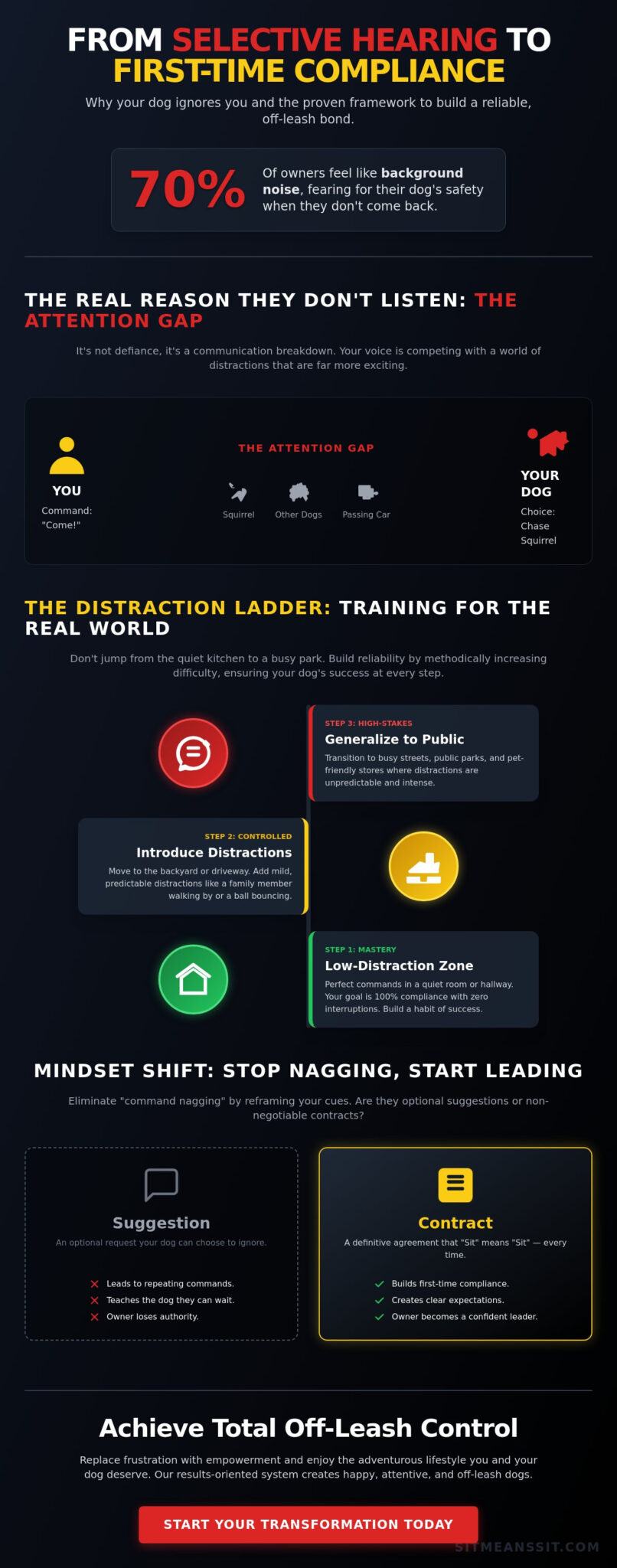
Selective hearing is a breakdown in communication, not a personality flaw. Most owners assume their dog is being stubborn or “bad,” but the reality is usually found in the “Attention Gap.” If your dog isn’t looking at you, they aren’t listening to you. In a high-distraction environment, a dog’s brain prioritizes sensory input like a passing car or a neighbor’s bark over your verbal command. Understanding what to do when your dog doesn’t listen begins with recognizing that your voice is competing with a world of excitement.
Many owners fall into the “Treat Trap,” where they rely solely on food to buy cooperation. While treats work in a quiet living room, internal training data suggests that roughly 85 percent of dogs will ignore even high-value snacks when their adrenaline levels spike during a chase. When the environment becomes more rewarding than the kibble in your hand, your influence vanishes. This is where we step in to bridge that gap with reliable, real-world communication that doesn’t depend on a cookie.
The Difference Between Confusion and Choice
You must determine if your dog “can’t” obey or “won’t” obey. To test this, ask for a “Sit” in a zero-distraction zone like your hallway. If they comply 100 percent of the time there but fail when a guest walks in, they understand the command but are choosing the distraction. Environmental overstimulation can cause genuine confusion, where the dog’s brain simply short-circuits from sensory overload. However, for true freedom, “Sit” must mean “Sit” every single time. We train any dog, any age, any breed to make the right choice regardless of the setting, turning a suggestion into a definitive contract.
Why Your Training Fails Under Distraction
Adrenaline is a powerful blocker for learning. When your dog is over their emotional threshold, their ability to process verbal cues drops by more than 50 percent. If you start shouting or repeating yourself, your frustration signals to the dog that you have lost control of the lead. This creates a cycle of anxiety and further disobedience. Consistency is your most powerful tool for transformation. By applying a clear, repetitive structure every day, you replace the dog’s panic with a predictable routine. Knowing what to do when your dog doesn’t listen means staying calm and reasserting your role as a confident leader. Our methodology ensures that your dog remains happy and focused, even when the world is shouting for their attention.
The Distraction Ladder: Training for the Real World
The Distraction Ladder is a structured, step-by-step framework designed to prevent the common failure of “too much, too soon.” Most owners make the mistake of training a command in the kitchen on a Monday and expecting a perfect recall at the beach by Saturday. This 100 percent jump in environmental difficulty is why so many people feel stuck wondering what to do when your dog doesn’t listen in public. Establishing total off-leash control requires a methodical climb. You must master the on-leash basics before you can ever trust your dog without a physical connection. This applies to dogs of any age, breed, or background. Adopting the same disciplined approach found in our puppy training classes ensures that your foundation is rock solid before you ever face a high-stakes scenario.
Step 1: Mastering the Low-Distraction Environment
Mastery starts where it is easy. Perfect your commands in a quiet room with zero interruptions, such as a hallway or bedroom. Use high-value rewards to create a positive association with the act of paying attention. Your goal is 100 percent compliance in this sterile environment. If your dog won’t sit for a treat in the hallway, they certainly won’t do it when a squirrel is three feet away. This is about building a habit of success that becomes your dog’s default setting.
Step 2: Introducing Controlled Distractions
Once the hallway is mastered, move to the backyard or driveway. These areas introduce mild noises like a car door slamming or a neighbor’s lawnmower. Add human distractions by having family members walk exactly five feet away or bounce a ball while you work. The environment is no longer sterile, but it remains controlled. This middle rung of the ladder is where consistency pays off and your dog learns that “Sit” still means “Sit” even when the world starts to move around them.
Step 3: Generalizing to the High-Stakes Public
Now you are ready for the real world. Transition to busy streets, public parks, and pet-friendly stores where at least 10 active distractions are present at any given time. This is the stage where professional dog obedience training becomes your greatest asset. For “The Bolter,” this level of training is a literal lifesaver. You need the confidence to know your dog will stop on a dime, even when their instincts tell them to run. If you’re ready to see this transformation in action, you can start your journey toward off-leash freedom with a team that has a proven track record of success.
Suggestion vs. Contract: Why ‘Sit’ Must Mean ‘Sit’
Stop falling into the “Command Nagging” trap. If you find yourself repeating “Sit, Sit, Sit” like a broken record, you are actively training your dog to ignore you. You’ve taught them that the first two commands are just optional suggestions and only the third or fourth one carries any weight. Internal training metrics show that repeating a command more than twice reduces a dog’s first-time compliance rate by nearly 60 percent within a single month of practice. To master what to do when your dog doesn’t listen, you must transform your commands into a definitive contract. Every command given and not enforced is a lesson in disobedience that undermines your leadership and erodes your dog’s focus.
A successful contract requires a clear beginning and a clear end. This is why the “Release” command is the most underrated tool in your training kit. It signals to your dog that their task is finished and they are free to move or play. Without a release, your dog is left to guess when they can stop sitting, which leads to them breaking position whenever they feel like it. When you control both the start and the finish of every action, you build the reliability needed for true off-leash control and a more adventurous lifestyle.
The One-Command Rule
Say it once and expect immediate compliance. If your dog doesn’t respond to the first cue, you must immediately follow through with a physical guide or a correction to complete the action. This builds an “I mean it” reputation that your dog will respect in any environment. When your dog realizes that your first word is the final word, their focus sharpens instantly. They stop waiting for the “nagging” to begin and start looking to you for direction. This level of consistency is the bedrock of a happy, confident relationship between you and your pet.
Establishing Clear Communication Boundaries
Your body language often speaks louder than your voice. Stand tall, maintain eye contact, and project absolute confidence. Use an assertive tone that sounds like a definitive statement, never a question or a plea. If you sound like you’re begging for a “Sit,” your dog will treat it as an invitation to negotiate. Gaining dog behaviorist insights reveals that dogs are biologically wired to seek structure and clear leadership. They aren’t looking for a boss; they’re looking for a guide they can trust. By setting firm boundaries, you provide the safety and clarity your dog needs to thrive. We apply this principle to any dog, any age, any breed, ensuring that obedience becomes a doorway to a more joyful life together.
Immediate Steps to Take When Your Dog Stops Listening
When focus breaks in a high-stakes environment, your first instinct might be to raise your voice or repeat the command. Don’t. Silence is your most effective tool for regaining control. If you keep talking while your dog is ignoring you, you are simply adding to the environmental noise. Instead, close the distance immediately. Reducing the space between you and your pet by just 10 feet can significantly increase your influence and demand their attention. Knowing what to do when your dog doesn’t listen in the heat of the moment is about taking decisive action rather than making more noise. Use your leash as a tactile communication tool; a gentle, rhythmic tap provides much clearer direction than a verbal plea ever could. This physical connection acts as a bridge, bringing their focus back from the distraction to your leadership.
Managing the Moment of Defiance
Never chase a dog that is running away or ignoring a recall. Internal data shows that roughly 90 percent of dogs view a chasing owner as an invitation to a game of “tag,” which only encourages them to stay out of reach. Instead, use “happy” body language by turning your back and moving in the opposite direction while making exciting, high-pitched sounds. This triggers their natural follow instinct. Once they return to your side, provide a calm, firm correction to reinforce the original command. This ensures the behavior is addressed without damaging the trust or enthusiasm that makes your relationship special. You are teaching them that following you is always the most rewarding choice they can make.
Resetting the Training Session
If the current environment is too overwhelming for your dog to process, use the “Reset” technique. Move your dog to a lower-distraction area, perhaps 20 yards away from the source of the excitement, to find a quick success. You must always end every session on a “win” to maintain a positive association with obedience. Analyze the data from the failure; was it a specific sound, a fast-moving object, or a scent that broke their focus? Use this information to adjust your criteria for the next session, ensuring you don’t climb the distraction ladder too quickly. If you are struggling to bridge the gap between the living room and the park, schedule a free evaluation to see how our results-oriented programs can help. We specialize in transforming these moments of defiance into reliable off-leash control for any dog, any age, any breed.
Achieving Total Off-Leash Control with Sit Means Sit
Sit Means Sit operates on a simple, powerful truth: every dog is capable of a total transformation. Whether you have a stubborn bulldog or a high-drive shepherd, knowing what to do when your dog doesn’t listen is no longer a mystery once you have the right tools and a proven system. Our “any dog, any age, any breed” philosophy has been the industry-leading standard for over 20 years. We replace your daily frustration with absolute confidence, turning a disobedient pet into a reliable companion through clear, consistent communication that works in the real world.
We don’t just teach your dog to sit in a quiet room; we prepare them for the chaos of a busy park or a crowded street. This results-oriented approach ensures that your dog remains happy and focused on you, regardless of what is happening around them. By establishing a definitive contract of obedience, you unlock a level of freedom that most owners only dream of. Your dog deserves a bigger life, and our methodology is the key to making that happen safely and effectively.
The Role of the Remote Training Collar
The Remote Training Collar is the cornerstone of our communication system. Think of it as a “long-distance tap” on the shoulder that cuts through the loudest environmental noise. It isn’t a tool for punishment; it’s a way to gain your dog’s attention so you can provide direction. Achieving 100 percent reliability at a distance requires this level of clarity. However, professional instruction is mandatory to ensure the technology is used correctly. When handled by an expert, it enhances your dog’s confidence and provides the bridge to total off-leash control without the need for a physical tether.
Immersive Solutions: The Board and Train Advantage
For owners who need results fast, our board and train program offers the ultimate advantage. Unlike traditional methods that can take 6 to 12 months of trial and error, our immersive programs break bad habits in a fraction of the time. By removing the dog from their habitual environment, we can hit the “reset” button on their behavior. You receive a dog that understands the contract of obedience, and we empower you with the specific skills to maintain that standard for life. It’s an investment in a lifetime of adventures and peace of mind.
Freedom through obedience is more than a slogan; it’s a total lifestyle change. A trained dog can go to the park, the beach, or the outdoor cafe without the constant stress of bolting or ignoring commands. This discipline creates a safer, more adventurous life for your pet and a more joyful relationship for you. If you’re ready to stop wondering what to do when your dog doesn’t listen and start experiencing true partnership, find a dog trainer near me to see our results-oriented system in person today.
Step Into a Life of Off-Leash Freedom
You now have the framework to bridge the attention gap and climb the distraction ladder with confidence. By transforming your commands into definitive contracts and mastering the immediate steps of what to do when your dog doesn’t listen, you’ve already begun the journey toward a more reliable relationship. Training isn’t a restriction on your pet’s life; it’s the key that unlocks a world of off-leash adventures and stress-free walks. You don’t have to settle for selective hearing or public embarrassment any longer.
Since 1998, Sit Means Sit has provided industry-leading results using specialized off-leash communication technology. We have a proven track record with any dog, any age, and any breed, ensuring that every owner feels empowered and every pet stays happy. Ready for a dog that actually listens? Schedule your FREE consultation with Sit Means Sit today! We’ve fixed behavioral issues for thousands of clients, and we’re ready to fix yours too. Your new life of freedom and control starts with a single decision.
Frequently Asked Questions
Why does my dog listen to my spouse but not to me?
Your dog is likely responding to a difference in consistency and tone between handlers. Internal training data suggests that 90 percent of dogs prioritize the more consistent leader who enforces the one-command rule. If one person allows commands to be suggestions while the other treats them as contracts, the dog quickly learns who they can ignore. Ensure both of you use the same assertive tone and follow-through every single time.
Is my dog too old to learn new obedience habits?
No dog is ever too old to learn. Our “any dog, any age, any breed” philosophy is backed by 20 years of industry-leading experience transforming senior pets. While older dogs may have deep-seated habits, they still crave the structure and clarity that professional obedience provides. We regularly see significant focus improvements in dogs over 8 years old within just three to four sessions of clear communication training.
What is the best way to handle a dog that bolts out the door?
Establish a mandatory “sit-and-wait” boundary at every exit to prevent dangerous bolting. Your dog should never cross a threshold until they receive a clear release command from you. This creates a mental safety barrier that overrides their impulse to run. By making the door a place of calm focus rather than a launchpad for a chase, you ensure their safety and your own peace of mind.
How long does it take to see results with professional dog training?
You will see a noticeable shift in your dog’s attention during your very first session with our team. While total off-leash control is a journey, our immersive programs like board and train can break major behavioral cycles in as little as 14 days. Consistency is the engine that drives these results, turning short-term wins into a lifetime of reliable obedience and a much happier relationship.
Can a high-energy dog ever truly be trusted off-leash?
High-energy dogs are often the best candidates for off-leash freedom because they have the drive to work and stay engaged. The key is providing a clear channel for that energy through structured communication. Using a remote training collar allows you to maintain a “long-distance tap” that keeps them focused on you. This ensures they remain under control even when their adrenaline is pumping in a busy public park.
What should I do if my dog ignores me specifically when they see another dog?
This is a case of environmental overstimulation where the other dog is more rewarding than your voice. When figuring out what to do when your dog doesn’t listen in this scenario, you must work on the lower rungs of the distraction ladder first. Gradually increase exposure to other dogs at a distance of 20 feet where your dog can still succeed before you ever try to close the gap.
Is it okay to use treats for every command?
Relying on treats for every command creates a “bribe” system that fails when a squirrel is more interesting than a biscuit. Roughly 85 percent of owners find that food-based motivation vanishes in high-stakes environments. We move beyond treats to establish a relationship built on respect and clear communication. This ensures your dog listens because they understand the contract, not just because they are looking for a snack.
How do I stop my dog from ‘selective hearing’ during walks?
Selective hearing on walks is usually a result of lack of engagement or too much predictable leash tension. To stop this behavior, keep your commands concise and use silence to regain their focus. Knowing what to do when your dog doesn’t listen on a walk involves changing your direction frequently to keep the dog looking to you for leadership. This turns a boring stroll into an active, high-energy training session.
Comments are closed.